
How to Plan a Beijing Itinerary for the First Time
Quick Answer
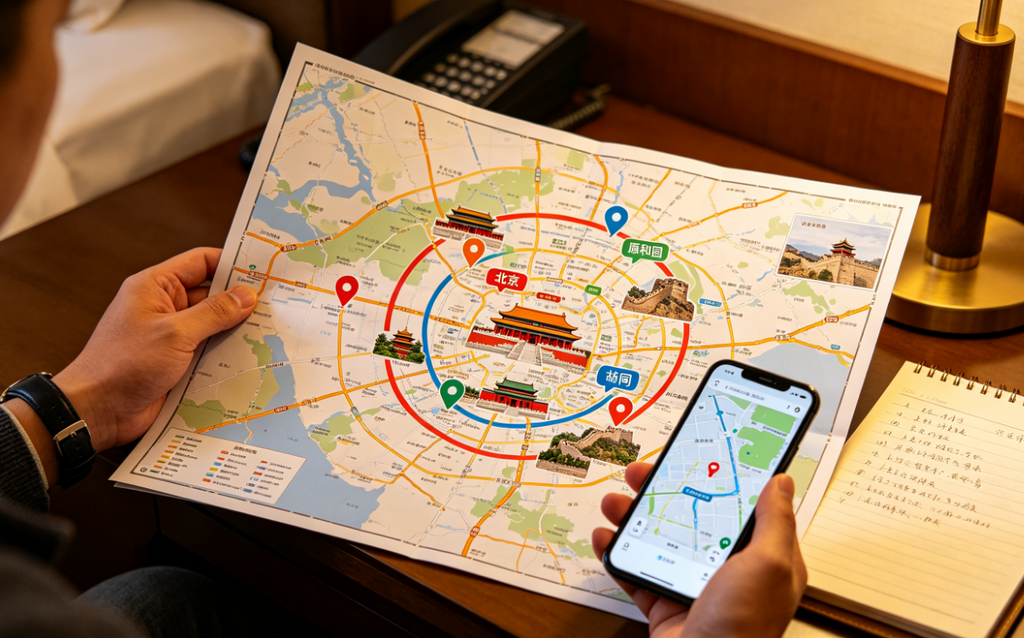
Planning a first Beijing trip is less about fitting as many attractions as possible into each day and more about organizing the city by geography, travel time, opening schedules, and priority.
Beijing is unusually difficult to plan as a simple sightseeing checklist because its major attractions are spread across different districts, many popular sites require advance reservations, and some experiences take considerably longer than their map distance suggests.
For most first-time visitors, a practical strategy is to:
- Choose your trip length before selecting attractions.
- Divide Beijing into geographic areas.
- Put major attractions into separate time blocks.
- Leave realistic time for transportation and security checks.
- Reserve attractions that require advance booking.
- Balance major landmarks with neighborhoods and slower experiences.
- Keep one or two flexible periods for weather, crowds, or unexpected changes.
A well-designed first-time Beijing itinerary planning strategy should therefore begin with priorities, not with a long list of places to visit.
1. How Many Days Do You Need in Beijing?
There is no single correct number of days for Beijing.
The ideal length depends on whether your priority is seeing China’s most famous landmarks, exploring historical neighborhoods, experiencing local culture, or traveling at a relaxed pace.
As a general framework:
| Trip Length | What It Allows |
|---|---|
| 2 days | Major central landmarks with a fast pace |
| 3 days | Core Beijing highlights with reasonable coverage |
| 4 days | Major sights plus hutongs and cultural experiences |
| 5 days | A more balanced first visit with additional neighborhoods |
| 6–7 days | Major attractions plus day trips and slower exploration |
Three days is often enough for a first introduction, but it requires prioritization.
If you have five or more days, you can reduce daily pressure and add experiences that are difficult to fit into a tightly scheduled trip.
The important point is that adding another day should not simply mean adding more attractions. It should also create more breathing room.
2. Start With Your Travel Priorities
Before opening a map, decide what you actually want from Beijing.
A first-time traveler may prioritize:
- Imperial history
- The Great Wall
- Traditional neighborhoods
- Chinese food
- Museums
- Architecture
- Shopping
- Photography
- Local cultural experiences
- A slower, more relaxed trip
These priorities should determine your itinerary.
For example, someone mainly interested in imperial history may spend more time around the Forbidden City, Tiananmen area, Temple of Heaven, and historic central Beijing.
Someone more interested in everyday life may reduce the number of major monuments and allocate additional time to hutongs, markets, local restaurants, and neighborhood walks.
This is one of the most important principles in first-time Beijing itinerary planning:
Build the trip around your interests, rather than trying to see every famous location.
3. Understand Beijing’s Geography Before Planning Your Days
Beijing is enormous.
This matters because two attractions that appear relatively close on a map may still require substantial travel time once you account for subway transfers, walking, security checks, entrances, and crowds.
A useful way to plan is to think in geographic clusters rather than individual attractions.
Central Historic Beijing
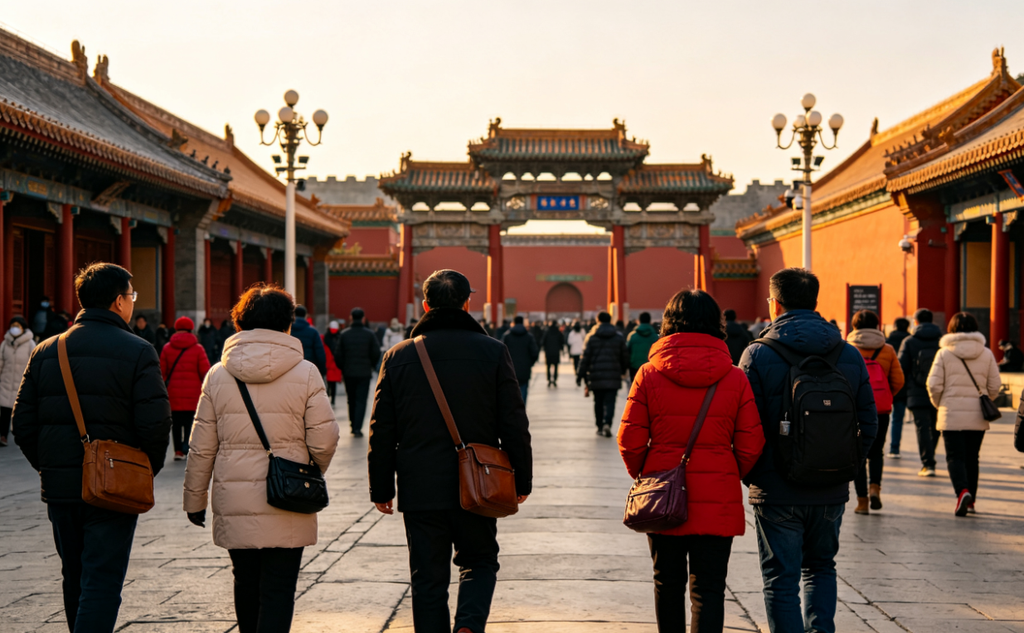
This area includes many of the city’s most important imperial and historic landmarks.
Possible stops include:
- Forbidden City
- Tiananmen Square
- Jingshan Park
- Beihai Park
- Qianmen
- Traditional hutongs
These locations can often be combined more efficiently than attractions scattered across the city.
Northern Beijing
Northern areas include destinations such as:
- Summer Palace
- Olympic Park
- Some Great Wall access points
These should generally be planned separately from a dense central-city sightseeing day.
Eastern and Northeastern Beijing
This part of the city contains modern commercial areas, embassy districts, contemporary architecture, and additional cultural attractions.
Southern Beijing
The Temple of Heaven and surrounding historic areas can form another useful sightseeing cluster.
Thinking geographically reduces unnecessary backtracking.
4. Group Attractions Instead of Following a Random List
One of the most common itinerary mistakes is creating a list such as:
Forbidden City → Summer Palace → Temple of Heaven → Great Wall → hutong → Olympic Park
and then trying to distribute these locations across several days without considering their relationships.
A better approach is:
Step 1: List the places you most want to visit.
Step 2: Put them on a map.
Step 3: Group nearby destinations.
Step 4: Identify which attractions require fixed entry times.
Step 5: Build each day around one geographic area.
This method produces a more realistic schedule.
For example, central imperial landmarks can form one sightseeing block, while the Summer Palace can be paired with other attractions in northwest Beijing rather than something on the opposite side of the city.
When you plan Beijing trip activities this way, transportation becomes part of the itinerary rather than an afterthought.
5. Give Your Biggest Attractions Enough Time
A common mistake is estimating attraction time based only on the time needed to physically walk through the site.
Major Beijing landmarks often require additional time for:
- Entry procedures
- Security screening
- Ticket verification
- Walking between sections
- Photography
- Queues
- Rest breaks
- Finding transportation afterward
The Forbidden City is a good example.
It is not simply a building that you enter, photograph, and leave. Its enormous historical complex contains multiple courtyards, halls, gates, and architectural spaces.
Similarly, visiting the Great Wall involves more than the time spent standing on the wall itself. Transportation, cable cars or shuttle buses where applicable, walking, and the return journey all affect the total time.
A strong itinerary should therefore estimate door-to-door time, not just sightseeing time.
6. Build Your Itinerary Around Fixed-Time Attractions
Some activities have greater scheduling constraints than others.
A useful distinction is:
Fixed-time activities
These may include:
- Attractions with timed admission
- Guided tours
- Performances
- Train journeys
- Airport transfers
- Reservations at specific restaurants
Flexible activities
These may include:
- Hutong walks
- Shopping
- Parks
- Neighborhood exploration
- Casual meals
- Photography
Always build the fixed elements first.
Then use flexible activities to fill the remaining time.
This creates a more resilient itinerary.
If your morning attraction takes longer than expected, you can move a flexible neighborhood walk to the afternoon rather than disrupting an entire day.
7. How to Design a Good Three-Day Beijing Itinerary
If you only have 3 days in Beijing, the goal should be selective coverage rather than completeness.
Day 1: Imperial Beijing
Focus on the historic heart of the city.
A possible structure is:
Morning: Tiananmen area and Forbidden City
Afternoon: Jingshan Park or another nearby historic attraction
Evening: Qianmen or a traditional neighborhood for dinner and an evening walk
The exact order should depend on your reservation time and attraction availability.
The key idea is to keep the first day geographically concentrated.
Day 2: Great Wall Day
Dedicate most of the day to the Great Wall.
Do not treat the Great Wall as a quick morning excursion unless you have a very specific reason to do so.
Travel time can be significant, and the experience is much more enjoyable when you do not have to rush back into central Beijing for another major attraction.
Return to the city for a relaxed dinner rather than scheduling several major attractions after the wall.
Day 3: Parks, Temples, and Local Beijing
Use the final day to experience a different side of the city.
Depending on your interests, possibilities include:
- Temple of Heaven
- Hutong neighborhoods
- Traditional markets
- Local food
- Beihai Park
- Modern Beijing districts
- Museums
This prevents the entire trip from becoming a sequence of monumental attractions.
For many visitors, the third day is also the best place to include activities that have more flexibility.
8. How to Expand a Three-Day Trip Into Five Days
If you have five days, do not simply add two more lists of attractions.
Instead, redistribute the existing itinerary.
For example:
Day 1
Imperial Beijing
Day 2
Hutongs and traditional neighborhoods
Day 3
Great Wall
Day 4
Summer Palace and northwest Beijing
Day 5
Temple of Heaven, museums, parks, shopping, or flexible exploration
This structure gives each major area more room.
It also creates opportunities to adjust the itinerary based on weather and energy levels.
A five-day Beijing trip can therefore feel considerably more relaxed than a three-day trip even when the number of major attractions visited is only slightly higher.
9. Don’t Put the Great Wall on the Same Day as Major Central Attractions
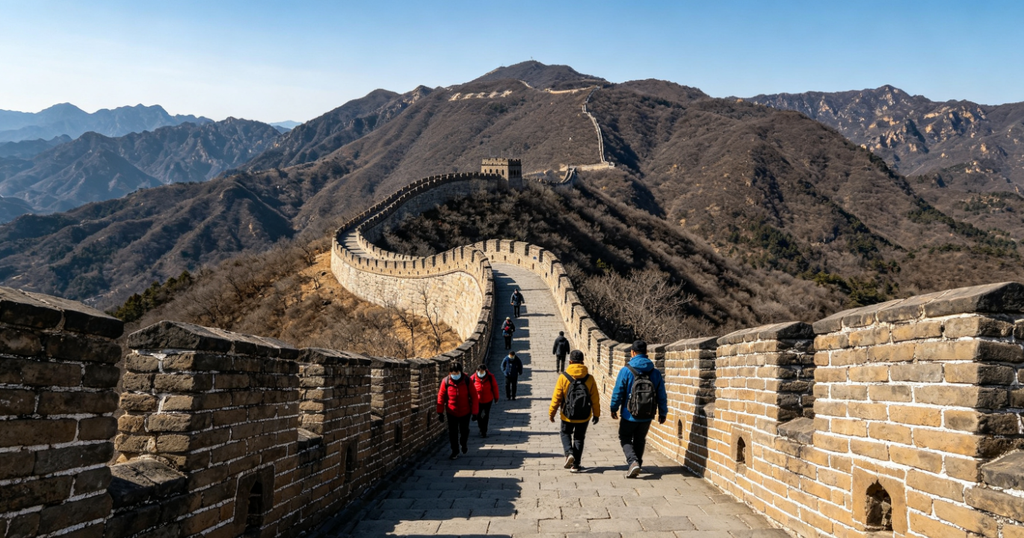
This deserves special attention.
The Great Wall is often treated as another item on a Beijing sightseeing list, but geographically and logistically it is different from most central attractions.
Trying to combine a Great Wall visit with several major central Beijing attractions can create an exhausting schedule.
A better approach is to treat the Great Wall as a full-day anchor.
The exact duration depends on the section you visit, transportation method, weather, walking ability, and whether you join a private or group tour.
For first-time visitors, the choice of Great Wall section can also significantly affect the overall itinerary.
10. How to Choose Between Beijing Attractions
You do not need to visit every major attraction.
Instead, classify them into three levels.
Tier 1: Must-see
These are places you would genuinely regret missing.
For many first-time visitors, this might include:
- Forbidden City
- Great Wall
- One major historic or cultural site
Tier 2: High priority
These are places you would like to visit if your schedule allows.
Examples could include:
- Temple of Heaven
- Summer Palace
- Jingshan Park
- Hutongs
Tier 3: Optional
These are attractions that can be added depending on time, weather, or personal interest.
This ranking prevents your itinerary from collapsing when one activity takes longer than expected.
The purpose of first-time Beijing itinerary planning is not to maximize the number of checkmarks. It is to protect the experiences you care about most.
11. Plan Around Beijing’s Opening Hours and Reservations
Before finalizing an itinerary, verify the current operating arrangements for each major attraction.
Important things to check include:
- Opening days
- Opening hours
- Timed-entry requirements
- Ticket release schedules
- ID requirements
- Holiday restrictions
- Temporary closures
- Special exhibition schedules
Do not assume that a place will be accessible simply because it appears on a travel website.
Major attractions can change reservation procedures, particularly during peak travel periods.
This is especially important for first-time travelers because a missed timed reservation can affect the entire day’s schedule.
12. Leave Buffers Between Major Activities
A realistic itinerary needs empty space.
For example, if you think a museum visit will take two hours, do not immediately schedule another attraction that starts exactly two hours later.
Allow time for:
- Walking
- Getting lost
- Subway transfers
- Finding the correct entrance
- Food
- Rest
- Unexpected queues
A useful rule is to avoid scheduling major attractions back-to-back throughout the entire day.
One or two major activities plus flexible time often produce a better experience than five tightly scheduled stops.
13. Consider Your Arrival and Departure Days Separately
Your first and last days should not be planned like full sightseeing days.
Arrival day
Your actual sightseeing time may be reduced by:
- Flight delays
- Immigration
- Baggage collection
- Hotel check-in
- Airport transportation
- Jet lag
Keep the first day relatively flexible.
A nearby neighborhood, dinner, or evening walk may be more realistic than a major timed attraction.
Departure day
Leave enough time for transportation to the airport or train station.
Avoid placing a must-see attraction several hours before departure unless the logistics are extremely reliable.
This simple adjustment can prevent an otherwise excellent itinerary from becoming stressful.
14. How to Balance Famous Landmarks With Local Experiences
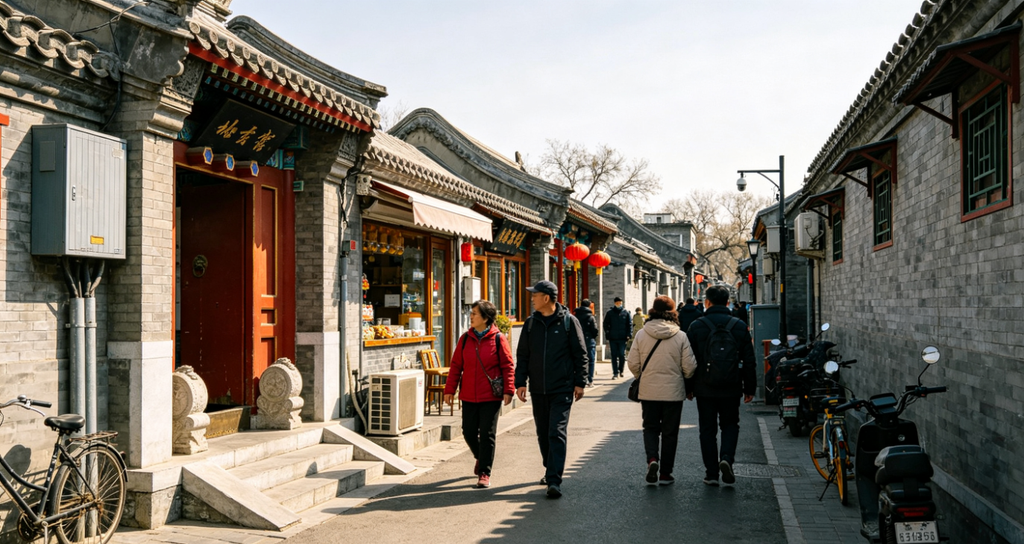
A first Beijing trip should include famous attractions, but it should not consist entirely of them.
Think of your itinerary as having three layers:
Layer 1 — Iconic landmarks
These establish your understanding of Beijing’s history.
Layer 2 — Cultural spaces
Hutongs, parks, markets, museums, and traditional neighborhoods provide additional context.
Layer 3 — Everyday experiences
Local breakfast, neighborhood restaurants, evening walks, and ordinary shopping areas show how the city functions today.
The combination creates a much richer trip.
You are not just visiting Beijing’s monuments; you are seeing how historical Beijing and contemporary Beijing coexist.
15. Transportation Should Influence Your Itinerary
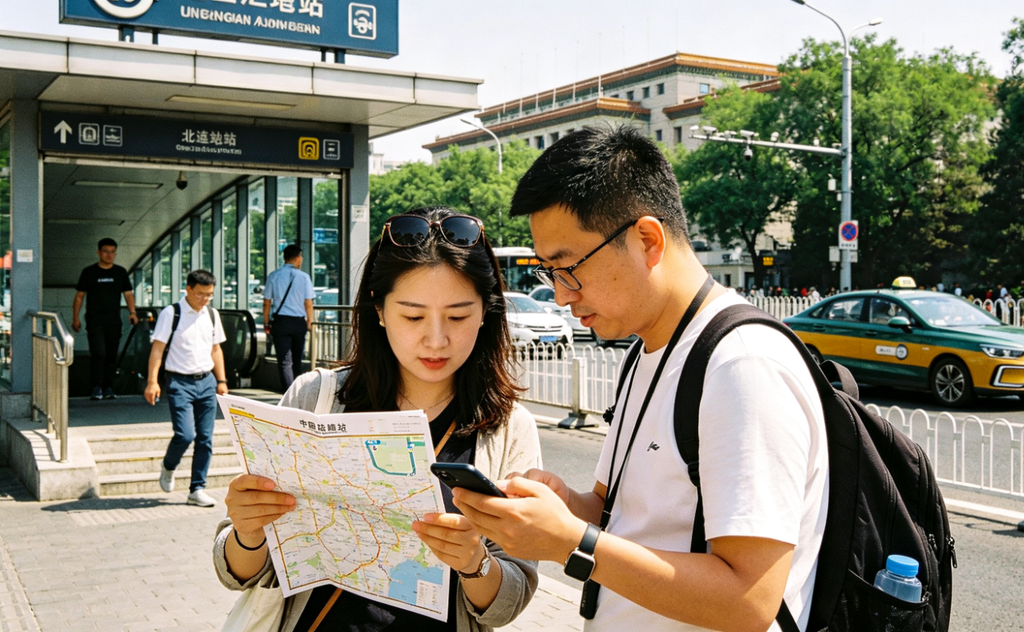
Beijing’s subway system makes many central attractions accessible, but transportation time still matters.
When planning each day, consider:
- Distance between attractions
- Subway transfers
- Walking distance
- Rush-hour congestion
- Taxi availability
- Entrance locations
- Return transportation
A route that looks efficient on a map may be inconvenient because the entrance to an attraction is far from the nearest station.
For this reason, calculate travel time from one actual entrance to the next, not simply from one attraction name to another.
16. Where to Stay Can Change Your Itinerary
Accommodation is not merely a hotel decision.
Your hotel location affects how much time you spend commuting every day.
For a first visit, staying relatively close to the central historic areas can simplify access to many major attractions.
However, the “best” location depends on your priorities.
If you are primarily interested in historic Beijing, central areas may be convenient.
If you value nightlife, shopping, or modern restaurants, another district may suit you better.
The key is to choose accommodation based on the overall shape of your itinerary, not simply on hotel price.
17. Plan Your Meals as Part of the Route
Food should not always be treated as a separate activity.
If you are already visiting a historic neighborhood, consider eating there rather than crossing the city for a restaurant.
This saves transportation time and makes meals part of the cultural experience.
For example, a day exploring hutongs can naturally include:
- Local breakfast
- Traditional noodle lunch
- Tea or coffee break
- Neighborhood dinner
This approach also prevents the common mistake of spending an hour or more traveling across Beijing simply because a restaurant appeared high on an online ranking.
18. Don’t Schedule Every Evening
Evenings are often where overly ambitious itineraries become exhausting.
After a full day of walking through major attractions, you may not want another two-hour cultural performance or distant restaurant reservation.
Leave some evenings open.
You can then decide based on your energy level whether to:
- Explore nearby streets
- Eat locally
- Visit a night market
- Walk around a historic district
- Return to the hotel early
Flexibility is particularly valuable on longer trips.
19. Adjust Your Itinerary for the Season
The same itinerary does not work equally well throughout the year.
Spring
Comfortable sightseeing conditions can make outdoor activities pleasant, but weather can vary.
Summer
Heat and occasional rain mean outdoor attractions may require earlier starts and additional breaks.
Autumn
Cooler weather can be excellent for sightseeing, while popular periods may bring increased demand.
Winter
Cold temperatures can affect outdoor activities, but winter also offers fewer crowds at some attractions.
Seasonality should influence not only what you visit but when during the day you visit it.
Outdoor activities may be more comfortable at different times depending on the season.
20. Build a Backup Plan
Good itinerary planning assumes that something will go wrong.
A backup plan could be as simple as identifying:
- One indoor attraction
- One flexible neighborhood
- One alternative restaurant
- One activity near your hotel
For example, if heavy rain makes a long outdoor walk unpleasant, you can replace it with a museum or indoor cultural activity.
This is much better than trying to preserve an original schedule at all costs.
21. A Simple Framework for Planning Your Own Beijing Trip
If you want to build your itinerary from scratch, use this sequence.
Step 1: Choose your trip length
Start with 3, 4, 5, or 7 days.
Step 2: Select your top five priorities
Do not start with twenty attractions.
Step 3: Group them geographically
Put nearby places on the same day where practical.
Step 4: Identify fixed reservations
Place timed-entry attractions and tours first.
Step 5: Add meals near your route
Avoid unnecessary cross-city travel for food.
Step 6: Add flexible activities
Use parks, hutongs, shopping, and neighborhood walks as adjustable elements.
Step 7: Add transportation buffers
Include realistic transfer and walking time.
Step 8: Protect free time
Do not fill every hour.
Step 9: Prepare alternatives
Have at least one indoor or flexible backup option.
This process is more reliable than copying a generic itinerary from the internet.
22. Sample First-Time Beijing Itinerary Structure
Here is a framework rather than a rigid timetable:
| Day | Main Focus | Supporting Experiences |
|---|---|---|
| Day 1 | Imperial Beijing | Historic streets, local dinner |
| Day 2 | Great Wall | Relaxed evening |
| Day 3 | Temple / parks / local Beijing | Hutongs or food |
| Day 4 | Summer Palace | Northwest Beijing |
| Day 5 | Flexible cultural day | Museums, shopping, neighborhoods |
The advantage of this structure is that each day has a clear purpose.
You can then replace individual activities according to your interests without rebuilding the entire itinerary.
23. When a Private Itinerary Makes More Sense
Independent travel works very well in Beijing, particularly for travelers who are comfortable navigating public transportation and researching reservations.
However, some travelers may prefer a more customized arrangement.
A private itinerary can be particularly useful when:
- You are traveling with older family members.
- You have limited time.
- You want to visit less accessible Great Wall sections.
- You prefer private transportation.
- You want deeper historical explanations.
- You have specific food or cultural interests.
- You want to avoid repeatedly figuring out logistics.
The benefit is not simply convenience.
A customized plan can connect attractions that make sense together geographically and culturally, reducing wasted travel time.
24. What a Good Beijing Itinerary Should Feel Like
At the end of a well-planned trip, you should feel that you experienced Beijing rather than simply completed a checklist.
A strong itinerary usually has:
A clear priority
You know which experiences matter most.
Geographic logic
You are not constantly crossing the city.
Realistic timing
You have enough time to enjoy major attractions.
Cultural variety
You experience both famous landmarks and everyday Beijing.
Flexibility
You can adapt to weather, crowds, delays, and energy levels.
Downtime
You have enough space to actually enjoy the city.
This balance is the real goal of first-time Beijing itinerary planning.
Final Takeaway
Planning a first Beijing trip is fundamentally an exercise in prioritization.
You do not need to visit every landmark. You need to understand which experiences matter most to you and arrange them in a geographically and logistically sensible order.
Start with your trip length, identify your highest-priority attractions, group destinations by area, reserve fixed-time activities first, and then build flexible experiences around them.
For a short trip, focus on Beijing’s historical core and the Great Wall. With more time, add the Summer Palace, Temple of Heaven, hutongs, museums, food experiences, and less tourist-oriented neighborhoods.
Most importantly, leave room for the city itself.
The best Beijing itinerary is not necessarily the one with the most attractions. It is the one that gives you enough time to understand why each place matters.
That is the foundation of effective first-time Beijing itinerary planning and the difference between a rushed sightseeing schedule and a genuinely enjoyable trip.