
How Far Apart Are Beijing’s Major Attractions?
Beijing’s major attractions are spread across a vast urban area, from the historic city center to imperial gardens in the northwest and the Great Wall in the surrounding mountains. Although several famous landmarks appear close together on a map, others may require an hour or more of travel each way.
Understanding the distance between Beijing attractions helps travelers estimate journey times, choose the right transportation, and avoid planning more sightseeing than a day realistically allows. The key is to consider not only how many kilometers separate two places, but also traffic conditions, subway transfers, entrance locations, walking distances, and the time needed to explore each site.
This guide compares the distances between Beijing’s best-known attractions, explains how long common journeys may take, and shows how to group nearby landmarks into practical sightseeing areas.
How Far Apart Are Beijing’s Main Attractions?
The following table provides indicative planning estimates for several popular attractions. Distances are approximate road distances rather than straight-line measurements, and travel times can vary significantly with departure point, traffic, transportation mode, and time of day.
| Attraction or route | Approximate distance | Typical travel-time estimate |
|---|---|---|
| Forbidden City to Tiananmen Square | Adjacent area | 10–30 minutes on foot, depending on the entrance and route |
| Forbidden City to Temple of Heaven | Around 6–9 km | 25–45 minutes by car; longer by public transport |
| Forbidden City to Summer Palace | Around 15–20 km | 35–60 minutes by car |
| Temple of Heaven to Summer Palace | Around 24 km by road | 40–75 minutes by car; around 60–90 minutes by subway |
| Central Beijing to Mutianyu Great Wall | Roughly 65–75 km | Often 1.5–2.5 hours by road |
| Central Beijing to Badaling Great Wall | Roughly 65–75 km | Often 1.5–2.5 hours by road |
| Summer Palace to Mutianyu Great Wall | Roughly 45–60 km | Often 1–2 hours by road |
These figures are practical estimates, not guaranteed journey times. The exact route to the Great Wall depends on the starting point and the selected entrance or visitor center. Subway travel times should also include transfers and walking between stations and attraction entrances.
For example, the official Beijing municipal website places the Summer Palace about 15 kilometers from central Beijing. The Temple of Heaven, meanwhile, is a large complex in the southeastern part of the city. These locations help explain why visiting both imperial gardens on the same day requires more planning than their names on a sightseeing list might suggest. Official Summer Palace information and official Temple of Heaven information.
1. The Forbidden City and Tiananmen Square: Close Together, but Allow Enough Time
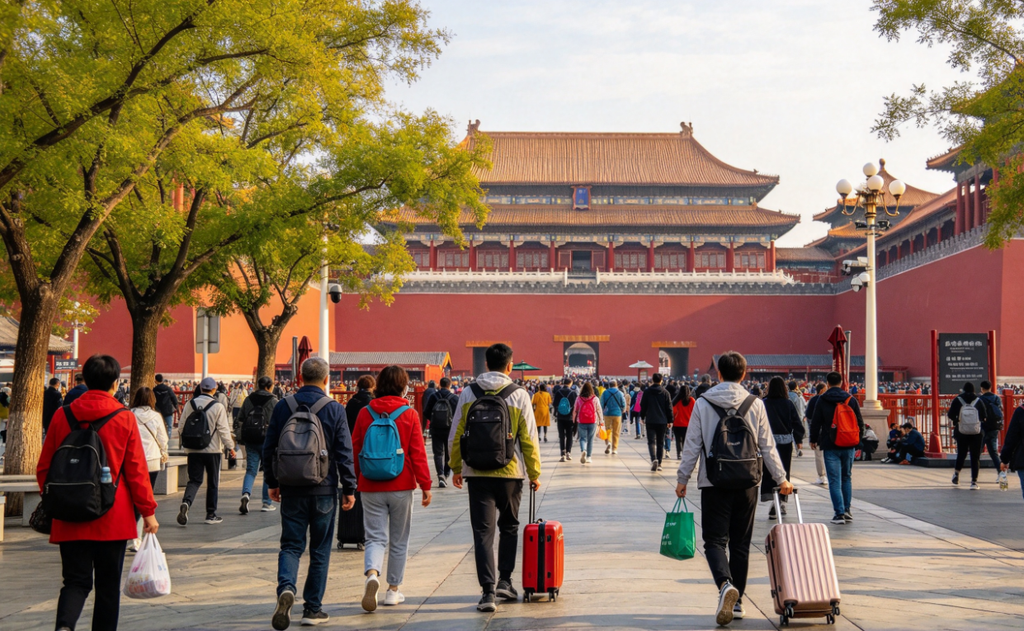
Tiananmen Square and the Forbidden City are located in Beijing’s historic central area. They are often combined in one visit because they are geographically close and provide a natural introduction to the city’s imperial and modern history.
However, proximity does not mean that the entire visit will be short. Tiananmen Square is a large public space, while the Forbidden City—also known as the Palace Museum—contains extensive courtyards, halls, galleries, and historic buildings. Visitors may spend several hours inside the palace complex alone.
Before planning the visit, check the current entry arrangements and identify the correct entrance. Security procedures, reservation requirements, and walking routes can affect how long it takes to move between the square and the palace.
Planning tip: Treat these landmarks as one central sightseeing area, but avoid scheduling another major attraction too soon afterward. The time spent walking through the palace grounds can be substantial even when the next destination is relatively nearby.
2. How Far Is the Forbidden City from the Temple of Heaven?
The Temple of Heaven lies southeast of the Forbidden City. The two attractions are not next to each other, but they can be combined in a carefully planned day if you account for transportation and visiting time.
By car, the journey may take approximately 25–45 minutes under ordinary conditions. The subway is another option, although the total journey depends on the nearest station, transfer route, and walking distance to the entrance.
The Temple of Heaven is more than a single building. Its grounds cover a large area, and the main ceremonial structures are separated by gardens, paths, and open spaces. Travelers who want to explore the Hall of Prayer for Good Harvests, the Circular Mound Altar, and other important features should allow sufficient time rather than treating the site as a quick photo stop.
A practical approach is to visit the Forbidden City in the morning and the Temple of Heaven later in the day only if your schedule allows enough time for both. If you prefer a slower pace or an in-depth historical visit, splitting them across different days may be more enjoyable.
3. How Far Is the Summer Palace from Central Beijing?

The Summer Palace is located in Haidian District in the northwest of Beijing, approximately 15 kilometers from the city center according to official municipal information.
The distance between Beijing attractions becomes especially important here because the Summer Palace is both outside the central sightseeing cluster and extensive in its own right. Its lakes, hills, bridges, corridors, and historic buildings create a landscape that rewards unhurried exploration.
Travelers can reach the area by subway or taxi. The official visitor information lists Xiyuan and Beigongmen stations on Subway Line 4 as useful access points, depending on which entrance they intend to use. Choosing the entrance first can reduce unnecessary walking and make the visit easier to organize.
Allow several hours for a meaningful visit, particularly if you want to walk along Kunming Lake, explore the Long Corridor, or climb Longevity Hill. A journey that takes 45 minutes does not mean the attraction can be fitted into a one-hour sightseeing window.
Best planning approach: Combine the Summer Palace with other destinations in the northwest only when the total schedule remains realistic. Avoid crossing back and forth between the northwest and the historic city center multiple times in one day.
4. How Far Is the Temple of Heaven from the Summer Palace?
The Temple of Heaven and the Summer Palace are separated by much of Beijing’s urban area. The road distance is approximately 24 kilometers, although the exact route depends on the entrance and departure point.
A car journey may take around 40–75 minutes, while public transportation can take approximately 60–90 minutes when transfers and walking are included. These estimates can change during rush hour, holidays, and periods of heavy tourist traffic.
The two attractions also offer different experiences. The Temple of Heaven focuses on imperial ceremonies and ritual architecture, while the Summer Palace is a large landscape garden. Visiting both in one day is possible, but it involves more than simply traveling between two points.
Consider the amount of walking you want to do, the opening hours of the individual attractions, and whether you prefer to spend longer at each location. If both are priorities, arrange them in a logical order based on your starting location rather than assuming the shortest-looking map route will always be the fastest.
For public transportation information, consult the Beijing public transportation guide and check current subway routing before departure.
5. How Far Is the Great Wall from Beijing’s City Center?

The Great Wall is the biggest exception to the idea that Beijing sightseeing can be organized entirely around central-city distances. Popular sections such as Mutianyu and Badaling are outside the urban center, and the journey involves traveling toward the surrounding mountains.
For many visitors staying in central Beijing, a drive to either section may take roughly 1.5–2.5 hours each way. The actual journey depends on the hotel location, road conditions, traffic, and the specific entrance or parking area.
This means a Great Wall visit should generally be treated as a major part of the day rather than a brief stop between city attractions. After arriving, visitors may still need time for ticket checks, shuttle buses where applicable, cable cars or chairlifts, stairs, and walking along the wall.
Mutianyu is a popular choice for travelers seeking mountain scenery and a well-developed visitor area. Badaling is another well-known section with extensive visitor facilities and convenient rail options on some routes. The better choice depends on your travel priorities, mobility, preferred experience, and departure arrangements.
If you want to visit the wall without managing every transfer independently, a private Great Wall trip can help coordinate pickup, transportation, arrival time, and the length of the visit. Confirm the itinerary and inclusions with the provider before booking.
6. Which Beijing Attractions Are Close Enough to Visit Together?

The most efficient way to plan sightseeing is to group attractions by geographical area. This reduces unnecessary cross-city journeys and gives you more time to explore.
Central Beijing: Imperial History and Historic Streets
Potential stops include:
- Tiananmen Square
- The Forbidden City
- Jingshan Park
- Beihai Park
- Nearby historic streets and hutong neighborhoods
These destinations are concentrated in or around the historic center, although walking distances between individual entrances and sites can still be considerable. The Forbidden City itself may take several hours to explore.
Southeastern Beijing: Temple of Heaven and Surrounding Areas
The Temple of Heaven is the main attraction in this area. Depending on your interests, it may be paired with nearby neighborhoods or other destinations in the southern part of the historic city.
Do not assume that every central Beijing attraction belongs in the same short walking route. Check actual distances between entrances and allow time for subway journeys or road transfers when moving farther north or west.
Northwestern Beijing: Summer Palace and Other Garden Sites
The Summer Palace is a natural anchor for a northwest Beijing sightseeing day. Nearby attractions may include other historic gardens and university-area landmarks, depending on opening hours and your interests.
Grouping these places together is often more efficient than visiting the Summer Palace in the morning and returning to the northwest after spending several hours elsewhere in the city.
Outside the Urban Center: The Great Wall
Mutianyu and Badaling should usually be planned as dedicated excursions. Adding several distant city attractions before or after the wall can make the day tiring and leave little time to appreciate the destination.
The guiding principle is simple: group central landmarks together, plan the Summer Palace around the northwest, and give the Great Wall enough time for transportation and exploration.
7. Which Transportation Method Works Best Between Attractions?
The best option depends on the distance, your budget, the number of travelers, and whether you are comfortable navigating transfers.
| Transportation option | Best suited to | Main consideration |
|---|---|---|
| Subway | Many journeys within the urban area | Transfers, station walking, and the distance from the station to the entrance |
| Taxi or ride-hailing | Direct trips between attractions | Traffic can make travel times unpredictable |
| Private vehicle with a driver | Multi-stop sightseeing and longer journeys | Confirm the route, waiting time, and pricing in advance |
| Walking | Nearby landmarks and historic neighborhoods | Actual walking distances can be greater than expected |
| Tourist or dedicated shuttle services | Specific destinations and routes | Check current schedules, departure points, and ticket conditions |
For most visitors, the subway is useful for many urban journeys, while direct road transportation can be more convenient for certain multi-stop days or trips to the Great Wall. Neither option is automatically fastest for every route.
When comparing journey times, consider the full door-to-door experience. A subway ride may be fast between stations but still require substantial walking. A car may offer a direct route but encounter traffic congestion. The most useful estimate is the total time from your hotel or previous attraction to the next entrance.
8. How to Plan Sightseeing Around Distance Rather Than Just a Map
A common planning mistake is to count the number of attractions rather than the time required to reach and explore them. A more reliable approach involves four steps.
First, identify the essential attractions. Decide which places matter most to you, such as the Forbidden City, the Summer Palace, or the Great Wall. Prioritize these before adding optional stops.
Second, group destinations geographically. Keep central Beijing attractions together where practical, reserve a suitable block of time for the northwest, and plan the Great Wall as an excursion outside the urban center.
Third, calculate door-to-door travel time. Include walking to stations, transfers, entrance procedures, traffic, and any shuttle or cable-car arrangements. Do not rely solely on the estimated time shown for a subway or car journey.
Fourth, leave room for delays. Timed admission, crowded security checks, weather, and unexpected traffic can all affect a sightseeing day. A realistic schedule is more valuable than one that looks impressive but leaves no flexibility.
For travelers who prefer help organizing transportation and sightseeing, Beijing private tours may be worth considering. A well-designed private itinerary can group attractions logically, account for pickup and drop-off points, and adjust the pace to suit your interests. For a dedicated palace visit, a Forbidden City tour can also help structure the time spent at one of Beijing’s largest historic sites.
Frequently Asked Questions
Can you visit the Forbidden City, Temple of Heaven, and Summer Palace in one day?
It may be possible to visit parts of all three in a very rushed schedule, but it is generally not ideal for travelers who want to explore them properly. The sites are spread across different parts of Beijing, and each requires time for entry, walking, and sightseeing. Focusing on one or two major areas usually creates a more comfortable day.
Is the Great Wall close enough to visit in half a day?
A half-day trip may be possible under selected conditions, but it can be tight when round-trip transportation, entry procedures, and time on the wall are included. For many visitors, allocating most of a day is more practical.
Is it better to travel between Beijing attractions by subway or car?
The subway can be efficient for many journeys within the city, especially when stations are close to your destinations. A car or private driver may be more convenient for direct transfers, travelers with limited mobility, families, or routes involving the Great Wall. Compare the full door-to-door time rather than the vehicle journey alone.
Does the distance between Beijing attractions affect how many days I need?
Yes. Beijing’s major sites are spread across a large area, and some attractions require substantial walking in addition to transportation. The number of days you need depends on which sites you want to visit, how thoroughly you want to explore them, and how much time you want to spend traveling.
What is the most important thing to check before setting out?
Check the attraction’s current admission arrangements, entrance location, opening hours, and recommended arrival time. Then confirm your transportation route on the day of travel. These details can make a bigger difference to your schedule than the distance alone.
Final Thoughts: Plan by Area, Not Just by Attraction Count
The distance between Beijing attractions varies from a short walk between landmarks in the historic center to a substantial road journey toward the Great Wall. The most effective itinerary accounts for travel time, entrance locations, walking requirements, and the time needed to appreciate each site.
Group nearby attractions together, avoid unnecessary cross-city journeys, and allow a dedicated day or substantial time block for the Great Wall. With realistic travel estimates and a flexible schedule, you can see more of Beijing without spending your trip rushing between destinations.