
Can You See the Great Wall from Space?
Can You See the Great Wall from Space?
Can you see the Great Wall from space? The most accurate answer is that the Great Wall of China is generally not visible to the unaided human eye from low Earth orbit, although some sections have been identified in astronaut photographs taken with powerful camera lenses and in specialized satellite images.
The common belief that the Great Wall is the only human-made structure visible from space is a myth. Its extraordinary length does not automatically make it easy to see from hundreds of kilometers away. The wall is relatively narrow, and much of it blends into the surrounding mountains, soil, and landscape.
NASA has addressed this misconception directly. Its Earth-observation resources explain that the Great Wall is difficult or impossible to distinguish from low Earth orbit without magnification, and it cannot be seen from the Moon with the naked eye.
For travelers visiting China, the real story is just as fascinating. Understanding why the wall is difficult to see from space reveals something important about human vision, landscape contrast, satellite imaging, and the remarkable scale of this historic structure.
Why Is the Great Wall Difficult to See from Space?
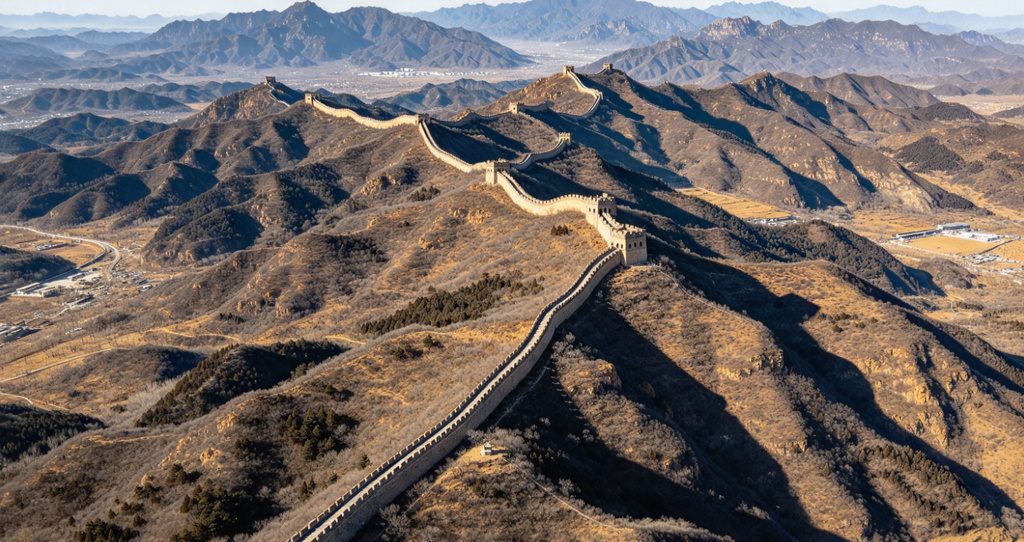
The main reasons are its width, the distance from which it is observed, and the lack of contrast between the wall and its surroundings.
1. The Wall Is Long but Relatively Narrow
The Great Wall stretches across northern China through mountains, ridges, valleys, and other landscapes. However, its visible sections are generally only a few meters wide.
This creates a common misunderstanding: people assume that an object extending across thousands of kilometers must be easy to see from space.
In reality, visibility depends heavily on an object’s apparent width, not simply its total length. A long, narrow structure can be difficult to distinguish when viewed from far away because it occupies very little space in the observer’s field of vision.
Imagine looking down at a narrow path winding across a mountain from an aircraft. You might see the surrounding mountain range clearly while struggling to identify the path itself. The Great Wall presents a similar challenge, but from a much greater distance.
2. The Wall Often Blends Into the Landscape
The Great Wall was built using materials available in different regions, including stone, brick, and compacted earth. These materials can have colors and textures similar to the terrain around them.
In mountainous areas, the wall may follow ridgelines, where exposed rock, vegetation, and shadows make its outline difficult to distinguish. In other regions, the wall’s color may closely resemble the dry soil around it.
NASA explains that the similarity between the wall’s materials and the surrounding ground is one reason the structure is difficult to identify in astronaut photography.
Contrast is critical when observing an object from a great distance. A bright structure against a dark background is generally easier to distinguish than a narrow structure whose color closely matches its surroundings.
3. Human Vision Has Physical Limits
Even when an object is technically present in a person’s field of view, that does not mean the eye can resolve its details.
The human visual system has a limited ability to distinguish small objects at long distances. As the observer moves farther away, the angle occupied by the object becomes smaller.
At orbital distances, the Great Wall’s narrow width presents a major challenge. The eye may detect broad features such as coastlines, large cities, or extensive terrain patterns without being able to distinguish the wall itself.
This is why the question is not simply whether the Great Wall is physically within sight of an astronaut. The important question is whether the unaided eye can separate it from the surrounding landscape.
Has the Great Wall Ever Been Photographed from Space?
Yes. Parts of the Great Wall have been photographed from orbit, but these images do not prove that the entire structure is easily visible to the naked eye.
In 2004, astronaut Leroy Chiao photographed sections of the wall from the International Space Station. NASA later published an image and explained that the wall was difficult or impossible to see from orbit without the high-powered lenses used to take the photograph.
The photographs demonstrate an important distinction between direct human vision and photographic observation.
A camera can use a telephoto lens to magnify a small section of the landscape. Image processing, sensor characteristics, lighting, and viewing conditions can also help researchers identify features that an astronaut might not notice when looking out of a spacecraft window.
NASA’s report on the subject notes that a section of the wall was identified in an astronaut photograph taken with a 180 mm lens. A later image taken with a 400 mm lens was also discussed, although the identification of particular features depended on interpretation.
The important conclusion is that a photograph taken from orbit and an object visible to the naked eye are not equivalent forms of evidence.
What About Satellite Images?
Satellite images can reveal sections of the Great Wall, especially when the imaging system has suitable resolution and the landscape provides enough contrast.
Some satellite photographs use visible light, while others rely on different parts of the electromagnetic spectrum. Radar imaging is particularly useful because it can detect physical surface features that may be difficult to distinguish in ordinary photographs.
NASA’s Spaceborne Imaging Radar-C/X-band Synthetic Aperture Radar captured sections of the Great Wall in 1994. The resulting images showed the wall as a distinct line because its surface geometry reflected radar signals differently from nearby terrain.
These images are valuable scientific evidence, but they should not be interpreted as proof that an astronaut can easily spot the same features with unaided vision.
Can You See the Great Wall from the International Space Station?
The International Space Station orbits Earth at an altitude of roughly 400 kilometers, although its exact altitude changes over time.
From this distance, astronauts can see many large geographical and human-made features. However, identifying a narrow structure such as the Great Wall is much more difficult than recognizing large cities, major rivers, or extensive road networks.
There are several reasons why an astronaut might fail to see the wall even when the station passes over a region containing it.
- Viewing angle: The wall may be viewed from an angle that makes its width even harder to distinguish.
- Lighting: Shadows and the direction of sunlight can change the appearance of the terrain.
- Atmospheric conditions: Haze, clouds, and other atmospheric effects can reduce clarity.
- Landscape contrast: The wall may closely resemble the ground around it.
- Visual magnification: A camera with a telephoto lens can reveal details that are difficult to see directly.
China’s first astronaut, Yang Liwei, reported that he had not been able to see the Great Wall during his spaceflight in 2003. His experience helped challenge the popular belief that the wall is readily visible from orbit.
NASA’s explanation is consistent with this observation: the wall is difficult to distinguish from low Earth orbit without optical magnification, even though certain sections have been identified in photographs.
What Can Astronauts See More Easily?
From low Earth orbit, astronauts can often recognize large-scale features such as coastlines, major rivers, extensive urban areas, agricultural patterns, and some transportation networks.
These features may cover larger areas or contrast more strongly with their surroundings than the Great Wall does.
The difference is not necessarily that these structures are more important or more impressive. They are simply easier to distinguish at the available viewing distance and resolution.
Can You See the Great Wall from the Moon?
No. The Great Wall cannot be seen from the Moon with the unaided human eye.
The Moon is approximately 384,400 kilometers from Earth on average, vastly farther away than the International Space Station. At that distance, the wall’s narrow width occupies an extremely small angle in the visual field.
Even if weather and lighting conditions are favorable, the human eye cannot resolve the wall as a distinct structure from the lunar surface.
NASA’s astronomy resources explicitly address this misconception. The idea that the Great Wall is visible from the Moon is a longstanding myth rather than an established scientific observation.
This does not diminish the Great Wall’s historical or architectural importance. It simply demonstrates that visual visibility depends on physical scale and viewing distance, not on how famous or extensive a structure is.
Why Does the Myth About the Great Wall Persist?
The claim that the Great Wall can be seen from space has circulated for generations. Its persistence is understandable because the wall is one of the world’s most recognizable historical landmarks.
Several factors help explain why the myth remains popular.
The Wall Is Extremely Long
The Great Wall is a network of fortifications and associated defensive structures built across different periods, rather than one uninterrupted wall.
Its overall scale makes it natural for people to imagine that the structure must be visible from far above Earth. However, total length does not determine whether an individual observer can resolve its width.
It Is a Powerful Symbol of Human Achievement
The wall represents centuries of engineering, construction, defense, and political history. Its cultural significance can encourage memorable descriptions that emphasize its extraordinary scale.
Over time, an impressive metaphor can be repeated as though it were a scientific fact.
Satellite Photographs Can Be Misinterpreted
Images taken with powerful lenses or specialized instruments may clearly show the wall after it has been identified and highlighted.
When these images are shared without an explanation of the equipment used, viewers may assume that the wall is equally obvious to the naked eye.
The correct interpretation is more nuanced: the wall can be detected in certain images under suitable conditions, but it is not generally visible to unaided vision from low Earth orbit.
Does the Great Wall Look Different from the Ground?
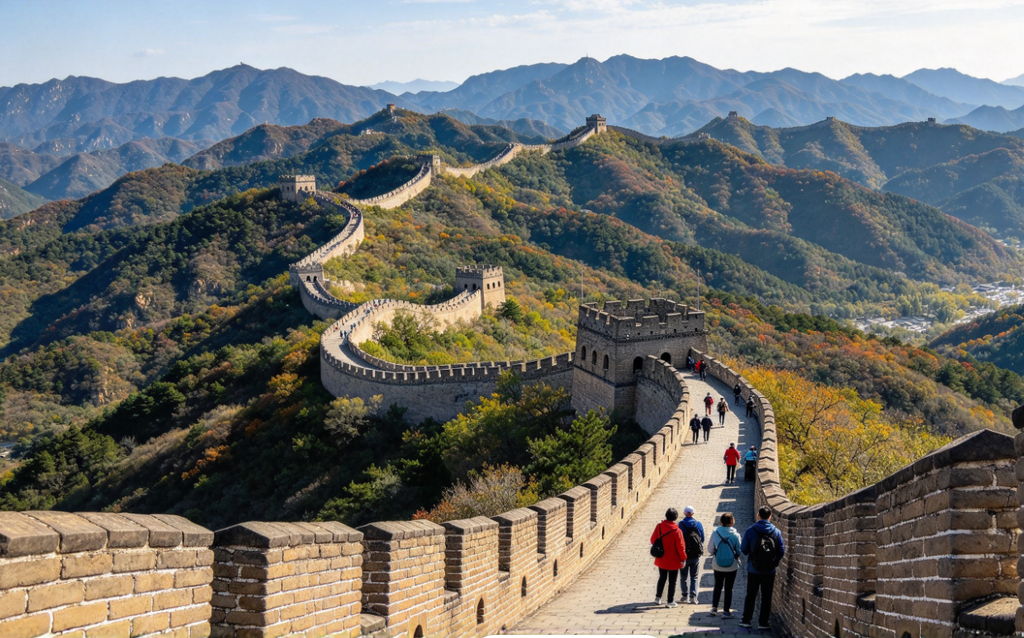
Absolutely. A structure that is difficult to identify from orbit can be visually impressive when viewed from nearby.
From a mountain ridge, visitors can follow the wall as it climbs steep slopes, descends into valleys, and disappears behind distant peaks. The terrain makes its scale and engineering challenges easier to appreciate.
At ground level, the visitor can observe details that cannot be resolved from space, including brickwork, watchtowers, stairways, defensive features, and the way the wall follows the contours of the mountains.
The experience also reveals that the Great Wall is not uniform. Different sections vary in preservation, restoration, accessibility, and surrounding scenery.
Some sections are restored and relatively convenient to visit, while others are steep, rugged, or partially ruined. Choosing a suitable section depends on your interests, fitness, available time, and preferred level of difficulty.
For many visitors, the most rewarding view is not from space but from a high point along the wall, where the fortifications stretch across the surrounding mountain landscape.
Which Great Wall Section Should You Visit Near Beijing?
Travelers staying in Beijing have several options for visiting accessible sections of the Great Wall. Each offers a different combination of scenery, historical atmosphere, physical difficulty, and visitor facilities.
Rather than choosing solely on the basis of popularity, consider what you want to experience.
Mutianyu: Scenic Views and Visitor Facilities
Mutianyu is a popular option for international visitors because it combines mountain scenery with restored wall sections and visitor facilities.
Depending on the route and ticket options, visitors may be able to use a cable car or other services to reduce the amount of climbing required.
It can suit travelers who want to experience the Great Wall without undertaking a particularly rugged hike. However, steep steps and uneven surfaces may still be present, so comfortable footwear is important.
Badaling: A Well-Known and Accessible Choice
Badaling is one of the most famous and frequently visited sections. Its restored fortifications and established visitor infrastructure make it a common choice for first-time visitors.
Because it is popular, visitor numbers and waiting times can vary substantially by date and time. Checking current booking requirements and planning transportation in advance can make the visit more manageable.
Jiankou: Rugged Scenery and Challenging Terrain
Jiankou is known for dramatic mountain scenery and unrestored sections of the wall. Some areas have steep, uneven, and potentially hazardous terrain.
It is not an appropriate choice for every traveler, particularly those without suitable hiking experience. Visitors should follow current access restrictions and safety guidance rather than assuming every visible stretch of wall is open for tourism.
How Should You Choose?
| Priority | Section to consider | What to keep in mind |
|---|---|---|
| Restored scenery and visitor facilities | Mutianyu | Check the walking route and optional transport |
| A famous landmark with established infrastructure | Badaling | Plan around crowds and booking arrangements |
| Rugged landscapes and demanding hiking | Jiankou | Check access, terrain, and safety restrictions |
No single section is best for every visitor. The most suitable choice depends on how much time you have, how physically demanding you want the visit to be, and whether you prefer convenient facilities or a more rugged environment.
If you prefer help coordinating transportation, timing, and sightseeing, Beijing private tours can be a useful starting point for exploring guided options.
For travelers who want to focus specifically on the Great Wall, a private Great Wall trip may offer more flexibility in choosing a section and arranging the day’s schedule. Compare what is included in the price, such as transport, guide services, admission tickets, and optional cable cars, before booking.
Is Visiting the Great Wall Worth It If You Cannot See It from Space?
Yes. The inability to see the wall with the naked eye from orbit has no bearing on its value as a historical and travel destination.
A visit offers a close look at a complex defensive system built and modified over many centuries. It also reveals the relationship between architecture and terrain, as the wall follows ridges, crosses mountain passes, and connects watchtowers across challenging landscapes.
The experience is fundamentally different from viewing the structure in a photograph.
Visitors can appreciate the scale of the fortifications, the steepness of the mountains, the changing scenery, and the practical challenges faced by the people who constructed and maintained them.
For first-time visitors to China, the Great Wall can also provide a valuable introduction to Chinese history and the diversity of landscapes around Beijing.
Practical Tips Before Your Visit
- Check access and opening information: Conditions and access rules may vary between sections and dates.
- Wear suitable shoes: Stone steps can be steep, uneven, or slippery in wet weather.
- Allow enough time: Include transportation, ticket checks, walking, breaks, and the return journey.
- Bring water: Walking along the wall can be physically demanding, especially in warm weather.
- Consider your fitness level: Choose a route that matches your mobility and hiking experience.
- Check the forecast: Rain, wind, heat, and visibility can affect both safety and the quality of the views.
The Great Wall is impressive because of its history, engineering, and landscape setting—not because it can be seen from the Moon.
Frequently Asked Questions
Can you see the Great Wall from space with the naked eye?
Generally, no. The wall is difficult to distinguish without magnification from low Earth orbit because it is narrow and often similar in color to the surrounding landscape. Certain sections have been identified in astronaut photographs, but that is not the same as easy naked-eye visibility.
Has NASA photographed the Great Wall from space?
Yes. NASA has published astronaut photographs showing sections of the wall, including images taken from the International Space Station. The photographs were made using camera equipment with optical magnification.
Can you see the Great Wall from the Moon?
No. The wall is far too narrow to be resolved by the unaided human eye from the Moon. The claim that it can be seen from the lunar surface is a longstanding myth.
Can satellites see the Great Wall?
Some satellites can detect or image sections of the wall, depending on their sensors, spatial resolution, viewing conditions, and the surrounding terrain. Radar imagery can be especially useful because it detects surface characteristics differently from ordinary visible-light photography.
Is the Great Wall the only human-made structure visible from space?
No. Large cities, roads, airports, agricultural patterns, reservoirs, and other human-made features can also be visible from low Earth orbit. Visibility depends on an object’s size, contrast, distance, and the equipment used to observe it.
Is the Great Wall visible from an airplane?
It may be possible to identify some sections from an airplane under favorable conditions, but visibility is not guaranteed. The result depends on altitude, distance, lighting, weather, viewing angle, and whether the wall contrasts with the surrounding terrain.
Does the myth make the Great Wall less impressive?
Not at all. Its historical importance, engineering, and relationship with the landscape remain extraordinary regardless of whether it is visible from orbit. Seeing the wall from a mountain ridge provides a much more detailed experience than trying to identify it from space.
Final Answer: Can You See the Great Wall from Space?
Can you see the Great Wall from space? Not reliably with the naked eye. Although sections have been identified in astronaut photographs and specialized satellite imagery, the wall is generally too narrow and too similar in color to its surroundings to stand out clearly from low Earth orbit. It cannot be seen from the Moon with unaided vision.
The distinction between human vision and camera-based observation explains why photographs can show details that astronauts cannot easily identify by looking out of a spacecraft window.
For travelers, the more rewarding perspective is often much closer to the ground. Walking along the Great Wall reveals its construction, its dramatic mountain setting, and the historical significance that made it one of China’s most famous landmarks.