
How Much of the Great Wall Is Still Standing? Facts & Figures
How Much of the Great Wall Is Still Standing?
A substantial amount of the Great Wall of China survives, but its condition varies dramatically. Some sections remain impressive, maintained structures, while others have deteriorated into broken walls, earthen ridges, foundations, or archaeological traces.
The most frequently cited official figures come from a national survey announced in 2012. It recorded 21,196.18 kilometers (13,170.7 miles) of Great Wall remains from different historical periods. An earlier survey measured the Ming Dynasty Great Wall at approximately 8,851.8 kilometers (5,500 miles). The same 2012 report stated that 8.2% of the Ming wall was in good condition, while 74.1% was in poor condition or had deteriorated to the point that only foundations remained. These are historical survey findings, not a current percentage for the entire Great Wall. (Xinhua report on the national survey)
The key distinction is that the length of the Great Wall recorded by surveyors is not the same as the length of intact, walkable wall. The Great Wall is a complex heritage system built by different states and dynasties over many centuries. Its surviving remains include walls, trenches, watchtowers, fortresses, passes, and other defensive structures.
To understand how much of the Great Wall still exists, it is necessary to examine what the measurements count, how different sections have deteriorated, and what conservation has preserved.
1. What Do the Great Wall’s Official Length Figures Actually Mean?

Three figures help explain the scale of the Great Wall and the condition of its remains.
| Measurement | Reported figure | What it tells us |
|---|---|---|
| Great Wall system across multiple dynasties | 21,196.18 km (13,170.7 miles) | Total length recorded in China’s 2012 national survey |
| Ming Dynasty Great Wall | Approximately 8,851.8 km (5,500 miles) | Length of the Ming-era defensive system measured in an earlier survey |
| Ming wall in good condition | 8.2% | Historical assessment of condition reported in 2012, not the percentage of the entire Great Wall still existing today |
Sources: Xinhua’s 2012 survey report and UNESCO’s Great Wall World Heritage description.
Why is the Great Wall measured at more than 21,000 kilometers?
The larger figure includes defensive remains from multiple periods of Chinese history. The smaller figure of approximately 8,851.8 kilometers refers to the Ming Dynasty system, which dates from 1368 to 1644 and includes many of the best-known sections near Beijing.
The two figures are therefore not competing estimates of the same structure. They use different historical scopes.
The Great Wall developed over centuries as political boundaries, military priorities, and defensive technologies changed. Different regimes built new fortifications, reinforced existing barriers, or established defensive lines in different locations. Some sections run parallel to others rather than forming one continuous route.
China’s 2012 national survey identified 43,721 heritage sites associated with the Great Wall, including wall sections, defensive works, passes, and related remains. This helps explain why the complete heritage system is much more extensive than the familiar brick wall seen in photographs. (Survey findings reported by Xinhua)
Does 8.2% mean that only 8.2% of the Great Wall survives?
No. This is one of the most important distinctions in interpreting Great Wall statistics.
The 8.2% figure describes the proportion of the Ming Dynasty wall reported to be in good condition in the historical survey. It does not mean that only 8.2% of the entire Great Wall remains.
A section can survive physically without being structurally intact. For example, an eroded earthen wall may still be identifiable as part of the original defensive route, even though it no longer resembles a tall wall. Foundations and partially collapsed structures may also preserve archaeological evidence.
Similarly, a section in poor condition has not necessarily disappeared completely.
The most accurate answer is that extensive Great Wall remains survive, but their condition ranges from well-preserved or restored structures to severely eroded ruins. There is no single current percentage that reliably describes every surviving section across the entire system.
2. Why Has So Much of the Great Wall Deteriorated?
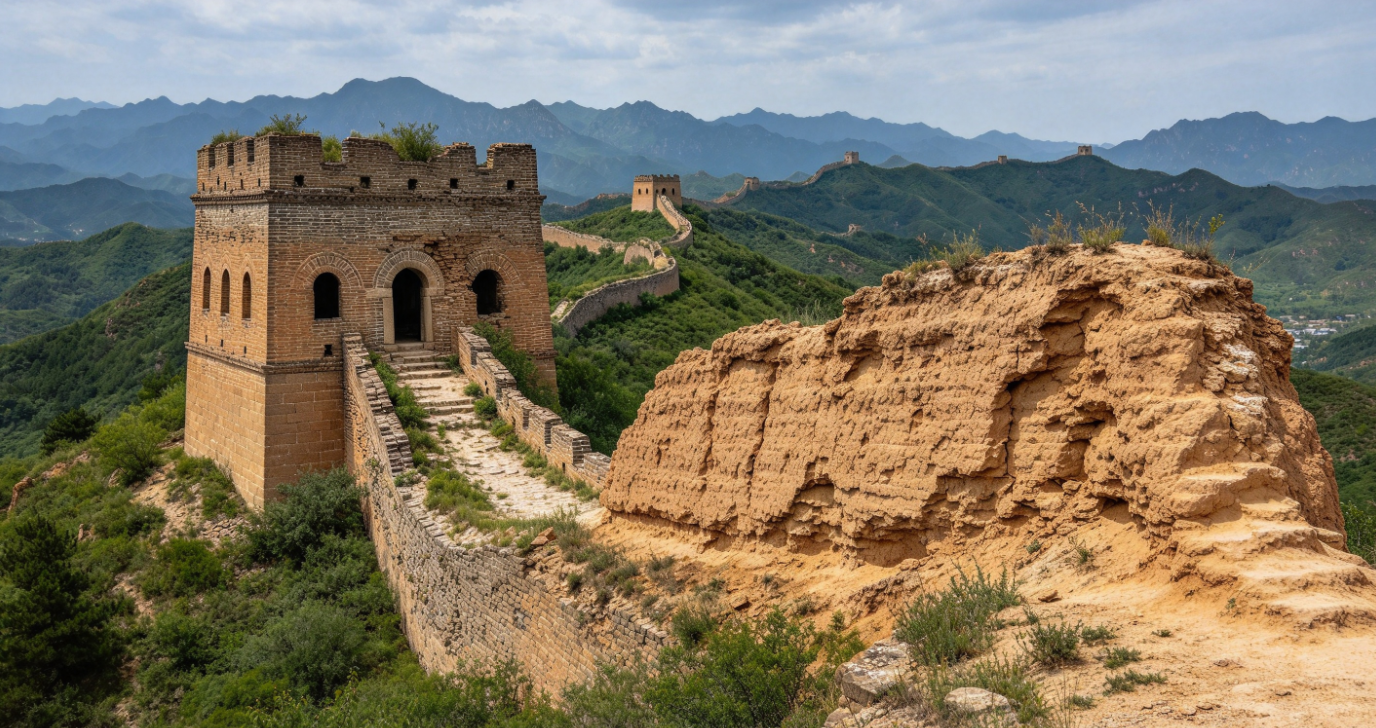
The Great Wall crosses a wide range of environments, including mountains, exposed plateaus, dry regions, and areas subject to seasonal rainfall. Its construction materials and maintenance histories differ substantially.
Three major factors explain why some sections remain recognizable while others have almost disappeared.
Natural erosion and weather
Wind, rain, temperature changes, flooding, and repeated freezing and thawing can gradually weaken exposed structures.
Water can wash away loose soil and erode the edges of earthen walls. In masonry sections, moisture can weaken mortar and penetrate gaps between bricks or stones. Over time, weathering may cause surfaces to crumble and unsupported portions to collapse.
The effects are cumulative. A small crack can allow more water to enter, and repeated exposure can enlarge the damaged area. Without suitable maintenance, the structure may eventually lose its original height and shape.
The landscape also matters. A wall running along an exposed ridge faces different environmental pressures from a structure protected by surrounding terrain. Drainage, soil stability, and local weather conditions all influence how quickly a section deteriorates.
Different construction materials
Not every section of the Great Wall was built from the large bricks and stones familiar from photographs of Beijing’s restored sections.
Some defensive walls used compacted earth, rammed earth, gravel, or locally available materials. These construction methods were adapted to local conditions and the resources available at the time.
UNESCO recognizes both the impressive masonry of the Ming Dynasty and earlier rammed-earth fortifications, including surviving remains in Gansu Province. Both types contribute to the Great Wall’s historical significance. (UNESCO World Heritage Centre)
The difference in materials helps explain why preservation varies so much.
A substantial brick wall may retain recognizable architectural features even after damage. An earthen wall exposed to wind and rain may gradually lose its outer layers, leaving a low ridge that is difficult to identify without historical records or archaeological investigation.
This does not make earthen remains less historically important. They can provide evidence of earlier construction techniques, defensive planning, and the geographical extent of historical fortifications.
Human activity and development
Natural forces are not the only threat. The Great Wall has also been damaged by the removal of bricks and earth, agricultural activity, mining, infrastructure development, and inappropriate tourism facilities.
Removing even a small amount of original material can weaken a structure or destroy evidence of how it was built. Development around a historic section can also alter its landscape and reduce its visual integrity.
The effects are particularly serious when damage occurs in remote areas where regular inspection and conservation are difficult.
In December 2023, China’s National Cultural Heritage Administration called for condition surveys and measures to protect the structural safety and historic features of existing Great Wall sections. It also instructed local authorities to maintain collapsed sections in their existing condition rather than undertaking large-scale reconstruction. (Chinese government’s conservation announcement)
This policy reflects an important conservation principle: protecting a historic structure does not always mean rebuilding it to look complete.
3. Which Parts of the Great Wall Are Still Well Preserved?
The Great Wall’s condition varies by location. Some sections have been repaired and maintained for visitors, while others preserve a more weathered appearance or survive mainly as ruins.
For travelers, it is useful to distinguish between three things:
- Physical survival: How much of the historic structure remains at the site.
- Preservation and restoration: How much original material survives and what conservation work has been carried out.
- Visitor accessibility: Whether the section is maintained, legally open, and suitable for the public.
These factors are related, but they are not interchangeable. A section can be well maintained for tourism without representing the condition of the Great Wall as a whole.
Badaling: A maintained and accessible section
Badaling is one of the best-known Great Wall destinations near Beijing. Its recognizable wall, watchtowers, established visitor facilities, and maintained routes make it a practical choice for travelers who want to experience the Great Wall without exploring remote ruins.
However, its accessible appearance should not be used as a measure of the condition of every Great Wall section in China. Restoration and visitor management have an important influence on what visitors see.
Badaling is most suitable for people who prioritize convenience, recognizable architecture, and established facilities.
Mutianyu: A mountain setting with maintained structures
Mutianyu offers another popular Great Wall experience near Beijing. The wall follows mountain ridges, with watchtowers and surrounding wooded hills creating a distinctive landscape.
Its maintained visitor routes make it a practical option for travelers who want to see the structure up close while avoiding the difficulties of remote, unrestored sections.
As at Badaling, visitors should understand that a maintained tourist site represents one part of a much larger heritage system. It does not demonstrate that all sections remain in similarly good condition.
Jinshanling: Varied structures and a hiking experience
Jinshanling is known for its watchtowers, mountain scenery, and routes that provide a different experience from the most heavily visited sections.
Preservation conditions vary along the route, and visitors may encounter different combinations of historic fabric, repairs, and weathered structures. This variation can make the site appealing to people interested in the relationship between the wall and its surrounding landscape.
Conditions, permitted routes, and access arrangements can change, so visitors should check current local guidance before setting out.
Why these visitor sections do not represent the whole Great Wall
Badaling, Mutianyu, and Jinshanling help visitors understand the scale and design of the Great Wall, but they cannot represent the condition of every surviving section.
The full system includes remote remains that may be low, fragmented, difficult to recognize, or inaccessible to the public. Some sections have undergone substantial restoration, while others preserve evidence of deterioration over centuries.
If you are comparing destinations for a visit, the Great Wall guide and section comparisons can help you consider access, scenery, walking conditions, and the type of experience each section offers.
4. Does a Restored Great Wall Section Still Count as Original?
Yes. A restored section can retain genuine historical value, but it is important to distinguish surviving historic fabric from later repairs and reconstruction.
A historic wall may contain original bricks, stones, foundations, and structural elements alongside materials added to stabilize the structure or make a visitor route safer. The amount of original material and the nature of the conservation work vary by site.
Restoration does not automatically make a place inauthentic. Carefully planned conservation can help protect original structures from further deterioration. However, extensive reconstruction may change how much of the visible wall represents surviving historic material.
UNESCO’s assessment of the Great Wall emphasizes the importance of retaining its original location, materials, form, construction techniques, and structure. It also notes that inappropriate tourism development can affect the integrity of the historic landscape. (UNESCO World Heritage Centre)
For this reason, the question should not simply be whether a wall is “original” or “rebuilt.” More useful questions include:
- How much historic material remains?
- What types of repairs or reconstruction have been undertaken?
- Are the original route and structural features preserved?
- Has conservation protected the historic landscape as well as the visible wall?
These distinctions matter when interpreting the Great Wall’s survival statistics. A restored section may look complete, but that appearance cannot be extrapolated to thousands of kilometers of other remains.
5. Can You See the Original Great Wall Near Beijing?
Yes. The Beijing region contains numerous Great Wall remains, including well-known visitor sections and stretches with different preservation conditions.
However, “original” does not necessarily mean untouched, completely preserved, or safe to explore. Some historic sections have been repaired, while others are unstable, difficult to reach, or closed to visitors.
Before choosing a section, consider three factors.
Preservation: Do you want a maintained wall with clear architectural features, or are you more interested in seeing weathered structures and traces of earlier construction?
Accessibility: Consider the distance, steepness, steps, transportation, and amount of walking involved. A remote or less-restored section may demand considerably more preparation.
Conservation and safety: Confirm that the route is officially open. Avoid climbing damaged walls, entering restricted areas, or treating photographs of remote ruins as proof that they are safe to visit.
For most first-time visitors, a recognized visitor section provides a practical balance between historical interest and accessibility. Travelers with a particular interest in archaeology or conservation should seek reliable information about specific sites rather than assuming that less-restored always means more historically authentic.
If you are planning a visit from Beijing, Great Wall tours from Beijing provide a starting point for comparing accessible destinations and travel arrangements.
6. Is the Great Wall Still Being Protected Today?
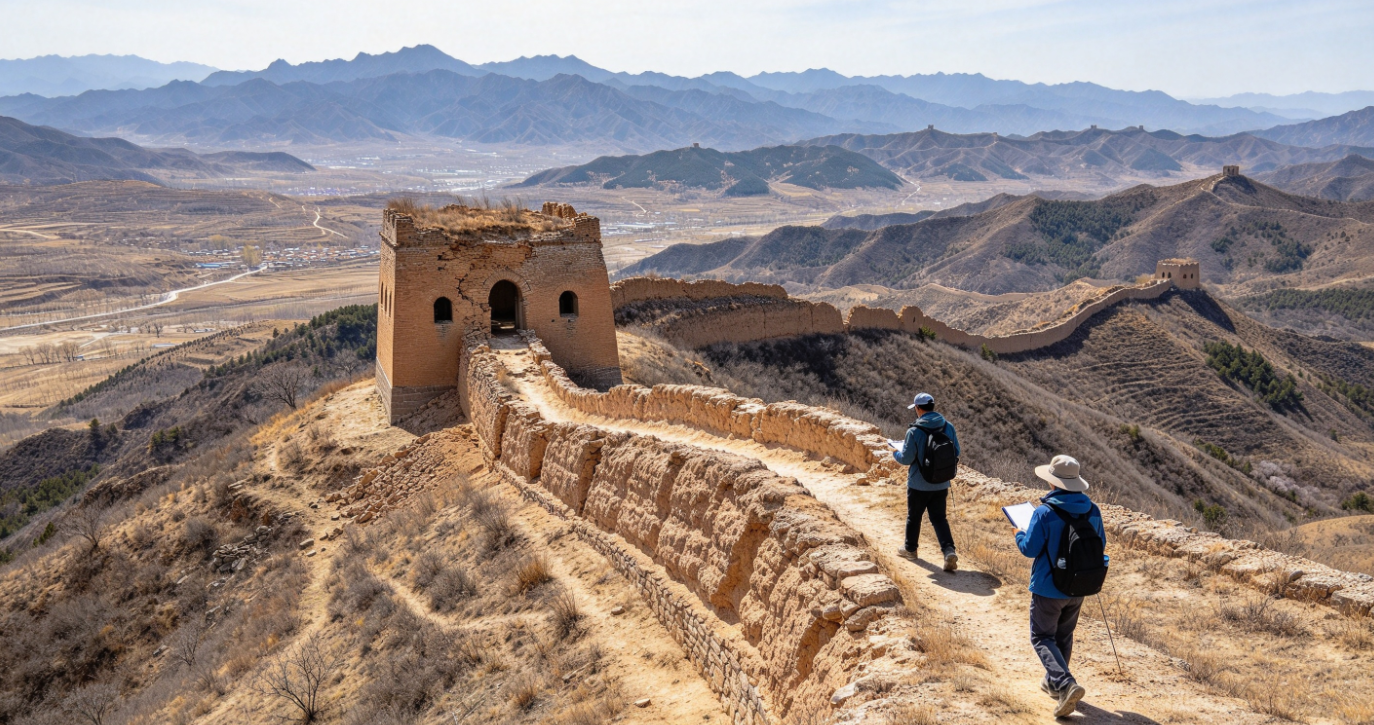
Yes. Conservation remains an ongoing responsibility because the Great Wall extends across a large geographical area and includes structures from different periods, built with different materials.
China’s December 2023 conservation announcement emphasized several priorities:
- Surveying the condition of existing sections.
- Protecting structural safety and historical features.
- Maintaining collapsed sections in their existing condition rather than rebuilding them on a large scale.
- Avoiding excessive tourism infrastructure that could undermine conservation objectives.
The announcement is particularly relevant to the question of how much of the Great Wall still stands. A collapsed or eroded section may retain significant archaeological value, even when it no longer looks like a complete wall.
Rebuilding every damaged stretch into a continuous-looking structure could erase evidence of the original construction and the ways the wall has changed over time.
Conservation can therefore involve documenting remains, monitoring vulnerable structures, stabilizing damaged areas, managing access, and protecting the surrounding landscape. The appropriate approach depends on the condition and historical significance of each section.
Visitors also have a role to play. Stay on permitted routes, avoid removing bricks or stones, do not carve names into the wall, and follow local instructions. Respecting restrictions helps protect the surviving structures and the archaeological evidence they contain.
Frequently Asked Questions
How much of the Great Wall of China is still standing?
A substantial amount of the Great Wall survives, but its condition varies widely. China’s 2012 national survey recorded 21,196.18 kilometers of Great Wall remains from different historical periods. A historical report stated that 8.2% of the Ming wall was in good condition. That figure does not mean only 8.2% of the entire Great Wall still exists.
Is 30% of the Great Wall still standing?
The often-repeated claim that around 30% remains should not be treated as a precise current measurement without a clearly defined survey, date, and meaning of “remaining.” Figures about the percentage of a particular wall that has disappeared are not equivalent to a measurement of how much of the entire Great Wall survives today.
How long is the Great Wall that survives today?
The widely cited official figure is 21,196.18 kilometers for the Great Wall system across multiple historical periods. The Ming Dynasty portion was measured at approximately 8,851.8 kilometers. These are recorded system lengths, not measurements of continuous, intact, walkable wall.
Which part of the Great Wall is in the best condition?
There is no single section that represents the condition of the entire Great Wall. Badaling and Mutianyu are popular maintained visitor sections near Beijing. Other sites preserve different combinations of original masonry, repaired structures, and ruins. The best choice depends on whether you prioritize accessibility, historical appearance, scenery, or hiking.
Has the Great Wall been completely rebuilt in some places?
Some visitor sections have undergone substantial restoration or repair, but the Great Wall is not one uniformly reconstructed structure. The extent of original material and later work varies by site. Consult reliable information about the specific section rather than assuming that every visible wall has the same conservation history.
Why are some parts of the Great Wall just low earth ridges?
Some sections were built from compacted earth or other materials that are more vulnerable to erosion than brick and stone. Weather and human activity can gradually reduce these structures to low ridges, foundations, or archaeological traces. Such remains can still provide important evidence of the original defensive route and construction methods.
Is it safe to visit unrestored sections of the Great Wall?
Not necessarily. Unrestored sections may have unstable masonry, steep slopes, missing steps, or restricted access. Visitors should choose officially open routes and follow local safety guidance rather than exploring damaged or closed areas independently.
Is the entire Great Wall connected?
No. The Great Wall is a complex system of defensive structures built by different states and dynasties over many centuries. Its components include walls, trenches, watchtowers, fortresses, and passes. Some sections follow different routes or run parallel to one another, so the total recorded length should not be understood as one continuous, intact wall.
Final Thoughts: The Great Wall Survives in Many Different Forms
The Great Wall of China remains an extraordinary historical landscape, but its surviving structures range from maintained visitor sections to eroded walls, foundations, and archaeological traces.
The most important distinction is between total recorded length, physical survival, and preservation condition. The figure of 21,196.18 kilometers describes the Great Wall system across multiple historical periods; it does not mean that this entire distance survives as an intact brick wall. Similarly, the historical finding that 8.2% of the Ming wall was in good condition should not be presented as the percentage of the entire Great Wall that still exists.
Natural erosion, differences in construction materials, human activity, restoration, and conservation policies have all shaped the condition of the surviving remains. Understanding these factors gives a more accurate picture than relying on a single percentage.
For visitors, the best approach is to choose a section based on historical interest, accessibility, and the kind of experience they want. For historians and conservationists, even a low ridge or fragment can matter because it preserves evidence of the Great Wall’s original route and construction.
The Great Wall has not survived everywhere in the same condition. Its significance lies both in the impressive sections that still rise above the mountains and in the less visible remains that preserve evidence of its long and complex history.