
Forbidden City Beijing: What to See Inside China’s Imperial Palace
The Forbidden City is more than Beijing’s most famous historic attraction. It was the political centre of imperial China for nearly five centuries, the residence of 24 Ming and Qing emperors, and one of the world’s most important surviving examples of traditional Chinese palace architecture. Visitors should begin with the central axis, where the Three Great Halls and the Inner Court reveal how imperial power was organised. The palace’s side courtyards, residential buildings, royal collections and decorative details then provide a deeper understanding of life inside the imperial court. A private Forbidden City tour can help visitors connect these buildings with the history and ceremonies that shaped them.
Covering approximately 720,000 square metres, the Forbidden City is large enough to make an unplanned visit feel overwhelming. Its main halls may look similar at first, but each building had a particular function, and the palace’s layout followed a carefully controlled system of hierarchy, ritual and symbolism.
This guide explains the most important places to see, the history behind the palace, the architectural details worth noticing, and how to plan a visit without spending hours walking through buildings without understanding their purpose.
1. Why Is the Forbidden City So Important?
The Forbidden City was built between 1406 and 1420 under the Ming emperor Yongle, Zhu Di. It became the principal imperial palace after the Ming capital moved to Beijing.
The complex remained the seat of imperial power through the Ming and Qing dynasties until the end of the Qing imperial system in 1911. During this period, 14 Ming emperors and 10 Qing emperors occupied the throne.
The Palace Museum was established in 1925, transforming the former imperial residence into a public institution dedicated to preserving and presenting China’s imperial collections and architectural heritage.
In 1987, the Forbidden City was included on the UNESCO World Heritage List as part of the Imperial Palaces of the Ming and Qing Dynasties.
Its importance comes from three connected aspects.
Political history: The palace was where emperors received officials, conducted important state ceremonies and exercised authority over the empire.
Architectural achievement: Its symmetrical layout, timber structures, stone platforms, decorative roofs and carefully arranged courtyards represent a highly developed system of traditional Chinese palace construction.
Cultural heritage: The buildings, furnishings, paintings, ceramics, calligraphy, ritual objects and historical records preserve evidence of imperial life and Chinese artistic traditions.
Understanding these three dimensions makes the visit much more meaningful than simply recognising famous buildings.
2. Understanding the Forbidden City’s Layout
Before exploring individual buildings, it helps to understand how the palace is organised.
The Forbidden City measures approximately 961 metres from north to south and 753 metres from east to west. Its walls stand about 10 metres high, and a wide moat surrounds the complex.
There are four principal gates:
- Meridian Gate (Wumen) in the south
- Gate of Divine Prowess (Shenwumen) in the north
- East Prosperity Gate (Donghuamen) in the east
- West Prosperity Gate (Xihuamen) in the west
The visitor route generally follows the central north-south axis, beginning at the Meridian Gate and ending near the northern exit.
The palace is divided into two major areas: the Outer Court and the Inner Court.
The Outer Court: Government and Imperial Ceremonies
The southern section of the palace was primarily associated with state ceremonies and formal imperial functions.
Its central architectural group consists of three major halls:
- Hall of Supreme Harmony
- Hall of Central Harmony
- Hall of Preserving Harmony
These buildings were arranged in a sequence that increased the sense of formality as visitors approached the most important ceremonial spaces.
The Outer Court was not simply a collection of impressive halls. Its design communicated the political structure of the empire. The emperor occupied the highest position, and the architecture reinforced that authority through height, scale, symmetry and controlled access.
The Inner Court: Imperial Residence and Family Life
North of the Outer Court lies the Inner Court, where the emperor’s domestic life and many important court activities took place.
Its central group is known as the Three Rear Palaces:
- Palace of Heavenly Purity
- Hall of Union
- Palace of Earthly Tranquility
The surrounding Eastern and Western Six Palaces contained residences for members of the imperial household.
Compared with the monumental ceremonial buildings in the south, the Inner Court had a more residential character. Its courtyards, smaller halls and enclosed spaces reveal how the palace accommodated daily routines, family relationships and the complicated hierarchy of the imperial household.
The distinction between the Outer and Inner Courts is one of the most important ideas to understand when exploring the Forbidden City.
3. The Three Great Halls: The Centre of Imperial Power
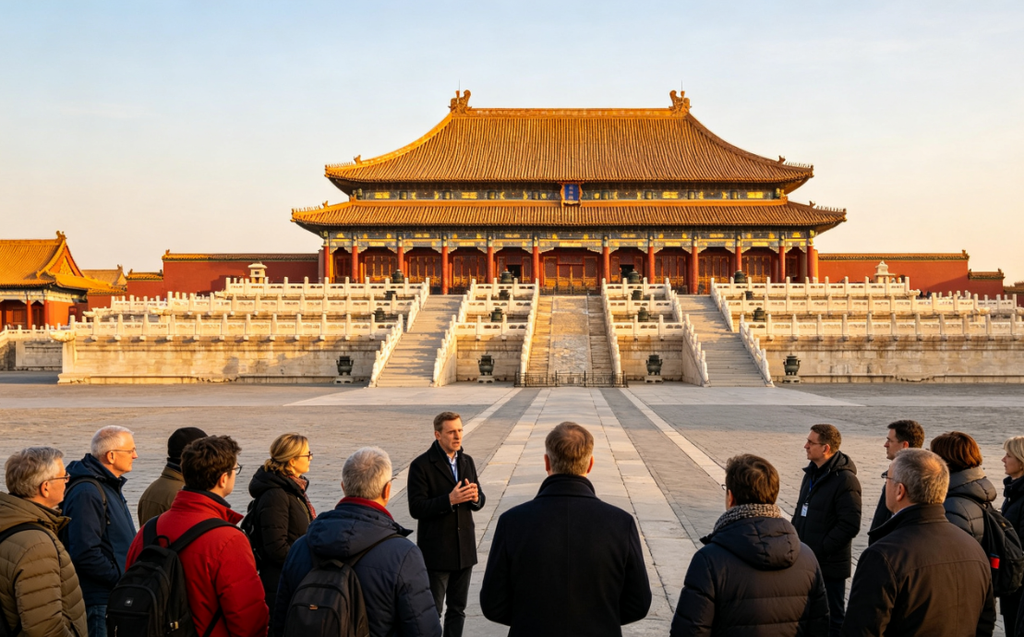
The Three Great Halls are the architectural highlights of the Outer Court. They stand on elevated white marble terraces and are among the most recognisable structures in the entire complex.
Hall of Supreme Harmony (Taihe Dian)
The Hall of Supreme Harmony is the largest and most prestigious building in the Forbidden City.
It was used for major imperial ceremonies, including enthronements, important court celebrations and other occasions requiring the highest level of state formality.
The hall’s elevated position is essential to its meaning. Visitors approach it through a broad stone terrace, with the building rising above the surrounding courtyards.
Look carefully at the following details:
- The enormous white marble platform beneath the hall
- The monumental staircase and carved stone decorations
- The yellow glazed roof tiles
- The richly decorated wooden columns and interior
- The ceremonial throne at the centre of the hall
The building’s scale was not designed simply to impress. It expressed the emperor’s position at the top of the political and ritual hierarchy.
Hall of Central Harmony (Zhonghe Dian)
Located between the other two great halls, the Hall of Central Harmony served as a smaller transitional space.
The emperor used it to prepare before important ceremonies and, on certain occasions, to receive officials or review ceremonial arrangements.
Its more compact design contrasts with the monumental Hall of Supreme Harmony.
The hall demonstrates that the palace’s architecture was organised around practical ceremonial functions, not just visual grandeur.
Hall of Preserving Harmony (Baohe Dian)
The Hall of Preserving Harmony is the northernmost of the Three Great Halls.
It was used for imperial banquets and other important ceremonies. During the Qing dynasty, it also became associated with the final stage of the highest-level imperial civil service examinations.
These examinations were central to the traditional Chinese system of selecting government officials. Their association with this hall connects the architecture of the Forbidden City with the broader history of education, bureaucracy and government in imperial China.
The three halls therefore represent different parts of the imperial ceremonial system rather than three interchangeable palace buildings.
4. The Three Rear Palaces: Where the Imperial Household Lived
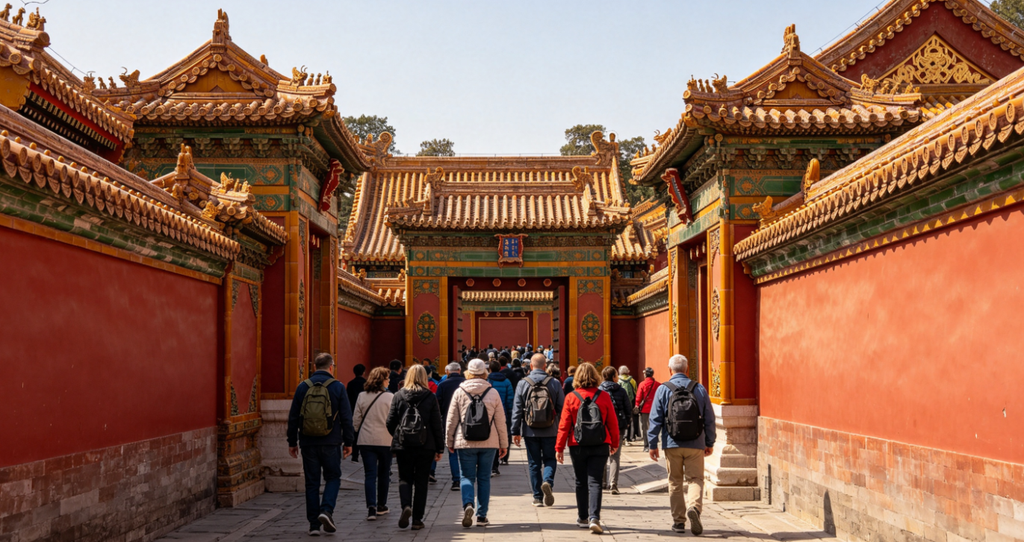
After the Outer Court, the Inner Court offers a different perspective on imperial life.
Palace of Heavenly Purity (Qianqing Gong)
The Palace of Heavenly Purity was an important imperial residence, particularly during the Ming dynasty and the early Qing period.
During the Qing dynasty, its role changed as the emperor’s living and working arrangements evolved. It became an important space for receiving officials, handling administrative matters and conducting court business.
One of its most recognisable features is the throne area, which reflects the palace’s continued political significance even as its residential function changed.
The palace also illustrates an important point about the Forbidden City: buildings did not always retain the same purpose throughout the Ming and Qing dynasties.
Hall of Union (Jiaotai Dian)
The Hall of Union stands between the Palace of Heavenly Purity and the Palace of Earthly Tranquility.
Its position reflects its symbolic role in connecting the emperor and empress within the traditional imperial order.
The hall contains ceremonial objects and furnishings associated with imperial authority. Its architectural position also forms part of the carefully arranged sequence of the Three Rear Palaces.
Palace of Earthly Tranquility (Kunning Gong)
The Palace of Earthly Tranquility was traditionally associated with the empress.
Its use changed during the Qing dynasty, when parts of the building were adapted for Manchu religious and ceremonial practices.
This is a useful reminder that the Qing court did not simply reproduce every Ming custom. The Manchu rulers maintained aspects of their own cultural and religious traditions while governing from the former Ming imperial palace.
5. The Eastern and Western Six Palaces: Life Behind the Ceremonial Halls
The Eastern and Western Six Palaces are among the most interesting areas for visitors who want to understand the human side of imperial history.
These residential courtyards accommodated empresses, imperial consorts and other members of the imperial household.
Although their overall architectural arrangement is similar, individual courtyards developed different histories and associations.
Some became connected with particular empresses, imperial consorts or important events in the Qing court.
The buildings are generally smaller than the major ceremonial halls, but their details can reveal a great deal about palace life:
- Courtyard layouts and enclosed entrances
- Decorative screens and interior furnishings
- Traditional roof structures and painted beams
- The relationship between private rooms and shared courtyards
- The separation of different ranks within the imperial household
For visitors interested in the stories of imperial women, these palaces provide a more personal perspective than the grand ceremonial buildings.
They also help explain why the Inner Court was not simply a residential neighbourhood. It was a carefully organised social environment in which rank, family relationships and access to the emperor influenced everyday life.
6. The Imperial Garden: A Different Side of Palace Architecture
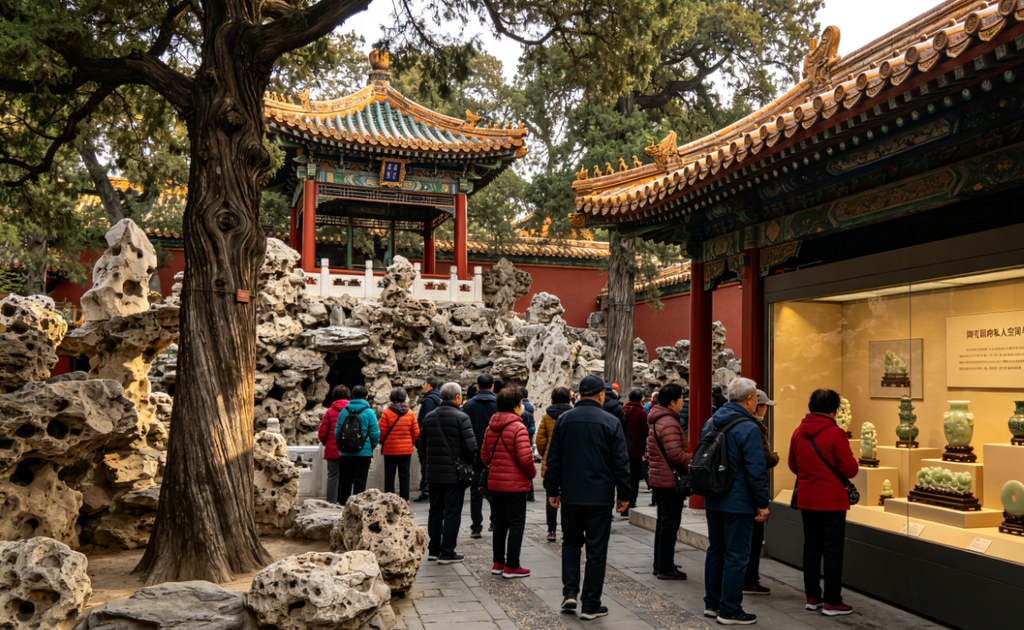
At the northern end of the central route is the Imperial Garden, located behind the Three Rear Palaces.
Unlike the monumental courtyards of the Outer Court, the garden is a more intimate environment.
It contains ancient trees, rockeries, pavilions, decorative walls and carefully arranged planting areas.
Traditional Chinese gardens were designed to create visual variety within a limited space. Instead of relying on enormous open lawns, they used rocks, trees, water features, architectural structures and framed views to create a changing sequence of scenes.
The Imperial Garden served as a recreational and leisure space for the imperial household.
Its layout also provides a useful contrast with the formal geometry of the main palace axis. The Forbidden City was not made up entirely of rigid ceremonial spaces; it also contained areas designed for rest, contemplation and private enjoyment.
When visiting, pay attention to how the pavilions and rockeries are arranged. The garden’s design becomes easier to appreciate when viewed as a carefully composed landscape rather than simply a green area at the end of the palace.
7. The Treasure Gallery: Imperial Objects and Decorative Arts
The Treasure Gallery is located in the northeastern part of the Forbidden City, within the Palace of Tranquil Longevity area.
It offers a different experience from the main palace route because its focus is on objects rather than monumental architecture.
Depending on the current exhibition arrangement, visitors may encounter:
- Gold and silver objects
- Jade carvings
- Imperial ornaments
- Decorative objects used by the Qing court
- Fine examples of traditional craftsmanship
- Objects associated with imperial ceremonies and court life
These collections help explain the material culture of the imperial household.
A jade object, for example, is not simply a decorative item. Its material, carving style and symbolic meaning can reveal how traditional Chinese culture associated precious materials with status, longevity, virtue and authority.
The Treasure Gallery is particularly worthwhile for visitors interested in Chinese decorative arts and imperial craftsmanship.
Admission requires a separate ticket from the main Palace Museum entrance ticket.
8. The Clock Gallery: European Technology Inside the Imperial Palace
The Clock Gallery is another worthwhile addition for visitors with an interest in technology and international cultural exchange.
The Qing imperial court collected elaborate mechanical clocks, including objects produced in Europe.
These clocks demonstrate how foreign technologies and artistic styles entered the imperial environment through trade, diplomacy and the activities of specialist craftsmen.
Some examples combine mechanical movement with elaborate decorative features, including moving figures, musical elements and intricate ornamentation.
The collection provides an interesting contrast with the traditional Chinese architecture surrounding it.
It also challenges the idea that the Forbidden City was culturally isolated. The imperial court maintained contact with overseas craftsmen, merchants and diplomatic representatives, and foreign objects became part of the material culture of the palace.
The Clock Gallery requires a separate ticket. Visitors should check current exhibition access and opening arrangements before visiting.
9. Architecture and Symbolism: Details Most Visitors Walk Past
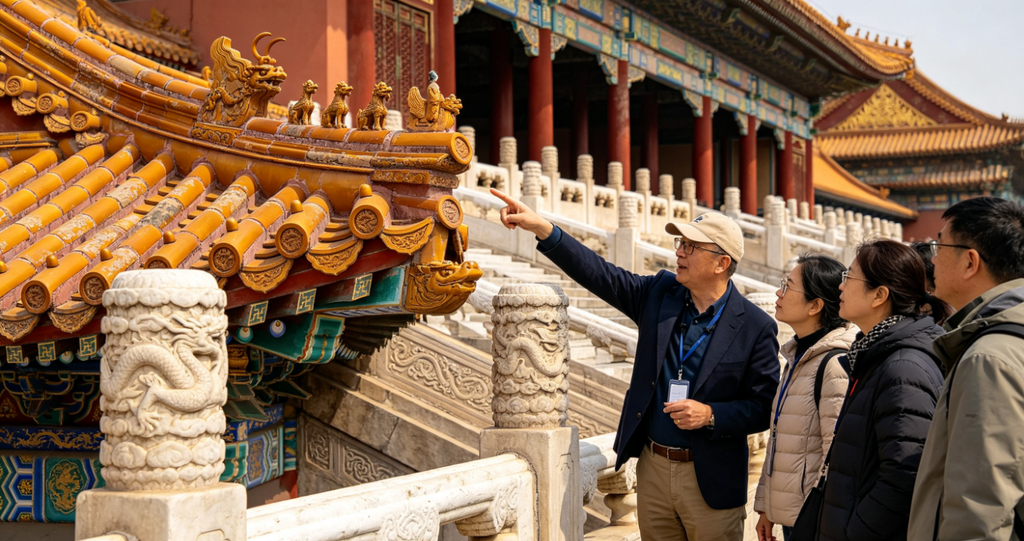
One of the best ways to deepen a visit is to stop looking only at the largest buildings.
The Forbidden City’s architecture contains a visual language of rank, authority and cosmological ideas. Many details that appear decorative were also intended to communicate meaning.
Yellow Roof Tiles and Imperial Status
Yellow glazed roof tiles are among the most recognisable features of the Forbidden City.
Yellow was strongly associated with imperial authority, and the use of yellow roof tiles on major palace buildings reflected the emperor’s privileged status.
Not every building in the complex had exactly the same architectural treatment. Roof forms, colours and decorative details varied according to the function and rank of the structure.
Looking at these differences helps visitors understand the palace as a hierarchy of spaces.
Roof Ridges and Decorative Animals
Look along the roof ridges of important buildings and you will notice rows of small decorative figures.
These are commonly known as roof ridge animals or decorative roof figures.
Their arrangement and number were associated with the status and importance of a building. The figures also had protective and auspicious associations in traditional Chinese architectural culture.
The Hall of Supreme Harmony has the most elaborate arrangement, reflecting its exceptional ceremonial status.
White Marble Terraces and Stone Carvings
The large white marble platforms beneath the major halls are not merely foundations.
They elevate the buildings, create a clear visual hierarchy and provide an impressive ceremonial approach.
The carved stonework, balustrades and staircases also demonstrate the technical skill of traditional Chinese stone carving.
Look for the large carved marble slabs along the central stairways. Their dragon imagery connects imperial authority with traditional Chinese symbolism.
Symmetry and the Central Axis
The central axis is one of the most important principles of the Forbidden City’s design.
Major buildings are arranged along a north-south line, while many supporting structures are positioned symmetrically on either side.
This arrangement reflects traditional Chinese ideas about order, balance and political hierarchy.
The central axis also connects the Forbidden City with the wider historical layout of Beijing, where imperial architecture and urban planning were closely related.
10. How the Ming and Qing Dynasties Changed the Palace
The Forbidden City is often presented as if it were a single, unchanging creation from the early fifteenth century.
In reality, its history includes centuries of adaptation, rebuilding and changes in how buildings were used.
The Ming Dynasty: Establishing the Imperial Palace
Construction began under the Yongle emperor in 1406, and the palace was completed in 1420.
The complex established the physical setting for Ming imperial government in Beijing.
Its architecture reflected the political ideals of the dynasty: centralised authority, formal court rituals and a carefully ordered imperial household.
The Qing Dynasty: Adapting an Existing Palace
The Qing dynasty entered Beijing in 1644 and adopted the Forbidden City as its principal imperial residence.
The new rulers retained much of the existing palace structure but adapted some buildings and spaces to reflect their own administrative practices, household customs and religious traditions.
The changes were not simply cosmetic. The functions of particular buildings and courtyards evolved as imperial life changed.
This is one reason why the Forbidden City should be understood as a living historical complex rather than a perfectly preserved snapshot of the Ming dynasty.
The End of Imperial Rule
The Qing dynasty ended in 1911, bringing the imperial system to a close.
The palace subsequently entered a new historical phase. The establishment of the Palace Museum in 1925 made the former imperial complex accessible as a public cultural institution.
Today, its role is no longer to house an emperor or administer an empire. It is to preserve, research and interpret the architectural and cultural heritage of China’s imperial past.
11. What Is the Difference Between the Forbidden City and the Palace Museum?
These two names are often used interchangeably, but they refer to different aspects of the same place.
The Forbidden City refers primarily to the historic imperial palace complex, including its buildings, courtyards, walls and gardens.
The Palace Museum is the institution established in 1925 to preserve and manage the former imperial palace and its extensive collections.
In practical terms, visitors enter the Palace Museum to explore the historic complex known as the Forbidden City.
This distinction matters because the museum experience includes more than walking through the former imperial residences. It also includes exhibitions, collections, conservation work and educational programmes.
12. How Much Time Should You Spend Inside the Forbidden City?
The amount of time required depends on your interests and whether you plan to visit the additional galleries.
A useful way to plan is to divide the visit into three levels.
Two to Three Hours: The Main Palace Highlights
This is a relatively short visit.
Focus on:
- Meridian Gate
- Gate of Supreme Harmony
- The Three Great Halls
- The Three Rear Palaces
- Imperial Garden
This route introduces the main architectural layout and the most important imperial spaces.
However, it leaves limited time for the side courtyards and additional exhibitions.
Four to Five Hours: A More Complete Visit
For many first-time visitors, this is a better balance.
In addition to the main route, allow time for:
- Selected Eastern or Western Six Palaces
- Treasure Gallery
- Clock Gallery
- Smaller courtyards and architectural details
This gives you a much better understanding of both the ceremonial and residential sides of the palace.
A Longer Visit: For History and Art Enthusiasts
Visitors with a strong interest in Chinese history, architecture or decorative arts may want to spend most of a day exploring the complex.
Allow additional time for exhibitions, individual collections and less crowded sections of the palace.
However, more time does not automatically mean a better experience. The Forbidden City is enormous, and walking through every accessible courtyard can become tiring. It is usually more rewarding to explore selected areas carefully than to try to see everything.
If you are deciding how much sightseeing to combine with the palace, our guide to how many attractions can you visit in Beijing in one day explains why travel time and realistic visiting durations matter.
13. Forbidden City Tickets, Opening Hours and Booking Rules
The Palace Museum operates a real-name reservation system and does not sell same-day admission tickets.
The following information reflects the official published ticket and visitor arrangements available at the time of writing. Policies, prices and temporary access restrictions can change, so check the official website before your visit.
Main Admission Prices
The standard admission prices are:
- Peak season, April 1 to October 31: CNY 60
- Low season, November 1 to March 31: CNY 40
- Treasure Gallery: CNY 10
- Gallery of Clocks: CNY 10
The two galleries require separate tickets.
Opening Hours
Peak season: April 1 to October 31
- Opening time: 8:30
- Last admission: 16:00
- Closing time: 17:00
Low season: November 1 to March 31
- Opening time: 8:30
- Last admission: 15:30
- Closing time: 16:30
The Palace Museum is normally closed on Mondays, except when a statutory public holiday changes the schedule.
The Treasure Gallery and Clock Gallery may have earlier last-entry times than the main museum. Check the official visitor information for the exact date.
How to Book Tickets
The official Palace Museum booking system generally releases tickets seven days before the visit, starting at 20:00 Beijing time.
Foreign visitors can use their passport details for booking through the official English website or the official Palace Museum booking channel.
Important points:
- Book through official channels rather than relying on unofficial ticket sellers.
- Use the same identification document for booking and entry.
- Bring the original valid passport used for the reservation.
- Check the selected admission date and entry session carefully.
- Review the official notices for temporary closures or exhibition restrictions.
Official visitor information: https://intl.dpm.org.cn/visit
Official ticket booking: https://www.dpm.org.cn/subject_booking/
Entry and Exit Arrangements
The standard visitor route is one-way.
Visitors enter through the Meridian Gate on the southern side and leave through the Gate of Divine Prowess in the north or the East Prosperity Gate.
You should not plan to return to the southern entrance after completing the visit.
Because access arrangements can change, check the latest official route information before travelling.
14. What You Should Know Before Visiting
A little preparation can make the experience significantly more comfortable.
Wear comfortable walking shoes. The palace covers a large area, and much of the visit involves walking across stone courtyards and paved paths.
Bring your original passport. A booking confirmation alone may not be sufficient for identity verification.
Allow time for security checks. Entry procedures and queues can take longer during holidays and busy travel periods.
Do not assume every building is open. Restoration, conservation and exhibition changes may temporarily restrict access to particular halls or courtyards.
Check temporary exhibition information. Some of the most interesting museum displays are not part of the main architectural route.
Avoid trying to see every courtyard. Choose the buildings and collections that match your interests.
Pay attention to the route direction. The palace is designed for a south-to-north visit, so plan your time with the one-way arrangement in mind.
15. Is an English-Speaking Guide Worth It?
The Forbidden City can certainly be visited independently. Official maps, information boards and audio-guide services help visitors understand the basic route and identify the main buildings.
However, there is a difference between knowing a building’s name and understanding why it was built in a particular way.
A Forbidden City tour with an English-speaking guide can add value in several specific areas.
Explaining architectural hierarchy: A guide can show how roof decorations, platform heights, building positions and ceremonial entrances reflected different levels of imperial status.
Connecting buildings with historical events: The Three Great Halls, the Three Rear Palaces and the residential courtyards make more sense when their changing functions during the Ming and Qing dynasties are explained.
Understanding imperial daily life: The residential areas provide opportunities to discuss the emperor, empress, imperial consorts, court officials and the structure of the imperial household.
Choosing the right areas to explore: Instead of trying to enter every courtyard, visitors can focus on the buildings and collections that best match their interests.
A guide is particularly useful for first-time visitors who want historical context rather than simply a route through the palace.
If you are comfortable exploring independently and mainly want to admire the architecture, an audio guide and a well-planned route may be enough.
16. When Is a Private Forbidden City Tour Worth It?
A private visit is not necessary for everyone, but it can make a significant difference when the palace is one of the main cultural experiences of your trip.
It is particularly worth considering when:
- You are visiting Beijing for the first time and want to understand imperial history.
- You are interested in Chinese architecture, symbolism and traditional culture.
- You want explanations in English rather than relying entirely on written signs.
- You are travelling with children or older family members and need a more flexible pace.
- You have limited time and want to focus on the most meaningful buildings.
- You want to understand how the Forbidden City connects with Beijing’s wider imperial history.
The main advantage is not simply moving faster. It is being able to interpret the palace as a connected historical and architectural system.
For travellers who already know the history or prefer independent exploration, visiting without a guide is also a perfectly reasonable choice.
17. Frequently Asked Questions About the Forbidden City
How many buildings are inside the Forbidden City?
The complex contains a large number of palace halls, gates, courtyards and other structures. The commonly quoted room count is approximately 8,700 based on an earlier survey, while UNESCO describes the complex as containing nearly 10,000 rooms. These figures use different counting conventions and should not be treated as an exact current inventory.
Why is the Forbidden City called the Forbidden City?
The name reflects the palace’s restricted access during the imperial period. It was the residence and working environment of the emperor and imperial household, and ordinary people could not freely enter its inner areas.
How old is the Forbidden City?
Construction began in 1406 and the complex was completed in 1420. It is more than 600 years old.
How many emperors lived in the Forbidden City?
The palace served as the residence of 14 Ming emperors and 10 Qing emperors, making 24 emperors in total.
Is the Forbidden City the same as the Palace Museum?
The Forbidden City is the historic imperial palace complex. The Palace Museum is the institution established in 1925 to preserve and manage the former palace and its collections.
Can foreigners book Forbidden City tickets with a passport?
Yes. Foreign visitors can use their passport details through the official booking channels. Bring the original passport used for the reservation.
Can I buy Forbidden City tickets at the entrance?
No. The Palace Museum does not sell same-day admission tickets. Visitors must make a reservation in advance through official channels.
Are the Treasure Gallery and Clock Gallery included in the admission ticket?
No. Both galleries require separate tickets, currently listed at CNY 10 each.
How long does it take to visit the Forbidden City?
Two to three hours is enough for a focused visit along the main route. Four to five hours provides more time for the side palaces and additional galleries. Visitors with a strong interest in history and art may want longer.
Which entrance should I use?
Visitors normally enter through the Meridian Gate on the southern side of the palace. The main visitor route is one-way, with exits on the northern and eastern sides.
Is the Forbidden City closed on Mondays?
It is normally closed on Mondays, except when statutory public holidays affect the schedule. Always check the official calendar before booking.
Is a guide necessary for the Forbidden City?
No. Independent visitors can use the official visitor information and audio-guide services. A knowledgeable English-speaking guide is useful if you want a deeper explanation of the palace’s architecture, ceremonies and imperial history.
Final Thoughts: What Makes the Forbidden City Worth Visiting?
The Forbidden City is not simply a collection of beautiful imperial buildings. Its architecture reveals how power, ceremony, family life and traditional Chinese beliefs were organised around the emperor.
The Three Great Halls explain the public face of imperial authority. The Three Rear Palaces and Six Palaces reveal the structure of the imperial household. The Imperial Garden offers a more personal side of palace life, while the Treasure Gallery and Clock Gallery demonstrate the artistic achievements and international connections of the Qing court.
For a first visit, focus on the central axis, then add the residential areas and galleries that interest you most. Allow enough time to look closely at the architecture instead of rushing from one famous hall to another.
A private Forbidden City tour can help turn those buildings into a connected story of Chinese imperial history. Whether you explore independently or with a guide, the most rewarding visit is one that helps you understand not only what you are seeing, but why the Forbidden City was designed this way.