
Summer Palace Beijing: What to See in China’s Famous Imperial Garden
The Summer Palace in Beijing is one of China’s most important surviving imperial gardens, combining a vast lake, an artificial mountain, ceremonial halls, Buddhist architecture, covered corridors and carefully arranged landscape views. Its main highlights include Longevity Hill, the Tower of Buddhist Incense, Kunming Lake, the Long Corridor, the Marble Boat and the Seventeen-Arch Bridge. But the real value of the garden lies in how these elements work together: the landscape was designed to express imperial authority, reproduce celebrated scenery from other parts of China and provide a setting for both court life and recreation. A private Summer Palace tour can help visitors understand the history and design behind the scenery rather than simply photograph its famous landmarks.
Covering approximately 3 square kilometres, with water occupying around three quarters of the site, the Summer Palace is too large to appreciate properly through a quick walk. It is not a conventional palace surrounded by a garden. It is an entire landscape composition in which hills, water, buildings, bridges and pathways were planned as connected parts of one imperial environment.
This guide explores the Summer Palace from several perspectives: its historical development, the meaning of its landscape design, the most important buildings, the stories behind its famous landmarks, and the practical decisions that make a visit more rewarding.
1. What Is the Summer Palace and Why Is It Famous?
The Summer Palace, known in Chinese as Yiheyuan, is a large imperial garden in Beijing’s Haidian District. It was originally called Qingyi Yuan, or the Garden of Clear Ripples, and was developed during the Qing dynasty.
Unlike the Forbidden City, which was primarily designed around imperial government and court ceremonies, the Summer Palace combined several functions:
- A royal retreat away from the main imperial palace
- A landscape garden for recreation and seasonal residence
- A setting for imperial ceremonies and court activities
- A place for religious buildings and Buddhist worship
- A venue for receiving visitors and conducting certain political and diplomatic activities
Its design brought together traditional Chinese garden principles, imperial architecture and landscape features inspired by famous scenic areas across China.
The two defining geographical elements are Kunming Lake and Longevity Hill. The lake creates the broad horizontal landscape, while the hill provides a vertical focal point. Buildings, temples, bridges and corridors connect the two.
The Summer Palace is also important because it preserves evidence of China’s imperial garden culture. In 1998, it was added to the UNESCO World Heritage List. Its significance lies not only in the beauty of individual structures but also in the way its landscape, architecture and historical associations form a coherent whole.
2. The History of the Summer Palace: From Qingyi Yuan to Yiheyuan
Understanding the Summer Palace requires looking at three major historical periods: its creation under the Qianlong Emperor, its destruction in the nineteenth century and its reconstruction during the late Qing dynasty.
The Qianlong Emperor and the Creation of Qingyi Yuan
Construction began in 1750 during the reign of the Qianlong Emperor and was completed in 1764.
The project was connected with the emperor’s mother, Empress Dowager Chongqing, and her birthday celebrations. The garden was developed around the existing Wengshan area and its water landscape, transforming it into an elaborate imperial retreat.
The original name, Qingyi Yuan, is often translated as the Garden of Clear Ripples.
The project also formed part of a much wider imperial garden landscape in Beijing’s western suburbs. Rather than treating the garden as an isolated park, the Qing court developed a network of imperial gardens and scenic areas around the western hills.
This reflects an important feature of Qing imperial culture: gardens were not simply decorative spaces. They were places where the emperor could demonstrate cultural refinement, recreate famous landscapes and enjoy an environment associated with the ideal relationship between human beings and nature.
The Destruction of 1860
In 1860, during the Second Opium War, Anglo-French forces entered Beijing and destroyed the original Qingyi Yuan along with other imperial properties in the western suburbs.
The destruction was part of a wider military campaign and marked a devastating chapter in the history of China’s imperial heritage.
Many buildings, decorative objects and landscape features were lost or damaged. The garden that visitors see today is therefore not an untouched survival of the Qianlong era.
This distinction matters. Some of the current structures preserve earlier design traditions, while others were reconstructed or altered during the late Qing period.
Reconstruction Under Empress Dowager Cixi
Reconstruction began in the late nineteenth century. The Qing government restored and expanded parts of the garden, and it was renamed Yiheyuan in 1888.
The rebuilt garden became closely associated with Empress Dowager Cixi, who used it as a residence and a setting for court activities.
Cixi’s presence is central to the modern history of the Summer Palace. Several important buildings are connected with her daily life, including the Hall of Happiness and Longevity, while the Garden of Virtue and Harmony contains a theatre associated with imperial performances.
The reconstruction took place during a period of serious political and financial pressure on the Qing dynasty. It is therefore part of a larger story about the late imperial court, the weakening of the dynasty and the changing role of the imperial family.
From Imperial Garden to Public Heritage Site
After the fall of the Qing dynasty in 1911, the Summer Palace gradually moved away from its former role as an exclusive imperial retreat.
It later became a major public heritage attraction and was included on the UNESCO World Heritage List in 1998.
Today, its historical importance comes from the combination of surviving Qing architecture, reconstructed structures, traditional garden design and the stories of the imperial family that once used it.
3. How the Summer Palace Was Designed: The Relationship Between Mountain and Water
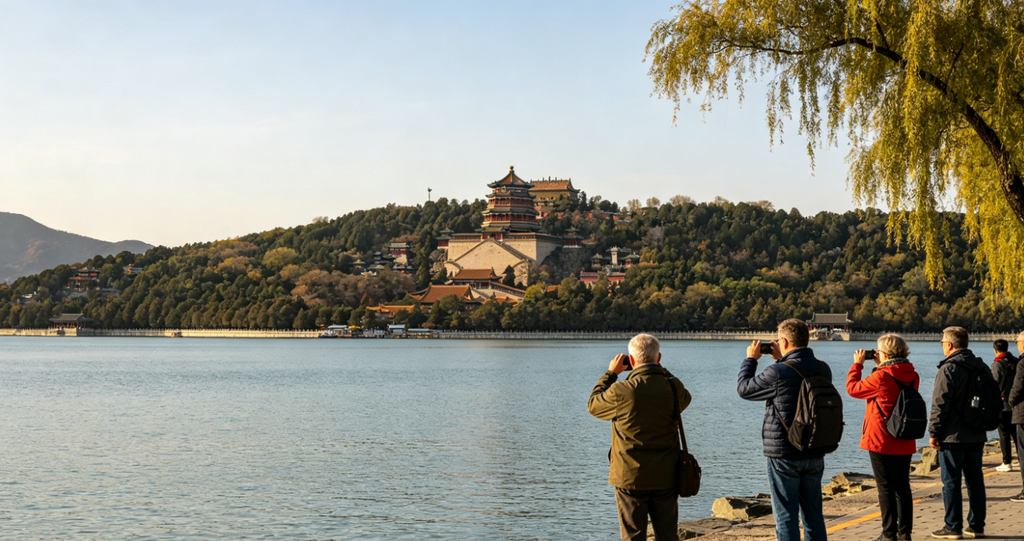
The most important principle behind the Summer Palace is the relationship between Longevity Hill and Kunming Lake.
A visitor who focuses only on individual buildings may miss the central idea of the entire garden: the landscape itself is the main composition, while architecture is used to frame and enrich it.
Longevity Hill: The Vertical Centre
Longevity Hill rises along the northern side of Kunming Lake.
Its slopes contain a sequence of temples, halls, pavilions and covered pathways. The most prominent structure is the Tower of Buddhist Incense, which occupies a commanding position on the southern slope.
The hill provides a strong vertical element that balances the broad surface of the lake.
It also creates changing views. From different positions along the lake, the tower appears at different heights and distances, while the surrounding buildings form a layered architectural composition.
Kunming Lake: The Open Landscape
Kunming Lake occupies roughly three quarters of the Summer Palace’s total area.
It is not merely a body of water placed beside the palace. Its shape, islands, bridges, causeways and shorelines were designed to create a sequence of scenic experiences.
The lake provides open views across the garden and makes the buildings on Longevity Hill appear more impressive.
It also creates a practical separation between different areas of the garden, allowing visitors to experience the site from the shore, from bridges and from boats.
The Influence of West Lake in Hangzhou
The Summer Palace draws inspiration from famous Chinese landscapes, particularly West Lake in Hangzhou.
This influence can be seen in the use of islands, causeways, bridges and carefully framed views.
The West Causeway is especially important. Its arrangement of bridges and tree-lined paths recalls the scenic character of Hangzhou’s West Lake.
However, the Summer Palace is not simply a copy of West Lake. It combines landscape references with imperial buildings, religious structures and the specific geography of Beijing.
The result is a garden that uses familiar Chinese landscape ideas on a much larger imperial scale.
Why the Garden Feels Different From a Normal Park
Traditional Chinese garden design often creates a sequence of changing scenes rather than presenting everything at once.
A visitor may pass through a narrow corridor, emerge beside a lake, approach a bridge and then discover a pavilion framed by trees.
The view changes with movement.
This is one reason the Summer Palace rewards slow exploration. The garden is designed to be experienced from multiple positions, not understood from a single viewpoint.
4. Longevity Hill: The Most Important Buildings on the Northern Shore
Longevity Hill contains some of the Summer Palace’s most recognisable architecture.
Its southern slope is particularly important because it forms a major architectural group facing Kunming Lake.
Tower of Buddhist Incense
The Tower of Buddhist Incense, known as Foxiang Ge, is the visual centre of the Summer Palace.
It stands on a high stone platform on Longevity Hill and is one of the most recognisable structures in Beijing’s imperial garden landscape.
The tower’s position is deliberate. From the lake, it appears above the surrounding buildings and becomes the main focal point of the northern shore.
Its elevated location also provides broad views across Kunming Lake and the surrounding garden.
The structure is associated with Buddhist worship, but its significance is also architectural. It links the hill’s religious buildings with the overall landscape composition.
The tower was destroyed during the nineteenth-century destruction of the original garden and later reconstructed.
For visitors, it is worth understanding the relationship between the tower, the Hall of Dispelling Clouds below it and the surrounding buildings. They form a connected architectural sequence rather than separate attractions.
Hall of Dispelling Clouds
The Hall of Dispelling Clouds, Paiyun Dian, is located below the Tower of Buddhist Incense.
It forms part of the central architectural axis on the southern slope of Longevity Hill.
The hall is associated with important imperial celebrations and ceremonies, particularly those connected with Empress Dowager Cixi.
Its location makes it an important transitional building. Visitors approaching from the lake move from the lower garden landscape toward the more elevated religious architecture above.
The hall’s decorative details, roof structure and relationship with the surrounding terraces show how ceremonial architecture was integrated into the garden.
Sea of Wisdom Temple
At the upper part of Longevity Hill is the Sea of Wisdom Temple, Zhihuihai.
It is a Buddhist structure with a distinctive decorative exterior, including glazed architectural elements.
Unlike the large halls lower on the hill, its position makes it part of the summit experience.
The building demonstrates the religious dimension of the Summer Palace and the importance of Buddhist architecture within Qing imperial gardens.
What to Look for on Longevity Hill
Rather than simply climbing to the top, pay attention to how the buildings are arranged vertically.
Notice how the Hall of Dispelling Clouds, the Tower of Buddhist Incense and the Sea of Wisdom Temple form a layered composition.
From lower positions, the tower dominates the view. As you climb, the relationship between the structures changes, and the lake gradually appears below you.
This movement is part of the original landscape experience.
5. The Long Corridor: A Painted Gallery Along Kunming Lake
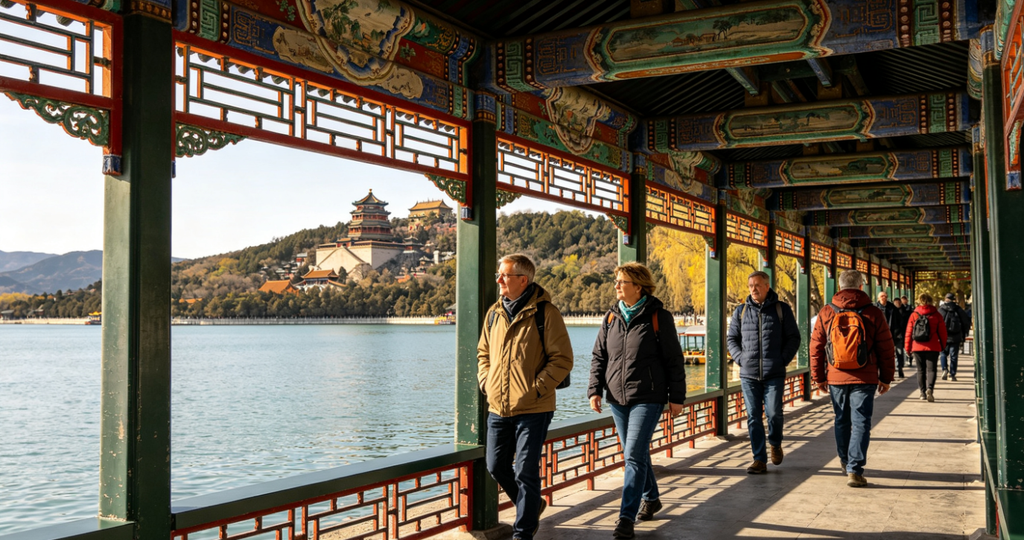
The Long Corridor is one of the Summer Palace’s most famous features.
It extends for approximately 728 metres along the northern shore of Kunming Lake, connecting different areas of the garden beneath a continuous covered roof.
Its importance goes beyond its length.
Why Was the Long Corridor Built?
The corridor provided a sheltered route along the lakeside, allowing members of the imperial household to move through the garden protected from strong sun and rain.
It also created a controlled sequence of views.
Instead of walking directly across an open lakeside area, visitors move through a covered structure where framed openings reveal changing views of the lake, hill and surrounding buildings.
This is a classic feature of traditional Chinese garden design: architecture guides the visitor’s movement while controlling what can be seen.
The Painted Scenes
The corridor is famous for its painted beams and decorative panels.
The paintings include landscapes, flowers, birds, figures and scenes drawn from Chinese literature and historical stories.
They turn the corridor into a kind of open-air illustrated gallery.
The paintings are not merely decorative additions. They connect the garden with Chinese literary and artistic traditions.
As you walk, look at the different subjects rather than treating the corridor as one continuous structure. The paintings offer small visual stories that reward closer attention.
The Four Pavilions
The Long Corridor contains four major pavilions along its length.
These structures divide the long walkway into sections and provide visual pauses along the route.
Their arrangement also helps connect the corridor with the wider landscape.
For visitors, the pavilions are useful places to stop and look across the lake rather than simply walking the entire corridor without interruption.
6. Kunming Lake: The Landscape That Holds the Garden Together
Kunming Lake is the largest visual element of the Summer Palace.
Its open water, islands, bridges and causeways create the space in which the garden’s architecture can be appreciated.
Seventeen-Arch Bridge
The Seventeen-Arch Bridge connects the eastern shore of Kunming Lake with South Lake Island.
It is one of the most recognisable structures in the garden.
The bridge’s multiple arches create a strong horizontal line across the water. Its stone balustrades are decorated with carved lions, each with individual details.
The bridge is especially interesting when viewed from a distance. From the shore, it appears as a long stone structure connecting the island with the main garden.
When walking across it, visitors can examine the stonework and the different lion carvings.
The bridge also demonstrates how practical structures in an imperial garden were designed to serve an aesthetic purpose.
South Lake Island
South Lake Island is connected to the eastern shore by the Seventeen-Arch Bridge.
It contains traditional buildings and offers a different perspective on the surrounding lake.
From the island, visitors can look back toward the bridge and the eastern side of the garden.
It is also a useful place to understand how islands were used in Chinese garden design. Rather than being isolated pieces of land, they form part of a larger composition of water, buildings and distant views.
The West Causeway
The West Causeway runs through the western part of Kunming Lake.
Its arrangement of bridges and tree-lined paths was inspired by the landscape traditions associated with West Lake in Hangzhou.
The causeway offers a quieter experience than the main eastern lakeside area.
It is particularly attractive when the trees and seasonal planting are at their best.
The six bridges along the causeway have different forms and visual characteristics, creating a sequence of changing scenes as visitors walk along the water.
The Bronze Ox
Near the eastern side of Kunming Lake stands a bronze ox.
The sculpture is associated with traditional beliefs about controlling floods and protecting the water environment.
Its presence also reflects the historical importance of water management in imperial gardens.
For visitors, it is a small but interesting detail that connects the garden’s decorative features with traditional Chinese ideas about water, protection and auspicious symbolism.
7. The Marble Boat: A Famous Landmark With a Complex History
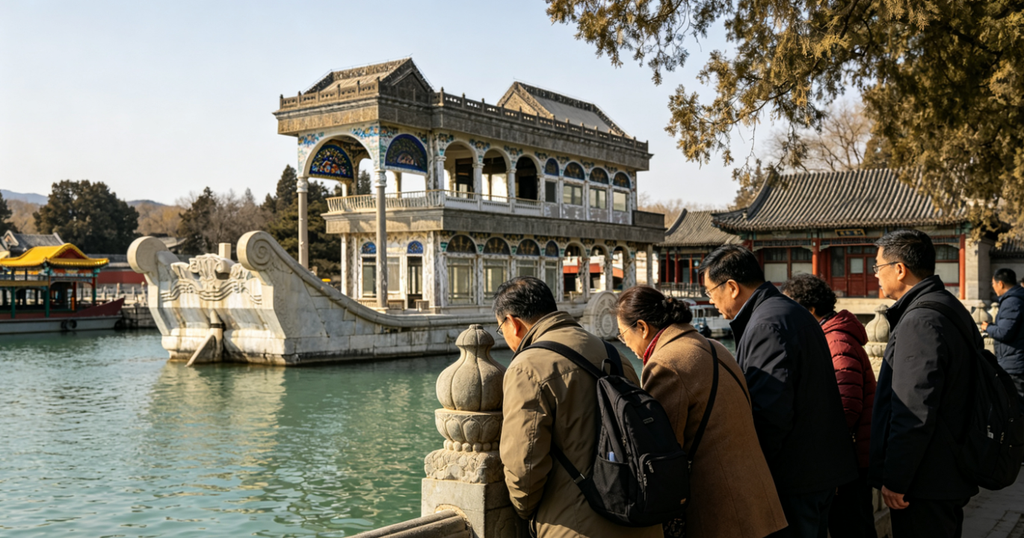
The Marble Boat, Shifang, stands at the western end of the Long Corridor.
It is one of the Summer Palace’s most photographed structures, but it is also one of the easiest to misunderstand.
Despite its name, it is not a functioning boat made entirely from marble. It is a decorative lakeside pavilion built in the form of a boat, with a stone base and an architectural superstructure.
The original structure was constructed in 1755 during the Qianlong period. It was destroyed in 1860 and later rebuilt during the reconstruction of the Summer Palace.
Why Build a Boat That Cannot Move?
The Marble Boat is often interpreted through the traditional Chinese metaphor of the ruler and the state.
In Chinese political thought, water can represent the people, while a boat represents the ruler or government. Water can support a boat, but it can also overturn it.
This interpretation connects the structure with ideas about political legitimacy and the responsibilities of rulers.
However, the pavilion should not be reduced to a single symbolic explanation. It was also a decorative structure designed to create a scenic endpoint along the lake.
Its location is important. The Long Corridor leads visitors toward the western shore, where the boat becomes a distinctive architectural feature against the water.
What Should You Notice?
Look at the contrast between the stone base and the decorative upper structure.
The windows and architectural details give the pavilion the appearance of a European-style pleasure boat, while its setting and construction remain part of the Chinese imperial garden tradition.
The Marble Boat is therefore an interesting example of how different visual influences could be incorporated into the design of a Qing imperial garden.
8. The Palace Area: Where the Imperial Family Worked and Lived
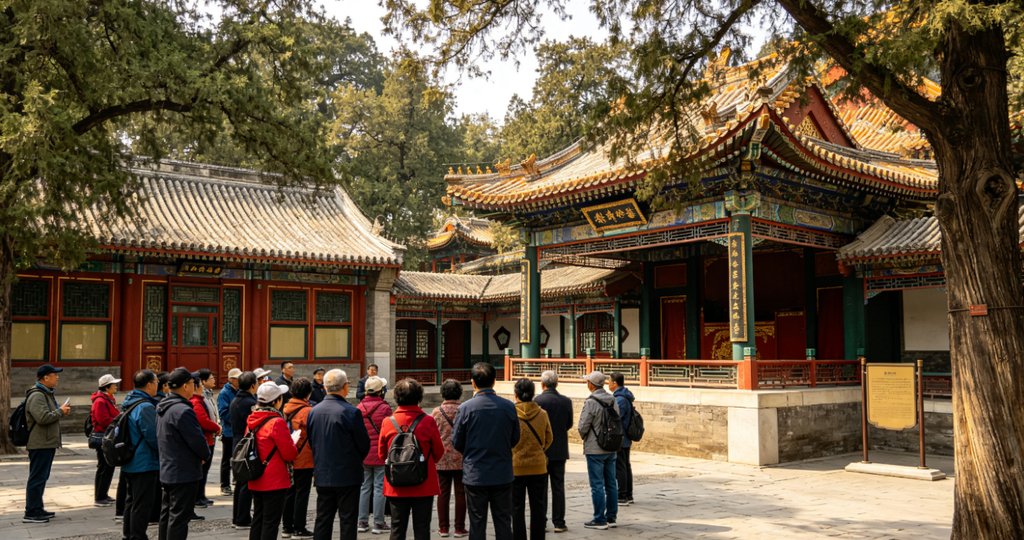
The Summer Palace was not only a recreational garden.
Its palace area contained buildings used for imperial residence, administration, ceremonies and everyday court activities.
This area is particularly important for understanding the late Qing period.
Hall of Benevolence and Longevity
The Hall of Benevolence and Longevity, Renshou Dian, is one of the principal buildings in the palace area.
It was used for court activities and for receiving officials.
Its function demonstrates that the Summer Palace could serve as more than a seasonal retreat. It was also a place where the emperor and empress dowager could conduct important business.
The hall’s position near the main entrance to the palace area makes it an important starting point for understanding the administrative side of the garden.
Hall of Happiness and Longevity
The Hall of Happiness and Longevity, Leshou Tang, was closely associated with Empress Dowager Cixi.
It served as an important residential building during the late Qing period.
Its interior arrangements and surrounding garden spaces offer insight into the daily life of the imperial household.
The building is particularly useful for visitors interested in Cixi’s role in the history of the Summer Palace.
Hall of Jade Ripples
The Hall of Jade Ripples, Yulantang, is another historically significant building.
It is associated with Emperor Guangxu, who was confined within the palace area after the failure of the Hundred Days’ Reform in 1898 and the political events that followed.
This connection makes the building important beyond its architectural appearance.
It represents the political tensions of the late Qing court and the complicated relationship between the Guangxu Emperor and Empress Dowager Cixi.
When visiting, it is worth remembering that the Summer Palace was not simply a peaceful retreat. It was also a setting for important political events during the final decades of imperial rule.
9. Garden of Virtue and Harmony: The Imperial Theatre
The Garden of Virtue and Harmony, Dehe Yuan, is one of the most distinctive cultural areas within the Summer Palace.
It contains a large traditional theatre associated with performances for the imperial household.
Why Is the Theatre Important?
The theatre was built for performances of traditional Chinese opera, particularly Peking Opera.
It reflects the importance of performance and entertainment within Qing court culture.
The imperial family did not experience opera in the same way as ordinary audiences. Performances were arranged within a controlled palace environment, with the theatre’s architecture designed to accommodate court spectators.
The Three-Storey Stage
The theatre’s three-storey stage is its most distinctive feature.
The structure allowed performances to use different levels and stage effects.
It also reveals the technical sophistication of traditional Chinese theatre architecture.
The building is worth visiting even for people who are not familiar with Peking Opera because it shows how entertainment was integrated into the imperial household.
The Garden of Virtue and Harmony is also a reminder that the Summer Palace was a place for culture and performance, not only landscape appreciation.
10. Suzhou Street: A Recreated Water Town Inside an Imperial Garden
Suzhou Street is located in the northern part of the Summer Palace.
It was designed to recreate the atmosphere of a traditional southern Chinese commercial street, particularly the canal-side towns associated with Jiangnan.
The street contains shops, waterside buildings, bridges and traditional architectural details.
Why Did an Imperial Garden Need a Shopping Street?
Suzhou Street was not intended to function as an ordinary commercial district.
It was created as part of the imperial garden experience, allowing members of the court to enjoy a carefully controlled recreation of a southern Chinese town.
The setting reflects the Qing imperial interest in famous regional landscapes and cultural traditions.
It also demonstrates how gardens could recreate not only natural scenery but also urban environments.
What Makes It Different From Other Areas?
Unlike the monumental halls and religious structures elsewhere in the Summer Palace, Suzhou Street has a more intimate and commercial atmosphere.
Its waterside buildings and narrow layout create a visual contrast with the broad open space of Kunming Lake.
It is particularly interesting for visitors who want to understand how the imperial court incorporated regional Chinese cultural styles into its gardens.
11. The Summer Palace and the Story of Empress Dowager Cixi
The Summer Palace is closely connected with Empress Dowager Cixi, one of the most influential figures in late Qing history.
Her relationship with the garden is important because it links architecture, personal residence and political history.
Cixi used the Summer Palace as a place to live and receive visitors. Several buildings, including the Hall of Happiness and Longevity and the theatre at Dehe Yuan, are associated with her activities.
The garden was also connected with the political situation of the late Qing dynasty.
Following the Hundred Days’ Reform in 1898, the Guangxu Emperor was placed under restriction, and the Hall of Jade Ripples became associated with this period.
These events show that the Summer Palace was not separate from the political life of the empire.
It was both a private imperial environment and a place where the relationships between the emperor, empress dowager and court officials continued to shape government.
For visitors, this historical background adds another dimension to the garden. Its beautiful scenery should not obscure the political events that took place within its buildings.
12. What Is the Difference Between the Summer Palace and the Old Summer Palace?
The Summer Palace and the Old Summer Palace are two separate historic garden complexes in Beijing.
Their English names are similar, which often causes confusion among international visitors.
The Summer Palace is Yiheyuan, formerly known as Qingyi Yuan. It is centred on Longevity Hill and Kunming Lake and is known for its surviving imperial garden landscape.
The Old Summer Palace is Yuanmingyuan, a separate imperial garden complex that included Yuanmingyuan, Changchun Garden and Qichun Garden.
The Old Summer Palace was famous for its extensive landscape design and its combination of Chinese and European architectural features. It was devastated in 1860, and its remaining ruins are an important part of modern Chinese historical memory.
The key differences are:
- Summer Palace: Known for its large lake, Longevity Hill, imperial buildings, corridors and surviving garden landscape.
- Old Summer Palace: Known for its former imperial garden complex, historic ruins and the destruction of 1860.
- Historical development: Both were connected with the Qing imperial court, but they had different functions, layouts and histories.
- Visitor experience: The Summer Palace is primarily experienced as a preserved and reconstructed landscape garden, while Yuanmingyuan is particularly associated with its ruins and historical memory.
Understanding this distinction helps visitors appreciate both sites without confusing their architectural and historical stories.
13. How to Explore the Summer Palace: Choosing the Right Areas
Because the Summer Palace is so large, the best way to visit is to choose areas based on your interests rather than trying to cover every path.
For First-Time Visitors
Focus on the main landscape and the most recognisable buildings:
- Longevity Hill
- Tower of Buddhist Incense
- Long Corridor
- Marble Boat
- Kunming Lake
- Seventeen-Arch Bridge
These features provide a good introduction to the garden’s overall design.
For Visitors Interested in Imperial History
Spend more time in the palace area.
Prioritise:
- Hall of Benevolence and Longevity
- Hall of Happiness and Longevity
- Hall of Jade Ripples
- Garden of Virtue and Harmony
These buildings provide a clearer picture of the imperial household and the political history of the late Qing period.
For Visitors Interested in Chinese Garden Design
Focus on the relationship between the hill, lake, bridges and causeways.
The West Causeway is especially useful for understanding how the garden uses water, islands and changing viewpoints.
The Long Corridor also demonstrates how architecture can guide movement and frame landscape views.
For Visitors Interested in Art and Culture
The Long Corridor’s paintings, the theatre at Dehe Yuan and the religious architecture on Longevity Hill are particularly worthwhile.
Together, they reveal the relationship between visual art, performance, religion and imperial life.
14. Summer Palace Tickets: Admission Ticket vs Combined Ticket
The Summer Palace uses a two-level ticket system.
Understanding the difference is important because the basic admission ticket does not automatically include every separately ticketed attraction.
Standard Admission Ticket
The standard ticket allows entry to the main garden.
It covers the general park areas, including the outdoor landscape, the lakeside paths, the Long Corridor and the main garden environment.
It is suitable for visitors who mainly want to explore the landscape and enjoy the scenery.
Combined Ticket
The combined ticket includes the standard park admission and entry to the separately ticketed garden attractions.
These include:
- Tower of Buddhist Incense
- Garden of Virtue and Harmony
- Summer Palace Museum
- Suzhou Street
For visitors who want to explore the major buildings and cultural attractions, the combined ticket is generally the more convenient option.
Published Ticket Prices
The official Summer Palace ticket information currently lists:
| Ticket | Peak season (Apr 1–Oct 31) | Off season (Nov 1–Mar 31) |
|---|---|---|
| Standard admission | CNY 30 | CNY 20 |
| Combined ticket | CNY 60 | CNY 50 |
| Garden of Virtue and Harmony | CNY 5 | CNY 5 |
| Tower of Buddhist Incense | CNY 10 | CNY 10 |
| Suzhou Street | CNY 10 | CNY 10 |
| Summer Palace Museum | CNY 20 | CNY 20 |
Prices and ticket arrangements may change. Check the official Summer Palace website before your visit.
Official website: https://www.summerpalace.net.cn/en/
15. Summer Palace Opening Hours and Important Visitor Rules
The main park and the separately ticketed attractions do not necessarily follow the same opening schedule.
This is one of the most important practical details to understand before visiting.
Main Park Opening Hours
Peak season: April 1 to October 31
- Opening: 06:00
- Last entry: 19:00
- Closing: 20:00
Off season: November 1 to March 31
- Opening: 06:30
- Last entry: 18:00
- Closing: 19:00
Main Garden-within-a-Garden Attractions
The Tower of Buddhist Incense, Garden of Virtue and Harmony, Summer Palace Museum and Suzhou Street have separate opening hours.
Peak season:
- Opening: 08:00
- Last entry: 17:30
- Closing: 18:00
Off season:
- Opening: 08:30
- Last entry: 16:30
- Closing: 17:00
These attractions are normally closed on Mondays, except on statutory public holidays.
This means that entering the main park does not guarantee that every building or separately ticketed attraction will be open.
If visiting the Tower of Buddhist Incense, the theatre or Suzhou Street is important to you, plan around their earlier closing times.
16. Are Boat Rides at the Summer Palace Worth It?
A boat ride can add a valuable perspective to the Summer Palace because the garden was designed to be viewed from both land and water.
From the lake, Longevity Hill appears as a broad landscape composition, with the Tower of Buddhist Incense rising above the surrounding buildings.
The Seventeen-Arch Bridge, South Lake Island and the lakeside architecture also look different when approached from the water.
Ferry Routes
The Summer Palace operates several ferry routes during the boating season.
These routes connect different piers around Kunming Lake and can help visitors avoid walking long distances around the shoreline.
However, not every ferry route operates in both directions, and fares vary by route.
Check the current route information at the official website or the pier before boarding.
Electric Boats
Self-drive electric boats are another option.
They allow visitors to explore part of the lake at their own pace, subject to the park’s operating rules and designated areas.
The official website lists six-seat electric boats and hourly rental arrangements. Prices, deposits and operating times should be checked before hiring.
When Is a Boat Ride Most Useful?
A boat ride is particularly worthwhile when:
- You want to see Longevity Hill from the lake.
- You want to reduce the amount of walking around the shoreline.
- The weather is suitable for being on the water.
- You have enough time to enjoy the landscape without rushing.
Boat services are seasonal. The official site lists an operating period generally running from mid-March to mid-November, but exact dates can change.
17. How Much Time Should You Spend at the Summer Palace?
The Summer Palace deserves at least half a day if you want to see its main attractions.
A short visit can cover the famous landmarks, but a longer visit allows you to understand the relationship between the palace buildings and the wider landscape.
Two to Three Hours: A Short Visit
Focus on:
- The main lakeside area
- Long Corridor
- Marble Boat
- Selected views of Longevity Hill
This is suitable for visitors who mainly want to see the famous scenery.
You will not have enough time to explore all the important inner attractions.
Four to Five Hours: A More Complete Visit
Allow time for:
- Longevity Hill
- Tower of Buddhist Incense
- Long Corridor
- Marble Boat
- Kunming Lake
- Seventeen-Arch Bridge
- Selected palace buildings
This is a better choice for first-time visitors who want both architecture and landscape.
A Longer Visit: For Garden and History Enthusiasts
A longer visit allows you to explore the palace area, the theatre, the West Causeway and the lake islands without rushing.
It is especially worthwhile for visitors interested in traditional Chinese garden design, Qing history or photography.
The important point is not to measure the visit only by the number of landmarks covered. The Summer Palace is designed around changing views and spatial relationships, so allowing time to stop and observe is part of the experience.
If you are planning to visit more than one major attraction in Beijing, consider the actual distance between Beijing attractions before deciding how much to fit into the same day.
18. Which Entrance Should You Use?
The Summer Palace has several entrances, and the best choice depends on which area you want to explore first.
East Palace Gate
The East Palace Gate is a useful entrance for visitors who want to begin near the main palace area.
It provides convenient access to the Hall of Benevolence and Longevity and other buildings associated with the imperial household.
It is a good choice if your main interest is the history of the late Qing court.
North Palace Gate
The North Palace Gate provides access to the northern part of the garden and the area around Suzhou Street.
It is useful for visitors who want to explore the northern landscape and approach Longevity Hill from that side.
New Palace Gate
The New Palace Gate is on the southern side of the garden.
It can be useful for visitors who want to begin near the southern lakeside areas or finish a route around Kunming Lake.
West Gate
The West Gate provides access to the western side of the garden and the West Causeway area.
It can be a suitable choice for visitors interested in the quieter western landscape.
The most important principle is to choose the entrance based on the attractions you want to see first, rather than assuming that every visitor should follow exactly the same route.
19. Is a Guided Visit Worth It?
The Summer Palace can be explored independently. Its main paths are established, the major buildings are identifiable and visitors can enjoy the scenery without a guide.
However, the garden is much easier to understand when its historical and architectural relationships are explained.
A Summer Palace tour with an English-speaking guide can be useful in several ways.
Understanding the landscape: A guide can explain why Longevity Hill and Kunming Lake form the central composition, how the West Causeway reflects the influence of West Lake and why buildings are positioned to frame particular views.
Connecting buildings with history: The Hall of Benevolence and Longevity, Hall of Jade Ripples and Hall of Happiness and Longevity are much more meaningful when visitors understand the imperial figures and political events associated with them.
Recognising architectural details: The Long Corridor’s paintings, the design of the Tower of Buddhist Incense and the arrangement of the Seventeen-Arch Bridge reveal aspects of Chinese art and architecture that can easily be overlooked.
Making better use of limited time: The garden is extensive. A guide can help visitors prioritise the areas that match their interests instead of spending too much time walking without a clear plan.
A guide is particularly valuable for travellers who want to understand the Summer Palace as a historical and cultural site.
If your main goal is simply to enjoy the lake, take photographs and walk through the garden, independent exploration may be sufficient.
20. Frequently Asked Questions About the Summer Palace
What is the Summer Palace famous for?
The Summer Palace is famous for its imperial garden landscape, particularly Kunming Lake, Longevity Hill, the Tower of Buddhist Incense, the Long Corridor, the Marble Boat and the Seventeen-Arch Bridge.
How old is the Summer Palace?
The original Qingyi Yuan began construction in 1750 and was completed in 1764. The garden was destroyed in 1860 and later reconstructed during the late Qing dynasty. It was renamed Yiheyuan in 1888.
Is the Summer Palace a UNESCO World Heritage Site?
Yes. It was added to the UNESCO World Heritage List in 1998 for its outstanding example of Chinese imperial garden design.
What is the difference between the Summer Palace and the Old Summer Palace?
The Summer Palace is centred on Longevity Hill and Kunming Lake and is known for its surviving imperial garden landscape. The Old Summer Palace, or Yuanmingyuan, is a separate historic garden complex best known for its former imperial architecture and the ruins left after its destruction in 1860.
How long does it take to visit the Summer Palace?
A short visit takes around two to three hours. Four to five hours is more suitable for exploring the main buildings and lake area. Visitors interested in the garden’s history and landscape design may want longer.
Is the Tower of Buddhist Incense included in the standard ticket?
No. It requires a separate ticket or a combined ticket that includes the garden’s separately ticketed attractions.
Is the Summer Palace open on Mondays?
The main park is generally open on Mondays. However, several separately ticketed attractions, including the Tower of Buddhist Incense, Garden of Virtue and Harmony, Summer Palace Museum and Suzhou Street, normally close on Mondays except statutory public holidays.
Can visitors take a boat across Kunming Lake?
Yes. Seasonal ferry routes and electric boats operate on Kunming Lake. Routes, prices and operating dates vary, so check the current information before boarding.
What is the best entrance for visiting the Summer Palace?
The East Palace Gate is convenient for the main palace area, the North Palace Gate for the northern attractions, the New Palace Gate for the southern lakeside area and the West Gate for the western landscape. Choose according to the places you want to explore.
Is a guided tour necessary?
No. Visitors can explore independently. A guide is most useful for understanding the garden’s design, the history of the Qing imperial family and the cultural meaning of its architecture.
Final Thoughts: Why the Summer Palace Is More Than a Beautiful Garden
The Summer Palace is best understood as a complete imperial landscape rather than a collection of individual attractions.
Kunming Lake provides the open space, Longevity Hill creates the vertical focal point, and the buildings, bridges, corridors and islands connect the two into a carefully designed composition.
Its history also makes the garden more complex than it first appears. The original Qingyi Yuan reflected the ambitions of the Qianlong Emperor, its destruction in 1860 marked a major loss of imperial heritage, and its reconstruction under Empress Dowager Cixi connected it with the political tensions of the late Qing dynasty.
For a first visit, prioritise Longevity Hill, the Tower of Buddhist Incense, the Long Corridor, the Marble Boat and Kunming Lake. If time allows, add the palace area, the Garden of Virtue and Harmony, Suzhou Street and the West Causeway.
A private Summer Palace tour can make the experience more rewarding by connecting the buildings, landscape and historical events into one coherent story. The garden is beautiful on its own, but understanding how and why it was designed is what makes a visit truly memorable.