
Where to Start Your Beijing Trip: Choosing the Right First Stop
A Beijing trip does not have one universally correct starting point.
Some travelers should begin with the imperial center. Others are better off starting in a park, a historic neighborhood, or even with a quiet first evening near their hotel. A traveler arriving after an overnight flight should not necessarily follow the same first-day plan as someone arriving in Beijing after several days elsewhere in China.
That is why the question of where to start your Beijing trip is more useful than simply asking which attractions are “must-sees.”
The right starting point should accomplish three things:
- Help you understand Beijing geographically.
- Match your physical and mental energy on arrival.
- Prepare you for the kind of experience you want from the rest of the trip.
The goal is not to see the most famous attraction first. It is to choose a beginning that makes the rest of Beijing easier to understand and enjoy.
1. First Decide What “Start” Means
Before choosing a neighborhood or attraction, separate three decisions that travelers often combine.
Your starting base
This is where you sleep.
It affects how much time you spend reaching major attractions, how easy it is to return during the day, and how convenient your evenings are.
Your first sightseeing area
This is the first part of Beijing you explore.
It might be the historic center, a hutong neighborhood, a park, or a modern commercial district.
Your first major experience
This is the moment when the trip begins to feel like Beijing.
For some travelers, that is seeing the Forbidden City for the first time. For others, it might be walking through a hutong at dawn, watching residents exercise in a park, or standing on the Great Wall.
These three starting points do not have to be the same.
For example, you can stay in Chaoyang, spend your first morning around the historic center, and make the Great Wall your first major experience on the following day.
This distinction is important because a good hotel location does not automatically create a good first day.
2. The Best Starting Point Depends on Your Arrival Condition
The most overlooked variable in Beijing planning is not distance.
It is arrival condition.
Two people can land at the same airport on the same day and need completely different first days.
Consider these four arrival profiles.
Profile A: Long-haul arrival with jet lag
If you arrive after a long overnight flight, your first priority should be orientation rather than achievement.
A compact neighborhood walk, an early meal, and a nearby park may be more valuable than immediately entering a huge palace complex.
Beijing’s major attractions can require substantial walking, security procedures, queues, and sustained attention. Those demands are not ideal when you are operating on four hours of sleep.
Profile B: Morning arrival with good energy
This traveler has more freedom.
If your luggage is handled quickly and your hotel is accessible, you can begin sightseeing on the same day.
However, the best choice is still not necessarily the most famous attraction.
A first day should usually have one meaningful geographic objective, rather than several disconnected landmarks.
Profile C: Late-afternoon arrival
Do not force a major attraction into a shrinking time window.
Instead, use the first evening to establish your relationship with the city.
Walk through a nearby neighborhood, have a proper Beijing meal, visit a local commercial street, or simply learn the route between your hotel and the nearest useful transport connection.
That evening can make the following morning substantially easier.
Profile D: Beijing is the middle of a longer China trip
This traveler is different again.
If you have already spent several days in China, you may not need a gentle orientation day. You may be ready to begin with Beijing’s most distinctive historical spaces immediately.
In this situation, the “best” start is determined more by your interests than by jet lag.
3. Use Your First Stop to Build a Mental Map
Beijing is easier to understand once you stop viewing it as a collection of isolated attractions.
The historic core has a strong north-south structure, while major destinations such as the Summer Palace and the Great Wall extend far beyond the central area.
This creates an important planning principle:
Your first sightseeing experience should ideally teach you something about Beijing’s geography.
That does not mean you need to study a map.
It means your first outing should reveal how different parts of the city relate to one another.
For example, a first visit to the historic center can introduce the relationship between:
- the imperial city;
- the Central Axis;
- traditional neighborhoods;
- major public spaces;
- older commercial areas;
- and the northern historic districts.
Once you understand that structure, later trips to the Summer Palace, Olympic area, Sanlitun, or the Great Wall feel less like isolated excursions.
This is more useful than simply checking off a famous attraction.
4. Three Strong Starting Strategies
There are three broad ways to begin a Beijing trip.
None is universally superior.
Strategy 1: Start with the historic core
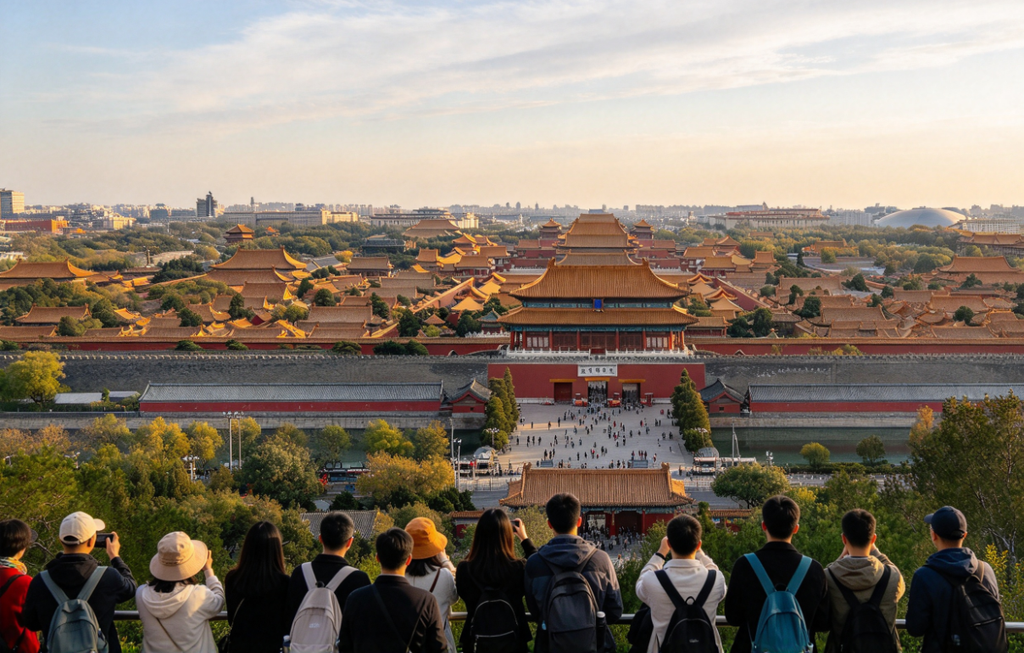
This is the strongest option for travelers whose primary goal is understanding Beijing’s history.
Your first area can include parts of the Central Axis and surrounding historic districts.
The advantage is context.
Instead of seeing the Forbidden City as a standalone palace, you begin to understand it as part of a much larger imperial and urban system.
This creates a narrative for the rest of the trip.
The downside is intensity.
The historic center contains some of Beijing’s largest and most heavily visited attractions. Starting there can feel overwhelming if you have just arrived after a long flight.
Strategy 2: Start with everyday Beijing
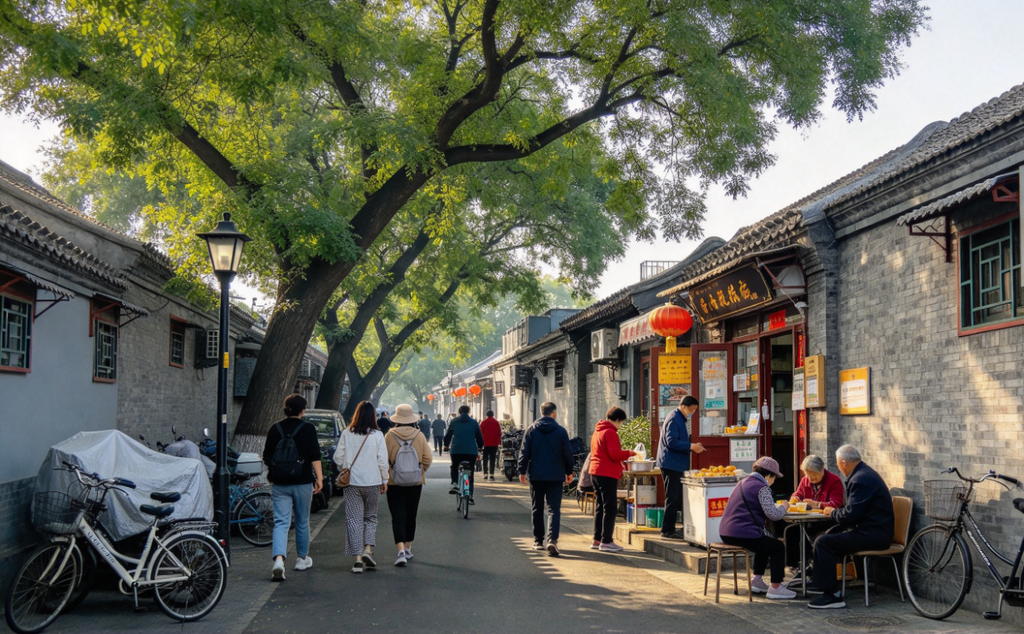
A different approach is to begin with a park, hutong, neighborhood market, or residential area before visiting the monumental landmarks.
This is particularly effective for travelers interested in contemporary life and local culture.
You see how people use public spaces, how older neighborhoods are organized, what mornings look like, and how traditional urban life exists alongside modern Beijing.
Then, when you visit the imperial landmarks later, you already have a better sense of the city beyond the tourist layer.
Strategy 3: Start with the landscape

Some travelers are motivated primarily by scenery and outdoor experiences.
For them, the Great Wall may be the emotional centerpiece of the entire trip.
Starting with the Wall can therefore make sense — but only under the right conditions.
You need sufficient energy, suitable weather, and enough time to recover afterward.
The mistake is not starting with the Great Wall.
The mistake is treating a demanding excursion as though it were simply another city attraction.
5. Should the Forbidden City Be Your First Stop?
For many first-time visitors, the Forbidden City seems like the obvious answer.
Sometimes it is.
But there is a difference between being the first major attraction and being the first experience of Beijing.
The Forbidden City works particularly well as an early anchor when:
- history is your primary interest;
- you have enough energy for several hours of concentrated sightseeing;
- you already understand the basic layout of your trip;
- your entry is properly arranged;
- and you are prepared to spend time rather than simply take photographs.
It works less well as an arrival-day activity when you are exhausted or dealing with luggage, delays, or uncertain arrival timing.
A dedicated Forbidden City tour can also make the experience more coherent for visitors who want historical interpretation rather than simply walking through the complex.
The deeper principle is this:
The first major landmark should match your attention span, not just your bucket list.
6. When the Great Wall Should Come First
The Great Wall presents a completely different decision.
Unlike an urban attraction, it changes the spatial scale of your trip.
You leave the central city, travel toward the mountains, spend several hours walking or exploring, and then return to Beijing.
That means a Wall visit can be an excellent first major experience — but it should usually be treated as a trip-defining excursion, not a casual first stop.
Starting with the Wall makes particular sense when:
- outdoor scenery is your main priority;
- you have limited days;
- weather conditions are especially favorable;
- you are physically ready for the hike;
- or you want to establish the biggest landscape experience early.
It makes less sense when you have just arrived from a long-haul flight or when your first day is already uncertain.
For travelers who prefer a structured transfer and clearly defined timing, Great Wall tours can simplify the most logistically demanding part of this decision.
7. The “First 24 Hours” Test
A useful way to choose your starting point is to stop thinking about the first day and think about the first 24 hours.
Ask four questions.
What time will I actually become available?
Landing time is not sightseeing time.
You still need immigration, baggage, transportation, hotel check-in, food, and basic orientation.
How much cognitive energy will I have?
A major historical site requires attention.
If your brain is still operating on your departure time zone, a complicated attraction can become an exhausting checklist rather than a meaningful experience.
How far am I willing to travel?
Your first outing should have a low probability of becoming a transportation problem.
What must happen on day one?
Some experiences are essential.
Others can move.
That distinction gives you a powerful rule:
Do not use your first day for anything that cannot tolerate a small delay unless the reservation makes it unavoidable.
This protects the trip from the most common arrival-day failure: one delayed flight causing a chain reaction through the entire itinerary.
8. Choose the Starting Area According to Your Travel Personality
The same Beijing can feel completely different depending on what you want from it.
| Traveler type | Strong starting point | Why |
|---|---|---|
| First-time history-focused traveler | Historic core | Establishes Beijing’s historical structure |
| Food-focused traveler | Traditional neighborhood + local dining area | Introduces everyday culture through food |
| Architecture enthusiast | Central Axis / imperial area | Shows the city’s planned historical structure |
| Outdoor traveler | Great Wall area | Starts with Beijing’s strongest landscape experience |
| Family traveler | Nearby park + manageable historic area | Lower pressure and easier pacing |
| Senior traveler | Compact sightseeing cluster | Reduces unnecessary transfers |
| Nightlife-focused traveler | Modern eastern districts | Easier evening access |
| Repeat visitor | Neighborhood or specialized museum area | Avoids repeating the classic introduction |
| Jet-lagged traveler | Park or nearby neighborhood | Low-pressure introduction |
This is why generic articles that name one “best first place” are incomplete.
The correct answer depends on what you want Beijing to become during the trip.
9. Your Hotel Does Not Have to Be Your Starting Point
One of the most useful distinctions for first-time travelers is understanding that your hotel is a logistical base, not necessarily your sightseeing starting point.
You might stay in a modern hotel in Chaoyang because you value room quality, dining, and evening convenience.
That does not mean your first sightseeing experience needs to be in Chaoyang.
Likewise, staying near the historic center does not mean every morning must begin at the Forbidden City.
Think of the hotel as your recovery point.
Think of the first sightseeing destination as your orientation point.
Separating these decisions gives you considerably more flexibility.
For travelers who want the itinerary to be designed around arrival conditions, interests, and preferred pace rather than a standard attraction list, a custom Beijing trip can use this distinction to build a more coherent sequence.
10. The Starting Point Should Change With Trip Length
Your available time changes the value of different starting strategies.
One or two days
You have almost no room for inefficient movement.
Start with the highest-value experience that defines why you came to Beijing.
For many travelers, that means the historic center or the Great Wall.
Do not spend the first day exploring a distant neighborhood simply because it is interesting.
Three to four days
You have enough time to create contrast.
A strong structure might begin with the historic city, follow with the Great Wall, and then move toward another side of Beijing.
The starting point should establish the historical or cultural context for what follows.
Five to seven days
You can be more experimental.
The first day can be slower, and you can reserve the most demanding experiences for later.
This is also the point where a neighborhood-focused opening becomes more valuable because you are not fighting the clock.
More than a week
Your first stop matters less as a logistical decision and more as a narrative choice.
You can begin slowly, return to favorite areas, and allow different parts of Beijing to reveal themselves over time.
The longer the trip, the less useful it becomes to treat every day as a sightseeing competition.
11. Weather Can Change Your Starting Point
A starting point chosen six months before departure should not be treated as untouchable.
Beijing’s weather can change the value of different experiences dramatically.
A clear, comfortable day can make an outdoor excursion exceptional.
Extreme heat can make a long exposed walking route exhausting.
Cold weather can make a shorter outdoor visit followed by an indoor museum more sensible.
Rain can also change the order of attractions without ruining the trip.
This suggests a better planning model:
Fixed elements
These are difficult to move because of reservations or limited availability.
Weather-sensitive elements
These should be placed when conditions are favorable.
Flexible elements
These can fill gaps or replace cancelled outdoor plans.
Your first day should ideally contain more flexible elements than fixed ones.
That gives the trip room to absorb reality.
12. Do Not Confuse “Famous” With “Best First”
The most famous attraction is often the wrong place to start for a simple reason:
fame tells you what is important to tourists, not what is useful for orientation.
A famous attraction can be:
- crowded;
- physically demanding;
- reservation-dependent;
- visually overwhelming;
- difficult to interpret without context;
- or simply too large to appreciate while jet-lagged.
A less famous neighborhood may teach you more about how Beijing actually works.
Likewise, a park may seem like a weak use of precious vacation time until you realize that it lets you recover from jet lag while experiencing an important part of local urban life.
The first stop should therefore be judged by strategic value, not popularity.
13. A Better Starting-Point Scorecard
If you are still undecided, score each possible first stop from 1 to 5 on six factors:
| Factor | Question |
|---|---|
| Arrival compatibility | Can I realistically reach it after arrival? |
| Energy demand | Can I enjoy it if I am tired? |
| Geographic value | Will it help me understand Beijing’s layout? |
| Trip importance | Does it represent something central to why I came? |
| Flexibility | Can I move it if my arrival changes? |
| Narrative value | Will it make later experiences easier to understand? |
The highest-scoring attraction is not necessarily the most famous one.
It is the one that gives you the best first-step return.
That is a much stronger way to answer the question than searching for a universal “best place.”
14. Four Starting Patterns That Work
Rather than copying a fixed itinerary, choose one of these starting patterns.
The History-First Pattern
Start: historic core
Then: imperial landmarks → traditional neighborhoods → Great Wall → northern or modern Beijing
Best for travelers who want the historical story to shape the trip.
The Recovery-First Pattern
Start: nearby park or neighborhood
Then: historic center → major landmark → Great Wall
Best after a long international flight.
The Landscape-First Pattern
Start: Great Wall
Then: historic center → imperial landmarks → local neighborhoods
Best for travelers whose strongest motivation is scenery and hiking.
The Local-Life-First Pattern
Start: park, hutong, market, or traditional neighborhood
Then: major landmarks → Great Wall → modern Beijing
Best for travelers who want to understand contemporary life rather than simply visit monuments.
These patterns are more useful than a single fixed “Day 1” because they can adapt to different travelers without rebuilding the entire trip.
15. What You Should Avoid on Your First Day
Several mistakes repeatedly turn the beginning of a Beijing trip into a stressful experience.
Avoid crossing the city repeatedly
Distance is not just measured in kilometers.
It includes waiting, transfers, traffic, walking, security, and the mental effort of navigating an unfamiliar city.
Avoid stacking major attractions
The first day should not become a competition between landmarks.
One strong experience is usually more memorable than three rushed ones.
Avoid putting your least flexible booking first
If your flight is delayed, the most fragile part of your itinerary should not be the first domino.
Avoid making the first day representative of the entire trip
Beijing is too large and varied for one day to summarize it.
The first day should open the story, not tell the entire story.
Avoid ignoring your own energy pattern
If you naturally wake early, use it.
If you need a slow morning after long-haul travel, protect it.
Good travel planning works with your body rather than against it.
16. A Practical Decision Tree
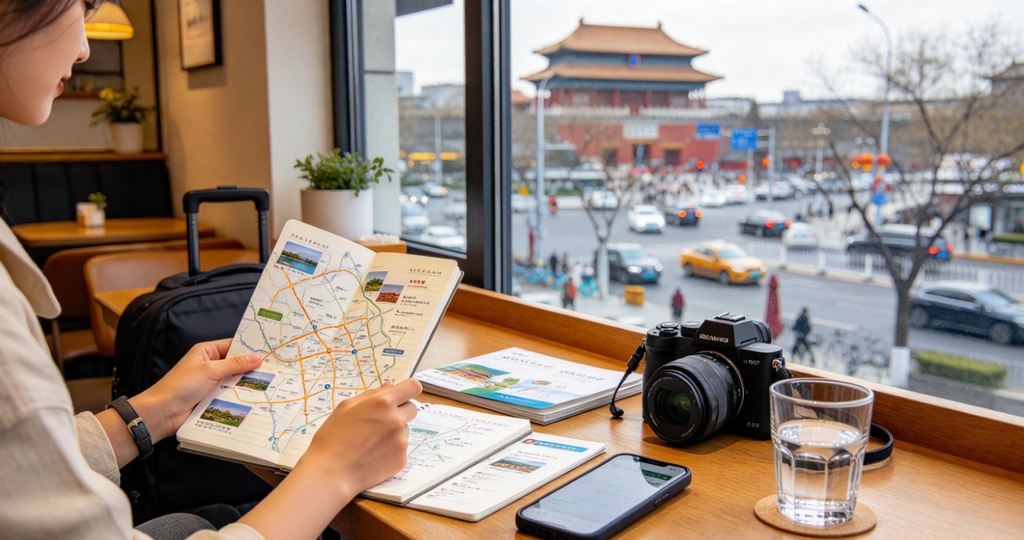
If you want a simple answer, use this sequence:
Did you arrive after a long international flight?
→ Yes: start with a nearby park or neighborhood and keep the first day flexible.
→ No: continue.
Is history your primary reason for visiting Beijing?
→ Yes: begin around the historic core and use the first major outing to understand the city’s imperial structure.
→ No: continue.
Is the Great Wall one of the main reasons you came?
→ Yes: consider making it your first major excursion, provided weather and energy are favorable.
→ No: continue.
Do you care more about everyday culture than monuments?
→ Yes: begin with a traditional neighborhood, park, market, or hutong environment.
→ No: use a central, geographically efficient sightseeing area as your introduction.
This produces a much more personalized answer than simply choosing the attraction with the highest search volume.
17. The Best Starting Point Is the One That Makes Day Two Easier
This is perhaps the most useful test of all.
Do not judge your first stop only by how enjoyable it is on day one.
Ask:
Will this starting point make the rest of my trip easier to understand and execute?
A historic-center opening can establish geographic context.
A relaxed neighborhood opening can solve jet lag.
A Great Wall opening can front-load the trip’s biggest outdoor experience.
A local-life opening can provide cultural context before the monumental sights.
The first day therefore has a hidden job: it should reduce uncertainty for the days that follow.
That is why the best starting point is often not the most spectacular one.
18. Final Takeaway
There is no single answer to where to start your Beijing trip because Beijing does not offer a single type of experience.
For a first-time history-focused visitor, the historic core is usually the strongest introduction. For a jet-lagged traveler, a nearby park or neighborhood may be much smarter. For an outdoor enthusiast, the Great Wall can become the trip’s first major experience. For a traveler interested in everyday culture, starting away from the monuments may create a richer understanding of the city.
The deeper rule is simple:
Start with the experience that gives you the most useful context for everything that comes next.
Choose your first stop according to arrival condition, energy, interests, weather, geographic logic, and trip length. Then let the rest of Beijing unfold from that foundation.
A good Beijing trip does not begin by asking, “What famous attraction should I visit first?”
It begins by asking:
What kind of Beijing do I want my first day to reveal?