
How to Plan Your Days in Beijing Efficiently
Quick Answer
To plan your days in Beijing efficiently, do not begin by filling every available hour with attractions.
Beijing is geographically large, major sights can take much longer than expected, and some journeys that look short on a map can consume significant time once walking, transfers, security checks, entrances, meals, and navigation are included.
An efficient day therefore has less to do with seeing the maximum number of places and more to do with controlling movement, timing, energy, and uncertainty.
A practical approach is to:
- Group destinations that are geographically compatible.
- Give major attractions enough time rather than treating them as quick stops.
- Place fixed-time reservations at the center of the day.
- Put demanding activities when your energy is highest.
- Avoid unnecessary cross-city travel between consecutive attractions.
- Build realistic meal and transportation windows.
- Leave flexible time instead of scheduling every minute.
- Keep at least one part of the day adjustable for weather or unexpected delays.
The result is not necessarily a fuller itinerary.
It is a day in which more of your available time is spent actually experiencing Beijing rather than moving between places.
Efficiency in Beijing Is Not the Same as Seeing More
Many travelers define an efficient travel day as one containing five or six attractions.
That definition is misleading.
Imagine two itineraries.
Day A
- Attraction 1
- Long cross-city transfer
- Attraction 2
- Another transfer
- Lunch
- Attraction 3
- Another transfer
- Attraction 4
It contains many places but also considerable transportation and decision-making.
Day B
- One major historical site
- Nearby neighborhood exploration
- Lunch in the same area
- Second attraction within the same district
- Relaxed evening
Day B may contain fewer recognizable names, but it can produce more usable sightseeing time.
This is the fundamental principle behind efficient Beijing planning:
Optimize the relationship between places, not the number of places.
A successful day has a coherent geographic and physical rhythm.
Start With Time, Not Attractions
Before deciding what to visit, determine how much usable time you actually have.
A nominal 12-hour day does not equal 12 hours of sightseeing.
Consider:
- Getting ready
- Breakfast
- Walking to transportation
- Waiting
- Transfers
- Security
- Ticket checks
- Finding entrances
- Meals
- Rest
- Navigation
- Returning to your hotel
A traveler who leaves the hotel at 8:00 a.m. and returns at 8:00 p.m. may have only a fraction of those twelve hours available for actual sightseeing.
This is why a useful daily plan should distinguish between available time and usable sightseeing time.
Build Your Day Around One Anchor
One of the simplest ways to create a realistic schedule is to select one anchor activity.
An anchor is something that determines when a significant part of your day must happen.
It could be:
- A timed attraction reservation
- A guided visit
- A train departure
- A restaurant reservation
- A morning excursion
- A Great Wall transfer
- A performance
- An airport departure
Once the anchor is fixed, build the surrounding day around it.
For example:
Morning anchor → nearby exploration → lunch → flexible afternoon
is generally easier to manage than:
Attraction → cross-city transfer → timed attraction → another transfer → reservation → evening activity
The anchor gives your day structure without forcing every hour into a rigid sequence.
Use the Three-Layer Day
A useful framework for Beijing is to divide each day into three layers.
Layer 1: Fixed
These are activities that cannot easily move.
Examples:
- Reservations
- Tours
- Trains
- Airport transfers
- Timed experiences
Layer 2: Planned
These are activities you want to complete but can move within a reasonable window.
Examples:
- Museums
- Neighborhood walks
- Shopping
- Parks
- Local food stops
Layer 3: Flexible
These are optional additions.
Examples:
- A second café
- Extra shopping
- An additional viewpoint
- A longer neighborhood walk
- An unplanned restaurant
This structure protects your day.
If the fixed element takes longer than expected, you can reduce the flexible layer without destroying the entire schedule.
Group Your Day Geographically
Beijing’s size makes geography one of the most important variables in daily planning.
A useful day usually has a geographic center of gravity.
For example, you might spend most of a day around:
- The historic central area
- A northern cultural cluster
- A western imperial-garden area
- A hutong district
- An Olympic-area cluster
- A Great Wall excursion area
The specific combination will depend on your interests.
The principle is more important than the list:
Move between nearby experiences rather than repeatedly crossing the city.
This reduces both transportation time and mental fatigue.
Don’t Measure Distance Only in Kilometers
Two destinations may look close on a map but still require substantial time to connect.
The real travel cost can include:
Walking + waiting + transfer + navigation + entrance + walking again
This is especially important around large attractions and transportation hubs.
A destination may be only a few kilometers away, but if reaching it requires multiple transfers and a long walk, it can effectively consume a large portion of your afternoon.
When planning your day, think in terms of door-to-door time, not straight-line distance.
Leave a Buffer After Major Attractions
Major attractions rarely end exactly when you expect.
A museum visit may take longer because you discover an exhibition you did not anticipate.
A historic complex may require more walking than expected.
A meal may last longer.
A transportation transfer may be slower than planned.
This is why putting two important timed activities back-to-back can make an itinerary fragile.
Instead, create a buffer between them.
For example:
10:00 fixed activity
↓
12:30 approximate finish
↓
12:30–1:15 buffer/lunch transition
↓
1:30 next activity
The buffer is not wasted time.
It is what makes the rest of the schedule more resilient.
Plan by Energy, Not Just Geography
Geographic efficiency is only half of the equation.
Your body also has a daily rhythm.
A day that is geographically perfect can still be exhausting if every activity requires intense concentration or walking.
Consider categorizing activities as:
High Energy
- Long Great Wall walks
- Extensive museum visits
- Large palace complexes
- Multiple-hour walking tours
Medium Energy
- Neighborhood exploration
- Temple visits
- Shopping districts
- Moderate museum visits
Low Energy
- Café breaks
- Restaurants
- Parks
- Scenic viewpoints
- Evening performances
- Relaxed shopping
A balanced day might look like:
High → Medium → Low
rather than:
High → High → High → High
This matters particularly during summer, winter, or after several consecutive sightseeing days.
Don’t Make Every Day Equally Busy
A common planning mistake is giving every day the same number of activities.
That ignores cumulative fatigue.
Imagine a six-day trip.
If Days 1–5 are all intensive sightseeing days, the final day may become physically and mentally difficult even if the schedule looked reasonable on paper.
Instead, vary the intensity.
For example:
Day 1 — Moderate
Day 2 — High
Day 3 — High
Day 4 — Moderate
Day 5 — High
Day 6 — Light
This creates recovery periods without sacrificing major experiences.
The exact pattern can change depending on your travel style.
Put the Most Important Experience at the Right Time
Not every attraction needs to happen early in the morning.
But your highest-priority experience should receive a time slot when you are most capable of enjoying it.
For some travelers, that means morning.
For others, late afternoon may work better.
Ask:
- Is the attraction physically demanding?
- Is it likely to be crowded?
- Does it require concentration?
- Is photography important?
- Is weather relevant?
- Does it have a fixed opening or reservation time?
- How much walking is involved?
Then match the experience to the time of day.
This is more sophisticated than simply following a generic “start early” rule.
Morning, Afternoon, and Evening Have Different Jobs
A useful Beijing day does not need to treat every time period equally.
Morning: Use for High-Value Activities
Morning can work well for activities that require focus, energy, or a fixed schedule.
Examples include:
- Major historical sites
- Museums
- Guided visits
- Long walks
Afternoon: Use for Flexible Exploration
This period can absorb delays more easily.
Good options include:
- Neighborhoods
- Shopping
- Parks
- Cafés
- Smaller attractions
Evening: Reduce Logistical Risk
After a long day, consider activities that are easier to enter and leave.
Examples include:
- Dinner
- A nearby neighborhood
- An evening walk
- A cultural performance
- A restaurant close to your accommodation
This reduces the chance that one late afternoon delay will disrupt your entire evening.
Make Transportation Part of the Itinerary
Transportation should not be treated as something that happens between attractions.
It is part of the daily schedule.
If your plan says:
9:00 Attraction A
11:00 Attraction B
you have not actually planned the period between them.
You need to account for:
- Exit time
- Walking to transportation
- Waiting
- Travel
- Transfers
- Finding the next entrance
- Possible delays
This is where Beijing public transportation becomes part of itinerary design rather than a separate research topic.
A route that is efficient on paper may still require substantial walking at both ends.
Use Different Transportation Modes for Different Parts of the Day
There is no need to use the same transportation method for every journey.
For example:
Morning: Subway for a predictable cross-city journey
Midday: Walking between nearby destinations
Afternoon: Ride-hailing if tired or carrying shopping
Evening: Subway or a short car ride back to the hotel
This can be more efficient than choosing one transportation method for the entire day.
The goal is not loyalty to a particular mode.
The goal is reducing friction.
When Walking Is Actually More Efficient
Walking can look slower than public transportation.
But short urban journeys can sometimes become inefficient when you include:
- Walking to the station
- Entering the station
- Security procedures
- Waiting
- Transfers
- Walking from the destination station
If two nearby destinations are comfortably walkable, walking can eliminate several small delays.
It also gives you something transportation cannot:
street-level observation.
You may discover:
- Hutongs
- Small shops
- Local restaurants
- Neighborhood architecture
- Parks
- Residential streets
- Unexpected public spaces
Therefore, walking is not simply a transportation choice.
It can also be part of the sightseeing experience.
Use the Best Ways to Get Around Beijing According to Context
The best ways to get around Beijing change depending on the day’s structure.
For predictable urban journeys, the subway can provide a clear framework.
For short distances, walking may be more efficient.
For luggage, tired travelers, or difficult transfers, a car may make more sense.
For a remote Great Wall excursion, door-to-door transportation can save significant coordination.
The important point is to choose transportation after understanding the day’s geography, rather than selecting transport first and forcing the itinerary around it.
Keep Meals Close to Your Sightseeing Area
Meals are another source of hidden travel time.
Suppose your morning attraction ends in one district, but you choose a restaurant forty minutes away because it appears highly rated online.
You have effectively added another transportation segment to your itinerary.
Instead, consider choosing restaurants according to the day’s geographic flow.
For example:
Morning attraction → nearby lunch → afternoon attraction
is often more efficient than:
Morning attraction → distant restaurant → return toward afternoon attraction
This does not mean you should never travel for food.
If a restaurant is itself a major priority, make it an anchor.
Otherwise, use meals to reinforce the day’s geographic structure.
Don’t Turn Every Meal Into an Event
Food is an important part of a Beijing trip.
But not every meal needs to be a major culinary experience.
If you schedule a long restaurant meal three times a day, your sightseeing schedule may become surprisingly compressed.
A practical rhythm might include:
- One deliberately chosen food experience
- One efficient meal
- One flexible snack or lighter meal
This leaves room for exploration without treating eating as another appointment.
Use “One Major + Two Supporting” as a Daily Framework
A useful alternative to a long attraction list is:
One Major Experience
The main reason you are visiting that area.
Two Supporting Experiences
Nearby or lower-intensity activities that complement it.
For example:
Major: Large historical complex
Supporting: Nearby neighborhood
Supporting: Local meal
Or:
Major: Museum
Supporting: Park
Supporting: Café or restaurant
The supporting experiences should not be mandatory in the same way as the major experience.
If the major activity takes longer, they can be shortened or removed.
This gives the day structure without making it fragile.
Build a “Cut First” List
An efficient itinerary is not just a list of things you will do.
It should also contain a list of things you are willing to remove.
Before each day, divide activities into:
Must Do
Missing it would significantly affect the trip.
Nice to Do
Worth doing if time permits.
Cut First
Interesting, but not important enough to create stress.
This hierarchy is especially valuable when something unexpected happens.
If a museum visit takes an extra hour, you should already know what can disappear from the schedule.
You should not have to make that decision while standing on a crowded street.
Avoid the Domino Effect
A poorly designed itinerary can create a chain reaction.
For example:
Attraction runs late
↓
Lunch starts late
↓
Transportation starts late
↓
Next attraction becomes rushed
↓
Reservation is missed
↓
Evening plan collapses
This is a domino effect.
The solution is not simply adding enormous amounts of spare time.
Instead, place buffers at critical transition points.
The most important buffers are usually:
- Before fixed reservations
- Before long-distance transportation
- Before trains
- Before airport transfers
- Between high-effort activities
- Before evening commitments
Plan the First and Last Activities Carefully
The first and last parts of the day have disproportionate importance.
The First Activity
It determines your starting energy and often establishes the day’s geographic direction.
Choose something that is realistic after breakfast and the journey from your hotel.
The Last Activity
It determines how easily you can recover.
After a long day, an activity close to your hotel or near a convenient transportation route can be more comfortable than another major attraction across the city.
This becomes especially important after a physically demanding excursion.
Don’t Cross Beijing Just to “Complete the List”
Suppose you have two attractions remaining on your list.
One is twenty minutes from your current location.
The other requires a long cross-city journey.
The second attraction may be more famous.
But if the purpose of the afternoon is simply to add another name to your checklist, the transportation cost may not justify it.
This is where efficient itinerary planning differs from attraction collecting.
You should evaluate each additional stop by asking:
How much time does it add?
How much transportation does it require?
How much energy does it consume?
How important is it to me?
That gives you a better decision than simply asking whether the attraction is famous.
Use a Daily Time Budget
Instead of scheduling every minute, create a rough budget.
For example:
| Daily Component | Approximate Planning Role |
|---|---|
| Main sightseeing | Largest block |
| Secondary sightseeing | Medium block |
| Transportation | Protected buffer |
| Meals | Flexible block |
| Rest | Deliberate recovery |
| Unplanned time | Safety margin |
The exact proportions depend on the traveler.
The important point is that transportation and rest should appear in the plan before the remaining time is filled.
If you schedule sightseeing first and transportation afterward, the day will almost always look more spacious than it really is.
Create a “Geographic Chain”
One of the most efficient planning methods is to build your day as a chain:
Hotel → Main attraction → Nearby attraction → Meal → Nearby neighborhood → Evening return
Each stop should logically connect to the next.
A poor chain looks like:
Hotel → East Beijing → Central Beijing → North Beijing → South Beijing → Hotel
The second itinerary may contain the same number of experiences, but much more time is spent repositioning yourself.
The geographic chain is particularly useful when you plan Beijing trip schedules independently because it gives you a simple test:
Does each stop make sense as the next stop?
If not, reconsider the order.
Weather Should Change the Structure of Your Day
An efficient itinerary is not identical in every season.
Weather can influence:
- Walking tolerance
- Outdoor sightseeing
- Lunch duration
- Museum preference
- Evening activities
- Transportation comfort
On a pleasant day, you might intentionally include more walking.
During extreme heat or cold, you may want shorter outdoor sections connected by indoor stops.
This is why a good itinerary should contain alternatives rather than one immutable schedule.
Have a Wet-Weather Version of Your Day
For every heavily outdoor day, identify one indoor substitute.
For example:
Outdoor plan:
Historic neighborhood → long walking route → park
Alternative:
Museum → indoor cultural site → restaurant → shorter neighborhood walk
The alternative does not have to be equally exciting.
Its purpose is to protect the overall trip from weather.
A flexible plan is more efficient than a perfect plan that becomes unusable after a weather change.
Account for Your Accommodation Location
The location of your hotel affects the structure of every day.
If your hotel is near the center, some historical areas may be easier to combine.
If you stay farther from the main sightseeing areas, you may want to cluster several destinations in the same direction on one day.
This means accommodation and daily planning should not be treated as completely separate decisions.
Your hotel effectively creates a daily starting and ending point.
That starting point determines how much transportation time you spend before sightseeing even begins.
Don’t Schedule the Most Important Activity on Arrival Day
Arrival days are unpredictable.
Flights can be delayed.
Immigration can take longer than expected.
Baggage collection can take time.
Getting to the hotel may be slower than expected.
You may also be tired.
For this reason, arrival day is usually better suited to a low-pressure activity close to your accommodation.
Save highly time-sensitive experiences for a day when you have greater control over your schedule.
Departure Day Needs the Same Logic
Departure day should not be treated as another full sightseeing day.
The real deadline is not your flight time.
It is the time by which you need to be moving toward the airport or station with an appropriate buffer.
A theoretically available morning can disappear quickly once you account for:
- Hotel checkout
- Luggage
- Transportation
- Airport or station procedures
- Potential traffic
- Navigation
A short nearby activity can work.
A cross-city attraction followed by a fixed departure is much more fragile.
Use Your Energy as a Planning Currency
Travelers usually count money.
They should also count energy.
Every activity has an energy cost.
A three-hour museum visit, a long Great Wall hike, and a relaxed café stop do not consume the same amount of physical or mental capacity.
Think of your daily energy as a limited budget.
If you spend most of it before lunch, the afternoon should not be planned as though you still have the same capacity.
This is particularly important for:
- Older travelers
- Families with children
- Travelers arriving after long flights
- People visiting during hot weather
- Travelers taking several consecutive sightseeing days
An itinerary that respects energy can produce a better experience without adding more attractions.
Don’t Optimize Every Minute
There is a point at which optimization becomes counterproductive.
If your itinerary requires checking the clock every fifteen minutes, it is no longer helping you travel efficiently.
Beijing contains experiences that cannot be scheduled precisely:
- A quiet street
- A local market
- A conversation
- A restaurant discovery
- An interesting shop
- A beautiful view
- An unexpected architectural detail
Leave some space for these moments.
Efficiency should reduce wasted time, not eliminate unplanned time.
A Better Daily Planning Formula
A practical daily formula is:
1 major anchor
- 1–2 nearby supporting experiences
- 1 flexible block
- realistic transportation time
- meal time
- recovery time
This is usually more resilient than a schedule containing six or seven equally important attractions.
The exact number can change according to your interests and travel style.
The principle is to give every activity a role.
Example of an Efficient Day Structure
Without creating a specific Beijing sightseeing itinerary, the structure could look like this:
8:00–9:00
Breakfast and departure
9:30–12:00
Major anchor experience
12:00–13:30
Nearby lunch and transition
13:30–15:30
Supporting cultural or neighborhood experience
15:30–16:30
Flexible block
16:30–18:00
Low-intensity exploration or return toward the hotel
Evening
Dinner and optional activity
Notice that the schedule does not attempt to fill every minute.
The flexibility is intentional.
How to Plan Several Days Without Repeating the Same Rhythm
Daily efficiency should also work across the entire trip.
Avoid creating five identical days:
Early wake-up → major attraction → lunch → major attraction → dinner → hotel
Instead, vary the rhythm.
For example:
Day A: Historical + walking
Day B: Major excursion + recovery
Day C: Museum + neighborhood
Day D: Gardens + relaxed exploration
Day E: Flexible cultural day
This creates variation in physical and mental intensity.
It also reduces the feeling that every day is simply another checklist.
What Makes a Beijing Day Truly Efficient?
An efficient day should satisfy five conditions.
1. Geographic Logic
Most movements make sense geographically.
2. Time Realism
Travel and transition time are included.
3. Energy Balance
Demanding activities are not stacked endlessly.
4. Flexibility
At least part of the day can absorb delays.
5. Priority
The most important experience receives appropriate time.
If an itinerary satisfies these five conditions, it does not need to contain a large number of attractions.
Final Checklist for Each Day
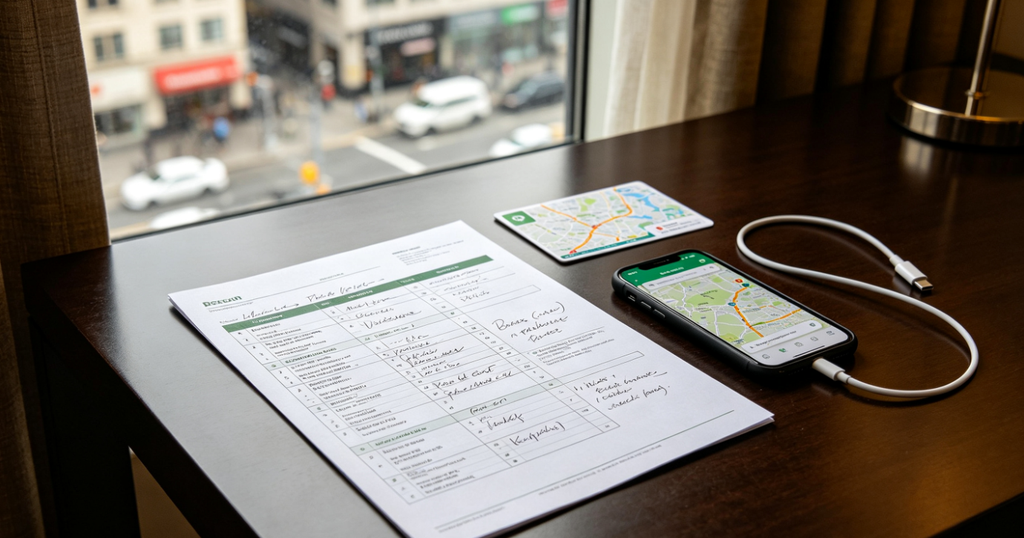
Before finalizing a day, ask:
- What is today’s main experience?
- Where is it located?
- What comes naturally before it?
- What comes naturally after it?
- How long does door-to-door transportation really take?
- Is there a fixed reservation?
- Where will I eat?
- Where can I rest?
- What happens if the main activity takes an extra hour?
- Which activity will I cut first?
- Is there a weather alternative?
- Am I crossing the city unnecessarily?
- Does the evening require too much energy?
- Can I comfortably return to my hotel?
If you can answer these questions, the day is probably structurally sound.
Final Takeaway
To plan your days in Beijing efficiently, think beyond attraction lists.
The most important resource on a Beijing trip is not the number of hours on your watch. It is the amount of those hours that can actually be used for meaningful experiences.
Start with one important anchor. Build nearby activities around it. Treat transportation as part of the schedule. Match demanding experiences to your energy level. Keep meals geographically sensible. Protect fixed reservations with buffers. And maintain enough flexibility to absorb weather, delays, or discoveries that were never part of the original plan.
The goal is not to make every minute productive.
It is to make the day coherent.
When geography, timing, transportation, energy, and priorities work together, you can experience more of Beijing without making the trip feel like a race.
And that is the real meaning of an efficient Beijing itinerary.