
Is Public Transportation Easy in Beijing?
Quick Answer
Yes. Beijing public transportation is generally easy for tourists to use once you understand the basic system.
For most first-time visitors, the subway is the easiest public transportation option because it covers many major tourist areas, avoids road traffic and provides relatively predictable travel times.
Buses offer broader local coverage but can be harder to navigate if you don’t read Chinese. Taxis and ride-hailing are useful when public transportation involves too much walking or too many transfers.
The bigger challenge isn’t learning how to take a train.
It’s understanding Beijing’s enormous size, station layouts, walking distances, transfers, payment methods and the difference between reaching an area and reaching the actual attraction entrance.
For most travelers, a practical combination is:
Subway + walking + occasional taxi or ride-hailing.
Is Beijing Public Transportation Good for Tourists?
Yes, but “easy” depends on what you’re comparing it with.
If you’re used to compact European cities where many attractions are within a short walking distance, Beijing may initially feel more complicated.
If you’re familiar with large metropolitan cities, however, Beijing’s transportation network is relatively straightforward.
The city has:
- An extensive subway network
- Numerous bus routes
- Taxis
- Ride-hailing services
- Airport transportation
- Shared bicycles
- High-speed rail connections
The subway is particularly useful for tourists because many major sightseeing areas are connected to the network.
But transportation convenience should always be evaluated based on your complete route.
A subway station may be close to a landmark on the map while still requiring 15–25 minutes of walking after you exit.
Why the Beijing Subway Is Usually the Easiest Option
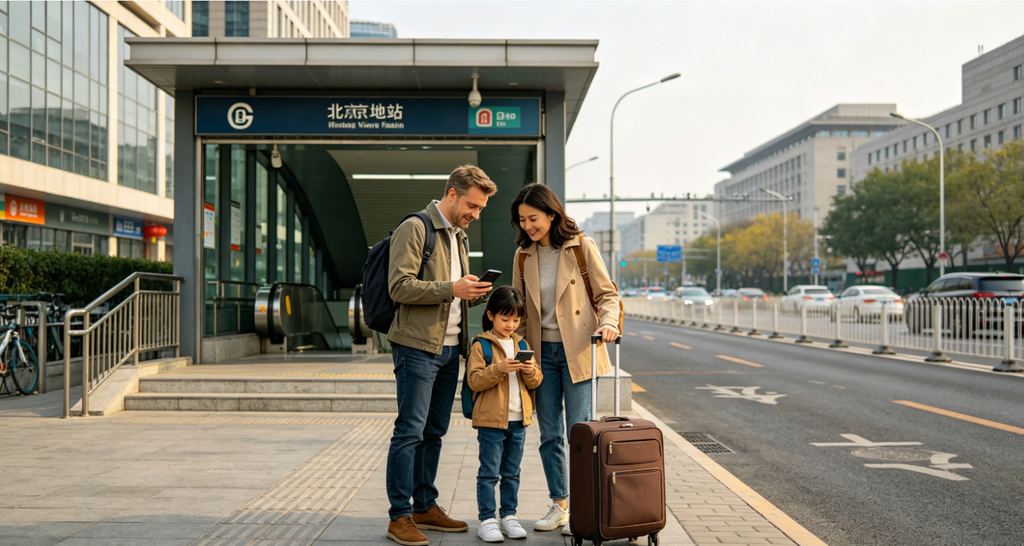
For first-time visitors, the subway has one major advantage:
It is less affected by road traffic.
Beijing is a major metropolitan area, and road congestion can significantly affect taxis, buses and private vehicles.
During busy periods, a subway journey can therefore be much more predictable.
The subway is particularly useful for:
- Central Beijing
- Major sightseeing areas
- Hotel-to-attraction journeys
- Longer journeys within the city
- Travelers on a budget
- Visitors who want predictable travel times
You don’t need to understand the entire subway network.
You only need to learn how to:
- Find your station
- Identify your line
- Follow the direction
- Transfer when necessary
- Find the correct exit
Once you understand those five steps, most subway journeys become manageable.
How Difficult Is the Beijing Subway for First-Time Visitors?
The trains themselves are usually not the difficult part.
The more challenging elements are often stations and navigation.
Large stations can involve:
- Security checks
- Multiple entrances
- Long underground corridors
- Several lines
- Multiple exits
- Considerable walking
A journey shown as “20 minutes by subway” doesn’t necessarily mean you’ll arrive at the attraction in 20 minutes.
Your actual journey may look more like:
Hotel → 10-minute walk → security → platform → train → transfer → exit → 15-minute walk → attraction
This is why you should always calculate door-to-door travel time.
Understanding Subway Transfers
Transfers can initially look complicated, but most major stations use clear line colors, numbers and directional signs.
The key is to identify:
Line + direction + transfer station
before entering the platform.
Don’t simply memorize the name of the next station.
Instead, know the direction you’re traveling.
For example, if your destination requires a transfer, check:
Line A → Transfer at Station X → Line B → Exit at Station Y
This is much easier to follow than trying to memorize the entire route.
Why Subway Exits Matter So Much
This is one of the most overlooked aspects of using public transportation in Beijing.
A large station may have many exits, and each exit can lead to a completely different street corner.
Choosing the wrong exit can result in:
- Extra walking
- Crossing busy roads
- Confusing navigation
- Difficulty finding your hotel
- Unnecessary backtracking
Before leaving the station, check the surrounding landmarks and street orientation.
For tourists carrying luggage, this can make a significant difference.
Can Tourists Use Beijing Buses Easily?
Buses are affordable and extensive, but they’re usually less beginner-friendly than the subway.
The main challenge isn’t boarding the bus.
It’s knowing:
- Which route to take
- Which direction it travels
- Where to get off
- Whether you’re at the correct stop
- How traffic will affect the journey
If you are an experienced traveler or comfortable with navigation apps, buses can be useful.
For a first trip, however, the subway is generally easier.
Should First-Time Visitors Use Taxis?
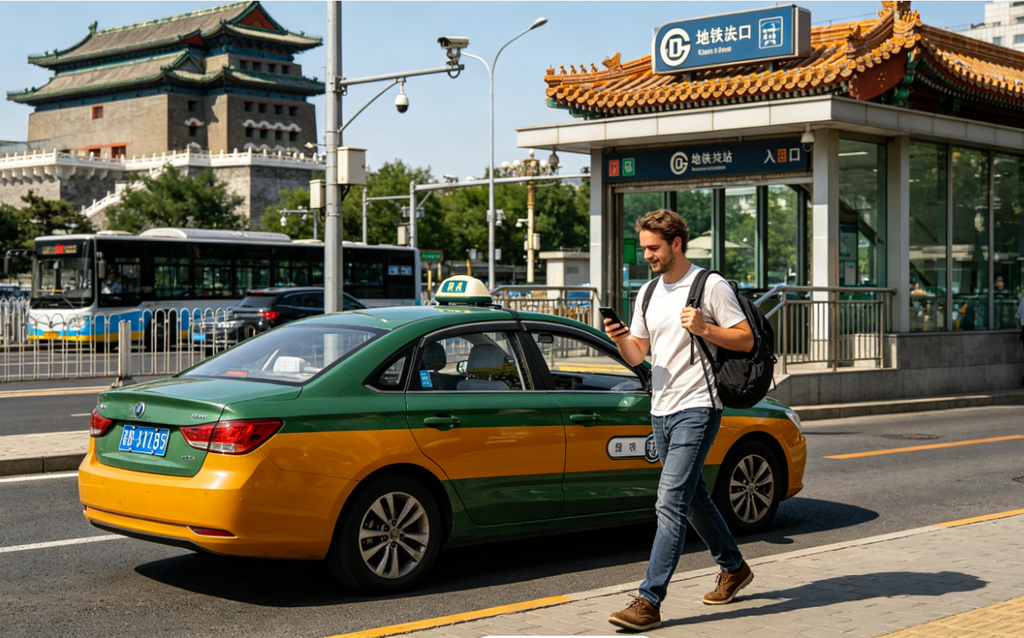
Absolutely.
You don’t have to choose between public transportation and taxis.
The most efficient Beijing trip often uses both.
A taxi or ride-hailing service makes sense when:
- You’re carrying luggage
- You’re traveling with young children
- Your destination is far from a subway station
- The subway requires multiple transfers
- You’re returning to the hotel late
- You’re traveling with several people
The key is to use taxis strategically rather than automatically.
When Is a Taxi Better Than Public Transportation?
Imagine two routes.
Option A
10-minute walk → subway → transfer → subway → 20-minute walk
Option B
25-minute direct taxi
Although the subway may cost less, the taxi could be the better choice.
This is especially true when you’re:
- Tired after sightseeing
- Carrying shopping bags
- Traveling with children
- Dealing with hot or cold weather
- Running late for a reservation
Transportation decisions should consider time and effort, not only price.
Is Beijing Public Transportation Safe?
For normal sightseeing, public transportation is a practical way to move around the city.
As with major metropolitan systems anywhere, travelers should use normal precautions in crowded areas.
Keep an eye on:
- Phones
- Wallets
- Passports
- Bags
- Luggage
Busy stations can become particularly crowded around commuting periods.
If you’re traveling with children, establish a simple meeting point in case someone gets separated.
Is Beijing Public Transportation Suitable for Families?
Yes, but families need to plan differently from solo travelers.
A route that looks efficient for one adult may be tiring with children.
Consider:
- Number of transfers
- Station walking distance
- Stairs and escalators
- Crowding
- Weather
- Rest periods
- Luggage
- Bathroom access
For a family with young children, reducing transportation changes can be more valuable than saving a small amount of money.
For example:
Direct taxi → attraction
may be better than:
Walk → subway → transfer → subway → walk
What About Older Travelers?
Older travelers should pay particular attention to walking distances.
Beijing attractions can be physically demanding even before transportation is considered.
The challenge may not be the subway ride itself.
It may be:
hotel → station → underground corridor → platform → train → exit → attraction entrance
If mobility is limited, use taxis or private transportation for selected journeys.
You don’t need to abandon public transportation completely.
Instead, use it where it provides the greatest benefit.
Can You Use Public Transportation With Luggage?
Yes, but luggage changes the calculation.
One small suitcase
The subway is usually manageable.
Several large suitcases
A taxi or private transfer may be much easier.
Airport arrival
Consider how tired you will be after a long flight.
Hotel change
If you’re moving between hotels, direct transportation can save considerable effort.
A cheap transportation option isn’t always the most convenient option.
How Do Tourists Pay for Transportation?
Payment is one area visitors should prepare before arriving.
Depending on the transportation method, travelers may encounter:
- Digital payment
- Transportation cards
- Mobile payment
- Ticket machines
- Cash
The exact process can vary.
Before your trip, make sure you have at least one reliable digital payment method and a backup option.
Also keep important information available offline.
Useful items include:
- Hotel address
- Train station name
- Airport name
- Attraction names
- Important reservations
Having these saved in Chinese can be particularly helpful.
Do You Need Chinese to Use Public Transportation?
Not necessarily.
The subway is relatively accessible to international visitors because major stations provide standardized signs and route information.
However, language can become more challenging with:
- Local buses
- Small taxi journeys
- Neighborhood destinations
- Restaurant addresses
- Small streets
Navigation and translation tools can therefore be very useful.
Save important addresses before leaving your hotel.
How Much Does Public Transportation Cost?
One of the major advantages of public transportation is affordability compared with private transportation.
For most tourists, subway and bus fares represent a relatively small portion of the overall Beijing travel budget.
However, don’t optimize every journey purely for the lowest fare.
Consider:
Transportation cost + time + walking + convenience
A slightly more expensive journey may provide significantly more value if it saves an hour of complicated transfers.
Is the Subway Better Than a Taxi During Rush Hour?
Often, yes.
Road congestion can make taxis and buses unpredictable during busy commuting periods.
The subway may still be crowded, but travel times are generally less dependent on road conditions.
If you have:
- A timed attraction
- A train reservation
- An airport departure
- A dinner reservation
allow extra time and consider whether the subway offers a more predictable route.
What Time Should Tourists Avoid Traveling?
You don’t necessarily need to avoid rush hour completely.
But you should understand that commuting periods can affect both road and subway transportation.
If you have flexibility, schedule:
major sightseeing during comfortable periods
and avoid unnecessary cross-city journeys during the busiest times.
A good itinerary is not simply a list of attractions.
It’s also a plan for when to move between them.
Public Transportation to Beijing’s Major Attractions
Forbidden City
The Forbidden City is located in central Beijing and is relatively convenient to reach by public transportation.
However, transportation is only one part of the visit.
You’ll also need to account for:
- Walking
- Security procedures
- Entrance arrangements
- Time spent inside the complex
Don’t schedule another distant attraction immediately afterward.
Temple of Heaven
The Temple of Heaven can be incorporated into a central or southern Beijing sightseeing day.
Subway transportation can be convenient depending on your hotel.
Because the site itself is large, allow additional walking time.
Summer Palace
The Summer Palace is northwest of central Beijing.
The subway can be practical, but visitors should remember that the park itself covers a large area.
Plan your route around the part of the site you most want to explore.
Great Wall
The Great Wall requires a different transportation strategy.
You should decide which section you want to visit first.
Popular choices include:
- Badaling
- Mutianyu
- Jinshanling
Badaling is relatively accessible for independent travelers.
Mutianyu and Jinshanling often require more transportation planning.
For many international visitors, especially families and groups, private transportation or an organized excursion can make the journey substantially easier.
Should You Use Public Transportation to the Great Wall?
You can, but you should consider the complete journey.
A Great Wall trip may involve:
Beijing hotel → city transportation → departure point → regional transportation → Great Wall area → entrance → hiking
This is very different from taking the subway between two central Beijing stations.
If your priority is simplicity, an organized option such as [Great Wall tours from Beijing] may be more practical than coordinating multiple transportation connections yourself.
How Transportation Should Influence Your Hotel Choice
Your hotel location can make a major difference to your trip.
When choosing accommodation, consider:
Distance to Subway Station
A hotel 5 minutes from a station can be significantly more convenient than one 20 minutes away.
Location Relative to Your Main Attractions
If most of your itinerary is in central Beijing, staying nearby can reduce transportation time.
Airport Access
If you have an early international flight, airport transportation should influence your hotel decision.
Evening Transportation
If you enjoy dining and exploring at night, consider how easily you can return to your hotel.
How to Plan a Beijing Day Around Transportation
Don’t create your itinerary like this:
Attraction A → Attraction B → Attraction C → Attraction D
Instead, ask:
Which attractions are geographically close?
Then build the day around that area.
For example:
Central Beijing Day
Hotel → Forbidden City → nearby historic area → hutong → dinner
This is more efficient than crossing the entire city after every attraction.
Transportation and Food Should Be Planned Together
Food is another factor that can easily create unnecessary travel.
Suppose you spend the afternoon exploring a historic neighborhood.
Instead of traveling 45 minutes to a restaurant elsewhere, consider eating locally.
This is where your Beijing food guide can become part of transportation planning.
Choose restaurants near your sightseeing route.
You’ll spend less time traveling and more time experiencing the city.
How to Build a More Efficient Beijing Itinerary
The most effective strategy is to plan according to geographic clusters.
For example:
Central Historic Area
- Forbidden City
- Tiananmen area
- Hutongs
- Traditional restaurants
Northwest
- Summer Palace
- Other nearby attractions
Great Wall
- Dedicated day
Local Neighborhoods
- Hutongs
- Markets
- Food experiences
This approach reduces backtracking.
If you’re still organizing your route, plan Beijing trip around areas first, then decide which attractions belong in each day.
A Sample 3-Day Transportation Plan
Day 1 — Central Beijing
Subway + walking
Focus on attractions in the central area.
Avoid crossing the city for dinner.
Day 2 — Great Wall
Private transportation or organized transportation
Treat the Wall as a full-day excursion.
Day 3 — Northwest Beijing
Subway + walking + occasional taxi
Visit the Summer Palace and other nearby attractions.
This structure keeps transportation relatively simple.
A Sample 5-Day Transportation Plan
With five days, you can spread attractions out more comfortably.
Day 1
Central Beijing
Subway + walking
Day 2
Great Wall
Private transportation
Day 3
Summer Palace and northwest Beijing
Subway + walking
Day 4
Hutongs and cultural experiences
Subway + walking
Day 5
Flexible day
Mix of subway + taxi
The extra day gives you room to adjust if weather, crowds or fatigue affect your plans.
Common Public Transportation Mistakes
1. Assuming Beijing Is Compact
It isn’t.
Allow realistic travel time between districts.
2. Looking Only at Subway Time
Add walking, security, transfers and exit time.
3. Choosing the Wrong Station Exit
This can add unnecessary walking.
4. Using Public Transportation for Every Journey
Some routes are simply better by taxi.
5. Using Taxis for Every Journey
Traffic can make road transportation unpredictable.
6. Ignoring Your Hotel Location
A convenient hotel can save significant time.
7. Forgetting Your Return Route
Always know how you’ll get back after the last attraction.
Is Beijing Easy to Navigate Without a Tour?
Yes.
Independent travelers can explore many parts of Beijing using public transportation.
You don’t need a private guide simply to take the subway.
However, a tour or private transportation can be useful when:
- You have limited time
- You’re traveling with children
- You want to visit the Great Wall
- You want historical context
- You prefer door-to-door transportation
- You don’t want to coordinate multiple connections
The decision should depend on what you value most: independence, convenience, efficiency, or guidance.
How to Make Public Transportation Less Stressful
A few simple habits make a significant difference.
Save Your Hotel Address in Chinese
Useful for taxis and navigation.
Check Tomorrow’s Route the Night Before
Don’t figure everything out at the station.
Screenshot Important Information
Useful if your connection fails.
Charge Your Phone
Navigation and payment can depend heavily on your phone.
Allow Extra Time
Especially for:
- Airports
- Railway stations
- Timed attractions
- Great Wall excursions
Avoid Overloading Your Day
A relaxed itinerary is easier to navigate.
What Is the Best Transportation Mix for Tourists?
For most first-time visitors, this combination works well:
Subway
Use it for longer urban journeys.
Walking
Use it inside neighborhoods and between nearby attractions.
Taxi/Ride-Hailing
Use it when convenience matters.
Private Transportation
Use it for the Great Wall and other difficult-to-reach destinations.
High-Speed Rail
Use it when traveling beyond Beijing.
This approach gives you flexibility without making transportation unnecessarily complicated.
Final Takeaway
So, is Beijing public transportation easy to use?
Yes—especially once you understand how to combine different transportation methods.
The subway is the most useful starting point for first-time visitors because it is extensive and relatively predictable. Walking is ideal for exploring historic neighborhoods, while taxis and ride-hailing solve many situations where public transportation becomes inefficient.
The most important thing to remember is that Beijing’s transportation challenge is less about complexity and more about scale.
Don’t judge a route by the subway journey alone.
Consider:
hotel → station → train → transfer → exit → walking → attraction
That is your real journey.
Plan attractions geographically, leave realistic time for walking, use public transportation when it offers a clear advantage, and switch to taxis or private transportation when convenience matters more.
If you approach transportation as part of the itinerary rather than an afterthought, Beijing is surprisingly manageable for first-time tourists.