
Best Ways to Get Around Beijing for Foreign Tourists
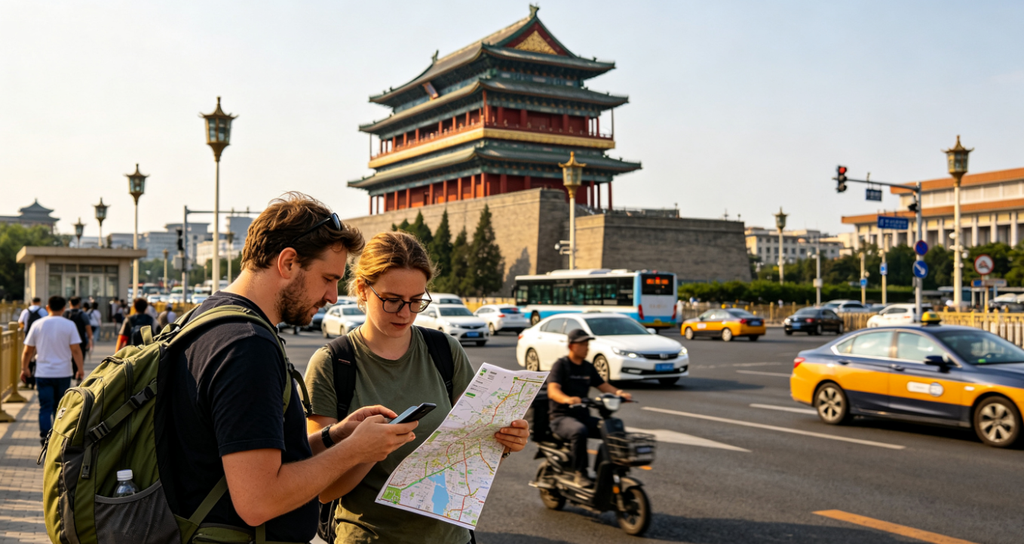
Getting around Beijing can seem complicated when you first look at the city map.
The city is enormous, major attractions are spread across different districts, and transportation options range from an extensive subway network to taxis, ride-hailing services, buses, bicycles, walking, and private transfers.
For foreign tourists, the challenge isn’t simply knowing that these options exist.
The more important question is:
Which transportation method should you use for each situation?
The best ways to get around Beijing depend on where you’re going, how much luggage you have, how comfortable you are using local apps, whether you’re traveling with children or older family members, and how much time you have.
For most visitors, the best strategy isn’t choosing one transportation method for the entire trip.
It’s using different options for different journeys.
Quick Answer: What Is the Best Way to Get Around Beijing?
For most foreign tourists, a combination of transportation methods works best:
| Transportation | Best For | Main Advantage | Main Limitation |
|---|---|---|---|
| Metro | Major attractions | Fast and predictable | Crowded at busy times |
| Taxi | Short direct journeys | Simple and comfortable | Traffic delays |
| Ride-hailing | Door-to-door travel | Convenient | App/payment setup |
| Bus | Local routes | Extensive coverage | More difficult for visitors |
| Walking | Historic neighborhoods | Free and immersive | Long distances |
| Bicycle | Short neighborhood trips | Flexible | Weather and traffic |
| Private car/driver | Families & complex itineraries | Convenient and efficient | Higher cost |
| Airport transfer | Airport ↔ hotel | Easy with luggage | More expensive than metro |
If you are staying in central Beijing, the metro + walking + occasional taxi or ride-hailing combination is usually the most practical.
For the Great Wall and other destinations outside central Beijing, a private transfer, organized tour, or suitable direct transportation can save considerably more time.
1. Start With the Metro
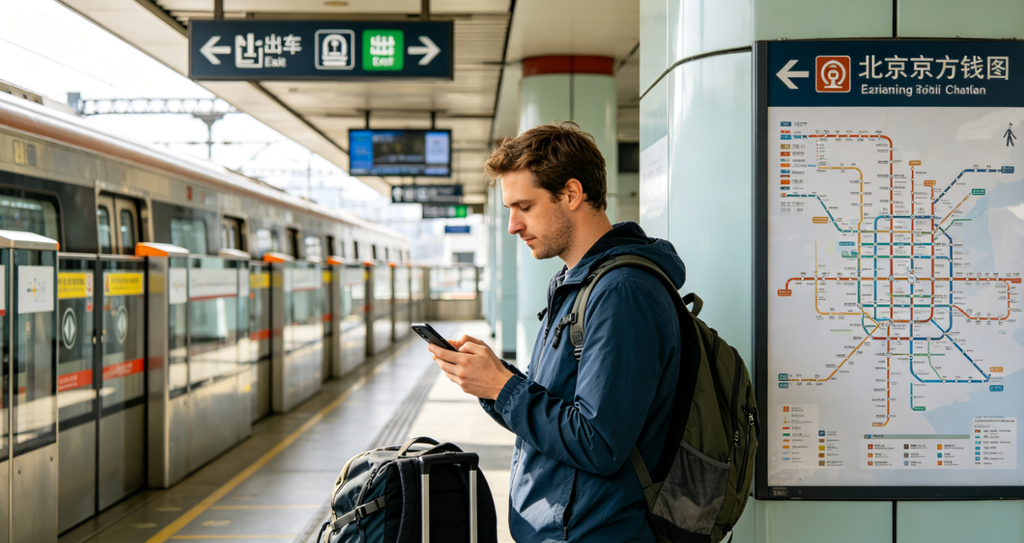
For many foreign visitors, Beijing’s subway is the backbone of city transportation.
It connects many of the city’s major sightseeing areas and avoids one of Beijing’s biggest transportation problems:
road traffic.
When traffic is heavy, a journey that looks short on a map can take much longer by car.
The metro is much less affected by road congestion.
That makes it especially useful when traveling between major areas of the city.
2. Why the Metro Works So Well for Tourists
The subway is particularly useful when:
- Your destination is near a station
- You’re traveling during busy periods
- You don’t have much luggage
- You want predictable travel time
- You’re comfortable walking after exiting the station
For example, if your hotel is near a subway station and your destination is also close to another station, the metro can be significantly more efficient than taking a car across the city.
3. But Don’t Assume the Metro Is Always Best
A subway journey isn’t necessarily faster simply because trains avoid traffic.
You also need to account for:
- Walking to the station
- Finding the correct entrance
- Security screening
- Walking through large stations
- Transfers
- Walking from the destination station
A route that looks like:
20-minute drive
might become:
10-minute walk + 25-minute subway + transfer + 15-minute walk
The metro wins in some situations, but not all.
This is why travelers should think about door-to-door travel time, not just the time shown on a subway map.
4. Beijing’s Subway Stations Can Be Much Larger Than Expected
Foreign tourists sometimes underestimate the amount of walking involved inside major stations.
You may need to:
- Walk through long corridors
- Follow multiple signs
- Change platforms
- Exit through a specific gate
- Walk several minutes after reaching the destination
When planning your day, don’t assume that arriving at the station means you’ve arrived at the attraction.
5. Use Taxis When Convenience Matters More Than Predictability
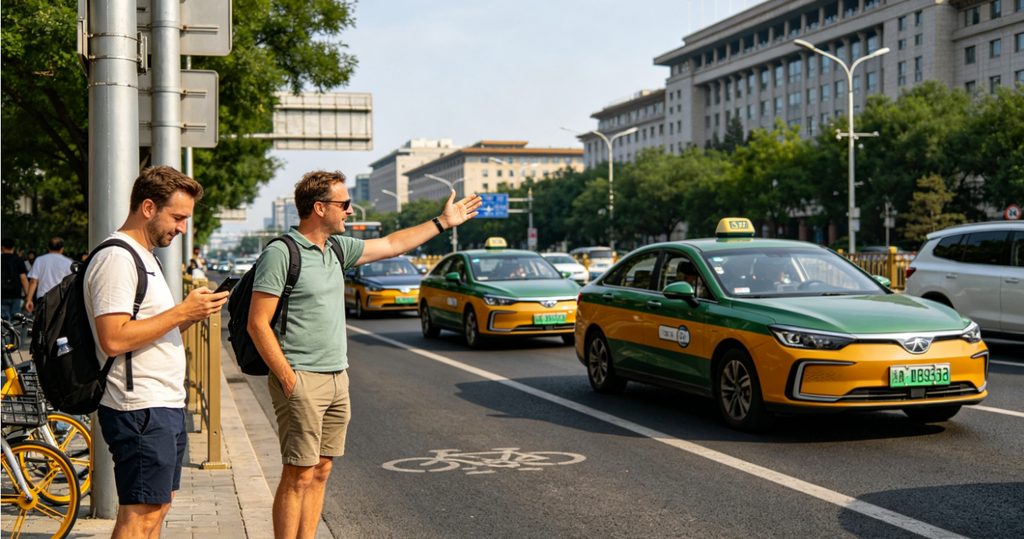
Taxis are useful for relatively short journeys or situations where you don’t want to deal with transfers.
They’re particularly convenient when:
- You’re carrying luggage
- You’re traveling with children
- You’re tired after a long sightseeing day
- Your destination isn’t near a subway station
- You are traveling with several people
The main disadvantage is traffic.
During peak periods, the same road journey can take substantially longer.
6. Ride-Hailing Can Be More Convenient Than Traditional Taxis
Ride-hailing is another useful option for foreign visitors.
The major advantage is that you can usually enter your destination digitally rather than explaining an unfamiliar Chinese address verbally.
That can reduce communication problems.
However, you should prepare the necessary app, payment method and account setup before you actually need the service.
Don’t wait until you’re standing outside a railway station with luggage to figure it out.
7. Airport Transportation Requires Different Thinking
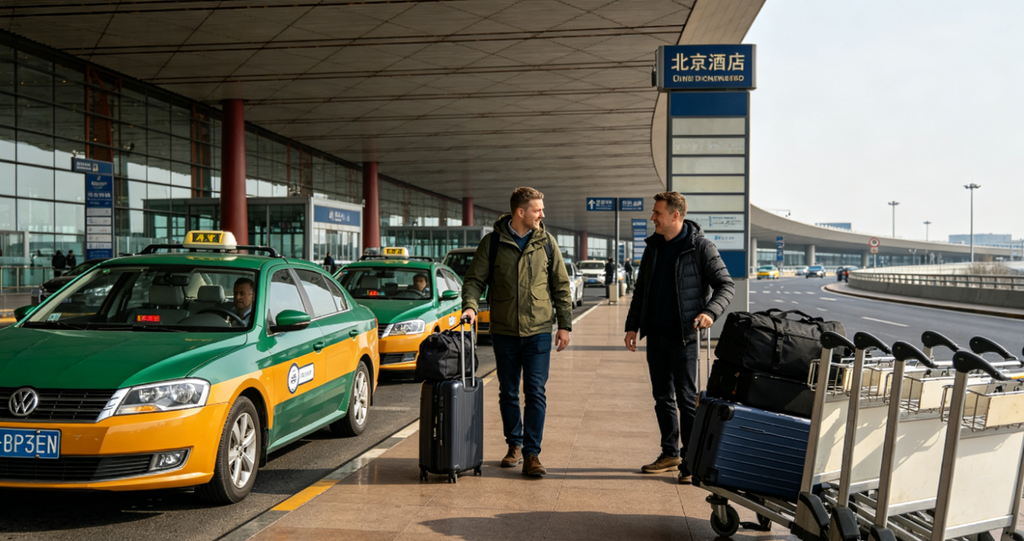
Getting from Beijing Capital International Airport or Beijing Daxing International Airport to your hotel is different from traveling around the city center.
You may have:
- Large luggage
- Jet lag
- Limited knowledge of Beijing
- A hotel address you don’t recognize
- A late-night or early-morning arrival
The cheapest option isn’t always the most practical.
If you’re traveling alone with minimal luggage, public transportation may work well.
For families or groups with several suitcases, a direct transfer can be worth paying for.
8. Metro vs Taxi: Which Should You Choose?
Here’s a simple comparison.
| Situation | Better Choice |
|---|---|
| Rush hour | Metro |
| Heavy luggage | Taxi / ride-hailing |
| Short journey | Taxi / walking |
| Long cross-city trip | Metro |
| Several travelers | Taxi may be convenient |
| Destination near station | Metro |
| Destination far from station | Taxi / ride-hailing |
| Late-night travel | Taxi / ride-hailing |
| Unfamiliar neighborhood | Ride-hailing |
The key is not loyalty to one transportation method.
It’s matching the method to the journey.
9. Walking Is More Useful Than Many Visitors Expect
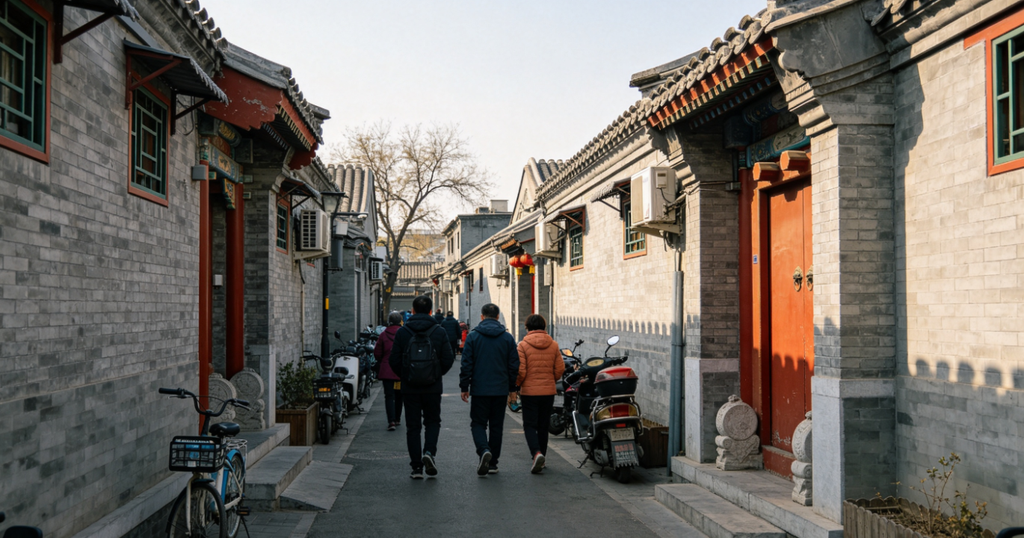
Beijing is a huge city, but individual sightseeing areas can be very walkable.
Walking works particularly well in:
- Hutong neighborhoods
- Historic streets
- Palace and temple areas
- Parks
- Traditional commercial districts
You can also discover things you would never notice from a taxi window.
A small restaurant, courtyard entrance, neighborhood market or local shop can become part of the experience.
10. Don’t Walk Across Beijing
Walking is excellent for exploring a neighborhood.
It is not an efficient way to cross the entire city.
This sounds obvious, but travelers sometimes underestimate Beijing’s scale.
A map may show two attractions that appear relatively close together.
In reality, you may encounter:
- Large roads
- Long blocks
- Restricted entrances
- Huge attractions
- Multiple pedestrian crossings
Use walking strategically rather than treating it as your primary citywide transportation method.
11. Bicycles Are Good for Short Neighborhood Trips
Bicycles can be useful for visitors who enjoy independent exploration.
They work particularly well for:
- Hutong areas
- Short distances
- Neighborhood exploration
- Flexible sightseeing
However, cycling isn’t necessarily the best choice for every visitor.
Traffic conditions, weather, road layouts and bicycle availability all matter.
For first-time visitors unfamiliar with local traffic patterns, walking can sometimes be simpler.
12. What About Beijing Buses?
Buses provide extensive coverage and can reach areas that aren’t immediately convenient by subway.
However, they are generally more challenging for first-time foreign visitors.
Potential difficulties include:
- Understanding routes
- Identifying stops
- Knowing where to get off
- Navigating Chinese-language information
- Dealing with route changes
If you already understand Beijing’s transportation system, buses can be extremely useful.
If this is your first day in China, the metro is usually easier to learn.
13. When Private Transportation Makes More Sense
Private transportation becomes particularly valuable when your itinerary includes multiple destinations that are difficult to connect efficiently by public transit.
For example:
Hotel → Great Wall → another attraction → restaurant → hotel
may involve several transportation changes.
A private vehicle can turn this into a continuous journey.
This is especially useful for:
- Families
- Small groups
- Travelers with limited time
- Travelers carrying luggage
- Visitors who prefer convenience
The trade-off is cost.
14. The Great Wall Is a Different Transportation Problem

One of the biggest mistakes visitors make is treating the Great Wall like another downtown attraction.
It isn’t.
The Great Wall sections around Beijing are outside the central city and require additional travel time.
Your transportation choice can significantly affect your day.
For a Great Wall visit, consider:
- Distance from your hotel
- Which section you’re visiting
- Public transportation availability
- Return transportation
- Hiking time
- Weather
- Group size
If you’re only in Beijing for a few days, transportation efficiency becomes particularly important.
15. Don’t Plan the Great Wall and Several Downtown Attractions Too Aggressively
A Great Wall visit can easily occupy most of a day.
The mistake is planning:
Great Wall → Forbidden City → Temple of Heaven → dinner
as though these were four neighboring attractions.
They aren’t.
Give the Great Wall its own time.
Your itinerary will be more realistic and much less stressful.
16. How to Get Around Beijing With Luggage
Luggage changes the equation completely.
A route that is perfectly reasonable without luggage can become frustrating when you’re carrying two suitcases.
With luggage, prioritize:
- Direct routes
- Fewer transfers
- Easy station access
- Short walking distances
- Reliable transportation
For airport arrival and hotel transfers, convenience may be more valuable than saving a relatively small amount of money.
17. Traveling With Children
Families should avoid building an itinerary around the assumption that everyone can walk indefinitely.
Children may need:
- Breaks
- Food
- Bathrooms
- Shorter transfers
- Flexible timing
A practical strategy is:
Metro for long predictable journeys
taxi or ride-hailing for the final connection
This hybrid approach often works better than using one transportation method exclusively.
18. Traveling With Older Family Members
The same principle applies to older travelers.
The subway itself may be perfectly manageable, but the walking required inside large stations and attractions can add up.
Consider using cars for:
- Hotel departures
- Late-day returns
- Short connections
- Places with inconvenient subway access
This lets you preserve energy for sightseeing itself.
19. Avoid Crossing the City Repeatedly
One of the biggest improvements you can make to a Beijing itinerary is reducing unnecessary backtracking.
Imagine this schedule:
East Beijing → West Beijing → North Beijing → East Beijing
Even if every attraction is excellent, the transportation will consume a large part of the day.
Instead, group attractions geographically.
For example:
Morning attraction
↓
nearby lunch
↓
afternoon attraction
↓
nearby dinner
This simple principle can save hours over several days.
20. Plan Your Route Before Choosing Your Transportation
Don’t start with:
“Should I take the subway?”
Start with:
“What is the most efficient way to get from here to there?”
Then compare:
- Metro
- Taxi
- Ride-hailing
- Walking
- Bicycle
- Private transportation
This is a much better way to think about the best ways to get around Beijing.
21. Don’t Optimize for the Cheapest Trip
Budget matters, but transportation is one area where saving a small amount can sometimes cost significant time.
For example:
A cheap route might require:
two subway transfers + 20 minutes walking
while a car might take you directly to the entrance.
If you’re traveling for only three or four days, the value of your time can be considerable.
22. Don’t Optimize for Convenience Either
The opposite mistake is taking a taxi everywhere.
This can create problems because Beijing traffic is unpredictable.
A car may be comfortable but still slower than the metro during peak hours.
The best strategy is therefore:
metro when traffic is the problem
and
car when transfers or walking are the problem.
23. A Hybrid Transportation Strategy Works Best
For most visitors, a practical combination looks like this:
Metro
Use it for long journeys across the city.
Walking
Use it within historic neighborhoods and attraction areas.
Taxi / Ride-Hailing
Use it when you have luggage, are tired, or need door-to-door service.
Private Transportation
Use it for complicated day trips or when convenience is particularly important.
Bus
Use it when you understand the route and it provides a clear advantage.
This is generally more efficient than relying on only one option.
24. How to Make Beijing Public Transportation Easier
You don’t need to become a transportation expert before your trip.
Instead, prepare a few basics.
Before arriving:
- Understand the major subway lines near your hotel
- Save your hotel address
- Know how to enter Chinese addresses into navigation tools
- Prepare a payment method
- Understand how you’ll travel from the airport
- Check the route to your first major attraction
A little preparation can remove a lot of friction.
25. Keep Your Hotel Address Available
This is one of the simplest but most useful travel habits.
Save your hotel’s:
- Chinese name
- Chinese address
- Phone number
A screenshot can be useful if you lose internet access or need to show the address to a driver.
Don’t rely entirely on remembering the English hotel name.
26. Leave Extra Time for Major Attractions
Transportation isn’t the only source of delay.
Popular attractions can involve:
- Security checks
- Ticket verification
- Queues
- Large walking distances
- Entrance restrictions
If your transportation plan gives you only five minutes of flexibility, it’s probably too tight.
Build reasonable buffers into your schedule.
27. Your Transportation Plan Should Follow Your Attraction Schedule
A strong Beijing itinerary isn’t simply:
Attractions + restaurants + hotels
It should also consider:
how you move between them.
When you plan Beijing trip logistics properly, transportation becomes part of the itinerary rather than something you figure out after booking everything.
This is particularly important if you have fixed-entry attractions or limited time.
28. A Practical Transportation Strategy for a 3-Day Trip
If you’re visiting for only three days, efficiency matters.
Day 1
Use the metro for central sightseeing.
Walk between nearby attractions where practical.
Use a taxi or ride-hailing service for dinner or the return journey if you’re tired.
Day 2
Use direct transportation for the Great Wall.
Avoid adding several unrelated attractions afterward.
Day 3
Combine metro and walking for central neighborhoods.
Use cars selectively when they save substantial time.
29. A Practical Strategy for a 5-Day Trip
With five days, you have more flexibility.
You can use public transportation for most city sightseeing while reserving private transportation or taxis for less convenient routes.
For example:
Day 1: Metro + walking
Day 2: Private transfer / organized transportation for Great Wall
Day 3: Metro + walking
Day 4: Metro + taxi
Day 5: Flexible combination
This avoids spending money on private transportation when you don’t need it.
30. Transportation for Evening Activities
Evenings are often when visitors change their transportation habits.
After a long day, you may not want to:
- Walk 20 minutes to a station
- Transfer twice
- Navigate a large station
A short taxi or ride-hailing trip can make sense.
The goal isn’t maximum transportation efficiency at every moment.
It’s maintaining enough energy to enjoy the evening.
31. What About Using a Private Tour?
A private tour can solve several transportation problems at once.
Depending on the service, it may combine:
- Transportation
- Attraction planning
- Local guidance
- Restaurant recommendations
- Route optimization
This can be particularly useful when visiting the Great Wall or combining several geographically separated locations.
However, independent travelers who are comfortable with public transportation can easily explore much of central Beijing themselves.
32. Which Transportation Method Is Best for Different Travelers?
Solo Budget Traveler
Metro + walking
Best for keeping costs low while maintaining independence.
Couple
Metro + walking + occasional taxi
Good balance between cost and convenience.
Family With Children
Metro + taxi/ride-hailing
Reduces unnecessary walking and transfers.
Older Travelers
Taxi/ride-hailing + selective metro
Prioritize comfort and energy management.
Small Group
Taxi or private transportation
Can become cost-effective when divided among several people.
First-Time International Visitor
Metro + ride-hailing + occasional private transportation
This gives you flexibility without requiring complete familiarity with the city.
33. Common Transportation Mistakes Foreign Tourists Make
Mistake 1: Using Taxis Everywhere
Traffic can destroy your schedule.
Mistake 2: Using the Metro for Every Journey
Transfers and walking can make some routes unnecessarily complicated.
Mistake 3: Underestimating Beijing’s Size
The city is much larger than many visitors expect.
Mistake 4: Ignoring Geography
Cross-city backtracking wastes time.
Mistake 5: Planning Too Many Attractions
Transportation time is part of your itinerary.
Mistake 6: Forgetting Luggage
A route that’s easy without luggage may be inconvenient with two suitcases.
Mistake 7: Leaving No Buffer
A perfectly timed itinerary can collapse after one delayed journey.
34. A Simple Rule for Choosing Transportation
When you’re unsure, ask five questions:
1. Is the route long?
If yes, check the metro first.
2. Is traffic likely to be heavy?
If yes, favor the metro.
3. Do you have luggage?
If yes, favor direct transportation.
4. Are you traveling with children or older family members?
If yes, reduce transfers and walking.
5. Is this a Great Wall or out-of-city trip?
If yes, consider direct transportation or a private option.
These five questions can solve most transportation decisions.
35. The Best Transportation Strategy Is Not the Same Every Day
Your transportation needs change throughout your trip.
A sightseeing-heavy day may favor the metro.
A food-focused evening may favor walking and short taxi rides.
A Great Wall day may require private transportation.
An airport day may prioritize convenience.
This is why a flexible approach is more useful than trying to decide before the trip that you’ll “only use the subway.”
36. Don’t Forget That Walking Is Part of the Experience
Transportation isn’t only about getting from A to B.
Walking through Beijing can be part of the attraction.
In hutongs, historic neighborhoods and local streets, walking allows you to experience:
- Architecture
- Shops
- Restaurants
- Courtyards
- Local routines
- Street life
Sometimes the best part of the route is the part that isn’t on your itinerary.
37. How to Build a Transportation-Friendly Beijing Itinerary
Start with the attractions.
Then divide them into geographic groups.
For each day, identify:
Starting point
↓
Morning attraction
↓
Lunch area
↓
Afternoon attraction
↓
Dinner area
↓
Hotel
Then choose transportation for each connection.
This method is much more effective than choosing attractions first and trying to solve transportation afterward.
38. A Useful Way to Think About Travel Time
Don’t ask:
“How long is the subway ride?”
Ask:
“How long will the entire journey take?”
Include:
- Walking to the station
- Waiting
- Security
- Transfers
- Walking from the station
- Finding the attraction entrance
Do the same for taxis:
- Waiting for the car
- Traffic
- Drop-off location
- Walking to the entrance
This gives you a much more realistic comparison.
39. What Should Foreign Tourists Prioritize?
For most visitors, prioritize these three things:
Reliability
You don’t want transportation uncertainty to destroy a timed attraction.
Simplicity
A slightly more expensive direct route may be worthwhile if it eliminates complicated transfers.
Geography
The best route is often the one that keeps your day’s attractions close together.
Once these three factors are considered, transportation becomes much easier to manage.
40. Final Recommendation
So, what are the best ways to get around Beijing for foreign tourists?
There isn’t one universal answer.
For most travelers:
Use the metro for long city journeys.
Walk when exploring individual neighborhoods.
Use taxis or ride-hailing when you need door-to-door convenience.
Consider private transportation for the Great Wall and complicated day trips.
Use buses selectively if you’re comfortable navigating local routes.
The biggest improvement you can make isn’t learning every transportation option.
It’s designing your itinerary so that you don’t need to travel unnecessarily in the first place.
Final Takeaway
Beijing is much easier to navigate when you stop thinking of transportation as a single system.
Think of it as a toolbox.
Metro gives you speed and predictability.
Walking gives you flexibility and local atmosphere.
Taxi and ride-hailing give you convenience.
Private transportation gives you efficiency for complex routes.
Buses and bicycles provide additional flexibility when they suit the situation.
For first-time foreign visitors, the most effective approach is usually a hybrid transportation strategy rather than relying exclusively on either public transit or cars.
And if you want a more detailed explanation of individual routes, [how to get around Beijing] can serve as a broader reference when planning your daily movements.
The goal isn’t to spend your vacation mastering Beijing’s transportation network.
The goal is to use the right transportation at the right time—and spend your valuable travel hours experiencing the city instead of sitting in traffic or making unnecessary transfers.