
Beijing Transportation Guide: How to Get Around Beijing
Quick Answer
For first-time visitors, the easiest way to get around Beijing is usually a combination of the subway, walking, taxis or ride-hailing, and occasional private transfers.
Beijing is a huge city, so there is no single transportation method that works best everywhere.
A practical approach is:
- Subway for major attractions and long urban journeys
- Walking for historic neighborhoods and attractions close together
- Taxi or ride-hailing when carrying luggage or traveling with children
- Airport transfer when arriving or departing with bags
- Private transportation for destinations such as the Great Wall
- High-speed rail for trips to other Chinese cities
The key is not simply choosing the cheapest option.
You want to balance travel time, convenience, walking distance, traffic, luggage, weather and the location of your attractions.
Understanding Beijing’s Geography Before You Travel
One of the most important things first-time visitors need to understand is that Beijing is much larger than its historic center suggests.
The Forbidden City, Tiananmen Square, Temple of Heaven and many hutongs are relatively central.
But other popular destinations can be much farther apart.
For example:
- Beijing Capital International Airport is outside the central area.
- Daxing International Airport is even farther from central Beijing.
- The Great Wall is outside the urban core.
- The Summer Palace is northwest of central Beijing.
- Universal Beijing Resort is in the east.
- Many modern hotels and residential districts are far from the traditional tourist center.
This means two attractions that look relatively close on a general map may still require significant travel time.
Before planning each day, check actual door-to-door travel time, not just the distance between two points.
Beijing Transportation at a Glance
| Transportation | Best For | Main Advantage | Main Limitation |
|---|---|---|---|
| Subway | City sightseeing | Fast and predictable | Walking and transfers |
| Taxi | Short or direct trips | Door-to-door | Traffic |
| Ride-hailing | Convenient city travel | Easy pickup | App/payment setup |
| Bus | Local routes | Extensive coverage | Harder for first-time visitors |
| Walking | Nearby attractions | Free and flexible | Distance/weather |
| Bike | Short neighborhood trips | Flexible | Traffic and weather |
| Airport transfer | Luggage-heavy trips | Convenient | Higher cost |
| Private vehicle | Great Wall / groups | Efficient | Higher cost |
| High-speed rail | Intercity travel | Fast | Requires advance planning |
For most first-time travelers, you don’t need to master every transportation option.
The subway plus taxis or ride-hailing will cover most city sightseeing needs.
1. Beijing Subway: The Best Option for Many City Trips
The subway is usually the backbone of urban transportation for visitors.
It connects many major tourist areas and avoids much of Beijing’s road traffic.
The biggest advantage is predictability.
A road journey that takes much longer during rush hour may be relatively straightforward by subway.
When Should You Use the Subway?
The subway works particularly well when:
- Your destination is near a station
- Traffic is heavy
- You are traveling during busy periods
- You want predictable travel times
- You’re traveling between major districts
It is especially useful for first-time visitors staying near a convenient station.
How to Use the Beijing Subway
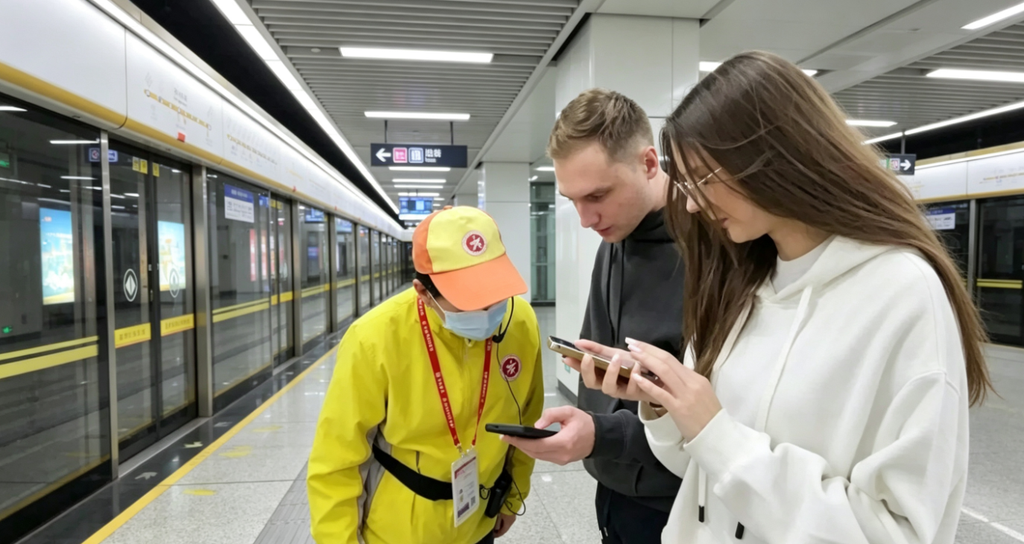
The basic process is straightforward:
Enter station → security check → buy or scan ticket → follow line signs → transfer if necessary → exit at the correct station
The stations can be large, so allow extra time when transferring.
Don’t judge a journey only by the number of subway stops.
You may still need:
- Walking between platforms
- Long underground corridors
- An exit several hundred meters from your destination
- Additional walking after leaving the station
Which Subway Exit Should You Use?
This is an underrated issue.
Large Beijing subway stations can have many exits.
Choosing the wrong exit can turn a short walk into a frustrating detour.
When navigating, pay attention to:
- Exit letters or numbers
- Nearby landmarks
- Street names
- Shopping centers
- Hotel names
Before leaving the station, confirm that you’re heading toward the correct side of the road.
This is especially useful when traveling with luggage.
2. Taxi and Ride-Hailing
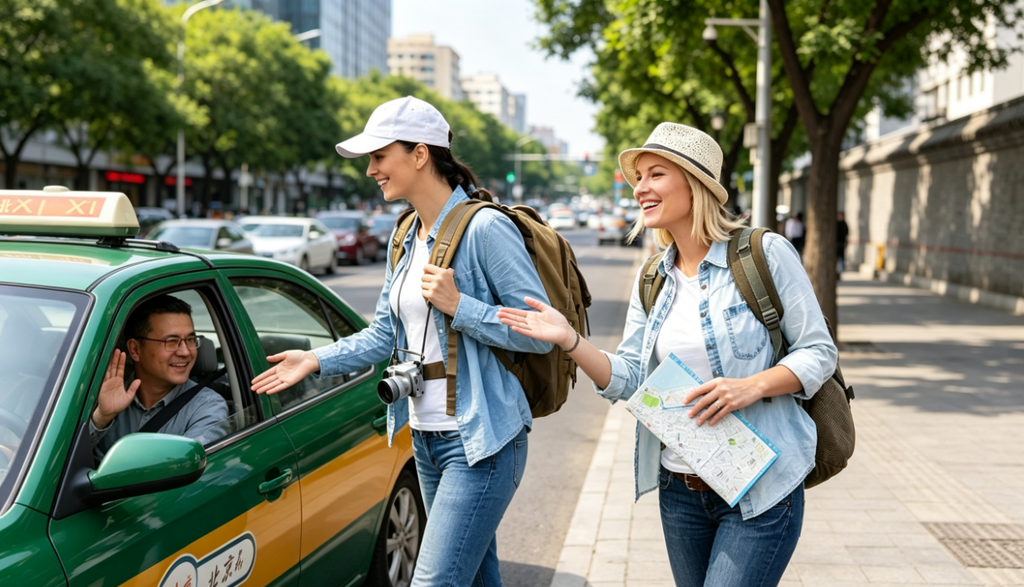
Taxis are useful when the subway isn’t convenient.
They are particularly valuable for:
- Hotels far from subway stations
- Short trips between attractions
- Late-night travel
- Travelers with luggage
- Families with young children
- Travelers who want door-to-door transportation
Traffic is the main disadvantage.
During peak commuting periods, a taxi can take much longer than expected.
For that reason, compare the route with the subway before deciding.
Taxi vs. Ride-Hailing
Ride-hailing can be more convenient for international visitors because you can enter the destination digitally instead of explaining an address to a driver.
However, visitors should make sure their phone, payment method and required apps are working before depending on them.
It’s also wise to keep your hotel address saved in Chinese.
If your phone battery is low, having the hotel information available offline can be extremely useful.
3. Walking in Central Beijing
Walking is often underestimated.
Some historic areas are best explored on foot because driving between nearby attractions can actually make the experience slower.
Walking works particularly well for:
- Hutongs
- Historic neighborhoods
- Shopping streets
- Temple areas
- Parks
- Attractions located close together
But Beijing’s scale means you should distinguish between:
walking around an area
and
walking between distant attractions.
The first can be enjoyable.
The second may become exhausting.
Walking + Subway Is Often the Best Combination
For many sightseeing days, the most efficient pattern is:
Subway → walk → attraction → walk → subway
This gives you the predictability of public transportation while allowing you to explore neighborhoods on foot.
Don’t try to use the subway for every short movement.
Sometimes a 15-minute walk is easier than entering a large station, passing security, taking a train and walking out again.
4. Public Buses
Beijing has an extensive bus network.
Buses can reach places that are less convenient by subway.
However, they are generally more difficult for first-time international visitors because:
- Routes can be complicated
- Stops may be difficult to identify
- Traffic affects travel time
- Navigation can be less intuitive
For experienced travelers, buses can be useful.
For a first trip, however, the subway is usually easier to understand.
5. Airport Transportation
Beijing has two major international airports:
- Beijing Capital International Airport
- Beijing Daxing International Airport
The best transportation option depends on:
- Your arrival time
- Hotel location
- Luggage
- Number of travelers
- Budget
- Whether you have children
Beijing Capital International Airport
Beijing Capital International Airport is northeast of central Beijing.
Travelers can use combinations of:
- Airport rail services
- Subway
- Taxi
- Ride-hailing
- Private transfer
For solo travelers with light luggage, public transportation can be practical.
For families or groups arriving after a long international flight, door-to-door transportation can be much more comfortable.
Beijing Daxing International Airport
Daxing Airport is south of central Beijing.
Its distance from many tourist areas means travelers should consider the total journey rather than simply choosing the cheapest transportation.
If you arrive with several suitcases, a direct transfer may save significant effort.
6. Getting to the Great Wall
This is where transportation planning becomes especially important.
The Great Wall is not one single attraction.
Different sections are located in different directions and have different transportation requirements.
Popular sections include:
- Mutianyu
- Badaling
- Jinshanling
You should therefore choose the Great Wall section first, then decide how to get there.
Mutianyu
Mutianyu is popular with international visitors because of its scenery and restored sections.
Transportation options can include:
- Private vehicle
- Tour transportation
- Public transportation
- Taxi or ride-hailing combinations
For families and small groups, private transportation is often more convenient because the journey involves more than simply getting from one subway station to another.
If your priority is minimizing transportation complexity, [Great Wall tours from Beijing] can combine transportation with the sightseeing itinerary rather than requiring you to organize each part independently.
Badaling
Badaling is one of the most accessible Great Wall sections from Beijing.
Its relatively convenient rail connections make it attractive to travelers who prefer independent transportation.
However, accessibility also means it can become very busy.
When choosing between Badaling and Mutianyu, don’t consider transportation alone.
Also compare:
- Crowds
- Scenery
- Hiking difficulty
- Travel time
- Season
- Your group’s physical ability
Jinshanling
Jinshanling is farther from central Beijing and is particularly attractive to travelers interested in hiking and dramatic scenery.
Because of the distance, transportation requires more planning.
A private vehicle or organized tour can be more practical than attempting to combine several public transportation connections.
7. Transportation for the Forbidden City
The Forbidden City is located in central Beijing and is generally easy to combine with other central attractions.
However, remember that vehicles cannot simply drop visitors anywhere they want immediately next to every entrance.
You may need to walk from your transportation drop-off point.
This is another reason to think in terms of door-to-door travel time, not simply driving distance.
When planning a Forbidden City day, allow time for:
- Security procedures
- Entrance procedures
- Walking
- The size of the complex
- Transportation before and after the visit
8. Transportation for the Summer Palace
The Summer Palace is northwest of central Beijing.
The subway can be a practical choice, depending on your hotel and itinerary.
However, the site itself is large.
Even after reaching the correct station, expect substantial walking.
This is an important lesson for Beijing transportation:
Arriving at the attraction is only part of the journey.
Always consider the walking required after you get off the train.
9. How to Get Around Beijing With Luggage
Transportation preferences change significantly when you’re carrying luggage.
With no luggage
Subway + walking is often ideal.
With one suitcase
Subway can still be practical if your hotel is close to a station.
With multiple suitcases
Taxi or ride-hailing becomes more attractive.
With a family
Door-to-door transportation may save time and energy even if it costs more.
The cheapest option isn’t always the most efficient option.
10. Traveling With Children
Families should consider more than transportation cost.
Think about:
- Walking distance
- Station stairs
- Crowded platforms
- Weather
- Meal timing
- Bathroom access
- Luggage
- Nap schedules
A route that looks efficient on Google Maps may not be efficient with young children.
For families, it can be better to reduce the number of transportation changes.
For example:
Hotel → direct vehicle → attraction → lunch → direct vehicle → hotel
may be much more comfortable than:
Walk → subway → transfer → walk → attraction → subway → transfer → walk
even if the second option is cheaper.
11. Transportation During Beijing Rush Hour
Beijing traffic can become significantly slower during peak commuting periods.
Morning and evening rush hours can affect:
- Taxis
- Ride-hailing
- Buses
- Private vehicles
The subway is often more predictable during these periods.
If you have a timed attraction reservation, avoid depending on an uncertain road journey when a reliable subway route is available.
12. Transportation at Night
Central Beijing is generally active into the evening, but transportation options become more limited later at night.
If you plan to stay out late:
- Check the last subway train
- Keep your hotel address available
- Make sure your phone has sufficient battery
- Have a backup payment method
- Consider a taxi or ride-hailing service
Don’t assume the subway will always be available when you finish dinner.
13. Payment and Mobile Apps
Digital payment is deeply integrated into everyday transportation in Beijing.
Before your trip, make sure you have a reliable way to:
- Pay for transportation
- Use navigation
- Translate Chinese
- Book rides
- Access your hotel information
International travelers should also make sure their payment cards and mobile services work in China before relying on them.
It is worth preparing a backup.
For example:
phone payment + physical card + some emergency cash
is safer than depending on a single method.
14. Should You Rent a Car in Beijing?
For most first-time visitors, renting a car is unnecessary.
Driving in Beijing can involve:
- Heavy traffic
- Complex roads
- Parking difficulties
- Local driving requirements
- Navigation challenges
The subway, taxis, ride-hailing and private transfers generally make more sense.
A private vehicle becomes more useful when you’re traveling to destinations outside the urban core, especially when several people are sharing the cost.
15. Public Transportation vs. Private Transportation
There isn’t one universally best option.
| Situation | Better Choice |
|---|---|
| Central sightseeing | Subway |
| Short local trip | Walk |
| Heavy luggage | Taxi / ride-hailing |
| Family with young children | Taxi / private vehicle |
| Rush hour | Subway |
| Great Wall | Private transfer / tour |
| Multiple attractions far apart | Combination |
| Late night | Taxi / ride-hailing |
| Intercity travel | High-speed rail |
The best Beijing transportation strategy is usually a combination rather than a single mode.
How to Plan Transportation Around Your Sightseeing
A common first-time mistake is planning attractions first and transportation second.
Instead, group attractions geographically.
For example, a day focused on central Beijing can combine several nearby attractions rather than crossing the city multiple times.
A more efficient daily structure might look like:
Hotel → central attraction → nearby attraction → lunch → neighborhood walk → dinner → hotel
rather than:
Hotel → east Beijing → west Beijing → central Beijing → east Beijing
The second itinerary wastes time in transit.
Build Your Route Around Neighborhoods
Think of Beijing as a collection of areas rather than one destination.
For example:
Central Historic Beijing
Good for:
- Forbidden City
- Tiananmen area
- Hutongs
- Traditional neighborhoods
Northwest Beijing
Good for:
- Summer Palace
- Other imperial gardens
- University areas
Great Wall Day
Treat the Wall as a separate major excursion.
Modern Beijing
Explore shopping districts, contemporary architecture and entertainment areas separately.
This geographical approach makes your itinerary more realistic.
How Transportation Affects Your Beijing Budget
Transportation costs can vary considerably depending on your choices.
Lowest Cost
Subway + walking.
Moderate Cost
Subway + occasional taxi.
Higher Cost
Frequent taxis or ride-hailing.
Premium Convenience
Private vehicle with driver.
For solo travelers, public transportation can be extremely economical.
For a family or group of four or more, however, the cost difference between multiple taxis and a private vehicle may be smaller than expected.
The calculation should include time and convenience, not just the ticket price.
Common Transportation Mistakes First-Time Visitors Make
Mistake 1: Underestimating Beijing’s Size
Two attractions may look close on a map but require substantial travel time.
Mistake 2: Using Taxis During Every Rush Hour
Traffic can make road journeys unpredictable.
Mistake 3: Ignoring Walking Distance
The subway station isn’t necessarily next to the attraction entrance.
Mistake 4: Planning Too Many Attractions in One Day
Transportation between attractions consumes time.
Mistake 5: Forgetting the Return Journey
It’s easy to plan how to reach a destination and forget how you’ll get back.
Mistake 6: Not Preparing Digital Payment
Transportation becomes much easier when your payment setup works before you need it.
How to Make Beijing Transportation Easier
A few preparations can dramatically reduce stress.
Save Your Hotel Address in Chinese
This is useful for taxis, ride-hailing and asking for directions.
Download Offline Information
Have important addresses and reservations available even if your connection fails.
Check Routes the Night Before
Don’t wait until you’re standing outside your hotel.
Leave Extra Time
Especially for:
- Airport departures
- Timed attractions
- Great Wall trips
- Railway stations
Avoid Overloading Each Day
Three well-connected attractions can be better than six attractions spread across the city.
How Transportation Fits Into a Beijing Trip
Transportation should influence your itinerary from the beginning.
For example, if your hotel is near a subway station, you can build more days around public transportation.
If you’re staying far from the center, you may want to group central attractions into fewer days.
If you’re traveling with children, reduce transfers.
If the Great Wall is a priority, treat it as a dedicated excursion rather than squeezing it between central attractions.
This is why a [custom Beijing itinerary] can be useful: transportation, sightseeing, meal locations and daily pace can be planned together instead of separately.
A Practical Transportation Strategy for a 3-Day Beijing Trip
Day 1: Central Beijing
Use:
Subway + walking
Group central attractions together.
Avoid unnecessary taxi rides between nearby sites.
Day 2: Great Wall
Use:
Private transfer or organized transportation
The Great Wall is far enough from central Beijing that transportation planning deserves its own attention.
Day 3: Northwest Beijing
Use:
Subway + walking + taxi if necessary
Group destinations such as the Summer Palace with other nearby experiences rather than crossing the city repeatedly.
A Practical Strategy for a 5-Day Trip
With five days, you have more flexibility.
You can dedicate:
- One day to central Beijing
- One day to the Great Wall
- One day to imperial gardens and northwest Beijing
- One day to hutongs and local neighborhoods
- One flexible day for shopping, food or attractions you missed
This reduces transportation pressure.
Instead of asking:
“How many attractions can I see?”
ask:
“How many good experiences can I have without spending the day in transit?”
That’s a much better way to plan Beijing.
Is Beijing Easy to Navigate for First-Time Visitors?
Yes, especially once you understand the city’s scale.
The transportation network is extensive, and the subway provides a reliable foundation for many city journeys.
The main challenge isn’t a lack of transportation.
It’s choosing the right transportation for each situation.
Use the subway when predictability matters.
Walk when attractions are close.
Use taxis or ride-hailing when convenience matters.
Use private transportation for destinations where public connections become inefficient.
And always consider the complete journey—not just the train or car ride.
Final Takeaway
For first-time visitors, learning how to get around Beijing is less about mastering every bus route or subway line and more about understanding when to use each option.
The most practical strategy is usually:
Subway for major city travel → walking for neighborhoods → taxis for convenience → private transportation for the Great Wall → high-speed rail for other cities.
Don’t try to force every journey into the cheapest possible transportation method.
Beijing is a large city, and your time is valuable.
A well-planned route that saves an hour of unnecessary travel can be worth far more than the small difference in transportation cost.
Most importantly, plan transportation together with your attractions, meals and daily pace. Once those pieces fit together, Beijing becomes much easier to explore—and your first trip will feel far less complicated.