
How to Travel Around Beijing Without Speaking Chinese
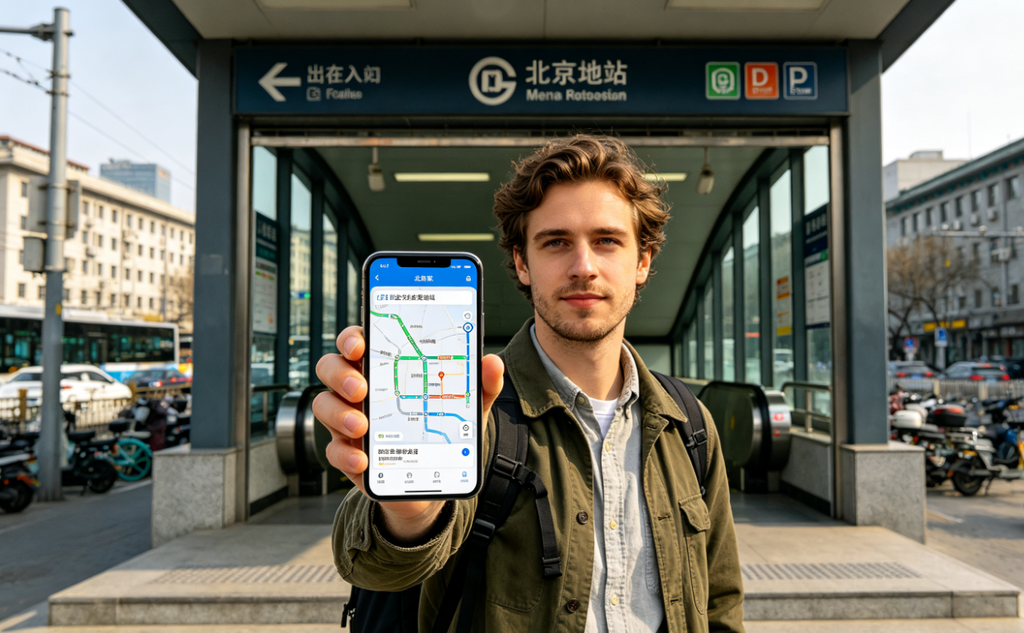
Quick Answer
Yes, you can travel around Beijing without speaking Chinese.
The bigger challenge is not usually the language itself. It is the need to handle Chinese addresses, transportation interfaces, payments, attraction names, restaurant menus, and location changes while moving through a very large city.
The most effective approach is not trying to learn enough Chinese to solve every situation. Instead, create a simple travel system that works even when communication fails:
- Keep destination names and addresses in Chinese.
- Use the subway for journeys where the route is straightforward.
- Use ride-hailing when the destination is difficult to reach or identify.
- Prepare payment methods before leaving your hotel.
- Save important locations offline.
- Use translation tools for longer conversations.
- Keep your hotel address available in Chinese.
- Allow extra time when traveling to unfamiliar areas.
- Treat major attractions, restaurants, and Great Wall sections as separate navigation tasks.
Once these systems are in place, the language barrier becomes much more manageable.
Is Beijing Difficult to Visit Without Speaking Chinese?
Beijing can look intimidating to first-time visitors who do not speak Chinese.
Street signs may use Chinese characters. Restaurant menus may contain unfamiliar names. Drivers may communicate primarily in Chinese. Some ticket machines, websites, and local services may not behave exactly as visitors expect.
But there is an important distinction between not speaking Chinese and not having access to Chinese information.
You may not be able to ask a local person a detailed question in Chinese, but you can still carry:
- A Chinese destination name
- A map pin
- A translated address
- A screenshot
- A QR code
- A reservation confirmation
- A digital translation tool
That changes the nature of the problem.
Instead of asking, “How can I communicate in Chinese?”, the more useful question is:
“How can I make my destination understandable without needing a conversation?”
That shift is the foundation of independent travel in Beijing.
The Real Language Barrier Is Usually About Addresses
One of the most important things to understand before your trip is that place names are not always enough.
A hotel may have an English name that is easy for you to recognize but less useful when communicating with a driver or searching for a local destination.
For example, a hotel could have:
- An English brand name
- A Chinese name
- A Chinese street address
- A map location
- A nearby landmark
These are not interchangeable.
If you are preparing to plan Beijing trip arrangements, save all five whenever possible.
Your essential destination card
For every important place, keep:
English name
Chinese name
Chinese address
Map location
Nearby landmark
This is particularly useful for:
- Hotels
- Restaurants
- Train stations
- Airports
- Great Wall entrances
- Museums
- Shopping areas
- Meeting points
- Private tour pickup locations
If communication breaks down, you can simply show the information.
Keep Chinese Destination Names on Your Phone
Translation is useful, but copying the original Chinese name is often even more practical.
Suppose you want to visit a restaurant.
Rather than showing someone a translated English name, save the restaurant’s Chinese name from its official listing or booking information.
The same principle applies to attractions.
For example, save both:
Forbidden City
故宫
Temple of Heaven
天坛
Summer Palace
颐和园
Beijing Railway Station
北京站
The Chinese version can be copied directly into search tools or shown to staff.
This creates a useful bridge between your English-language travel planning and Beijing’s Chinese-language local environment.
Learn a Few Chinese Words, Not an Entire Language
You do not need conversational Chinese for a short trip.
However, learning a small number of practical words can make everyday interactions easier.
Useful examples include:
| English | Chinese | Pinyin |
|---|---|---|
| Hello | 你好 | nǐ hǎo |
| Thank you | 谢谢 | xièxie |
| How much? | 多少钱? | duōshao qián? |
| Where? | 哪里? | nǎlǐ? |
| Toilet | 洗手间 | xǐshǒujiān |
| Entrance | 入口 | rùkǒu |
| Exit | 出口 | chūkǒu |
| Subway | 地铁 | dìtiě |
| Train station | 火车站 | huǒchēzhàn |
| I don’t understand | 我不明白 | wǒ bù míngbai |
But memorizing vocabulary should not become the main preparation strategy.
A saved address or map pin is usually more useful than knowing twenty additional words.
Use Beijing Public Transportation as a System, Not a Language Test
The subway can be one of the easiest ways to move around Beijing because stations and routes are structured.
The challenge is usually not communicating with another person.
It is understanding:
- Which station you need
- Which line to take
- Where to transfer
- Which exit to use
- How far you need to walk afterward
This is why using Beijing public transportation effectively is more about route preparation than language ability.
Before leaving, check the complete journey rather than only the subway line.
For example:
Hotel → Subway Station → Transfer → Destination Station → Correct Exit → Final Walk
The final step can be surprisingly important.
Beijing stations can be large, and two exits from the same station may lead to very different streets.
Why Subway Exit Numbers Matter
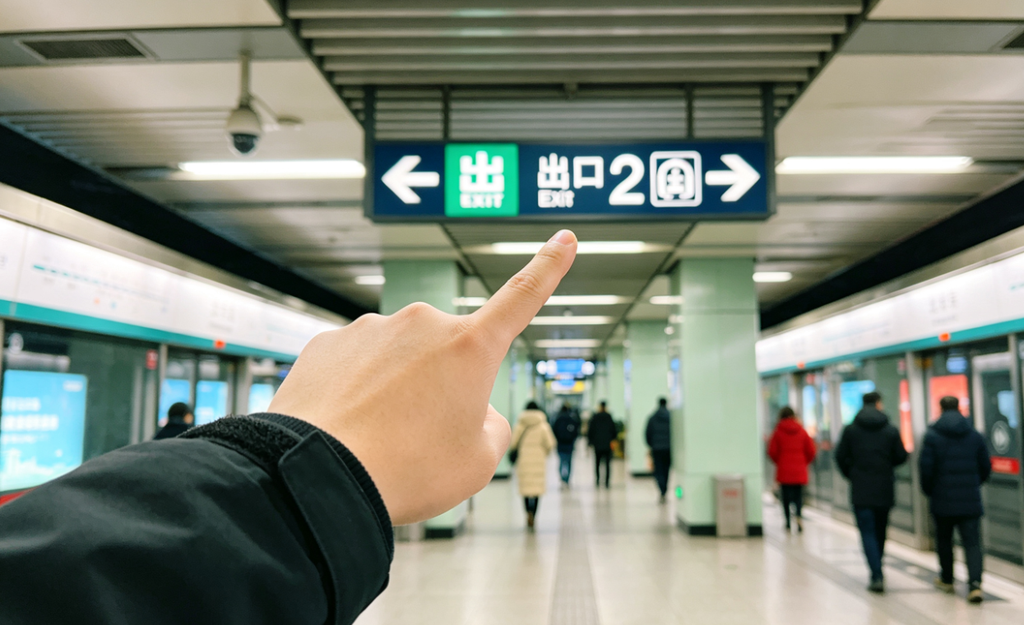
A common mistake for visitors is assuming that reaching the correct subway station means the journey is finished.
It may not be.
A large Beijing station can have several exits, sometimes serving completely different streets, attractions, or commercial areas.
If your map tells you to use Exit C, do not automatically choose Exit A simply because it is closer to where you happen to be standing.
The correct exit can save considerable walking.
This becomes particularly important when:
- You are carrying luggage
- It is hot or cold
- You have a timed reservation
- You are traveling with children
- You are meeting a guide
- You are visiting a large attraction
For a language-limited traveler, good route preparation can replace a surprising amount of verbal communication.
Ride-Hailing Can Reduce the Language Problem
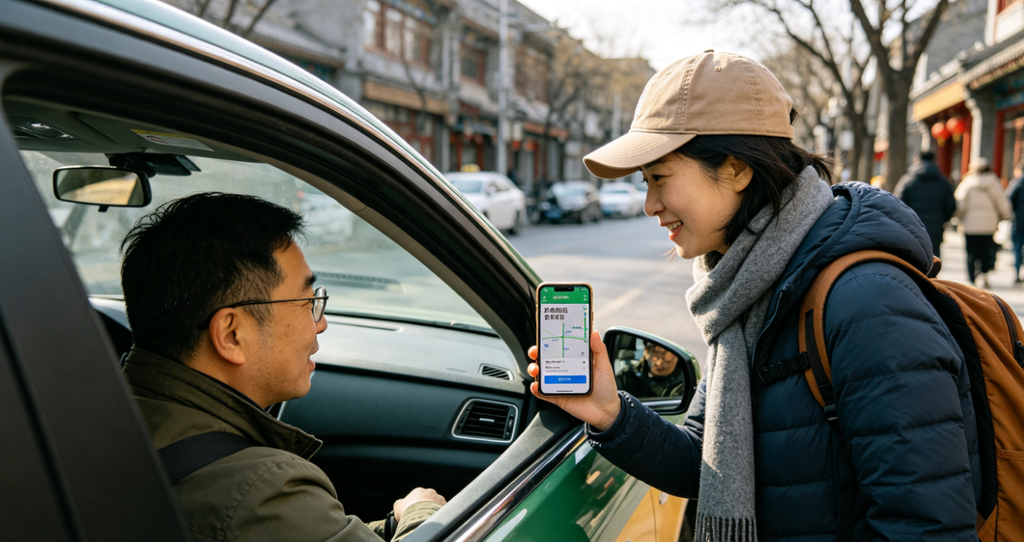
Taxis can involve direct communication.
Ride-hailing can reduce it.
When you use a digital ride-hailing service, the destination can be entered before the driver arrives. The driver can then see the destination through the platform rather than requiring you to explain it verbally.
That does not eliminate every problem.
Drivers may still need clarification about:
- The exact entrance
- Hotel pickup points
- Large shopping complexes
- Restricted roads
- Pedestrian-only areas
- Attraction gates
But a digital destination is generally easier to communicate than an unfamiliar English pronunciation.
The important principle is:
Use technology to transmit the destination instead of trying to describe the destination.
What If a Driver Calls You?
This is one of the situations that can feel stressful for non-Chinese speakers.
A driver may call because:
- They cannot find the pickup point.
- The road is restricted.
- They are waiting somewhere nearby.
- They want you to walk to a different location.
- They need confirmation of the destination.
If you cannot communicate comfortably, do not panic.
Use a short message such as:
“I don’t speak Chinese. Please send me a message.”
You can also use your translation tool to communicate through text.
Another practical solution is to show the driver the exact destination and pickup information on your phone.
For complicated locations, a screenshot can be more reliable than pronunciation.
Your Hotel Is Your Communication Anchor
For travelers who do not speak Chinese, the hotel should function as a stable reference point.
Keep the hotel’s information in both English and Chinese.
Save:
- Hotel name
- Chinese hotel name
- Full Chinese address
- Phone number
- Map location
- Nearest subway station
- Nearby major landmark
Take a screenshot before leaving.
This matters because your phone battery, internet connection, or translation application may not always work exactly when you need it.
If you become disoriented, the hotel information gives you a fixed destination to return to.
It also provides a useful reference when communicating with drivers.
Don’t Depend on One App
A common digital-travel mistake is building your entire journey around one application.
A better system uses several layers.
Layer 1: Navigation
Use a reliable map service to understand the route.
Layer 2: Translation
Use a translation tool when you need to understand text or communicate a longer message.
Layer 3: Destination Information
Keep the original Chinese name and address.
Layer 4: Screenshots
Save critical information before leaving.
Layer 5: Human Assistance
Hotel staff, attraction staff, transportation employees, or guides can help when technology fails.
The goal is redundancy.
If one layer fails, another should still work.
Screenshots Are an Underrated Travel Tool
Screenshots are especially useful for travelers who do not speak the local language.
Before leaving your hotel, save screenshots of:
- Your destination
- Your route
- Hotel information
- Attraction reservations
- Train tickets
- Meeting instructions
- Restaurant reservations
- Pickup locations
- Important Chinese addresses
Why?
Because a screenshot does not require:
- Mobile data
- A successful translation
- A working website
- Repeated searching
- Verbal explanation
It becomes a visual communication tool.
You can simply show it.
Learn to Recognize a Few Chinese Characters
You do not need to read Chinese fluently.
Recognizing a handful of characters can still help enormously.
Start with practical signs:
入口 — Entrance
出口 — Exit
男 — Men
女 — Women
地铁 — Subway
站 — Station
东 — East
西 — West
南 — South
北 — North
You will begin seeing these characters repeatedly.
This is particularly useful in transportation hubs and public facilities.
Even partial recognition can reduce dependence on translation.
Restaurants Are Easier When You Change the Ordering Strategy
Food can initially appear to be one of the biggest language barriers.
But you do not necessarily need to have a long conversation with restaurant staff.
Use visual information.
Look for:
- Photos
- Digital menus
- English menus
- Bilingual menus
- Dish names you have saved
- Translation tools
- Reviews describing specific dishes
You can also save the names of dishes you want to try before entering the restaurant.
For example, instead of trying to pronounce a dish perfectly, you can show the Chinese name.
This is particularly useful for local specialties with unfamiliar pronunciation.
Ordering Food Is Different From Understanding Food Culture
A translation app can tell you what a dish is called.
It cannot necessarily explain:
- Why it is traditionally eaten
- Which region it comes from
- How it is normally served
- What ingredients define it
- Whether it is breakfast, a snack, or a formal meal
- How locals typically order it
This distinction matters.
If food is an important part of your trip, consider using a dedicated food resource rather than relying entirely on machine translation.
Language technology can solve the communication problem.
It cannot automatically solve the cultural interpretation problem.
Major Attractions Are Usually Easier Than Small Local Destinations
International visitors sometimes assume that the most famous attractions will be the hardest places to visit without Chinese.
Often the opposite is true.
Major attractions receive international visitors and therefore tend to have more structured visitor information.
The more challenging situations can occur at:
- Small neighborhood restaurants
- Residential areas
- Local markets
- Small shops
- Unfamiliar bus stops
- Independent attractions
- Rural destinations
- Remote Great Wall sections
The less standardized the environment, the more important your preparation becomes.
The Great Wall Requires Extra Preparation
The Great Wall is a special case because different sections are geographically separated.
If you simply search for “Great Wall” and assume every result represents the same destination, you can create serious confusion.
You need to know:
- Which section you are visiting
- Which entrance you need
- How you are getting there
- Where transportation drops you off
- Whether your ticket corresponds to that section
- How you will return to Beijing
This is one area where independent travelers may benefit from additional planning.
A private Great Wall trip can also reduce communication complexity because transportation, entrance logistics, and meeting points can be organized around a specific section rather than left to the traveler to coordinate independently.
Don’t Confuse Translation With Navigation
This is one of the most important distinctions for non-Chinese-speaking travelers.
A translation tool answers:
“What does this mean?”
A navigation tool answers:
“Where should I go?”
These are different problems.
You can successfully translate a station sign and still take the wrong train.
You can translate a restaurant name but arrive at the wrong branch.
You can understand an attraction’s name but enter through the wrong gate.
A reliable Beijing travel system therefore needs both language tools and spatial tools.
Use “Show, Don’t Explain” Communication
When language fails, physical or digital information can often replace speech.
Instead of explaining:
“I need to go to the entrance of the museum near the eastern side of the square.”
Show the destination on your phone.
Instead of trying to pronounce a restaurant name:
Show the Chinese name.
Instead of explaining your hotel:
Show the hotel address.
Instead of describing your train:
Show the ticket.
This method is especially effective because it reduces ambiguity.
What to Do When Your Phone Has No Internet
This is one of the scenarios worth preparing for before your trip.
Do not assume you will always have perfect connectivity.
Keep offline copies of:
- Hotel details
- Important addresses
- Train information
- Attraction reservations
- Tour meeting points
- Emergency contacts
- Your daily destination list
You can also keep a small paper card with your hotel name and address in Chinese.
It is old-fashioned, but it creates a backup when your digital system fails.
What to Do If You Get Lost
Getting lost does not automatically mean you have a language problem.
It becomes a problem when you do not have a stable reference point.
If you become disoriented:
Step 1: Stop moving
Do not continue walking randomly.
Step 2: Identify your current location
Check the nearest station, landmark, street, or map location.
Step 3: Identify your destination
Use the saved Chinese name and address.
Step 4: Compare the two
Determine whether you should walk, take the subway, or use a car.
Step 5: Ask for help visually
Show the destination on your phone rather than attempting a complicated explanation.
This method is much more reliable than trying to solve the entire problem through language.
The Best Ways to Get Around Beijing Depend on the Situation
There is no single transportation method that solves every trip.
The practical choice depends on four factors:
| Situation | Usually Practical |
|---|---|
| Long urban journey | Subway |
| Simple central-city route | Subway + walking |
| Luggage | Ride-hailing or taxi |
| Difficult-to-reach destination | Ride-hailing |
| Multiple stops | Planned private transport |
| Great Wall excursion | Organized/private transport |
| Short local distance | Walking |
| Complex route with limited language ability | Pre-planned door-to-door transport |
This is why the best ways to get around Beijing should be understood as a combination of methods rather than one universal answer.
The most useful transport system is the one that minimizes both travel time and communication uncertainty.
When Should You Consider a Private Tour?
Independent travel is entirely possible without Chinese.
But there are situations where professional assistance can reduce logistical complexity.
A private guide or driver can be particularly useful when you are:
- Visiting a remote Great Wall section
- Traveling with elderly family members
- Traveling with young children
- Managing a tight schedule
- Combining several geographically separated destinations
- Visiting Beijing for only a short time
- Concerned about navigation rather than sightseeing alone
The advantage is not simply language translation.
It is coordination.
A good guide or driver can help connect transportation, timing, entrances, meeting points, and local context into one system.
How to Prepare Before You Leave Your Hotel Each Morning
A five-minute preparation routine can dramatically reduce problems.
Before leaving, check:
Destination
Do you have the Chinese name and address?
Route
Do you know how you will reach the destination?
Payment
Can you pay for the transportation and planned activities?
Reservations
Do you have the required ticket or confirmation?
Phone
Is your battery sufficient?
Backup
Do you have screenshots?
Return
Do you know how you will get back?
This routine is more useful than trying to memorize large amounts of Chinese vocabulary.
A Useful “No Chinese Required” Travel Folder
Create one digital folder before your trip.
Include:
01 — Hotel
Chinese name, address, phone number, map pin
02 — Attractions
Names, tickets, reservations, entrances
03 — Transportation
Airport information, train tickets, route screenshots
04 — Restaurants
Names, addresses, reservation details
05 — Great Wall
Section, entrance, transportation, return plan
06 — Emergency Information
Hotel contact, travel insurance, important contacts
This turns your phone into a portable communication kit.
What Not to Do
Traveling without Chinese becomes unnecessarily difficult when visitors rely on assumptions.
Avoid:
Relying only on English pronunciation
A name that sounds understandable to you may not be recognized by someone else.
Assuming every driver understands English
Some may; others may not.
Keeping everything inside one app
Connectivity or technical problems can interrupt access.
Leaving hotel information only in English
Keep a Chinese version available.
Assuming every attraction has the same entrance
Large sites can have multiple gates and visitor routes.
Waiting until you are lost to check the route
Preparation is much easier than recovery.
Carrying no backup
Screenshots and offline information can save considerable stress.
A Better Mindset: Design for Low Communication
The most successful travelers without Chinese are not necessarily those who know the most vocabulary.
They are often the ones who design their trip so that fewer conversations are required.
For example:
Instead of asking where a restaurant is → save the map pin.
Instead of explaining your hotel → show the Chinese address.
Instead of asking which subway station to use → check the route beforehand.
Instead of explaining a Great Wall destination → show the exact section.
Instead of trying to describe a dish → show its Chinese name.
This is a form of travel design.
You are not trying to eliminate every language barrier.
You are reducing the number of situations in which language becomes critical.
A Three-Level Communication Strategy
You can think of Beijing travel as having three levels.
Level 1: No Conversation Needed
Use:
- Maps
- QR codes
- Tickets
- Screenshots
- Chinese addresses
- Digital transportation
These should handle many ordinary situations.
Level 2: Short Communication
Use:
- Simple Chinese words
- Translation
- Showing destination information
- Short written messages
This works for taxis, restaurants, shops, and directions.
Level 3: Complex Communication
Use:
- Hotel staff
- Professional guides
- Translation assistance
- Customer service
- Written communication
This is appropriate for complicated problems, reservations, medical situations, or major travel disruptions.
The goal is not to force every situation into Level 1.
It is to know when to move between levels.
How Language Changes the Way You Should Plan Beijing
Traveling without Chinese can influence your itinerary even when it does not prevent you from visiting major attractions.
For example, a first-time visitor might benefit from:
- Keeping complicated journeys earlier in the day
- Avoiding unnecessary same-day geographic jumps
- Grouping destinations by area
- Leaving more time for transfers
- Using fixed meeting points
- Choosing accommodations with straightforward transportation
- Preparing Chinese destination information in advance
This does not mean you need a rigid schedule.
It means that communication difficulty should be treated as one of the practical variables in trip planning.
Final Checklist
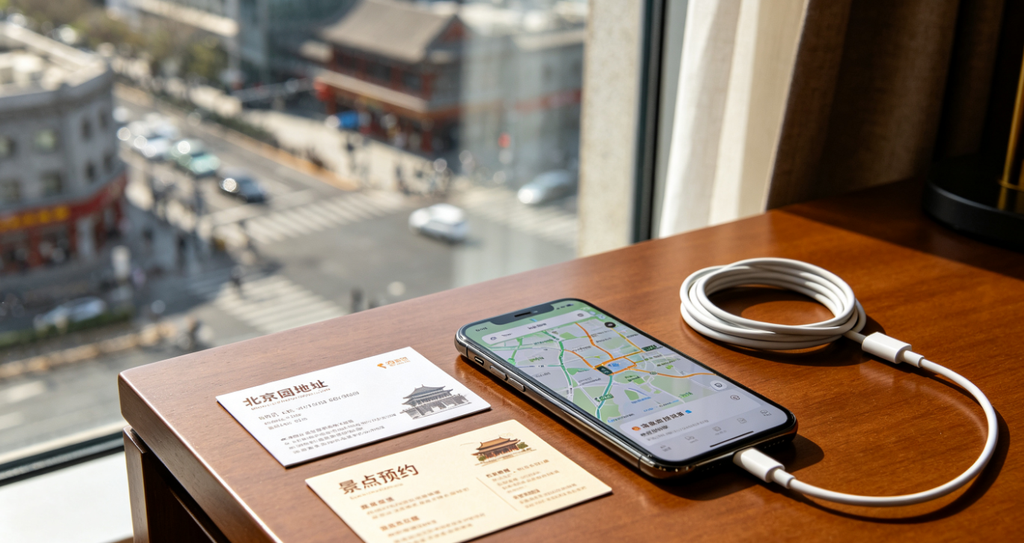
Before traveling around Beijing without speaking Chinese, make sure you can answer these questions:
- Do I have my hotel’s Chinese name and address?
- Do I have Chinese names for my main destinations?
- Can I access my maps and transportation information?
- Do I have a backup if my internet connection fails?
- Have I saved important screenshots?
- Do I know how to reach major attractions?
- Do I know which Great Wall section I am visiting?
- Do I have my reservations available?
- Can I show my destination instead of explaining it?
- Do I have enough phone battery?
- Do I know where I can ask for assistance if something goes wrong?
If the answer is yes, you are already much better prepared than someone who simply memorizes a list of Chinese phrases.
Final Takeaway
You do not need to speak Chinese fluently to travel independently around Beijing.
The key is to replace unnecessary verbal communication with accurate destination information, digital navigation, screenshots, translation tools, and backup plans.
The subway can handle many predictable journeys. Ride-hailing can simplify door-to-door travel. Major attractions are often easier to navigate when reservations and entrances are prepared in advance. More complicated destinations, especially remote Great Wall sections, may justify professional transportation or guiding.
Most importantly, do not treat the language barrier as a single problem.
Break it into smaller tasks:
Where am I going?
How will I get there?
How will I identify the destination?
How will I pay?
What will I do if something goes wrong?
Once those questions have answers, it becomes much easier to travel around Beijing without speaking Chinese.
Beijing is a large city, and navigating it successfully depends less on speaking every word and more on building a reliable system before you start moving.