
How to Get from Beijing Airport to the City Center
Quick Answer
Getting from Beijing airport to the city center is relatively straightforward, but the best option depends on which airport you arrive at, where your hotel is located, your arrival time, how much luggage you have, and how many people are traveling together.
Beijing has two major international airports:
- Beijing Capital International Airport (PEK) — northeast of central Beijing
- Beijing Daxing International Airport (PKX) — farther south of the city
Both airports are connected to Beijing by rail and road.
For many travelers, the airport rail network is a practical combination of speed and predictable travel time. Taxis and ride-hailing are more convenient for travelers with heavy luggage or hotels that are inconveniently located near a station. Private transfers can be useful for families, groups, late arrivals, or travelers who want door-to-door service immediately after a long flight.
The key is not simply choosing the cheapest transportation.
It is choosing the option that fits your arrival conditions and first-day itinerary.
1. Beijing Has Two Major Airports
Before deciding how to reach the city, check your airport code.
Beijing Capital International Airport — PEK
PEK is located northeast of central Beijing and has traditionally handled a large share of international and domestic flights.
Its location makes several transportation options practical, including:
- Airport Express
- subway connections
- taxi
- ride-hailing
- airport buses
- private transfers
Beijing Daxing International Airport — PKX
PKX is located south of central Beijing and is a major newer airport serving the capital.
It also has:
- airport rail connections
- subway connections
- taxis
- ride-hailing
- airport buses
- private transfers
The important point is that PEK and PKX are not interchangeable.
Their locations are different, and the most convenient route to your hotel can therefore be completely different.
2. The Main Ways to Reach Central Beijing
For most international visitors, there are five practical categories.
| Option | Main Advantage | Main Limitation | Best For |
|---|---|---|---|
| Airport rail | Predictable journey | May require transfers | Solo travelers, couples |
| Subway | Low cost and broad network | Slower with luggage | Budget travelers |
| Taxi | Door-to-door | Traffic | Families, luggage |
| Ride-hailing | Convenient booking | Requires app/payment setup | Independent travelers |
| Private transfer | Door-to-door and prearranged | Higher cost | Groups, late arrivals |
There is no universal winner.
A traveler arriving at 7 a.m. with one backpack has different transportation needs from a family arriving at midnight with four suitcases.
This is why airport transportation should be considered as part of your overall itinerary rather than as an isolated journey.
3. From PEK to Central Beijing
Beijing Capital International Airport is connected to the city through several transportation systems.
The Airport Express is one of the most recognizable options for visitors.
It connects the airport with the urban rail network and provides a relatively predictable alternative to road traffic.
The exact usefulness depends on your hotel location.
If your hotel is close to a convenient subway connection, rail can be highly practical.
If your hotel is several blocks from the nearest station and you have multiple suitcases, the apparent savings may be less attractive once you account for transfers and walking.
PEK is particularly convenient for:
- travelers comfortable using public transport
- visitors staying near major subway lines
- travelers without excessive luggage
- people who want to avoid unpredictable road traffic
4. From PKX to Central Beijing
Daxing Airport is farther from many central neighborhoods, but it has strong rail connections.
The airport’s transportation system was designed with high-capacity connections to the city in mind.
Depending on your destination, you may use:
- airport rail
- subway
- taxi
- ride-hailing
- private transfer
For a hotel in central Beijing, rail can be attractive because it avoids road congestion.
However, once again, the final destination matters.
A direct road journey may be more convenient if your hotel is not close to a useful rail station.
5. Airport Rail: When It Makes Sense
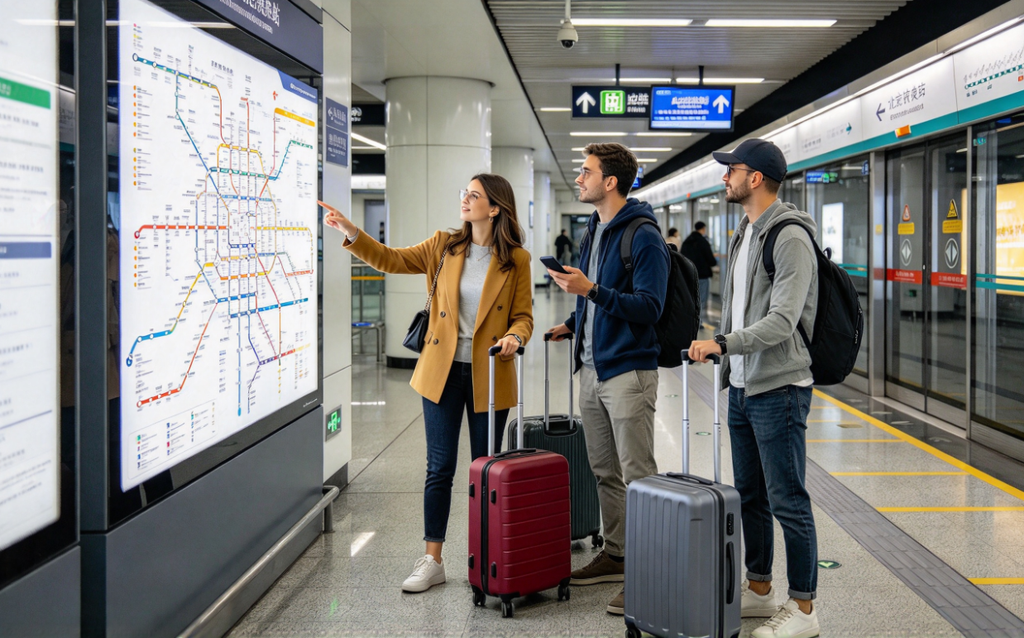
Rail is often attractive because travel time is more predictable than driving.
Beijing traffic can change considerably depending on:
- time of day
- weather
- weekday or weekend
- road conditions
- major events
- holiday travel
A train does not face the same road congestion.
This makes rail particularly useful when you have a fixed appointment later in the day.
However, rail has one major limitation:
It does not take you directly to your hotel door.
You may still need:
Airport → rail station → subway transfer → station → walk/taxi → hotel
That can be efficient for some travelers and inconvenient for others.
6. Subway: The Budget-Friendly Choice
Beijing’s extensive subway network gives travelers another way to continue from airport rail connections into the city.
For budget-conscious visitors, the subway can keep transportation expenses low.
But airport-to-hotel journeys are different from ordinary sightseeing trips.
You may be carrying:
- large suitcases
- backpacks
- shopping bags
- children’s luggage
- winter clothing
Multiple transfers can become tiring.
Therefore, the cheapest option is not always the easiest option.
If you arrive after a long international flight, convenience may have more value than saving a relatively small amount of money.
7. Taxi: The Simplest Door-to-Door Option
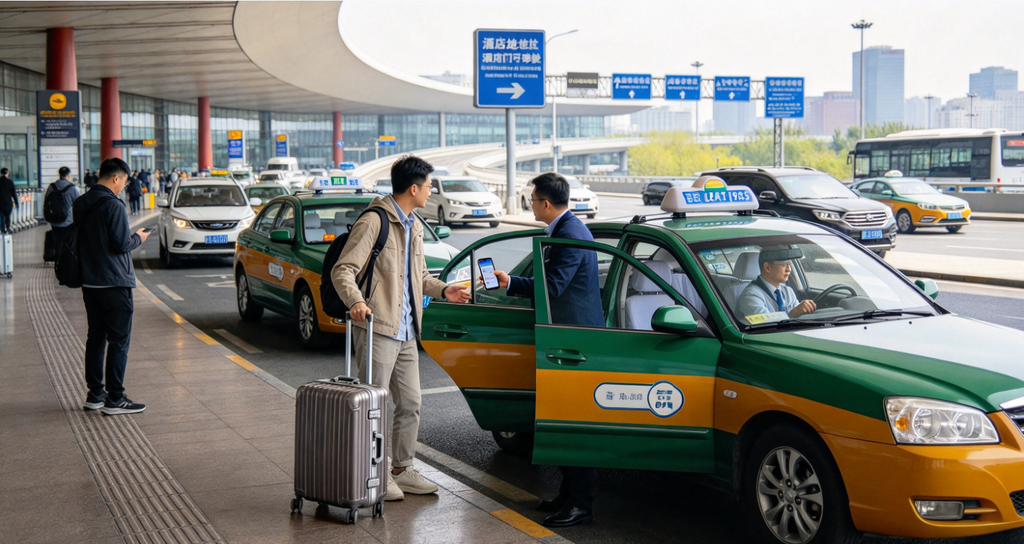
A taxi is straightforward:
Airport → vehicle → hotel
There is no need to carry luggage between multiple rail platforms.
This can be especially useful when:
- traveling with children
- carrying several bags
- arriving late
- staying far from a subway station
- feeling tired after a long flight
- traveling with several people
The major variable is traffic.
A taxi may be relatively fast when roads are clear but considerably slower during congested periods.
Therefore, taxi travel time should not be treated as a fixed number.
8. Ride-Hailing From the Airport
Ride-hailing can offer many of the same benefits as a taxi while allowing you to request the vehicle through an app.
For foreign visitors, however, the main challenge is preparation.
Before arriving, make sure you understand:
- how to register
- which payment method is connected
- where airport pickup is located
- how to identify the correct pickup point
- how your destination is entered
Airport pickup areas can be confusing because large terminals have multiple exits and designated vehicle zones.
Do not assume that the driver can simply stop anywhere outside the terminal.
Follow the app’s pickup instructions carefully.
9. Private Airport Transfer
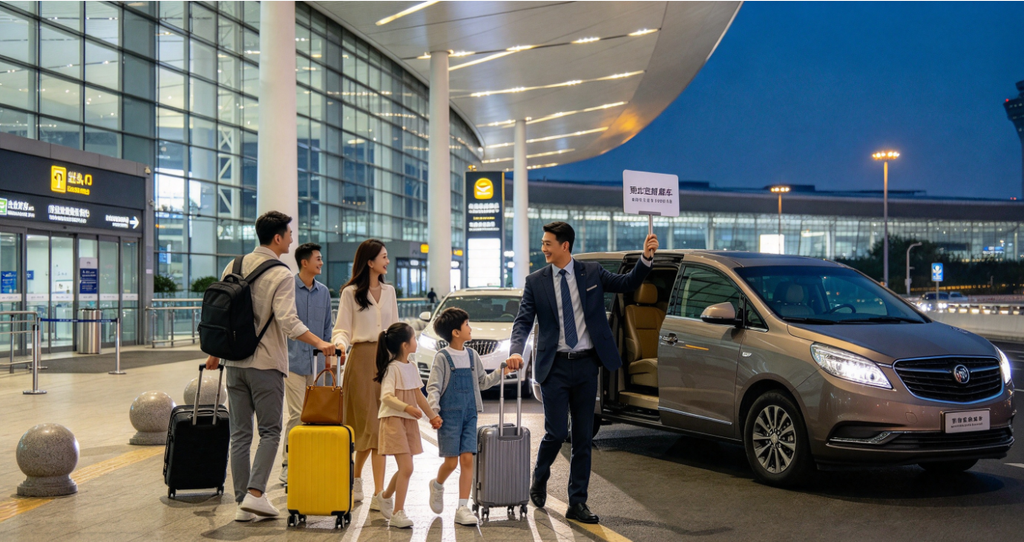
A private transfer works differently because the transportation is arranged in advance.
Instead of figuring out transportation after landing, you have a driver or vehicle scheduled for your arrival.
This can be particularly useful for:
- families
- groups
- travelers arriving late
- visitors with substantial luggage
- first-time visitors
- travelers who do not want to navigate public transport after a long flight
The major benefit is not necessarily speed.
It is reduced decision-making at the airport.
After immigration, baggage collection, and customs, the last thing some travelers want is another transportation problem to solve.
10. Which Option Is Best for First-Time Visitors?
The answer depends on what “easy” means to you.
If easy means inexpensive
Airport rail and subway connections may make sense.
If easy means no luggage transfers
Taxi or private transfer is simpler.
If easy means booking from your phone
Ride-hailing may be attractive.
If easy means someone handles the arrival logistics
A prearranged private transfer provides the most structured experience.
This is why airport transportation should not be ranked purely by price.
The better question is:
What inconvenience are you willing to trade for lower cost?
11. How Luggage Changes the Decision
Luggage is one of the most underestimated factors in airport transportation.
A subway route that looks simple on a map may involve:
- stairs
- elevators
- long corridors
- crowded platforms
- multiple transfers
- walking outside the station
With a backpack, this may be easy.
With two large suitcases, it can become considerably less comfortable.
This is particularly important for winter travelers, when coats and additional luggage increase the physical burden.
If your hotel is near a convenient station, rail remains attractive.
If the final connection is complicated, a taxi or private transfer may save significant effort.
12. Arrival Time Matters
The same route can feel completely different at different times.
Early morning
Road traffic may be manageable, but some travelers may prefer rail for predictable timing.
Morning commute
Road congestion can make driving less predictable.
Afternoon
Travel conditions depend heavily on the specific day and location.
Evening
Road traffic may again become an important factor.
Late night
The availability and convenience of public transportation become more important considerations.
If your flight arrives late, a prearranged transfer or taxi can simplify the first stage of your trip.
13. What If You Arrive After a Long International Flight?
This is a practical question rather than a purely economic one.
After a long-haul flight, you may have already spent many hours:
- sitting
- waiting
- navigating an airport
- passing immigration
- collecting luggage
At that point, transportation decisions should account for your energy level.
A complicated combination of rail lines and walking may be technically efficient but physically exhausting.
If you arrive rested with light luggage, public transportation may be perfectly comfortable.
If you arrive exhausted with children and several suitcases, door-to-door transportation may have much greater value.
14. How to Pay for Airport Transportation
Payment preparation is particularly important at the airport because it is usually your first transportation transaction in Beijing.
Depending on the transportation method, you may encounter:
- mobile payment
- transportation cards
- ticket machines
- bank cards
- cash
- prepaid transfers
The exact payment options vary by service.
This is why it is useful to understand how to pay for transportation in Beijing before your flight.
Do not assume that every transportation provider accepts every foreign bank card directly.
A practical backup system is:
mobile payment + international bank card + some Chinese yuan.
This gives you alternatives if one method encounters a problem.
15. Should You Exchange Money at the Airport?
You do not necessarily need to exchange a large amount of money immediately after landing.
Modern Beijing uses extensive digital payment.
However, having some Chinese yuan as a backup can still be useful.
A small cash reserve can help if:
- your phone has no connection
- your mobile payment is not configured
- a card transaction fails
- your battery is low
- you encounter a service where cash is accepted
The goal is not to rely entirely on cash.
It is to make sure a digital payment problem does not leave you without options.
16. What About Foreign Credit Cards?
International cards can be useful, but travelers should not assume they function identically across every transportation service.
Some transactions may support international cards directly.
Others may rely on mobile wallets or local payment infrastructure.
Therefore, an international card is best treated as one component of your payment strategy.
Before departure, check:
- international transaction availability
- card expiration
- spending limits
- bank security settings
- mobile-wallet compatibility
Having two separate cards can also provide additional backup.
17. Save Your Hotel Address in Chinese
This is one of the simplest preparations you can make.
Before leaving the airport, save:
Hotel name in English
Hotel name in Chinese
Chinese address
Phone number
Why?
Because a driver may recognize the Chinese name much more easily than the English spelling.
This is particularly useful for:
- small hotels
- hutong guesthouses
- apartment-style accommodations
- properties inside large compounds
- hotels near complicated intersections
A Chinese-language address can save several minutes of explanation.
18. Do Not Rely Only on the Hotel Name
Large hotels may be easy to find.
Smaller properties can be harder.
There may be several hotels with similar English names.
A driver needs the correct location, not merely a brand name.
For this reason, save the exact address.
If possible, also save a map location before leaving the airport.
That way, you can show the driver precisely where you are going.
19. Airport Bus: When Is It Useful?
Airport buses can be another option for travelers who prefer road transportation without paying for a taxi.
They may serve different destinations and routes.
The main limitation is that they may not take you directly to your hotel.
You may still need another transportation method after getting off the bus.
For travelers who understand the route and are staying near a bus stop, this can be practical.
For first-time visitors carrying substantial luggage, the extra transfer may make rail or door-to-door transportation more appealing.
20. How Much Time Should You Allow From the Airport?
Do not calculate your airport transfer based only on the vehicle journey.
Your first arrival involves several stages:
Landing → immigration → baggage → customs → transportation pickup → city journey → hotel
International arrivals can therefore take considerably longer than the driving or train portion alone.
If you have a reservation, meeting, tour, or attraction visit shortly after landing, build in a substantial buffer.
This is especially important if you arrive during a busy travel period.
21. Should You Book a Tour Immediately After Landing?
Generally, avoid creating an overly tight schedule on your arrival day.
International flights can be delayed.
Immigration may take longer than expected.
Baggage collection can vary.
Transportation can also be affected by traffic.
A better arrival-day structure is often:
Airport → hotel → check-in or luggage storage → meal → light activity
rather than:
Airport → major attraction → scheduled tour → evening activity
Your first day is also when you are most likely to experience jet lag.
Leave some flexibility.
22. How Airport Transportation Fits Into Your Beijing Itinerary
Airport transportation is the first and last part of your itinerary.
It should therefore be considered when you plan Beijing trip, not added as an afterthought.
For example:
Arrival day
Airport → hotel → nearby neighborhood → dinner
Middle days
Major attractions and sightseeing
Departure day
Hotel → airport with sufficient buffer
This structure reduces the risk of turning transportation into a source of unnecessary stress.
23. Choosing Transportation by Traveler Type
Solo traveler with light luggage
Airport rail can be highly practical.
Couple with moderate luggage
Rail, taxi, or ride-hailing can all work depending on hotel location.
Family with children
Door-to-door transportation can reduce transfers and luggage handling.
Group of friends
A private vehicle can become more attractive when several people share the journey.
Business traveler
Predictable travel time may be more important than minimizing cost.
First-time Beijing visitor
Simplicity may be worth paying for, especially after an international flight.
24. A Simple Decision Tree
Use this framework after checking your airport and hotel.
Step 1: Which airport?
PEK or PKX?
Step 2: Where is your hotel?
Near a major subway connection?
Or somewhere requiring additional transfers?
Step 3: How much luggage?
Light luggage?
Or several large suitcases?
Step 4: What time do you arrive?
Peak traffic?
Late night?
Daytime?
Step 5: How many people?
Solo?
Couple?
Family?
Group?
Step 6: What matters most?
Lowest cost?
Predictable journey?
Convenience?
Door-to-door service?
Once these questions are answered, the transportation decision becomes much simpler.
25. Common Airport Transportation Mistakes
Mistake 1: Confusing PEK and PKX
Always check your flight confirmation.
Mistake 2: Looking only at price
A cheap route can become inconvenient with luggage and multiple transfers.
Mistake 3: Ignoring traffic
Road travel time can vary significantly.
Mistake 4: Waiting until landing to set up payment
Prepare your mobile payment before departure.
Mistake 5: Not saving the Chinese hotel address
This can make taxi communication harder.
Mistake 6: Scheduling sightseeing too soon after arrival
Allow time for immigration, luggage, and transportation.
Mistake 7: Assuming every airport pickup point is the same
Follow the instructions for your specific service and terminal.
26. What Should You Prepare Before Your Flight?
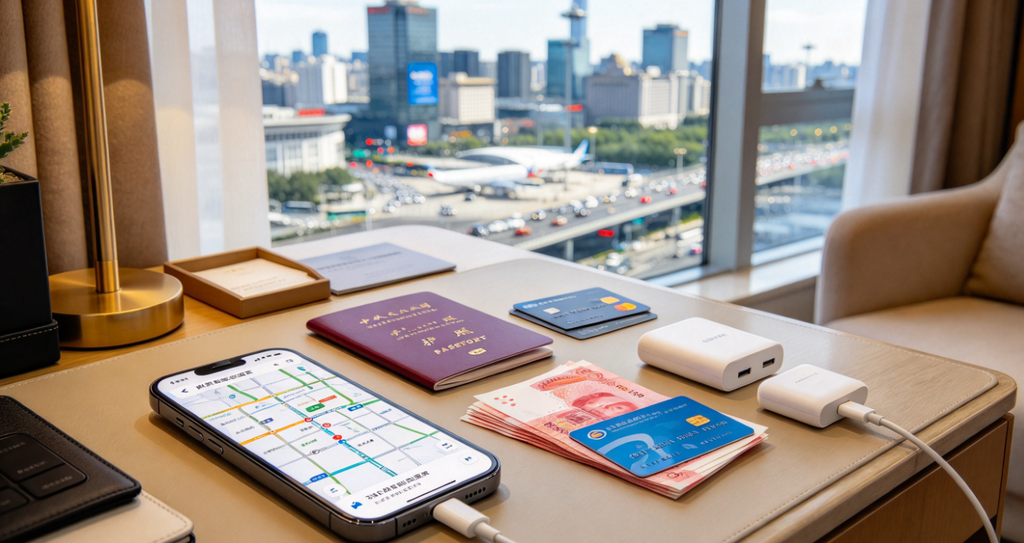
A short checklist can prevent most arrival-day problems.
Before departure:
- Confirm whether your flight arrives at PEK or PKX.
- Save your hotel address in Chinese.
- Set up your preferred mobile payment method.
- Add a backup international bank card.
- Prepare some Chinese yuan.
- Install or configure your preferred transportation apps.
- Check your hotel’s check-in time.
- Save important contact information.
- Bring a portable power bank.
- Check your airport transfer arrangements if you have booked one.
These preparations take little time but can make the first few hours in Beijing much easier.
27. What If Your Flight Is Delayed?
If you have arranged a private transfer, check the provider’s flight-monitoring or delay policy before traveling.
If you are using public transportation, a delay may simply mean taking the next available service.
For ride-hailing, you can request the vehicle after collecting your luggage rather than booking too early.
The key principle is:
Do not create unnecessary time pressure around your airport transfer.
Your arrival time is controlled partly by the airline and airport, not just by your itinerary.
28. What If Your Hotel Is Outside Central Beijing?
“City center” is not a precise transportation destination.
Beijing is enormous.
A hotel in Dongcheng may have completely different transportation needs from one in Chaoyang, Haidian, or another outer district.
Therefore, do not choose your airport transportation solely according to whether your hotel is “in Beijing.”
Look at the actual neighborhood.
A rail route that is excellent for one district may require several transfers for another.
Your final destination should determine the last part of the journey.
29. Why Door-to-Door Convenience Can Matter
Travelers sometimes focus heavily on ticket price.
But transportation has several types of cost:
Money + time + physical effort + complexity
A cheaper route may cost less money but require more transfers.
A taxi costs more but may save significant effort.
A private transfer costs more again but can remove most arrival-day decision-making.
The right choice depends on which type of cost matters most to you.
This is especially relevant after a long flight.
30. Comparing the Options at a Glance
| Option | Cost Level | Convenience | Traffic Risk | Luggage Friendly | Best Use |
|---|---|---|---|---|---|
| Airport rail | Low–Medium | High | Low | Medium | Predictable arrival |
| Subway | Low | Medium | Low | Low–Medium | Budget travel |
| Taxi | Medium | High | High | High | Door-to-door |
| Ride-hailing | Medium | High | High | High | Flexible travelers |
| Airport bus | Low–Medium | Medium | High | Medium | Specific routes |
| Private transfer | High | Very high | High | Very high | Families and groups |
The table should be used as a planning framework rather than a fixed ranking.
Actual convenience depends heavily on your hotel location and arrival conditions.
31. The Best Strategy May Be a Combination
You do not have to use the same transportation method throughout your Beijing trip.
For example:
Airport → hotel: private transfer
Central sightseeing: subway
Late evening: taxi
Great Wall day: private vehicle
Return to airport: airport rail
This mixed strategy often makes more sense than choosing one transportation method for every journey.
Different parts of Beijing require different solutions.
32. How Airport Transportation Connects With the Rest of Your Trip
Once you understand the airport journey, you can build the rest of your transportation plan around it.
For example, if your hotel is close to a major subway station, public transportation may become your main system for the next several days.
If your hotel is far from rail connections, you may rely more heavily on taxis.
If you are traveling with a family, a private vehicle may be useful for longer day trips.
This is why the airport transfer is not just an isolated ride.
It can help determine how efficiently the rest of your trip works.
FAQ
Which Beijing airport is closer to the city center?
Beijing Capital International Airport is generally closer to central Beijing than Daxing International Airport, but the actual journey depends on your destination and traffic conditions.
Is there public transportation from Beijing airports to the city?
Yes. Both major airports have rail and public transportation connections into Beijing.
Is a taxi easier than the airport train?
For travelers with heavy luggage, families, or hotels far from convenient rail stations, a taxi can be simpler. For travelers prioritizing predictable travel and lower cost, rail can be attractive.
Can foreigners use mobile payment for airport transportation?
Many transportation services support digital payment, but the exact options vary. Set up your mobile wallet and verify your international card before arrival rather than assuming every service will accept it directly.
Should I book a private airport transfer?
It can be useful if you prioritize door-to-door convenience, are traveling with several people or lots of luggage, or arrive late.
How long does it take to get from Beijing airport to the city?
Travel time varies substantially depending on the airport, destination, transportation method, traffic, and time of day. Avoid using one fixed travel time for every itinerary.
Final Takeaway
The best answer to how to get from Beijing airport to city center depends on more than the airport itself.
First identify whether you are arriving at PEK or PKX. Then consider your hotel location, luggage, arrival time, group size, and tolerance for transfers.
For travelers who want predictable transportation, airport rail can be practical.
For those carrying substantial luggage or staying somewhere inconveniently located for rail, taxis and ride-hailing provide greater door-to-door convenience.
For families, groups, late arrivals, or travelers who want the simplest possible arrival, a prearranged private transfer can reduce the number of decisions you need to make after landing.
Before departure, prepare your payment method, save your hotel’s Chinese address, keep your phone charged, and allow enough time for immigration and baggage collection.
If you plan Beijing trip carefully, your airport transfer should become the first smooth step of the itinerary rather than the first logistical challenge.
And if you are comparing options beyond the airport itself, a comprehensive Beijing transport guide can help you understand how rail, subway, taxis, buses, and private vehicles fit together throughout the rest of your stay.
Finally, reviewing how to pay for transportation in Beijing before departure is worthwhile, because having a working payment method and a backup can be just as important as choosing the right route.
The simplest airport journey is not necessarily the cheapest one.
It is the one that gets you from the terminal to your hotel with an appropriate balance of time, cost, luggage handling, convenience, and reliability.