
How to Build a Flexible Beijing Itinerary
Introduction
Planning a trip to Beijing involves more than choosing famous attractions and arranging them into a daily schedule. The city covers a large area, some attractions require advance reservations, and travel times can vary considerably depending on traffic, subway connections, and the location of your accommodation. A tightly packed itinerary may look efficient on paper but become stressful once you begin exploring.
A flexible Beijing itinerary gives you a clear structure without requiring every hour to go exactly as planned. It helps you prioritize important sights, group nearby destinations, leave room for unexpected discoveries, and adjust your schedule when weather, queues, or transportation affect your plans.
The key is not to plan less carefully. It is to distinguish between the parts of your trip that need firm arrangements and those that can remain open. This guide explains how to build an adaptable Beijing travel plan, organize attractions geographically, estimate realistic travel times, and make changes without disrupting your entire trip.
1. Start With Your Travel Priorities, Not a List of Attractions
Before choosing which attractions to visit each day, decide what you want your Beijing trip to accomplish.
Some travelers prioritize imperial history and traditional architecture. Others want to visit the Great Wall, explore hutongs, experience local food, or discover contemporary neighborhoods. Trying to include every popular attraction can leave little time to appreciate any of them.
Begin by separating your interests into three groups.
Must-see attractions
These are the experiences you would regret missing. Examples might include the Forbidden City, the Great Wall, or the Temple of Heaven.
If an attraction requires a reservation, a specific entry time, or a substantial journey, give it priority when building your schedule.
Preferred experiences
These are places you would like to visit but could move to another day if necessary. A hutong walk, a museum visit, a local market, or an additional temple might fall into this category.
These experiences help fill your itinerary without making it too rigid.
Optional activities
Optional activities are useful when you have spare time or when an original plan becomes impractical. They might include exploring a nearby shopping street, visiting a café, taking photographs, or trying another local restaurant.
This three-level approach prevents one delayed reservation or rainy afternoon from turning into a complete planning problem.
2. Build Your Itinerary Around Geographic Areas
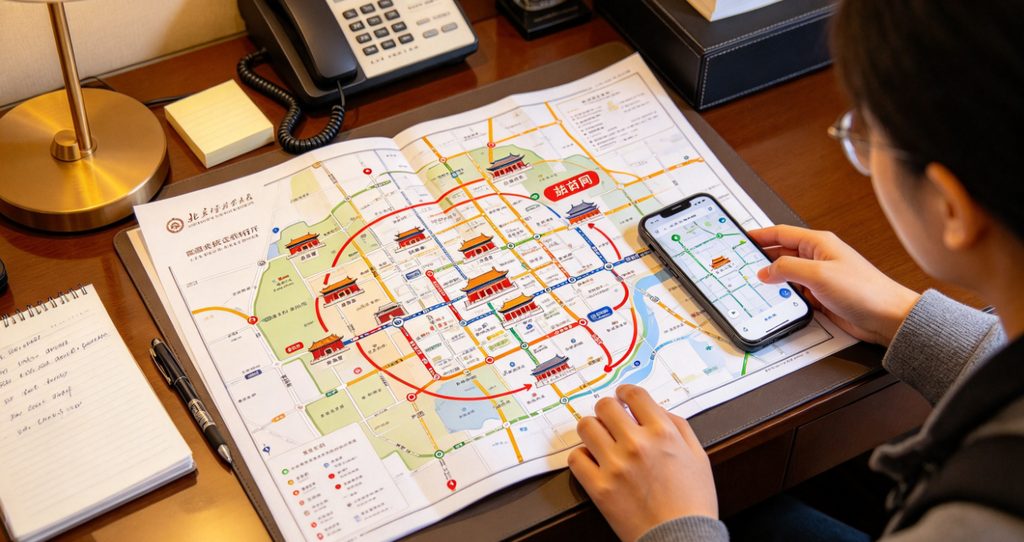
One of the most effective ways to make a Beijing trip more manageable is to organize attractions by location.
Beijing’s major sights are spread across a large urban area and its surrounding mountains. Crossing the city several times in one day can consume valuable sightseeing time, even when each individual journey appears manageable.
Instead of planning attractions solely according to popularity, look at where they are located relative to one another.
Central Beijing: Imperial history and traditional landmarks
The Forbidden City, Tiananmen-area attractions, and nearby historic sites can form the basis of a central Beijing sightseeing day. However, entry arrangements, security procedures, walking distances, and opening schedules need to be checked individually.
Avoid assuming that every attraction in the central area can be visited quickly simply because the locations appear close on a map.
Western and northwestern Beijing: Gardens and cultural sites
The Summer Palace and other attractions in western or northwestern Beijing may work well together when their opening hours and travel requirements align.
These visits can involve extensive walking, so avoid adding too many physically demanding activities to the same day.
The Great Wall: Plan a dedicated excursion
A Great Wall visit generally deserves its own substantial time block because reaching the chosen section, entering the site, walking on the wall, and returning to Beijing all take time.
Choose the section according to your preferred scenery, walking ability, transport arrangements, and available time. Do not schedule several distant attractions afterward unless you have verified that the complete route is realistic.
Hutongs and neighborhood experiences
Traditional hutong areas, local restaurants, markets, and shopping streets can be incorporated around other activities when the locations make sense.
These experiences are especially useful for filling a flexible afternoon because you can often adjust how long you spend exploring, provided any specific bookings or opening hours are respected.
The general rule is simple: group destinations geographically before arranging them chronologically. This reduces unnecessary travel and creates more room for spontaneous experiences.
3. Decide Which Activities Need Fixed Time Slots
Not every part of your trip needs a precise schedule. Some attractions require advance planning, while others are better suited to flexible exploration.
Divide your planned activities into fixed and flexible commitments.
| Activity type | Planning approach | Why it matters |
|---|---|---|
| Attractions with timed reservations | Confirm the required date and entry time in advance | Missing a designated slot may affect the visit |
| Great Wall excursions | Reserve a substantial block for transport and sightseeing | Travel and walking time can vary |
| Restaurants with confirmed bookings | Keep the reservation time and allow for travel | Delays may affect the booking |
| Museums and indoor attractions | Check opening days and admission requirements | Some venues have specific entry rules |
| Hutong walks and neighborhood exploration | Leave the duration flexible | You can explore at your own pace |
| Shopping and café visits | Use as optional activities | These can be shortened or moved easily |
For each day, identify the commitments that cannot move. Arrange the rest of the schedule around them.
This approach is more practical than assigning an exact time to every meal, photograph, and short walk. It preserves the structure of your trip while allowing you to respond to real conditions.
4. Estimate Travel Time Realistically

A common itinerary-planning mistake is to calculate only the time spent inside an attraction. In reality, the total time includes getting there, locating the entrance, completing any required checks, walking between areas, and returning to your next destination.
For example, a museum visit may require additional time for security screening and movement through a large complex. A Great Wall excursion may involve a long road journey and uphill access before the actual walk begins.
When estimating a journey, consider four components:
- Door-to-door transport: Include the walk from your hotel, transfers, and the final approach to the destination.
- Entry procedures: Allow time for ticket checks, security, and any queues that may occur.
- Actual exploration: Estimate how long you want to spend seeing the attraction rather than relying only on the shortest possible visit.
- Transition time: Include the time needed to leave, find the next entrance, and get ready for the following activity.
Use current route information and attraction guidance to estimate these components. Avoid relying on an old travel blog’s journey time when your accommodation, travel date, or transport method may be different.
A useful planning principle is to leave a buffer after important reservations or long journeys. The more uncertain a journey is, the less sensible it is to schedule another non-movable activity immediately afterward.
5. Leave Space in Every Day for Changes
Flexibility works best when it is deliberately built into the schedule.
If every morning, afternoon, and evening is already occupied, a delayed train, bad weather, or an attraction that takes longer than expected can force you to cancel several activities.
Instead, create three types of time blocks.
Core block
The core block contains your main planned attraction or experience. It receives the largest share of your attention and should not be surrounded by too many additional commitments.
Supporting block
The supporting block contains a nearby attraction, a meal, or a shorter activity that complements the main visit. It can be shortened or moved if necessary.
Open block
The open block is reserved for rest, unexpected delays, a spontaneous discovery, or an activity you decide to add during the trip.
An open block does not have to mean an empty afternoon. You can prepare several optional activities nearby and choose one when you know how much time and energy remain.
This is particularly valuable in Beijing, where large attractions can involve more walking than visitors expect.
6. Use a Priority-Based Schedule Instead of a Rigid Timetable

A flexible itinerary should tell you what matters most each day without requiring you to follow every detail to the minute.
Consider this example for a day focused on central Beijing.
| Priority | Activity | How to keep it flexible |
|---|---|---|
| High | Visit a major reserved attraction | Keep the confirmed entry time and protect enough time for the visit |
| Medium | Explore a nearby historic site | Adjust the duration according to queues and walking time |
| Medium | Have lunch in the surrounding area | Choose a suitable restaurant without committing to an unnecessarily tight schedule |
| Low | Explore a shopping street or café | Include it only if time and energy allow |
The specific attractions will differ according to your interests, but the structure remains useful.
If the first visit takes longer than expected, reduce or move the low-priority activity first. Do not sacrifice an important reservation simply to preserve an optional stop.
This is a more reliable way to adapt your schedule than repeatedly trying to make up lost time by rushing through every remaining attraction.
7. Adapt Your Plans to Weather and Seasonal Conditions
Weather can change which activities are comfortable and how much time you need to allow for them.
Beijing experiences distinct seasons, and outdoor sightseeing can feel very different depending on temperature, wind, rainfall, and visibility. Your itinerary should account for these conditions rather than assuming that every day will be suitable for the same type of activity.
Spring
Spring can be suitable for walking and outdoor sightseeing, but conditions may vary. Keep an eye on forecasts and consider carrying layers that can be added or removed.
Summer
Hot weather can make long walks and exposed mountain routes tiring. Start demanding outdoor activities earlier when practical, carry water, and avoid scheduling several strenuous visits back to back.
Autumn
Autumn can offer comfortable walking conditions and attractive mountain scenery. However, popular dates may also bring greater visitor demand, so confirm reservations and transport arrangements early.
Winter
Cold temperatures and possible icy conditions can affect outdoor comfort and walking safety. Check the forecast and current access conditions before committing to an extended outdoor visit.
A useful strategy is to prepare an indoor alternative near your planned area. If the weather changes, you can replace an outdoor walk with a suitable museum, cultural venue, or other activity without spending the rest of the day traveling across the city.
Always confirm current opening hours, admission requirements, and weather-related restrictions before changing plans.
8. Choose Transportation That Supports Your Schedule
Transportation is not simply a way to move between attractions. It determines how much of your day remains available for sightseeing.
The subway can be practical for many journeys within Beijing, while taxis or ride-hailing services may be more useful when carrying luggage, traveling with a group, or reaching a destination far from a convenient station.
For a flexible itinerary, evaluate the complete journey rather than choosing transport based only on the shortest estimated travel time.
Ask yourself:
- Is there a convenient subway connection?
- How much walking is required at each end?
- Will I be carrying luggage or traveling with children?
- Is road traffic likely to affect the journey?
- Does the destination have a specific arrival or entry time?
- What is the backup option if my preferred transport method is unavailable?
For example, if a morning reservation is important, choose a route that gives you a reasonable time buffer. For an unstructured neighborhood walk, you can afford to be more spontaneous.
Avoid scheduling activities in distant parts of Beijing consecutively unless the transport connection has been checked and the timing remains comfortable.
9. Match the Itinerary to Your Travel Style
A flexible schedule should reflect how you prefer to travel. There is no universal number of attractions that every visitor should aim to see each day.
First-time visitors
First-time visitors may want to prioritize major landmarks and a few distinctive local experiences. A clear structure helps ensure that the most important attractions are covered without making the entire trip feel like a checklist.
Families with children
Families often benefit from shorter activity blocks, convenient meal locations, rest opportunities, and fewer long transfers. Allow the schedule to change according to children’s energy levels rather than forcing every planned stop into the day.
History and culture enthusiasts
Visitors who enjoy history may prefer longer visits to museums, palaces, temples, and historic neighborhoods. Leaving fewer activities on the schedule can create more time to appreciate the places they choose.
Food-focused travelers
Travelers interested in local cuisine can organize meals around their sightseeing areas. Keep restaurant choices flexible when possible, but confirm reservations for restaurants or experiences that require them.
Independent travelers
Independent travelers may prefer to leave more time open for exploring. A short list of nearby alternatives allows you to change direction without losing the overall structure of the trip.
If you are organizing a more personalized experience, a custom Beijing trip can be planned around your interests, preferred pace, group size, and transport needs rather than following a standard schedule.
10. Build a Simple Backup Plan for Every Important Day

A backup plan does not need to be a complete alternative itinerary. In most cases, two or three practical alternatives are enough.
For each day, identify:
- The activity you most want to complete.
- One nearby alternative if the original plan becomes impractical.
- One indoor option if the weather changes.
- A reasonable point at which to stop adding activities.
Suppose your morning visit runs late. You could shorten an optional afternoon stop and keep the evening open. If rain affects an outdoor plan, you could move to an indoor attraction in the same general area. If transport becomes inconvenient, you could postpone a lower-priority destination rather than spending several hours traveling.
The aim is to preserve the main purpose of the day, not to complete every item on your original list.
Before your trip, save reservation details, attraction addresses, transport information, and essential contact details in an accessible format. This makes changes easier when mobile connectivity is unreliable or you need to make a quick decision.
11. A Practical Framework for Planning Each Day
You can apply the same process to a short city break or a longer visit.
Step 1: Choose one main experience. Identify the attraction or activity that defines the day.
Step 2: Add nearby supporting activities. Select destinations that fit naturally around the main visit rather than crossing the city repeatedly.
Step 3: Confirm non-negotiable details. Check opening days, reservation requirements, entry times, and transport availability.
Step 4: Estimate the complete journey. Include transport, entry procedures, exploration, meals, and transitions.
Step 5: Leave an open block. Keep part of the day available for rest, delays, or spontaneous discoveries.
Step 6: Prepare one or two alternatives. Choose options that are practical to reach if the weather or timing changes.
Step 7: Review the schedule each evening. Check the next day’s reservations, weather forecast, and transportation arrangements before going to bed.
Following this process helps you plan your days in Beijing efficiently while keeping enough room for changes. Efficiency means reducing unnecessary travel and protecting your priorities—not filling every hour.
12. Common Mistakes That Make a Beijing Itinerary Too Rigid
Even a detailed travel plan can become difficult to follow if it is built around unrealistic assumptions.
Scheduling too many major attractions
Large attractions may involve extensive walking, queues, and entry procedures. Trying to visit several major sites in one day can reduce the time available for each and leave you exhausted.
Ignoring the location of attractions
A route that moves repeatedly between distant districts can waste time and increase transportation costs. Group nearby destinations before deciding the order of visits.
Treating estimated travel times as guarantees
Traffic, transfers, station layouts, and queues can all affect the schedule. Use realistic estimates and retain a buffer around important commitments.
Failing to check reservation requirements
Some attractions have specific entry procedures or booking requirements. Confirm these before finalizing the itinerary rather than assuming tickets can always be purchased at the entrance.
Leaving no time for rest
Walking through large palaces, museums, and mountain attractions can be tiring. Meal breaks and rest periods are part of a workable itinerary, not wasted time.
Refusing to change the plan
A schedule is a tool for making decisions, not a rule that must be followed at any cost. If an activity no longer fits, move it, shorten it, or leave it out.
Conclusion
Building a flexible Beijing itinerary means creating a plan that can adapt to real travel conditions without losing sight of your priorities. Start by identifying your must-see attractions, group destinations by location, confirm activities that require reservations, and estimate the complete time needed for transportation and sightseeing.
Then leave room for unexpected delays, changing weather, rest, and spontaneous experiences. Prepare nearby alternatives instead of creating an entirely new route whenever something changes.
The most useful itinerary is not necessarily the one with the most attractions. It is the one that allows you to experience the places you care about without spending unnecessary time traveling or feeling pressured to keep up with an unrealistic timetable.
A flexible Beijing itinerary gives you both direction and freedom: enough structure to make the most of your visit, and enough flexibility to enjoy Beijing as it unfolds.
If your interests, travel dates, or group requirements call for a more personalized route, a custom Beijing itinerary can help align sightseeing, transport, and daily pacing with the way you actually want to travel.
Frequently Asked Questions
What is the best way to make a Beijing itinerary flexible?
Start with your highest-priority attractions and any fixed reservations. Group nearby destinations, leave open time each day, and prepare alternatives for bad weather or delays. This allows you to adjust the schedule without losing the main purpose of your trip.
How many attractions should I plan to visit each day?
There is no ideal number for every traveler. The right number depends on the size of the attractions, travel distances, opening hours, walking ability, and your interests. Plan around realistic time requirements rather than a fixed attraction count.
Should I book Beijing attractions in advance?
Check the current entry and reservation requirements for each attraction. Where advance booking or a timed entry is required, secure the reservation before finalizing the surrounding schedule. Keep enough time for transport and entry procedures.
How can I avoid wasting time traveling across Beijing?
Group attractions by geographic area and check the complete route between them. Consider subway connections, road traffic, walking distances, and the location of station exits. Avoid placing distant destinations back to back without checking whether the schedule is realistic.
What should I do if it rains during my Beijing trip?
Check the weather forecast and prepare an indoor alternative near the area you planned to visit. Depending on opening hours and availability, a museum or other indoor attraction may replace an outdoor walk. Confirm any reservation changes before making the switch.
Is a custom Beijing itinerary better than a fixed tour?
A custom itinerary can offer more control over attraction choices, daily pace, and transport arrangements. A fixed tour may be more convenient if you prefer a prearranged schedule. The better option depends on your budget, interests, group needs, and desired level of independence.