
How to Group Beijing Attractions by Location: A Booking-First Guide
Planning Beijing sightseeing by location can save travel time, reduce unnecessary transfers, and make a multi-day itinerary easier to manage. However, the most efficient route is not always the one that connects the closest attractions.
The best way to group Beijing attractions is to check reservation requirements first, secure the Forbidden City visit date, and then organize the remaining attractions into geographic clusters. After that, adjust each day according to walking distance, physical effort, opening hours, and last-mile transportation.
This order matters because some of Beijing’s most important attractions have advance reservation requirements. The Forbidden City does not sell same-day tickets, while Tiananmen Square requires real-name reservations. If you build your itinerary around geography before checking availability, you may have to rearrange several days later.
This guide explains how to group Beijing attractions by location, which places work well together, which combinations may be too demanding, and how to build a practical itinerary around confirmed reservations.
Quick Answer: How Should You Group Beijing Attractions?
For most first-time visitors, Beijing attractions can be organized into these geographic areas:
| Area | Main Attractions | Recommended Planning Approach |
|---|---|---|
| Central Beijing | Tiananmen Square, Forbidden City, Jingshan Park, Beihai Park | Build around your confirmed Forbidden City booking date |
| Old Beijing Hutongs | Drum Tower, Shichahai, Nanluoguxiang, Yuer Hutong, Mao’er Hutong | Combine traditional neighborhoods and lakeside walks |
| Southern Beijing | Temple of Heaven, Qianmen, Dashilar | Group historical architecture, local streets, and food |
| Western Beijing | Summer Palace, Old Summer Palace | Allow substantial time for large palace gardens |
| Northern Beijing | Olympic Green, Bird’s Nest, Water Cube | Combine major Olympic landmarks |
| Northeastern Beijing | 798 Art District | Allow time for galleries and the journey from the subway |
| Outside Central Beijing | Great Wall sections, Ming Tombs | Usually plan a separate day for the Great Wall |
These clusters are a starting point, not a fixed itinerary. The actual order should depend on ticket availability, opening days, and how much walking you want to do.
1. Check Reservations Before Grouping Attractions
The biggest mistake when planning Beijing sightseeing is choosing attractions by location first and checking tickets afterward.
For certain major attractions, the reservation date is a fixed constraint. Your itinerary should be built around those confirmed dates rather than assuming you can visit whenever convenient.
Book the Forbidden City First
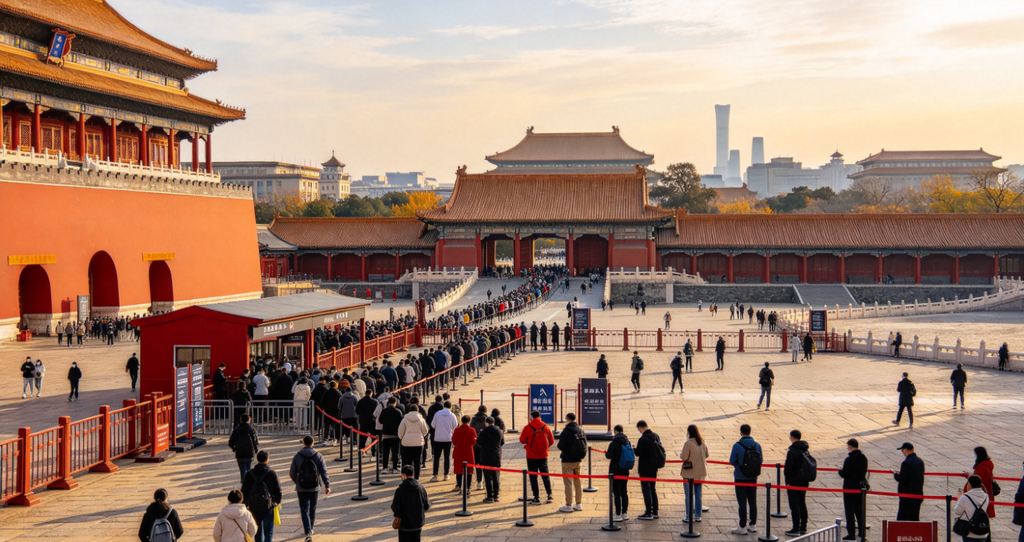
The Forbidden City, also known as the Palace Museum, should usually be the first major attraction you check when planning a Beijing trip.
Its official ticketing rules include several important points:
- Tickets are released seven days before the visit date.
- Ticket reservations open at 20:00.
- Same-day tickets are not sold.
- Visitors must use real-name reservations.
- International visitors need to provide the passport information required by the official booking system.
- The main visitor entrance is the Meridian Gate on the south side.
- Visitors generally exit through the Gate of Divine Might or the East Prosperity Gate.
The Palace Museum is normally closed on Mondays, except when a statutory holiday changes the opening arrangement. Seasonal opening and last-entry times also differ, so check the official Palace Museum visitor information and official ticketing platform before planning your visit.
For international visitors, the Beijing government also provides guidance on using passport information for Palace Museum reservations. See the official foreign visitor ticketing guidance.
Why this changes your itinerary: If you want to visit the Forbidden City on Wednesday, you need to plan around the ticket release for that date. Once the reservation is confirmed, Wednesday becomes the anchor for your central Beijing sightseeing route.
Do not assume that you can simply move the Forbidden City visit to another day if tickets sell out.
Reserve Tiananmen Square Separately
Tiananmen Square is geographically close to the Forbidden City, but it has its own reservation requirements.
According to official Beijing government information:
- Visitors must make real-name reservations.
- Reservations are generally available one to seven days in advance.
- Reservation availability is updated daily at 12:00 noon.
- Visitors without a valid reservation generally cannot enter during controlled visiting periods.
- Visitors planning to attend the flag-raising ceremony should select the appropriate visit period through the current reservation system.
Official information: Tiananmen Square reservation rules.
International visitors should pay particular attention to the booking process. The official Beijing government FAQ explains that the reservation system may not support registration with a non-Chinese phone number. Foreign visitors can use the Tiananmen Square reservation mini-program or ask another person to make the reservation on their behalf, providing the required passport details.
See the official guidance for foreign visitors.
A confirmed Forbidden City ticket does not automatically mean you have a separate Tiananmen Square reservation. Check both requirements and make sure the selected time periods fit your intended route.
A Reservation-First Decision Tree
Use this sequence before assigning attractions to individual days:
Step 1: Check the Forbidden City.
If visiting the Palace Museum is a priority, check ticket availability first and secure a date before finalizing the central Beijing itinerary.
Step 2: Check Tiananmen Square.
Look for an appropriate reservation on the same day or another day that works with your schedule. If you plan to attend the flag-raising ceremony, check the relevant time slot rather than assuming ordinary daytime access will be sufficient.
Step 3: Lock the confirmed dates.
Treat the Forbidden City and Tiananmen Square reservations as fixed itinerary points. Do not build a route that depends on entering either attraction without the required reservation.
Step 4: Add nearby attractions.
Once the central Beijing dates are settled, consider Jingshan Park, Beihai Park, Qianmen, or other attractions according to your available time and energy.
Step 5: Organize the remaining days by region.
Put the Summer Palace and Old Summer Palace in the western area, the Temple of Heaven and Qianmen in the south, and the Great Wall on a separate day.
What if Forbidden City tickets are sold out?
Do not plan to buy a same-day ticket at the entrance. Instead:
- Check whether another available date fits your trip.
- If possible, move the central Beijing sightseeing day to that date.
- If no date works, rebuild the itinerary around other attractions rather than treating the original Forbidden City route as guaranteed.
- Consider Jingshan Park, Beihai Park, or other available central Beijing attractions, after checking their own current access rules.
The important principle is simple: book first, group second, optimize transport and walking last.
2. Central Beijing: Tiananmen Square, Forbidden City, and Jingshan Park
<|end|>
The central Beijing area contains several of the city’s most recognizable historical landmarks. On a map, Tiananmen Square, the Forbidden City, and Jingshan Park appear close together, making them natural candidates for one sightseeing day.
However, the route requires more time and physical effort than the map alone suggests.
Tiananmen Square and the Forbidden City
Tiananmen Square is south of the Forbidden City, while the Palace Museum’s main visitor entrance is the Meridian Gate.
A typical central Beijing visit may include:
- Entering Tiananmen Square during the reserved period.
- Allowing time for security checks and walking through the square.
- Proceeding toward the Forbidden City’s south entrance.
- Spending several hours exploring the Palace Museum.
The Palace Museum is a large complex. Even visitors who follow a relatively straightforward route should expect considerable walking.
Do not schedule a tight appointment immediately after leaving the Forbidden City. Security procedures, walking time, visitor volume, and the route to your next destination can all affect the schedule.
Is Jingshan Park Worth Adding?
<PRIVATE_PERSON> is located directly north of the Forbidden City, across from its northern exit. It is especially popular for the elevated view over the palace rooftops.
For visitors who still have energy after the Palace Museum, Jingshan is a logical addition.
However, reaching the viewpoint involves an uphill walk and stairs. After several hours inside the Forbidden City, this extra climb may feel more demanding than expected.
A practical recommendation:
- High-energy visitors: Add Jingshan Park after the Forbidden City for the panoramic view.
- Moderate-energy visitors: Visit the Forbidden City first and decide whether to continue after checking the time and your energy level.
- Visitors who prefer a slower pace: Skip Jingshan or visit it on another day.
Jingshan is geographically convenient, but it should not be treated as a compulsory part of every central Beijing itinerary.
Should You Add Beihai Park on the Same Day?
Beihai Park is northwest of Jingshan Park and is another attractive historical garden.
Although these attractions are close on the map, combining the Forbidden City, Jingshan, and Beihai can create a long walking day.
The issue is not simply the distance between the entrances. Visitors need to account for:
- The size of the Forbidden City.
- The uphill climb at Jingshan.
- The walking required to explore Beihai Park.
- The time needed to reach the next attraction or return to the hotel.
For many travelers, the better options are:
- Option A: Tiananmen Square + Forbidden City + Jingshan Park.
- Option B: Tiananmen Square + Forbidden City, with a slower visit and no additional park.
- Option C: Jingshan Park + Beihai Park on a separate, more relaxed day.
Beihai is worth visiting, but adding it automatically just because it is nearby can make the itinerary unnecessarily tiring.
3. Old Beijing: Drum Tower, Shichahai, and Nanluoguxiang
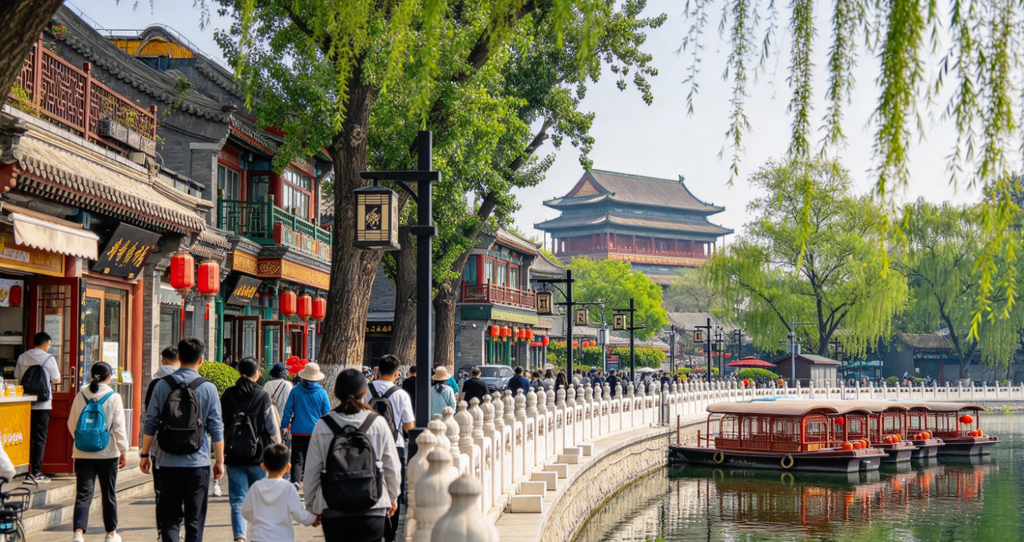
The northern central area offers a different experience from the imperial landmarks. It is better suited to visitors interested in traditional neighborhoods, lakeside scenery, old streets, and everyday Beijing life.
A useful route can include:
- Drum Tower
- Shichahai
- Yandai Xiejie
- Nanluoguxiang
- Yuer Hutong
- Mao’er Hutong
These places can be combined into a half-day or longer walking route, depending on how much time you spend exploring.
Drum Tower and Shichahai
<PRIVATE_PERSON> and Shichahai are good starting points for exploring the old city.
The Drum Tower is a recognizable historical landmark, while Shichahai is known for its lakes, traditional streets, and surrounding hutong neighborhoods.
Visitors can walk around the lakes, explore nearby streets, stop for refreshments, and enjoy a less formal sightseeing experience.
This area works well for travelers who want to experience Beijing beyond its major ticketed attractions.
Nanluoguxiang: Visit the Side Hutongs, Not Just the Main Street
Nanluoguxiang is one of Beijing’s best-known hutong streets, but the experience can be different from what first-time visitors expect.
Its main commercial street can be crowded and heavily oriented toward tourism. Snack stalls and souvenir shops sell popular street foods, but the atmosphere may feel more commercial than traditional.
That does not mean the area is not worth visiting. The key is to avoid spending the entire visit on the main street.
For a quieter neighborhood experience, consider exploring nearby side hutongs such as:
- Yuer Hutong: A traditional residential lane that offers a different atmosphere from the main commercial street.
- Mao’er Hutong: Another historic hutong area where visitors can see more of the neighborhood’s traditional street layout.
When exploring side alleys, remember that hutongs are also residential areas. Keep noise low, respect private entrances, and do not enter courtyards or buildings without permission.
A practical route is to walk through Nanluoguxiang briefly, then explore selected side lanes and continue toward Shichahai or the Drum Tower.
Can You Combine Nanluoguxiang and the Lama Temple?
The Lama Temple and the Confucius Temple area are farther north than the main Shichahai and Nanluoguxiang cluster.
They can be included in a broader northern Beijing day, but adding every attraction may create an overly long walking route.
A more balanced approach is:
- Relaxed hutong route: Drum Tower + Shichahai + Nanluoguxiang + selected side hutongs.
- Cultural route: Lama Temple + Confucius Temple + Imperial College.
- Longer route: Combine both only if you have enough time and are comfortable with extended walking.
4. Southern Beijing: Temple of Heaven, Qianmen, and Dashilar
Southern Beijing is a convenient area for combining historical architecture, traditional commercial streets, and local food.
The main attractions include:
- Temple of Heaven
- Qianmen Street
- Dashilar
- Nearby traditional commercial neighborhoods
Temple of Heaven
The Temple of Heaven is one of Beijing’s most important historical sites.
It is a large complex, so visitors should allow enough time to explore its main structures and surrounding parkland.
The Hall of Prayer for Good Harvests is the best-known building, but the wider grounds are also part of the experience.
Check current ticket and opening arrangements before visiting, particularly if you want to enter specific buildings rather than only walk through the park.
Qianmen and Dashilar
Qianmen and Dashilar are suitable for visitors interested in traditional commercial streets, historic architecture, restaurants, and local snacks.
Qianmen Street has a more organized tourist-shopping atmosphere, while Dashilar contains a mixture of historic businesses, shops, and food outlets.
You can combine them into one afternoon or evening, especially if you want to enjoy dinner after visiting the Temple of Heaven.
However, the Temple of Heaven itself requires substantial walking. If you prefer a relaxed day, consider visiting Qianmen and Dashilar separately rather than trying to see every attraction in the south.
5. Western Beijing: Summer Palace and Old Summer Palace

The Summer Palace and Old Summer Palace are both located in western Beijing, making them a logical geographic pair.
However, they are large historical garden sites. Their proximity does not mean they can be explored quickly.
Summer Palace
The Summer Palace is famous for Kunming Lake, Longevity Hill, traditional architecture, and landscaped gardens.
Visitors can choose different routes depending on their interests and available time.
A shorter visit may focus on the main palace buildings and lake scenery, while a longer visit can include more of the gardens and walking paths.
Old Summer Palace
The Old Summer Palace, also known as Yuanmingyuan, has a different historical character.
Its grounds are extensive, and visitors often explore the remains of the Western Mansions area as well as the surrounding landscape.
It is particularly relevant to travelers interested in Qing dynasty history and the destruction of the imperial garden complex.
Should You Visit Both in One Day?
It is possible to visit both sites in one day, but the decision depends on your preferred pace.
| Travel Style | Recommendation |
|---|---|
| Fast-paced visitor | Visit selected highlights at both sites |
| History-focused visitor | Allow more time for each site |
| Relaxed traveler | Give each attraction a separate visit |
| Family with young children | Avoid forcing both into a tightly scheduled day |
If you only have one day available, the Summer Palace is often the more straightforward choice for a first-time visitor seeking classic Beijing scenery.
If you have more time, visiting both provides a broader understanding of the imperial gardens.
6. Northern Beijing: Olympic Green, Bird’s Nest, and Water Cube
The Olympic Green area is a convenient cluster for visitors interested in modern Beijing architecture and the city’s Olympic legacy.
Main attractions include:
- National Stadium, commonly known as the Bird’s Nest.
- National Aquatics Center, commonly known as the Water Cube.
- Olympic Forest Park.
- Other Olympic Green public spaces and cultural venues.
The Bird’s Nest and Water Cube are close enough to combine in one visit.
Some visitors prefer to see the buildings from the outside, while others may want to enter for exhibitions or events. Entry arrangements depend on the venue and current programming.
Olympic Forest Park is a much larger outdoor area. It can be added if you want more time outdoors, but it should not be treated as a quick stop if you plan to explore its grounds.
A practical route is to visit the Bird’s Nest and Water Cube first, then decide whether you have enough time and energy for the forest park.
7. Northeastern Beijing: 798 Art District
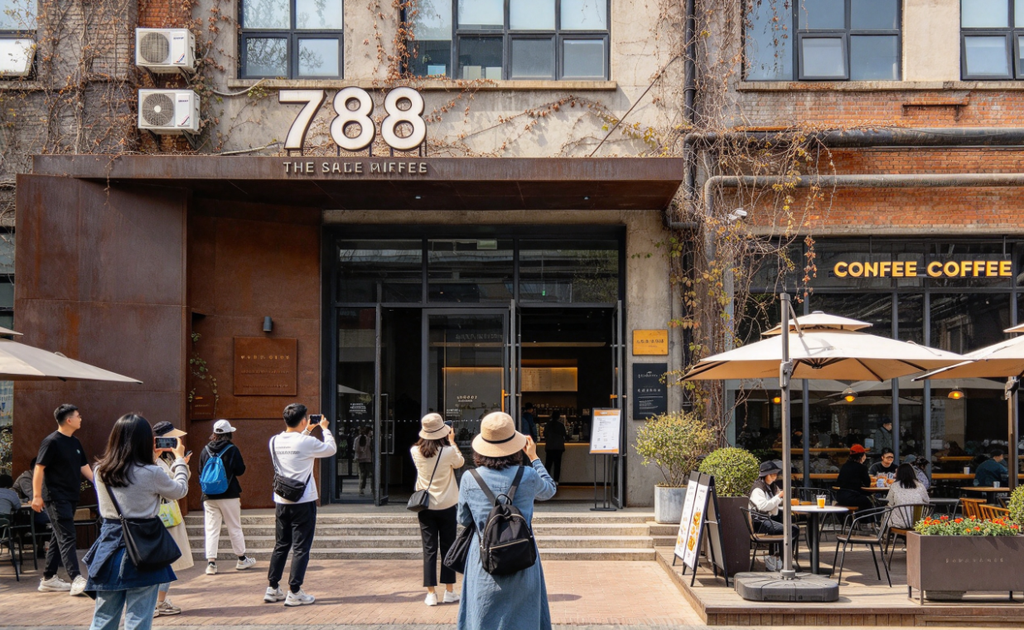
798 Art District is located in the Jiuxianqiao area of northeastern Beijing. It is different from the city’s historical attractions and is best suited to visitors interested in contemporary art, galleries, design, photography, and creative spaces.
The area contains galleries, exhibition venues, cafés, restaurants, and converted industrial buildings.
How to Get to 798 Art District
The subway journey deserves some attention because the last part of the trip depends on which line you use.
According to the official 798 visitor guide:
- Line 12: Gaojiayuan Station, Exit B, is directly beside the art district.
- Line 14: Wangjing South Station or Jiangtai Station can be used, but the remaining journey is approximately 1.5 km on foot or by bicycle.
If you use Line 14, do not assume that leaving the subway means you are already at the entrance. Plan for the last-mile journey, particularly if you are traveling with children, carrying luggage, or visiting in bad weather.
You can also consider a bus or taxi for the final section.
Check the official 798 Art District visitor guide for current transportation information.
How Much Time Should You Allow?
The art district itself is generally accessible without a separate admission reservation, but individual galleries and exhibitions may have their own opening hours or booking requirements.
Many galleries operate during daytime hours, but schedules vary. Some venues may close on Mondays or have temporary exhibition arrangements.
A practical plan is to allow half a day if you want to explore several galleries, take photographs, and stop for food or coffee.
Do not schedule 798 as a short stop between distant attractions unless you have already checked the transport connections and the opening hours of the places you want to visit.
8. Great Wall of China: Plan It as a Separate Day
The Great Wall is outside central Beijing, so it should usually be planned separately from city sightseeing.
Different sections offer different experiences, travel times, walking conditions, and facilities.
Popular choices include:
- Badaling
- Mutianyu
- Jinshanling
- Simatai
For first-time visitors, Mutianyu and Badaling are common options because they have established visitor facilities and transportation arrangements.
The best section depends on your travel dates, preferred scenery, walking ability, and whether you want a private transfer or organized tour.
Avoid combining the Great Wall with several major central Beijing attractions on the same day. Travel time, traffic, and the amount of walking on the Wall can make the schedule exhausting.
If you are considering a Great Wall visit, choose the section first and then plan the rest of your itinerary around it.
9. Beijing Attraction Grouping: A Practical Comparison
The following table summarizes the main geographic clusters and the planning considerations that matter most.
| Area | Suggested Attractions | Physical Effort | Important Planning Considerations |
|---|---|---|---|
| Central Beijing | Tiananmen Square, Forbidden City, Jingshan | High if all are included | Secure Forbidden City and Tiananmen reservations first |
| Old Beijing | Drum Tower, Shichahai, Nanluoguxiang | Moderate | Allow time for walking and exploring side hutongs |
| Southern Beijing | Temple of Heaven, Qianmen, Dashilar | Moderate to high | Temple of Heaven requires substantial walking |
| Western Beijing | Summer Palace, Old Summer Palace | High if both are explored fully | Both are large garden complexes |
| Northern Beijing | Bird’s Nest, Water Cube, Olympic Forest Park | Low to high, depending on park exploration | Check venue access and event schedules |
| Northeastern Beijing | 798 Art District | Moderate | Check gallery hours and last-mile transportation |
| Great Wall | One selected section | Moderate to high | Allow a separate day for travel and walking |
Physical effort is not determined by geographic distance alone. A short transfer between two large attractions can still lead to a demanding day if both involve extensive walking.
10. Sample Beijing Itineraries Based on Geographic Grouping
These examples show how to organize the main attractions into practical sightseeing days. They are starting points, not fixed schedules. Your confirmed reservation dates should determine the final order.
Three-Day Beijing Itinerary
| Day | Suggested Route | Main Focus |
|---|---|---|
| Day 1 | Tiananmen Square + Forbidden City + optional Jingshan | Imperial Beijing |
| Day 2 | Temple of Heaven + Qianmen + Dashilar | Historical sites and traditional streets |
| Day 3 | Great Wall of China | A full day outside central Beijing |
If you cannot secure a suitable Tiananmen Square reservation, adjust the route rather than assuming you can enter without one. If the Forbidden City is unavailable on Day 1, move the central sightseeing day to the confirmed ticket date.
Four-Day Beijing Itinerary
| Day | Suggested Route | Main Focus |
|---|---|---|
| Day 1 | Tiananmen Square + Forbidden City + optional Jingshan | Imperial Beijing |
| Day 2 | Drum Tower + Shichahai + Nanluoguxiang side hutongs | Old Beijing |
| Day 3 | Great Wall of China | Mountain scenery and history |
| Day 4 | Summer Palace or Temple of Heaven + Qianmen | Gardens or southern Beijing |
Choose either the Summer Palace or the Temple of Heaven according to your interests and available time. Do not force both into the same day if you prefer a relaxed pace.
Five-Day Beijing Itinerary
| Day | Suggested Route | Main Focus |
|---|---|---|
| Day 1 | Tiananmen Square + Forbidden City + optional Jingshan | Imperial Beijing |
| Day 2 | Temple of Heaven + Qianmen + Dashilar | Southern Beijing |
| Day 3 | Great Wall of China | A separate Great Wall day |
| Day 4 | Summer Palace + optional Old Summer Palace | Western Beijing |
| Day 5 | Drum Tower + Shichahai + Nanluoguxiang, or 798 Art District | Hutongs or contemporary art |
If you want to visit both the Summer Palace and Old Summer Palace, consider reducing the number of other stops on Day 4.
For more route combinations and trip-length ideas, see our Beijing itinerary ideas.
11. Common Mistakes When Grouping Beijing Attractions
Even a geographically sensible itinerary can become difficult if it ignores reservations, walking effort, or transportation details.
Mistake 1: Planning the Forbidden City Before Checking Ticket Availability
The Forbidden City does not sell same-day tickets. Planning a central Beijing day around an unconfirmed visit can disrupt the rest of your trip.
Better approach: Check ticket availability first, secure the date, and then build the central route.
Mistake 2: Assuming a Forbidden City Ticket Includes Tiananmen Square Access
These are separate attractions with separate reservation arrangements.
Better approach: Check the requirements for both and confirm that the chosen time periods work together.
Mistake 3: Adding Too Many Attractions Because They Look Close on a Map
The Forbidden City, Jingshan, and Beihai are close geographically, but visiting all three can involve considerable walking and climbing.
Better approach: Distinguish between nearby locations and attractions that are realistic to explore in one day.
Mistake 4: Treating Nanluoguxiang’s Main Street as the Whole Hutong Experience
The main commercial street can be crowded and tourist-oriented.
Better approach: Explore selected side hutongs such as Yuer Hutong and Mao’er Hutong, while respecting residential privacy.
Mistake 5: Underestimating the Last Mile to 798
Some subway stations are not immediately beside the galleries.
Better approach: Consider Line 12 to Gaojiayuan or plan the additional journey if using Line 14.
Mistake 6: Combining the Great Wall with Too Many City Attractions
The Great Wall is outside the central sightseeing area, and transportation can take a significant part of the day.
Better approach: Give it a separate day whenever your schedule allows.
Mistake 7: Treating Every Attraction as Having the Same Reservation Rules
Beijing attractions do not all use one ticketing system. Some require advance reservations, some have different entry arrangements for particular venues, and temporary exhibitions may have separate requirements.
Better approach: Check the official website or reservation platform for each major attraction before finalizing your daily route.
12. How to Build a More Efficient Beijing Route
Once reservations and geographic clusters are clear, use the following process to finalize your itinerary.
1. List your must-see attractions.
Separate essential attractions from optional stops. For example, the Forbidden City and Great Wall may be priorities, while Beihai Park or 798 may depend on available time.
2. Check reservation requirements.
Start with the Forbidden City and Tiananmen Square. Then check any other attraction that requires advance booking or has a timed-entry arrangement.
3. Lock the fixed dates.
Put confirmed ticket dates into your calendar before arranging the remaining sightseeing days.
4. Group attractions by area.
Keep central, southern, western, northern, and northeastern Beijing visits in separate geographic clusters where practical.
5. Estimate physical effort.
Consider not only the distance between attractions but also the size of each site, stairs, slopes, and the time spent walking inside.
6. Check transport and last-mile access.
Look at subway stations, bus connections, walking routes, and taxi options. Do not assume that a nearby subway station is always close to the attraction entrance.
7. Keep some flexibility.
Weather, crowds, temporary closures, and changing reservation availability can affect the route. Avoid scheduling every hour too tightly.
If you want a route based on your hotel location, trip length, confirmed tickets, and preferred sightseeing pace, use our custom Beijing itinerary planning service.
Frequently Asked Questions
1. Which Beijing attractions should I book first?
If the Forbidden City is on your must-see list, check its ticket availability first. Tickets are released seven days ahead at 20:00, and same-day tickets are not sold.
Then check Tiananmen Square reservations and any other attractions that require advance booking.
2. Can I visit the Forbidden City without reserving Tiananmen Square?
The Forbidden City and Tiananmen Square have separate reservation arrangements. A Palace Museum ticket does not automatically guarantee access to Tiananmen Square.
Check the current square entry rules and your Palace Museum entrance arrangements before traveling. Certain confirmed reservations at designated nearby venues may affect daytime square access under specific official rules, so do not assume an exception applies to every visitor.
3. Can I visit the Forbidden City, Jingshan Park, and Beihai Park in one day?
Yes, it is possible for some visitors, but it can be a demanding day.
The Forbidden City requires extensive walking, Jingshan involves an uphill climb, and Beihai is another large park. Many visitors will find it more comfortable to visit the Forbidden City and Jingshan first, then leave Beihai for another day.
4. How can foreign visitors book Forbidden City tickets?
International visitors should use the official Palace Museum booking platform and provide the passport details requested by the system.
Bring the original valid travel document used for the reservation. Check the official international visitor information before departure because booking procedures can change.
5. What should I do if Forbidden City tickets are sold out?
Do not assume that you can buy a ticket at the entrance on the same day.
Check other available visit dates first. If none fits your trip, reorganize the central Beijing itinerary around other attractions that you can access under their current rules.
6. Is Nanluoguxiang worth visiting?
It can be worth visiting if you are interested in hutong neighborhoods, street food, and traditional Beijing street layouts.
However, the main street is commercial and can be crowded. For a more residential neighborhood atmosphere, explore selected side lanes such as Yuer Hutong and Mao’er Hutong.
7. Which subway station is best for 798 Art District?
Line 12’s Gaojiayuan Station, Exit B, is directly beside the art district according to its official visitor guide.
Line 14’s Wangjing South and Jiangtai stations are alternatives, but they require an additional journey of approximately 1.5 km on foot or by bicycle.
8. Should I visit the Summer Palace and Old Summer Palace on the same day?
You can visit both in one day, but both are large garden complexes.
If you want to explore them in depth, separate days are more comfortable. If you have limited time, prioritize the Summer Palace and visit selected areas of the Old Summer Palace only if your schedule allows.
9. Should I visit the Great Wall and the Forbidden City on the same day?
For most travelers, no. They are in different areas, and each requires substantial time.
The Great Wall is best planned as a separate day so you can account for transportation, walking, and possible traffic delays.
Final Recommendation
The most efficient Beijing itinerary is not simply a list of attractions arranged by geographic distance. It is a route built around confirmed reservations, realistic walking effort, and practical transportation.
Start by securing your Forbidden City visit date. Check Tiananmen Square separately, then organize the rest of your trip into regional clusters: the old hutongs, southern Beijing, western imperial gardens, Olympic Green, 798 Art District, and the Great Wall.
Most importantly, do not confuse geographical proximity with a comfortable sightseeing combination. A well-planned itinerary should reduce unnecessary travel without forcing too many large attractions into one day.
Book first. Group by location second. Optimize walking and transport last.