
How to Avoid Wasting Time When Planning a Beijing Itinerary
The best way to avoid wasting time when planning a Beijing itinerary is to organize your days around geography, opening schedules, realistic travel times and the experiences that matter most to you. However, an efficient itinerary should not simply fit as many attractions as possible into each day. It should also leave room for cultural experiences, relaxed neighborhood walks and enough time to appreciate Beijing’s history.
Beijing is a large city. The Forbidden City, Temple of Heaven, Summer Palace and Great Wall are spread across different areas, and each requires a different amount of time. Combining too many major attractions can leave you spending more time in traffic and queues than actually exploring.
The solution is to understand your priorities before choosing attractions, group nearby places sensibly and adjust your schedule to the season and your travel pace.
1. Decide What Kind of Beijing Experience You Want

Two visitors can spend a day at the same attraction and need completely different schedules. A traveler interested in famous photographs may want to see the main landmarks quickly. Someone interested in Chinese history may prefer to explore exhibitions, architecture and historical details at a slower pace.
Your itinerary should reflect that difference.
A landmark-focused visit to the Forbidden City
If your priority is seeing the most recognizable parts of the Forbidden City, concentrate on the central route through its main ceremonial buildings.
This approach is suitable for visitors with limited time who want to understand the overall layout, see the major courtyards and take photographs. Avoid trying to explore every side building or exhibition in the same visit.
A focused visit still needs time for security checks, the entrance process, walking distances and the exit route. The Forbidden City is much larger than it may appear on a map.
A history and exhibition-focused visit
If you are interested in imperial history, architecture or museum collections, allow more time and choose specific exhibition areas before arriving.
The difference is important: a visitor who wants to study the palace’s historical development should not follow exactly the same schedule as someone who only wants to walk along the central axis.
Check the current exhibition information before your visit. Temporary exhibitions, access arrangements and available galleries can change, so do not build your entire schedule around an exhibition without confirming that it will be open.
A slower cultural experience
Some travelers do not want every hour planned. They may prefer to spend an afternoon walking through traditional neighborhoods, stopping for tea, exploring small shops or observing everyday life.
For these visitors, a slower itinerary can be more rewarding than adding another major attraction.
Consider leaving part of an afternoon open for the hutongs around Shichahai or for a relaxed walk through a traditional neighborhood. You may not cover as many landmarks, but you gain a better sense of how Beijing feels beyond its famous monuments.
Planning principle: Decide whether each day is primarily for landmark sightseeing, historical exploration or cultural discovery. Trying to do all three at full depth often creates an unrealistic schedule.
2. Group Attractions by Geography, Not Just Popularity
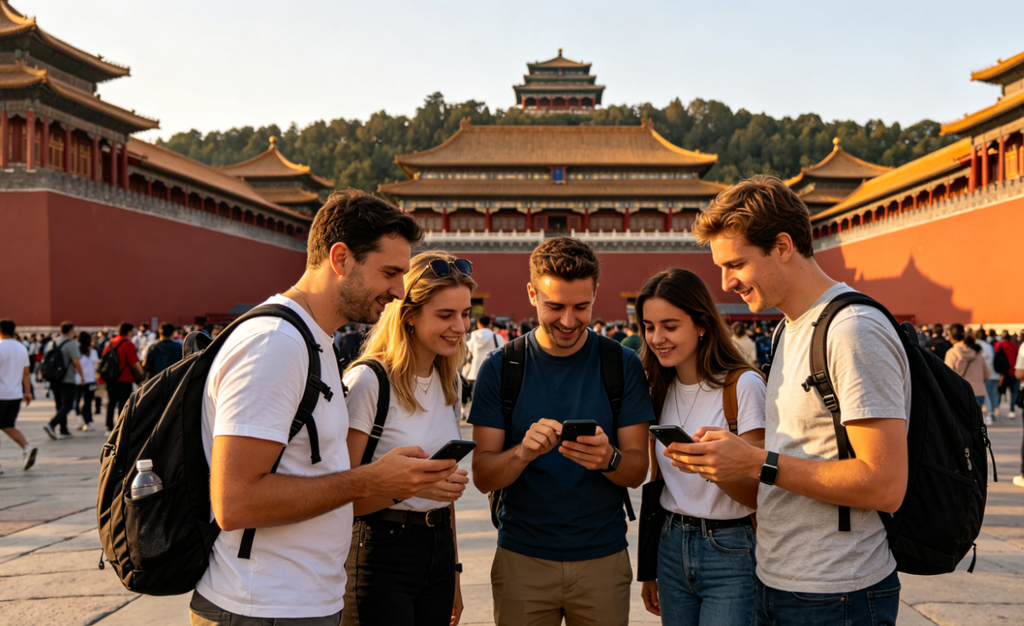
One of the biggest sources of wasted time in Beijing is crossing the city repeatedly because attractions were selected by popularity rather than location.
The following groups offer practical starting points. They are planning clusters, not instructions to visit every listed attraction in one day.
Central Beijing: Tian’anmen Square, the Forbidden City and Jingshan Park
<PRIVATE_PERSON>
These attractions form a natural central Beijing sightseeing group.
A practical sequence is:
- Tian’anmen Square, if you have arranged the required reservation.
- The Forbidden City.
- Jingshan Park, if you still have enough time and energy.
Jingshan Park is particularly useful after visiting the palace because its elevated viewpoint offers a broader view of the Forbidden City’s layout.
However, the Forbidden City can occupy most of a day if you want to explore its exhibitions and buildings carefully. Do not treat Jingshan Park as an automatic addition if you are already tired or running behind schedule.
Southern and southeastern Beijing: Temple of Heaven and Qianmen
The Temple of Heaven and Qianmen area can be combined in a day, although they offer different experiences.
The Temple of Heaven is a large historic park with important ceremonial architecture. Visitors who want to understand its design and historical significance should allow time to walk around rather than simply photograph the main hall.
Qianmen offers a different atmosphere, with historic streets, shops and traditional-style commercial buildings. It is better suited to a more relaxed afternoon or evening.
A reasonable sequence is to visit the Temple of Heaven earlier in the day and explore Qianmen later. If you are interested in food and local street life, leave enough time for a meal rather than rushing through the area.
Western Beijing: Summer Palace
The Summer Palace deserves its own substantial block of time.
Its lakeside scenery, gardens, bridges and historic buildings make it a different kind of experience from the Forbidden City. The distance between individual sights inside the grounds can also make a quick visit less satisfying than expected.
For a short visit, choose a limited route around the areas that interest you most. If you want to explore the gardens and lakeside paths at a relaxed pace, avoid combining the Summer Palace with another major attraction across the city.
Northern Beijing: Great Wall and Olympic Park
The Great Wall is best treated as a dedicated day trip rather than a quick stop between central Beijing attractions.
Travel time depends on the section, transport method, traffic and starting point. The actual visit can also involve substantial walking, stairs and time spent using cable cars or other facilities.
Olympic Park is another northern Beijing destination, but it should not automatically be treated as part of the same convenient sightseeing route. Whether the combination works depends on your chosen Great Wall section, return time and energy level.
If you want to compare different sections and understand their access arrangements, start with this Great Wall guide.
Haidian: Summer Palace, Yuanmingyuan and university surroundings
For travelers interested in gardens, education and modern Chinese intellectual history, Haidian offers another useful cluster.
Possible stops include:
- Yuanmingyuan, also known as the Old Summer Palace.
- Peking University surroundings.
- Tsinghua University surroundings.
- The Summer Palace, if you have enough time and want a longer day.
Yuanmingyuan has a different historical character from the Summer Palace. Its ruins and landscaped grounds provide an opportunity to explore the history of the imperial gardens and the destruction of parts of the complex.
The university areas offer a different perspective on Beijing, although access to university campuses may be subject to visitor registration or changing entry rules. Check the latest visitor arrangements before planning a campus visit.
Do not assume that Yuanmingyuan and the Summer Palace can both be explored thoroughly in one day. Combining them is possible for some visitors, but it creates a garden-focused day with substantial walking.
Shichahai, Nanluoguxiang and the Drum and Bell Towers
This cluster is particularly suitable for visitors who want to experience Beijing’s traditional urban atmosphere.
Possible stops include:
- Shichahai, with its lakeside scenery and historic surroundings.
- Nanluoguxiang, known for its hutong lanes and commercial activity.
- The Drum Tower and Bell Tower area.
- Nearby traditional residential streets.
The best reason to visit this area is not to rush between monuments. It is to walk through the lanes, notice the layout of traditional neighborhoods and stop when something interests you.
Nanluoguxiang can be busy and commercial, so travelers looking for a quieter hutong experience may prefer to explore nearby residential lanes rather than spending all their time on the main street.
Allow time for walking and unplanned stops. This is one of the areas where leaving a flexible afternoon can be more valuable than following a tightly timed checklist.
3. Calculate Door-to-Door Travel Time, Not Just Metro Time
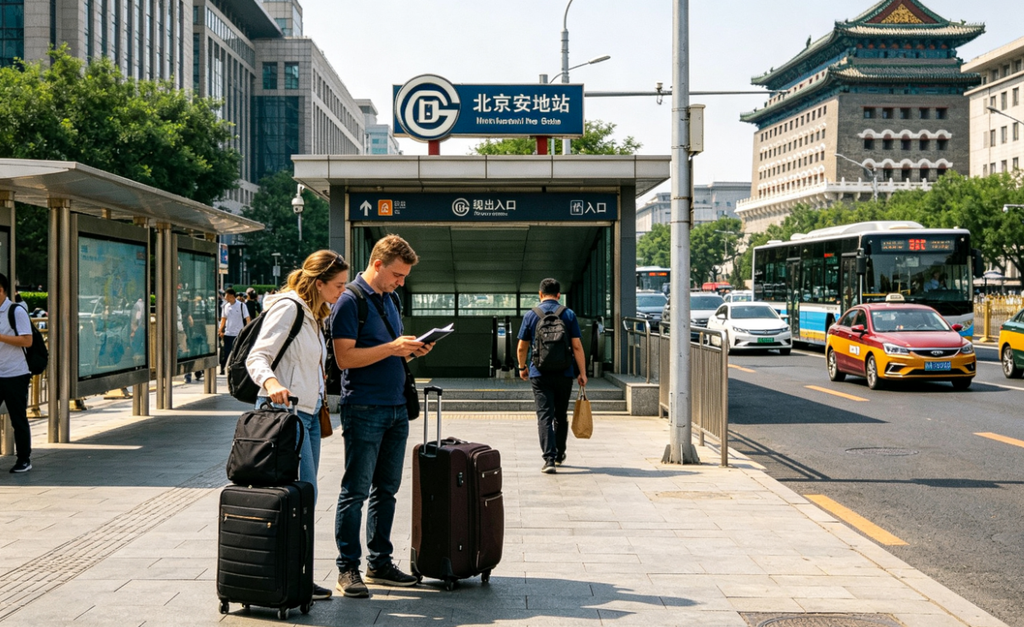
A metro journey that appears to take 20 minutes does not mean you can reach the attraction in 20 minutes.
Your actual transfer may include:
- Walking from your hotel to the station.
- Finding the correct entrance and security checkpoint.
- Waiting for a train.
- Transferring between lines.
- Walking from the destination station to the attraction entrance.
- Queuing for security or ticket checks.
The same problem applies to taxis. Traffic conditions, pickup locations and the distance between the drop-off point and the entrance can all affect the journey.
For each transfer, estimate the complete journey from your starting point to the place where you will actually begin sightseeing.
When should you use the subway?
The subway is often a sensible choice when attractions are connected by convenient lines and road traffic is heavy.
It is especially useful for moving between central areas, but large stations and transfers can still involve considerable walking.
When is a taxi more practical?
A taxi or ride-hailing service may be more convenient when:
- You are traveling with children or older family members.
- You have heavy luggage.
- Your destination is far from a convenient metro station.
- You are traveling early in the morning or after a long sightseeing day.
- Several people can share the cost.
Do not assume a taxi is always faster. Congestion can make road journeys unpredictable.
For route choices, airport connections and practical public transport information, consult the Beijing transport guide.
4. Adjust Your Itinerary to the Season

The same sightseeing order does not work equally well throughout the year.
Temperature, daylight, wind and weather conditions can change how comfortable an outdoor attraction feels. Seasonal planning should influence not only what you visit, but also when you visit it.
Summer: Put demanding outdoor visits earlier in the day
Beijing summers can be hot, and walking across large open spaces in the middle of the day can be tiring.
A practical summer strategy is:
- Visit outdoor attractions earlier in the morning.
- Avoid scheduling the longest exposed walking periods around midday.
- Use the afternoon for museums, indoor exhibitions, restaurants or other less demanding activities.
- Keep water, sun protection and rest breaks in your daily plan.
For example, you might visit the Temple of Heaven in the morning and choose an indoor cultural activity later in the day.
Do not assume that every attraction is suitable for an afternoon visit simply because it is open. Comfort and walking conditions matter too.
Winter: Consider wind and exposure at the Great Wall
Winter visits to the Great Wall can be rewarding, particularly for travelers who enjoy quieter scenery. However, exposed sections can feel significantly colder when wind conditions are strong.
Plan the Wall for a suitable weather window rather than choosing the day only because it fits your calendar.
Before leaving, check the forecast for the actual destination, not just central Beijing. Dress in layers, protect exposed skin and allow enough time for the return journey.
If conditions are poor, consider moving an indoor attraction to that day and visiting the Great Wall when the weather improves.
Spring and autumn: Use comfortable weather for longer outdoor days
Spring and autumn often provide more comfortable conditions for walking, although wind, rain, dust and temperature changes are still possible.
These seasons are good opportunities to plan longer visits to gardens, historic parks and the Great Wall.
However, popular holiday periods can bring heavier crowds. Comfortable weather does not necessarily mean shorter queues.
Keep one flexible time block
If your schedule allows, leave at least one half-day flexible during a longer stay.
This gives you room to respond to rain, poor visibility, unexpected closures or a change in energy levels without having to abandon the entire itinerary.
5. What If You Only Have Three Days and Must Combine Two Major Attractions?
The ideal advice is to avoid combining two attractions that each deserve a full day. But travelers with only three days in Beijing may have to make compromises.
The important question is not whether two attractions can technically fit into one day. It is whether the combination still provides a worthwhile experience.
Option A: Forbidden City and Temple of Heaven
This is one of the more realistic combinations for visitors with limited time, provided they are comfortable with a faster pace.
A possible schedule is:
Morning: Visit the Forbidden City, concentrating on the central route and the buildings that interest you most.
Afternoon: Travel to the Temple of Heaven and choose a shorter route through the main architectural highlights.
Evening: Have dinner in the Qianmen area if time and energy permit.
The compromise is clear: you will not have the same depth of experience at either attraction as you would with separate days. You may need to skip some exhibition areas, side buildings or longer park walks.
Check entry arrangements and opening schedules for both attractions before committing to this plan.
Option B: Summer Palace and Yuanmingyuan
These two garden sites are in the same general area, making them a more logical combination than attractions on opposite sides of Beijing.
A possible approach is to choose one as the main attraction and visit a limited section of the other.
For example:
- Spend the main part of the day exploring the Summer Palace.
- Visit selected areas of Yuanmingyuan if you still have enough time.
The compromise is reduced exploration time at both sites. Trying to see every major area in both parks can create a tiring day with little opportunity to appreciate either garden.
Option C: Forbidden City and a hutong walk
For travelers who want both imperial history and traditional neighborhood life, this can be a more balanced combination.
Spend the morning and early afternoon at the Forbidden City, then choose one nearby or conveniently connected hutong area for a relaxed walk later.
Do not try to visit every hutong attraction. Choose a manageable area and allow time to stop for food, tea or photographs.
The compromise is that your hutong experience will be relatively short, but it may still provide a valuable contrast to the formal palace environment.
When should you not combine two major attractions?
Avoid forcing a combination when:
- One attraction requires a long journey outside central Beijing.
- Both places have extensive grounds and substantial walking.
- You have fixed entry times that leave little flexibility.
- You are traveling with young children or people who need frequent breaks.
- Weather conditions make outdoor walking difficult.
In particular, combining the Great Wall with a full visit to the Forbidden City on the same day is generally a poor choice for first-time visitors. The distance, travel uncertainty and physical demands leave too little room for a satisfying experience.
If you must make a compromise, shorten the visit to one attraction deliberately rather than rushing through both without a plan.
6. Protect Your Arrival and Departure Days
Do not plan your first sightseeing day as if you will wake up in central Beijing after a full night’s sleep.
International arrivals may involve immigration queues, baggage collection, transport delays and hotel check-in. Even after reaching the hotel, you may need time to recover from a long flight.
For your arrival day, choose something close to your hotel or leave the schedule open.
The same principle applies to your departure day. Allow enough time to collect luggage, travel to the airport and complete airline procedures.
Avoid scheduling a major attraction with a fixed entry time immediately before an airport transfer.
7. Avoid the Most Common Beijing Itinerary Mistakes
| Planning mistake | Why it wastes time | Better approach |
|---|---|---|
| Choosing attractions only by popularity | Creates unnecessary cross-city journeys | Group attractions by location |
| Treating every attraction as a short stop | Underestimates walking and exploration time | Decide how deeply you want to visit |
| Combining too many major sights | Leaves little time for the actual experience | Choose one main attraction per day |
| Ignoring seasonal conditions | Creates uncomfortable outdoor schedules | Adjust the order according to weather |
| Assuming metro journey time is total travel time | Ignores station access and walking | Calculate door-to-door time |
| Filling every afternoon | Leaves no room for delays or spontaneous experiences | Keep some flexible time |
| Visiting hutongs only to take photographs | Misses the neighborhood atmosphere | Allow time to walk and explore |
8. A Practical Method for Building Your Beijing Itinerary
Use this process before confirming your daily schedule.
Step 1: List your must-see attractions.
Separate essential destinations from optional stops. This makes it easier to identify what can be removed if the schedule becomes too crowded.
Step 2: Decide your preferred travel pace.
Choose whether you prefer fast landmark sightseeing, detailed historical visits or a more relaxed cultural experience.
Step 3: Group attractions by location.
Start with central Beijing, southern Beijing, western Beijing, northern Beijing and the additional cultural clusters that interest you.
Step 4: Identify fixed entry requirements.
Check whether reservations, timed tickets or special visitor arrangements apply. Confirm the information through official channels before your trip.
Step 5: Estimate complete transfer times.
Include walking, station transfers, queues and the journey from the transport stop to the actual entrance.
Step 6: Adjust for the season.
Place demanding outdoor activities at more comfortable times and keep an alternative for poor weather.
Step 7: Protect one main experience each day.
A day can include several stops, but one attraction or experience should usually receive the majority of your time.
Step 8: Leave room for the unexpected.
A flexible schedule makes it easier to enjoy a meal, explore a side street or stay longer somewhere that interests you.
Frequently Asked Questions
How many attractions should I visit in Beijing each day?
There is no fixed number. Two or three nearby stops may be comfortable if they are relatively small, but one major attraction can already occupy most of a day. The Forbidden City, Summer Palace and Great Wall should not be treated as quick stops.
Can I visit the Forbidden City and the Great Wall on the same day?
It is generally not recommended. The Great Wall requires travel outside central Beijing, while the Forbidden City involves substantial walking and a fixed visitor-entry process. Combining both leaves little time for either experience and increases the risk of missing your plans.
Is it better to visit Beijing attractions in the morning or afternoon?
For large outdoor attractions, morning is often more comfortable, particularly in summer. However, the best time also depends on opening schedules, ticket arrangements, weather and crowd levels. Indoor museums and exhibitions can be useful afternoon alternatives.
Should I leave time for hutong exploration?
Yes, if traditional neighborhoods and everyday local culture interest you. Hutongs are not simply another landmark to check off. Their value often comes from walking, observing the surroundings and discovering small details at your own pace.
Is it worth visiting both the Summer Palace and Yuanmingyuan?
It can be worthwhile because they are in the same general area and offer different historical and landscape experiences. However, allow enough time for both or choose one as your main destination and explore only part of the other.
How much free time should I leave in a Beijing itinerary?
There is no universal formula, but avoid filling every hour with fixed activities. Even a half-day of flexibility during a longer trip can help accommodate weather changes, delays, unexpected discoveries and rest.
Final Thoughts
Avoiding wasted time in Beijing is not about moving faster or visiting every famous attraction. It is about making deliberate choices.
Group destinations by geography, understand how much time each experience deserves and adjust your schedule to the season. Most importantly, decide what kind of Beijing experience you want. Some travelers will be happiest seeing the major landmarks efficiently, while others will value a longer museum visit or an unhurried afternoon in the hutongs.
A well-planned itinerary should give you enough structure to avoid unnecessary travel while leaving enough freedom to enjoy the city.