
Exploring Beijing on Your Own: A Practical Guide That Covers the Hard Parts
Exploring Beijing on your own is entirely possible, but independent travel here requires more preparation than simply downloading a map and buying a metro ticket. The biggest challenges are not finding famous attractions. They are securing admission to popular sights, paying with overseas bank cards, navigating large metro stations, arranging reliable transport to the Great Wall, and handling unexpected changes without a guide.
For most foreign visitors, the best approach is to prepare the essential systems before arrival and leave the actual sightseeing flexible.
You do not need to book every meal, plan every metro journey, or arrange a private driver for every attraction. You do need a reliable payment backup, a clear understanding of attraction booking rules, and a realistic return plan for destinations outside central Beijing.
This guide explains what independent travelers should prepare, where problems are most likely to occur, how to solve them, and when paying for additional convenience is genuinely worthwhile.
1. Can You Explore Beijing Independently?
Yes. Beijing has an extensive public transportation network, internationally recognized tourist attractions, a growing range of services for overseas visitors, and plenty of restaurants and neighborhoods that are easy to explore without a guide.
However, independent travel becomes more complicated when several systems interact.
Consider a typical sightseeing day:
- You need a reservation to enter the Forbidden City.
- Your passport information must match the booking.
- You use a mobile payment app to pay for lunch.
- You take the metro to another attraction.
- Your chosen exit is on the opposite side of a large intersection.
- Your return journey takes longer than expected.
None of these situations is particularly difficult on its own. The problem is that one delay can affect the rest of your schedule.
The most useful way to think about independent travel in Beijing is to divide it into three levels.
| Travel activity | Difficulty without a guide | What you need |
|---|---|---|
| Central Beijing sightseeing | Low to moderate | Maps, attraction reservations and a payment method |
| Cross-city sightseeing | Moderate | Metro planning, station exits and time buffers |
| Great Wall day trips | Moderate to high | Confirmed transport, admission arrangements and return planning |
| Remote attractions or countryside trips | Higher | Reliable transfers or a carefully researched route |
For a first visit, independent sightseeing is particularly practical around central attractions such as Tiananmen Square, the Forbidden City, Jingshan Park, the Temple of Heaven and nearby hutong neighborhoods.
The Great Wall is different. It is possible to visit independently, but transport connections and return arrangements deserve much more attention.
2. Attraction Reservations: The First Problem to Solve Before Arrival
One of the biggest mistakes foreign visitors make is assuming that they can decide which attractions to visit after arriving in Beijing.
That approach works for some parks, shopping areas and neighborhoods. It is risky for popular museums and attractions with reservation requirements or limited daily admission.
The important distinction is that Beijing does not have one universal ticket-booking system. Each attraction can have its own booking platform, release schedule, identification requirements and on-site procedures.
Which attractions need advance planning?
| Attraction | What independent travelers should know |
|---|---|
| Palace Museum (Forbidden City) | Advance reservation is essential. Foreign visitors can use the official English booking website and passport information. |
| National Museum of China | Check the official reservation arrangements and available dates before visiting. Do not assume walk-in admission is possible. |
| Summer Palace | Online booking and on-site ticket purchasing arrangements may differ for foreign visitors. Confirm the current procedure. |
| Temple of Heaven | Check whether your chosen ticket type and visit date require advance booking. |
| Badaling Great Wall | Confirm admission and transport arrangements separately, especially during holidays. |
| Mutianyu Great Wall | Check the official admission and shuttle or cable-car arrangements before departure. |
These are not interchangeable booking situations. A free museum may still have a reservation requirement, while a park may offer an on-site purchase option even when its online booking process is inconvenient for overseas visitors.
The Forbidden City: Passport booking matters
The Palace Museum is one of Beijing’s most popular attractions, and its ticket arrangements should be handled before your sightseeing day.
Foreign visitors can book through the official English Palace Museum website using their passport details.
A particularly useful clarification comes from the Beijing municipal government’s official 12345 hotline: foreign visitors do not need a Chinese mobile phone number to book through the English Palace Museum website. Visitors should bring the original valid identification document used for booking and follow the designated manual ticket-checking procedure.
Official booking information: Palace Museum English website.
This matters because a foreign visitor who encounters a phone-number problem on a Chinese booking platform might incorrectly assume that a Chinese SIM card is compulsory.
It is not necessarily the case.
The Summer Palace: A different booking problem
The Summer Palace provides a useful example of why you should not assume every attraction works like the Forbidden City.
In a June 2025 response, the Beijing municipal government explained that foreign phone numbers were not supported by the Summer Palace’s online ticket-purchasing process at that time. However, overseas visitors could purchase tickets at the entrance service window through staff-assisted on-site booking using valid identification.
The official response also provided the Summer Palace service hotline: +86 (10) 62881144.
Because booking arrangements can change, check the current official procedure before traveling rather than relying on an old blog post.
Source: Beijing Government: Foreign visitors booking the Forbidden City and Summer Palace.
How to avoid fake booking services and unnecessary fees
Searching for an attraction’s name inside WeChat can produce multiple results. Not every result is the attraction’s official account.
Some third-party services sell tickets together with guided tours, transport or other add-ons. These packages are not automatically fraudulent, but they can be more expensive than buying admission directly.
Before paying, check:
- Is the account or mini-program operated by the attraction itself?
- Does the listed price include admission only, or also a guide, shuttle bus or other service?
- Is the ticket issued in your own name and linked to your passport?
- Can you identify the official attraction website or verified account?
- What happens if your booking fails or your visit date changes?
Do not assume that the first search result is official.
What if you cannot get a reservation?
Do not build an entire day around one attraction until admission is confirmed.
Use a backup plan:
- If the Forbidden City is unavailable, consider Jingshan Park, the hutongs around the Drum and Bell Towers, or another suitable city attraction.
- If a museum has no available reservations, check its official notices for alternative dates or admission arrangements.
- If an online booking platform does not accept your overseas phone number, check whether the attraction provides an English booking channel or an official on-site alternative.
- If a popular attraction is fully booked during a public holiday, rearrange your sightseeing order rather than paying an unknown intermediary simply because it promises a ticket.
Practical rule: Confirm the attractions with restricted admission first. Arrange flexible sightseeing around them afterward.
3. Beijing’s Subway: Cheap Fares Do Not Always Mean a Quick Journey

The Beijing subway is one of the most useful tools for independent travelers. It connects many major attractions and is generally more predictable than traveling across the city by road during busy periods.
But there is a difference between subway travel time and actual door-to-door travel time.
A navigation app might show a 25-minute metro journey. Your actual trip could take 40 minutes or more after walking to the station, passing security, navigating transfers, and finding the correct exit.
How much does the Beijing subway cost?
Beijing’s standard urban rail network uses distance-based fares.
| Journey distance | Standard fare |
|---|---|
| Up to 6 km | ¥3 |
| Over 6–12 km | ¥4 |
| Over 12–22 km | ¥5 |
| Over 22–32 km | ¥6 |
| Beyond 32 km | Additional ¥1 per 20 km |
The Capital Airport Express has a separate fixed fare of ¥25.
These standard fares exclude the Capital Airport Express and Daxing Airport Express.
Source: Beijing Government: Subway fare information.
Is a one-day or multi-day pass worth buying?
Beijing offers unlimited-use rail transit passes for defined periods. Published prices include:
| Pass | Price |
|---|---|
| 1-day pass | ¥20 |
| 2-day pass | ¥30 |
| 3-day pass | ¥40 |
| 5-day pass | ¥70 |
| 7-day pass | ¥90 |
These passes generally apply to the urban rail network covered by the pass rules, excluding the airport express lines.
Source: Beijing MTR: Ticket purchase and pass rules.
A one-day pass costs the equivalent of several ordinary metro journeys. It is therefore not automatically the cheapest choice.
For example:
- Two short journeys costing ¥3 each: ordinary tickets cost ¥6.
- Four journeys costing ¥4 each: ordinary tickets cost ¥16.
- Seven journeys costing ¥3 each: ordinary tickets cost ¥21, making the ¥20 pass slightly cheaper.
The right decision depends on the number and distance of your journeys, not simply how many attractions you visit.
If you plan to take the subway several times a day, compare the expected fares with the pass price. If your hotel is near the attractions and you plan to walk extensively, ordinary tickets may be cheaper.
The hidden cost: Station walking and transfers
Some Beijing metro stations are large. Interchange stations can involve long corridors, several escalators and multiple directional signs.
For first-time visitors, this creates three common problems:
1. Choosing the wrong exit
A station may have several exits serving different streets or sides of a major intersection. Choosing the wrong one can add a significant walk.
Check the exit number before leaving the platform, particularly when visiting an attraction with a specific entrance.
2. Underestimating transfer time
A transfer may involve a substantial walk even when both lines are inside the same station complex.
If you have a timed attraction reservation, do not plan your arrival around the train journey alone.
3. Traveling with luggage
A route that is convenient for a backpack may be uncomfortable with a large suitcase. Elevators, station layouts and crowded platforms can make transfers slower.
For airport arrivals or hotel changes, compare a direct taxi or private transfer with the metro rather than assuming the cheapest route is always the most practical.
Metro or taxi: Which should you choose?
| Situation | Better option | Why |
|---|---|---|
| Traveling between major central attractions | Metro | More predictable during road congestion |
| Traveling during rush hour | Usually metro | Road traffic can become slow and unpredictable |
| Traveling with heavy luggage | Taxi or private transfer | Fewer station transfers and less walking |
| Traveling with elderly relatives | Depends on the route | A direct car may reduce walking and transfers |
| Traveling late at night | Check both | Metro operating hours and taxi availability matter |
| Traveling to a destination poorly served by metro | Taxi or ride-hailing | May avoid complicated connections |
A useful example is the journey between the Forbidden City area and the Temple of Heaven.
The metro can be economical, but the actual journey includes walking to the station, security and possibly transfers. A taxi may provide a more direct route, but traffic can make its arrival time less predictable.
For two or more people traveling together, the price difference between public transport and a taxi can become smaller when divided among passengers.
What about the last train?
Do not assume every Beijing metro line has the same closing time.
First and last train times vary by line, station, direction and day. Airport and suburban services can follow different schedules.
Before going out in the evening:
- Check the last train from the station you will actually use.
- Check the direction of travel, not just the line’s general operating hours.
- Allow time to walk from the attraction or restaurant to the station.
- Keep a backup taxi or ride-hailing option available.
If your evening plans are flexible, do not make the final metro departure the exact moment you expect to leave a restaurant.
4. Payments: Prepare More Than One Way to Pay
Mobile payment is widespread in Beijing, and foreign visitors can use international bank cards with supported payment apps.
However, being able to link a foreign card does not guarantee that every transaction will work at every merchant.
The most reliable approach is to prepare mobile payment in advance and keep a separate backup.
Can foreigners use Alipay and WeChat Pay?
Yes. Both Alipay and WeChat Pay support linking eligible overseas bank cards.
The exact supported card brands, verification process, limits and fees depend on the payment service and card issuer.
The Chinese government has also published guidance explaining that overseas visitors can register payment apps using foreign or Chinese mobile numbers and link eligible international cards.
Sources:
- Beijing Government: Mobile payment for overseas visitors
- Chinese Government: Payment service guide for overseas visitors
What can go wrong?
The most frustrating problems usually happen at the point of payment.
| Problem | Possible reason | What to do |
|---|---|---|
| Overseas card cannot be linked | Issuing bank rejects verification | Contact the card issuer or try another eligible card |
| SMS verification does not arrive | International SMS or carrier restrictions | Complete registration before departure and check roaming |
| Payment is declined | Card restrictions, issuer security or app verification | Try the alternative payment method |
| Merchant does not accept your physical card | Small businesses may not have compatible terminals | Use a supported mobile wallet or cash |
| App requires additional verification | Security or transaction checks | Complete verification before relying on the app for urgent purchases |
The important point is that these problems are not solved by simply downloading more apps after arrival.
Test your payment setup before traveling.
A practical three-layer payment strategy
Layer 1: Primary mobile payment
Set up Alipay or WeChat Pay and link an eligible overseas bank card.
Make sure you can log in, receive verification messages if required, and understand how to show your payment QR code or scan a merchant’s code.
Layer 2: A second payment method
Carry a physical bank card that works internationally. Do not keep all your payment capability inside one phone.
Layer 3: RMB cash
Keep a modest amount of cash for situations where mobile payment or card acceptance is inconvenient.
China’s official payment guidance confirms that overseas visitors can use a combination of mobile payment, bank cards and cash. Major tourist attractions and hotels are also subject to policies intended to improve bank-card acceptance.
However, smaller independent restaurants and street-level businesses may be less convenient for foreign-card payments.
What if your phone dies?
This is an overlooked problem for solo travelers.
If your phone is your map, translator, payment device, transport tool and booking confirmation, a dead battery can disrupt almost everything at once.
Before leaving your hotel:
- Charge your phone fully.
- Carry a power bank.
- Keep important reservation confirmations accessible offline.
- Save your hotel name and address in Chinese.
- Carry a physical bank card and some cash.
- Make sure your phone can access the internet in China.
A second payment method is not a luxury. It is part of your basic travel preparation.
5. The Great Wall: Plan the Return Journey Before the Outbound Journey
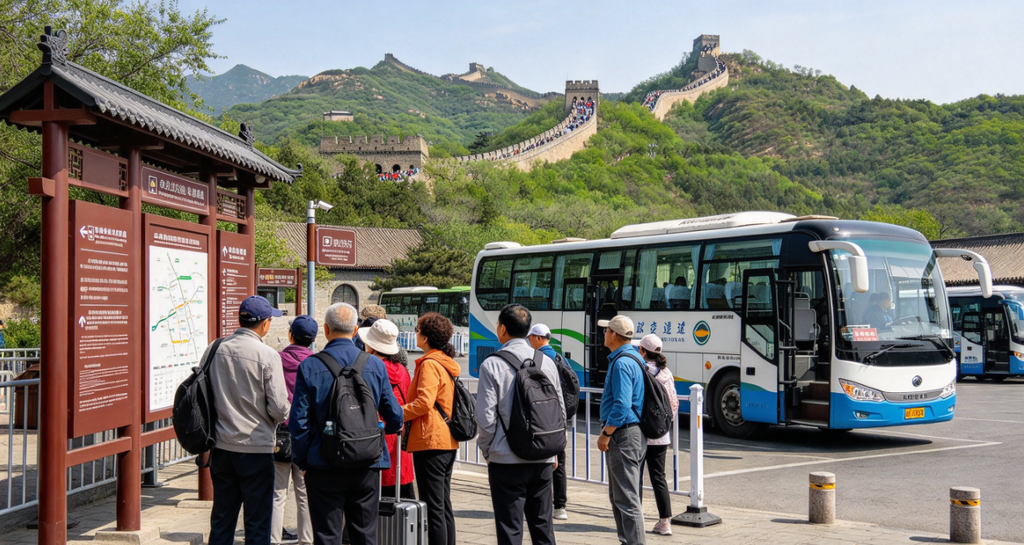
The Great Wall is where independent travel becomes substantially more demanding.
Central Beijing attractions are connected by a dense metro network. Great Wall sections are outside the urban center, and the transport arrangements differ considerably.
For solo travelers, the biggest question is not simply how to reach the entrance.
It is how to get back to Beijing reliably after several hours of walking.
Badaling: A practical choice for independent travelers
Badaling is one of the most accessible Great Wall sections from Beijing.
Its advantages include:
- High-speed rail connections from Beijing.
- Public bus options.
- A developed visitor area.
- More established transport infrastructure than many remote sections.
However, rail tickets, departure stations and available services must be checked for your actual travel date.
Do not assume that a train will always have seats available when you decide to return.
A sensible independent itinerary looks like this:
- Check the official railway timetable and purchase the outbound and return tickets where appropriate.
- Confirm which Beijing railway station your train uses.
- Check the route from Badaling Railway Station to the attraction entrance.
- Allow enough time for walking, sightseeing and returning to the station.
- Keep an alternative transport option in mind if your original departure is missed.
The advantage of rail is that it avoids much of the road traffic uncertainty. The disadvantage is that you must work around a fixed timetable.
Mutianyu: Beautiful scenery, but more transport coordination
Mutianyu is another excellent option, particularly for visitors who prefer a scenic section with substantial visitor facilities.
However, its public transport route requires more planning.
The Beijing municipal government’s current attraction information describes a public transport route involving:
- Express Bus 916 from Dongzhimen to Huairou Beidajie.
- A transfer to a local bus such as H23, H3 or H71.
- Getting off at the Mutianyu scenic-area stop.
Source: Beijing Government: Mutianyu Great Wall visitor information.
The important detail is that reaching Huairou is not the same as reaching the Great Wall entrance.
You still need to account for the local connection, waiting time and the scenic area’s internal transport arrangements.
Bus schedules and operating arrangements can change, so confirm them before departure.
Badaling vs Mutianyu for independent travelers
| Factor | Badaling | Mutianyu |
|---|---|---|
| Independent transport | Generally more straightforward | Requires more transfer planning |
| Rail access | High-speed rail connection | No equivalent direct high-speed rail arrival at the attraction |
| Public bus options | Available | Available, but usually involves more coordination |
| Return planning | Easier when using confirmed rail tickets | Requires checking the return bus and transfer chain |
| Visitor facilities | Well developed | Well developed |
| Best suited to | Travelers prioritizing transport simplicity | Travelers prioritizing scenery and willing to plan connections |
Neither section is universally better.
If your priority is independent travel with fewer transport uncertainties, Badaling is a practical option.
If you prefer Mutianyu, it can still be visited independently, but you should confirm the entire route rather than relying on an approximate map estimate.
When should you choose a day tour instead?
A private transfer or organized day tour may be worth the extra cost when:
- You are traveling with elderly relatives or young children.
- You have limited time in Beijing.
- You do not want to manage several bus transfers.
- You are visiting during a busy holiday period.
- You want to visit a more remote Great Wall section.
- You are uncomfortable coordinating a fixed return timetable.
For a solo traveler, the price of a private car can be relatively high because there is no group to share the cost.
A scheduled group tour may therefore be a more economical compromise.
Compare the total package, not just the advertised headline price. Check whether admission, internal shuttle buses, cable cars, meals and return transport are included.
A cheap advertised price is not necessarily the cheapest completed trip.
6. Safety in Beijing: Avoid the Situations That Create Unnecessary Risk
Beijing is generally manageable for solo visitors, including first-time travelers. But no major city is completely risk-free.
For independent travelers, the most useful safety advice is not simply to avoid dark streets. It is to recognize situations where unclear prices, unofficial services or fatigue can lead to poor decisions.
Be careful with unsolicited tour offers
If someone approaches you near a major tourist attraction and offers an unusually cheap Great Wall trip, ask for the full details before agreeing.
Check:
- The exact Great Wall section.
- Departure and return times.
- Whether admission is included.
- Whether shuttle buses or cable cars cost extra.
- Whether the vehicle and operator are identifiable.
- Whether the total price is confirmed in writing.
Avoid boarding a vehicle when the destination, itinerary or total price is unclear.
If the offer changes after departure, you may have limited practical options for resolving the disagreement.
Use identifiable transport services
When taking a taxi or ride-hailing service:
- Use an official taxi stand or a recognized booking app.
- Confirm the destination address before departure.
- Check the vehicle details against the booking.
- Avoid accepting unsolicited rides from strangers.
- Keep the trip details available on your phone.
For late-night travel, a direct ride to your hotel may be more sensible than walking a long distance to reach a metro station.
Protect your travel documents
Keep your passport secure, but make sure you can access the identification information needed for bookings.
Save copies of your reservation confirmations and keep the original passport available when an attraction requires it.
If you lose your passport, contact your country’s embassy or consulate and follow the relevant local procedures.
Manage decision fatigue
This is a particularly important issue for solo travelers.
When traveling alone, you make every decision yourself: transport, restaurants, ticket purchases, directions and schedule changes.
After several busy days, you may become less careful about checking prices or verifying a service.
A practical way to reduce this risk is to avoid filling every day with tightly scheduled attractions.
Leave a break between major activities. Return to your hotel when you are tired. Avoid making expensive transport or tour decisions simply because you want to save time at the end of a long day.
Good travel planning is also a form of risk management.
7. Eating Alone in Beijing: What to Order and How to Avoid Overordering

Eating alone in Beijing is generally straightforward. Many restaurants serve individual noodle dishes, rice meals, dumplings and small portions.
The challenge is choosing the right restaurant and ordering an appropriate amount of food.
Which types of restaurants work best for one person?
| Restaurant type | Suitability for solo diners | Practical advice |
|---|---|---|
| Noodle shops | Excellent | Usually easy to order one bowl |
| Dumpling restaurants | Excellent | Check whether portions are sold by weight or number |
| Local neighborhood restaurants | Good | Ask whether smaller portions are available |
| Hotpot restaurants | Varies | Look for individual hotpot options |
| Peking duck restaurants | Good, but can be expensive | Ask about half-duck or smaller serving options |
| Large banquet restaurants | Less convenient | Check minimum order requirements before sitting down |
How to order without speaking Chinese
Do not depend entirely on live translation.
Save pictures of dishes you want to try before visiting restaurants. A photograph can be more effective than trying to pronounce an unfamiliar dish name.
A few useful phrases:
| English | Chinese |
|---|---|
| No cilantro, please. | 不要香菜,谢谢。 |
| Not spicy, please. | 不要辣,谢谢。 |
| One portion, please. | 一份,谢谢。 |
| Can I pay by card? | 可以刷卡吗? |
| Can I pay in cash? | 可以付现金吗? |
| Is this enough for one person? | 这个一个人够吃吗? |
You can show these phrases directly to restaurant staff.
How much should you order?
A common mistake is ordering several dishes because restaurant menus show large portions.
For one person, a noodle bowl, dumpling portion or rice meal is often sufficient.
At a traditional restaurant, you can ask for smaller portions or a half-sized serving where available.
For Peking duck, check whether the restaurant offers a half-duck option and whether the accompanying pancakes, vegetables and side dishes are included.
You do not need to avoid famous restaurants simply because you are traveling alone. You just need to check the portion size and minimum order requirements before ordering.
For more local food ideas, see our Beijing food guide.
8. Traveling Alone with Children, Older Relatives or in Bad Weather
Independent travel does not mean every traveler should use the same itinerary.
The route that works for a healthy solo traveler with a small backpack may be uncomfortable for an older visitor, a family with children or someone visiting during heavy rain.
If you are traveling with elderly relatives
Prioritize fewer attractions per day.
The distance between a metro station and an attraction entrance can be substantial. Large sites such as the Forbidden City also involve considerable walking.
Consider:
- Using taxis for journeys that involve several transfers.
- Choosing hotels closer to the main sightseeing area.
- Scheduling rest periods.
- Avoiding long walking routes on consecutive days.
- Checking accessibility and mobility arrangements before visiting.
For older visitors, reducing unnecessary walking can be more valuable than saving a few yuan on transport.
If you are traveling with children
Allow more time for toilets, meals, breaks and unexpected delays.
A day containing the Forbidden City, the Temple of Heaven and a long evening walk may look efficient on paper but can be exhausting in practice.
It is often better to complete one major attraction and one nearby activity than to cross the city repeatedly.
If it rains
Beijing’s outdoor attractions become less comfortable in wet weather.
The Great Wall can be particularly challenging because wet steps and uneven surfaces increase the risk of slipping.
A better strategy is to keep an indoor alternative available:
- Museums with confirmed admission.
- Shopping areas.
- Indoor cultural activities.
- Restaurants or tea experiences.
Check the weather before leaving your hotel and avoid committing to a long outdoor journey when conditions are poor.
If you are arriving late at night
Do not assume the metro will still be operating when your flight arrives.
Allow for immigration, baggage collection and the time required to reach your hotel.
If you arrive after the most convenient public transport options have stopped running, compare official taxis and pre-arranged transfers.
Having your hotel address written in Chinese can make the journey much easier.
9. Where Should You Stay if You Want to Explore Beijing Independently?
Hotel location has a direct effect on the cost and difficulty of independent travel.
A cheaper hotel far from the main sightseeing areas may require longer journeys every day. The money saved on accommodation can disappear through extra transport costs and lost time.
For a first-time visitor, consider the following areas:
| Area | Advantages | Potential disadvantages |
|---|---|---|
| Wangfujing | Central location and convenient access to major attractions | Can be expensive |
| Qianmen | Historic atmosphere and access to central sightseeing areas | Some streets can be busy |
| Dongdan | Convenient metro access and central location | Less atmospheric than traditional hutong areas |
| Dongzhimen | Useful transport connections and access toward the northeastern part of the city | Not ideal for every central sightseeing route |
| Xidan | Shopping, restaurants and metro connections | Busy commercial environment |
The best hotel is not necessarily the one closest to the Forbidden City.
Look for a location that makes your overall itinerary convenient. A hotel near a useful metro interchange or within reasonable walking distance of several attractions can save considerable time.
Before booking, check the actual walking route to the nearest station, not just the distance shown on a hotel map.
10. A Practical Preparation Checklist for Independent Beijing Travel

The easiest way to avoid problems is to separate preparation into three stages.
Before departure
- Check your passport validity and travel requirements.
- Download an offline-capable map or prepare an alternative navigation method.
- Install Alipay and/or WeChat and attempt to link an eligible overseas bank card.
- Check that your phone can access the internet in China.
- Save your hotel address in Chinese.
- Confirm reservations for attractions with restricted admission.
- Check whether your passport details match the booking information.
- Save important confirmations offline.
- Prepare a physical bank card and some RMB cash.
- Install a translation app and download the relevant language pack if available.
Before leaving your hotel each morning
- Confirm the day’s attraction opening and admission arrangements.
- Check the weather.
- Check the route and station exit.
- Make sure your phone and power bank are charged.
- Carry your passport or the identification required for your bookings.
- Check whether your itinerary includes a fixed train or bus departure.
- Keep a backup destination in case your main attraction is unavailable.
Before returning from a distant attraction
- Confirm the return departure point.
- Check the last available train or bus.
- Allow enough time to walk back to the station.
- Keep a backup transport option.
- Do not wait until the final departure to start planning your return.
For a more structured route, see our Beijing travel guide.
11. When Is Independent Travel Not the Best Choice?
Independent travel is not automatically the cheapest or most convenient option.
Sometimes paying for transport or a guide is a rational decision.
| Situation | Independent travel | Better alternative |
|---|---|---|
| Central Beijing sightseeing | Usually straightforward | No guide necessary for most visitors |
| Visiting several central attractions | Good with route planning | Private guide if you want deeper historical explanations |
| Great Wall visit with limited time | Possible but requires preparation | Organized transport or a private transfer |
| Traveling with elderly relatives | Depends on mobility | Private car or customized itinerary |
| Visiting remote Great Wall sections | More complicated | Experienced driver or organized tour |
| Traveling during peak holiday periods | Possible, but less flexible | Confirmed transport and reservations |
| First visit with very limited time | Can be time-consuming | A private tour may reduce navigation and coordination time |
The key is to pay for the problem you actually need solved.
If your only concern is getting around central Beijing, a private guide is probably unnecessary.
If you want to visit a remote Great Wall section, avoid multiple transfers, or make the most of a short stay, organized transport may provide better value.
For travelers who want a customized route without arranging every detail themselves, our Beijing trip planning service can help match the itinerary and transport arrangements to the available time.
Frequently Asked Questions
Is Beijing easy to explore on your own as a foreigner?
Yes. Most major tourist areas are accessible by metro, taxi or walking. The main difficulties are attraction reservations, payment setup, language barriers and transport to destinations outside central Beijing. Preparing these essentials before arrival makes independent travel much easier.
Do I need a Chinese phone number to travel independently in Beijing?
No. Foreign visitors can register supported payment apps using eligible overseas phone numbers. However, individual attraction booking platforms may have different requirements. For example, the Beijing government has confirmed that foreign visitors can book the Forbidden City through its official English website using a passport, while the Summer Palace has previously offered an on-site booking alternative for visitors whose foreign numbers were not supported online.
Can I visit the Forbidden City without a tour guide?
Yes. You can visit independently if you secure the required admission reservation and bring the identification document used for booking. A guide is optional, although visitors interested in the palace’s architecture and history may benefit from a guided explanation.
Is it difficult to use the Beijing subway without speaking Chinese?
Not necessarily. Major stations generally provide bilingual signage, and navigation apps can help with route planning. The more difficult parts are sometimes choosing the correct exit, managing transfers and estimating walking time inside large stations.
Is Alipay enough for traveling around Beijing?
Alipay is convenient and widely used, but it should not be your only payment method. Keep another eligible bank card and some RMB cash available in case your app, card or phone stops working.
Is Badaling or Mutianyu easier to visit independently?
Badaling is generally more straightforward for independent travelers because it has established high-speed rail and public transport connections. Mutianyu is also accessible independently, but its public transport journey involves more coordination. Confirm the return arrangements before choosing either section.
Is Beijing safe for solo female travelers?
Beijing is generally manageable for solo female travelers, particularly in busy tourist areas and established commercial districts. Use identifiable transport, avoid unsolicited tour offers, keep your accommodation details accessible and take normal precautions when traveling late at night.
How many days should I spend exploring Beijing independently?
Three days is a reasonable starting point for major central attractions, while four or five days allow a more relaxed schedule and a Great Wall excursion. The ideal duration depends on your interests, walking pace and whether you want to visit museums, traditional neighborhoods or more distant attractions.
Should I book a private tour or explore Beijing independently?
For central sightseeing, independent travel is usually practical. A private tour becomes more valuable when you have limited time, want detailed historical explanations, travel with people who have mobility limitations, or need reliable transport to a less accessible Great Wall section.
Final Verdict: Prepare the Essentials, Then Enjoy the Freedom
Exploring Beijing on your own is not difficult because the city lacks transport or tourist facilities. It is challenging because several practical systems operate independently of one another.
A successful trip depends on getting four things right:
- Reservations: Know which attractions require advance booking and which offer alternative admission arrangements.
- Payments: Set up mobile payments before departure, but never rely on a single phone or card.
- Transport: Use the subway for many central journeys, taxis when they genuinely save time, and confirm the entire return route for Great Wall trips.
- Time management: Leave room for station walking, queues, weather changes and rest.
You do not need to plan every minute of your visit. You need to make sure that one failed payment, one unavailable ticket or one missed bus does not ruin an entire day.
Once those essentials are in place, Beijing becomes much easier to explore independently. You can spend less time troubleshooting and more time enjoying the places that make the city memorable: the Forbidden City’s vast courtyards, the quiet hutongs, traditional Beijing food and the Great Wall stretching across the mountains.