
Beijing Food Culture: A Beginner’s Guide to Local Cuisine
Quick Answer
A Beijing food culture guide is about more than knowing what dishes to order. Beijing cuisine reflects the city’s imperial history, northern Chinese geography, seasonal eating habits, migrant influences, and everyday social traditions.
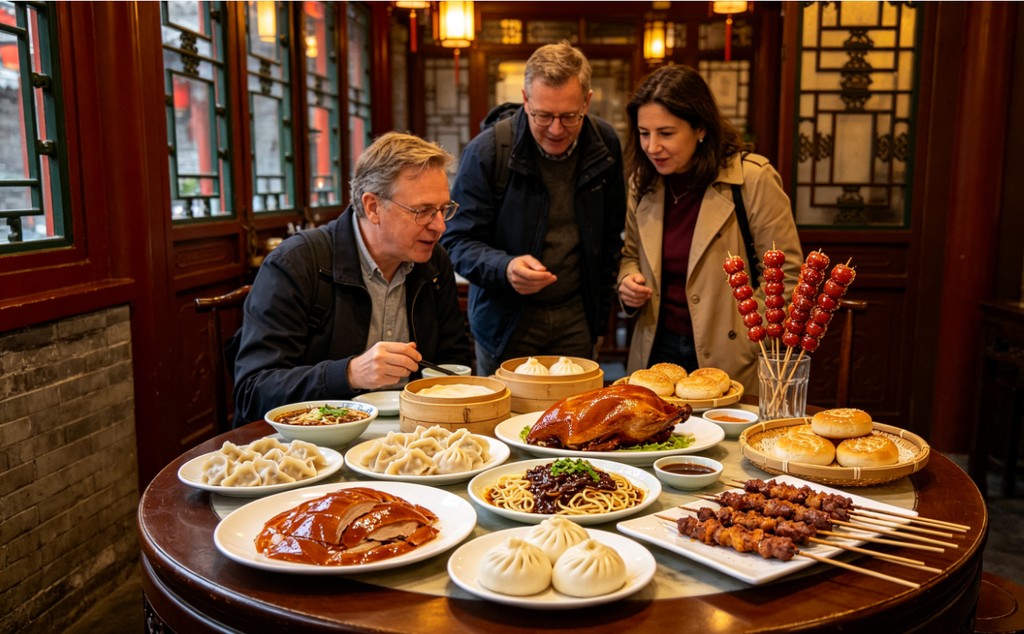
For first-time visitors, the easiest way to understand Beijing food is to look beyond famous dishes. Peking duck represents ceremonial dining and culinary craftsmanship; zhajiangmian reflects everyday northern eating; jiaozi and baozi show the importance of wheat-based foods in northern China; while street snacks reveal how Beijing’s food culture developed through generations of local communities.
A good introduction to Beijing cuisine should therefore answer three questions:
- What foods are traditionally associated with Beijing?
- Why do these foods taste and look different from cuisine in southern China?
- How should travelers experience Beijing food rather than simply photograph it?
This guide explains the cultural background behind Beijing’s food traditions and provides a practical framework for experiencing local cuisine as a first-time visitor.
What Makes Beijing Food Culture Different?
Beijing is located in northern China, where wheat has historically played a more important role than rice in everyday diets. This geographical background helps explain the popularity of noodles, dumplings, steamed buns, pancakes, and other wheat-based foods.
But geography is only part of the story.
For centuries, Beijing was the political and cultural center of China. The imperial court, officials, soldiers, merchants, migrants, and ordinary residents all contributed to the city’s culinary development. As a result, Beijing food is not one perfectly defined cuisine. Instead, it is a combination of northern Chinese culinary traditions and influences brought to the capital from other regions.
This is one reason a Beijing food culture guide should include both famous restaurant dishes and ordinary neighborhood foods.
The food culture of Beijing can broadly be understood through four influences:
- Northern Chinese staple foods, particularly wheat-based dishes
- Imperial and court cuisine, which influenced formal dining
- Muslim culinary traditions, especially lamb and beef dishes
- Regional migration, which introduced flavors from other parts of China
The result is a food scene that can feel simultaneously traditional, practical, sophisticated, and highly diverse.
1. The Historical Roots of Beijing Cuisine
Beijing’s culinary identity developed alongside the city’s changing role in Chinese history.
When Beijing became the capital during the Yuan Dynasty, the city attracted people from different parts of China and beyond. Later, during the Ming and Qing dynasties, its importance as an imperial capital further strengthened its cultural diversity.
The imperial court created demand for elaborate dishes, refined cooking techniques, and carefully selected ingredients. At the same time, ordinary Beijing residents developed simpler foods suited to daily life.
This created two parallel sides of Beijing cuisine:
Formal Beijing dining emphasized presentation, craftsmanship, hospitality, and carefully prepared dishes.
Everyday Beijing food emphasized practicality, strong flavors, affordable ingredients, and filling wheat-based staples.
That distinction remains useful for travelers today. Eating at a famous roast-duck restaurant and buying a simple breakfast from a neighborhood shop can both be authentic Beijing experiences, but they represent different parts of the city’s food culture.
2. Why Wheat Matters in Beijing Food
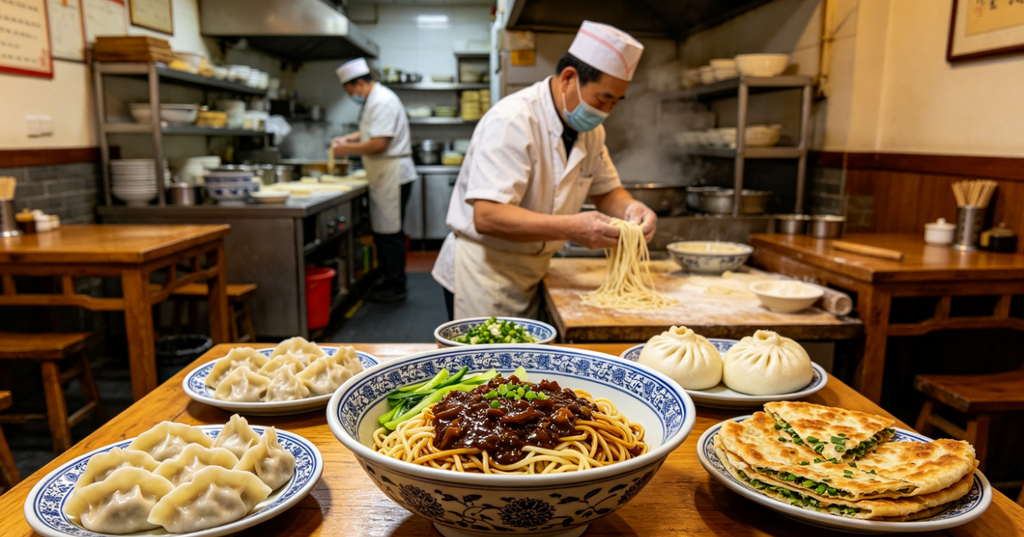
One of the easiest ways to recognize northern Chinese food culture is through its dependence on wheat.
Compared with many southern Chinese regions where rice is central, northern diets traditionally make extensive use of wheat flour. This has produced an impressive range of foods based on noodles, dough, and pancakes.
Common examples include:
- Noodles
- Dumplings
- Steamed buns
- Stuffed buns
- Savory pancakes
- Hand-pulled or knife-cut noodles
- Various forms of flatbread
This does not mean Beijing people do not eat rice. Rice is widely available and extremely common in modern Beijing. Rather, wheat-based foods historically played a particularly important role in the city’s traditional diet.
For visitors, this difference becomes obvious when comparing a traditional noodle shop with a southern Chinese rice-focused restaurant.
3. Peking Duck: More Than Beijing’s Most Famous Dish
Peking duck is probably the dish most closely associated with Beijing internationally.
However, simply saying that Peking duck is “famous” does not explain why it matters.
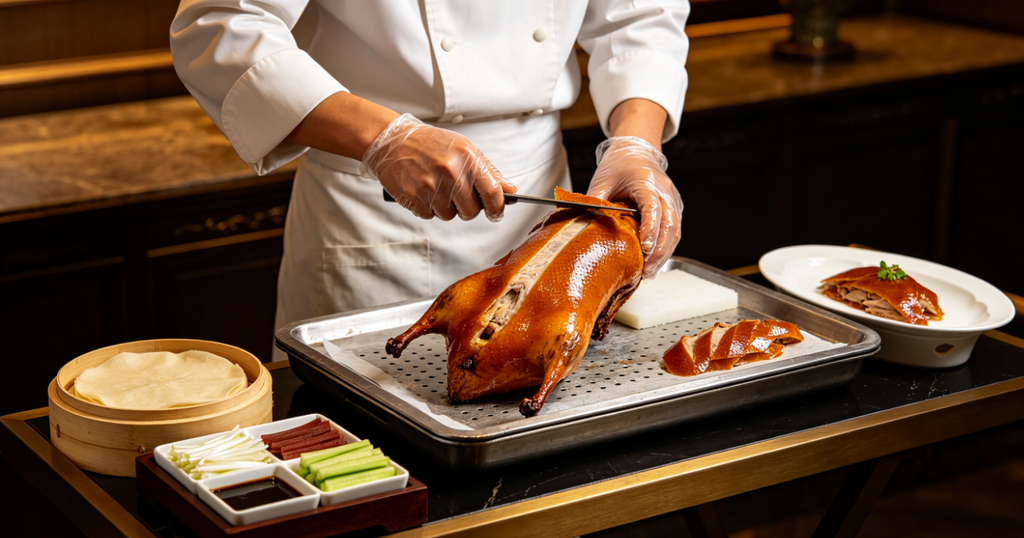
The dish is closely connected to Beijing’s history of formal dining. Preparing it involves controlling the duck’s skin, drying and roasting it carefully, and slicing the finished duck with considerable precision.
Traditionally, the crisp skin is eaten with thin pancakes, sauce, and accompaniments such as cucumber and scallions.
The experience is as much about how the dish is served as the flavor itself.
At a traditional restaurant, diners may watch the duck being carved or receive carefully arranged slices designed to emphasize the contrast between crisp skin and tender meat.
For first-time visitors, this makes Peking duck particularly interesting as a cultural dining experience rather than simply another Chinese dish.
4. Zhajiangmian and the Everyday Side of Beijing Cuisine
If Peking duck represents the formal side of Beijing dining, zhajiangmian offers a glimpse into everyday food culture.
Zhajiangmian consists of wheat noodles served with a savory fermented soybean-based sauce and a selection of vegetables. The precise ingredients and preparation can vary between restaurants and families.
Its importance lies in its simplicity.
Unlike elaborate banquet dishes, zhajiangmian is closely associated with ordinary meals and northern Chinese noodle culture. The combination of noodles, sauce, and fresh vegetables creates a substantial meal without requiring expensive ingredients.
For travelers trying to understand Beijing beyond its tourist landmarks, traditional noodle dishes can be more revealing than another visit to a high-end restaurant.
A Beijing food culture guide should therefore treat everyday foods as equally important cultural evidence.
5. Beijing Snacks: A Window Into Local Life
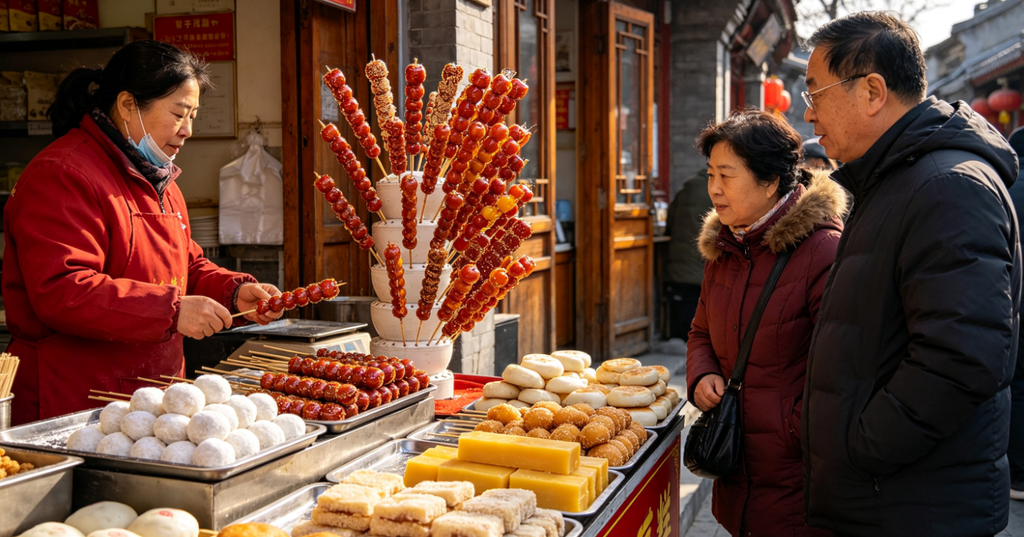
Beijing’s traditional snacks offer another perspective on the city’s culinary history.
Some are associated with old neighborhoods, markets, breakfast shops, or Muslim communities. Others developed from northern Chinese traditions and later became identified with Beijing itself.
Depending on the season and neighborhood, travelers may encounter foods such as:
- Jiaoquan, a traditional fried breakfast item
- Douzhi, a fermented mung-bean drink with a distinctive flavor
- Aiwowo, a glutinous rice-based snack
- Wandouhuang, a pea-based traditional sweet
- Tanghulu, candied fruit traditionally associated with northern China
- Various stuffed buns and steamed foods
- Lamb dishes influenced by Beijing’s Muslim communities
Not every traditional snack will appeal to every visitor.
That is part of the experience.
Some foods have strong fermented, savory, sour, or earthy flavors that may be unfamiliar to people who primarily know Chinese cuisine through international restaurants. Trying them provides an opportunity to understand local tastes rather than simply searching for familiar flavors.
6. The Role of Muslim Food Traditions in Beijing
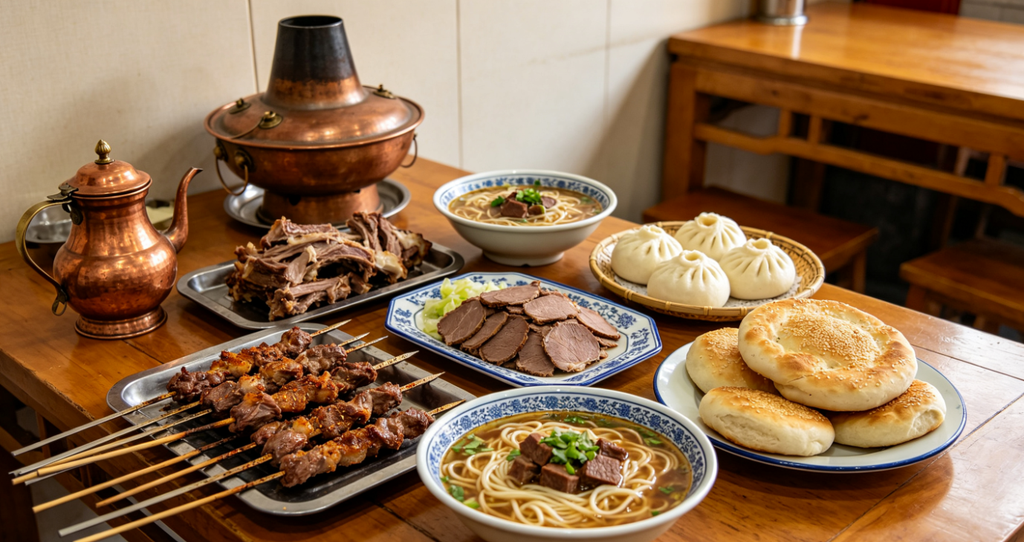
Beijing’s food culture cannot be fully understood without recognizing the city’s long-established Muslim communities.
Beijing has historically been home to Hui Muslim communities, and their culinary traditions have influenced the city’s food landscape.
Lamb and beef are particularly important examples.
Visitors may encounter dishes featuring:
- Roast or grilled lamb
- Lamb skewers
- Hand-cut lamb
- Beef noodles
- Halal dumplings and buns
- Traditional Muslim-style pastries
These foods demonstrate that Beijing cuisine is not a single culinary tradition.
Instead, the city’s food culture developed through interactions among different communities over many centuries.
This is particularly useful to remember when exploring neighborhoods away from the most heavily visited tourist areas.
7. Beijing Dining Is Also About Seasonality
Traditional Chinese food culture generally pays close attention to seasonal ingredients, and Beijing is no exception.
Historically, Beijing’s climate—with cold winters and hot summers—encouraged people to adapt their diets according to the season.
Winter foods tend to emphasize warming, substantial meals, while summer eating may include lighter dishes and fresh vegetables.
Seasonality can also be seen in the popularity of certain fruits, snacks, vegetables, and preserved foods at different times of the year.
For travelers, this means the best food experience can change depending on when you visit.
A dish that feels particularly appropriate during a cold Beijing winter may not have the same appeal during the height of summer.
8. Why Beijing Food Can Taste Stronger Than Expected
Visitors sometimes describe traditional northern Chinese food as salty, savory, rich, or strongly flavored.
There are historical reasons for this.
Northern China developed food traditions around wheat, preserved ingredients, fermented sauces, meat, and hearty staple foods. Fermented soybean sauces, scallions, garlic, vinegar, and other strong-flavored ingredients are important components of many traditional dishes.
This does not mean every Beijing dish is heavy or salty.
Modern Beijing restaurants cover an enormous range of styles, including lighter contemporary cuisine, Sichuan food, Cantonese food, Japanese cuisine, Western restaurants, and international dining.
The important distinction is between traditional Beijing flavors and the broader restaurant scene of modern Beijing.
9. Beijing Food Culture and Social Dining
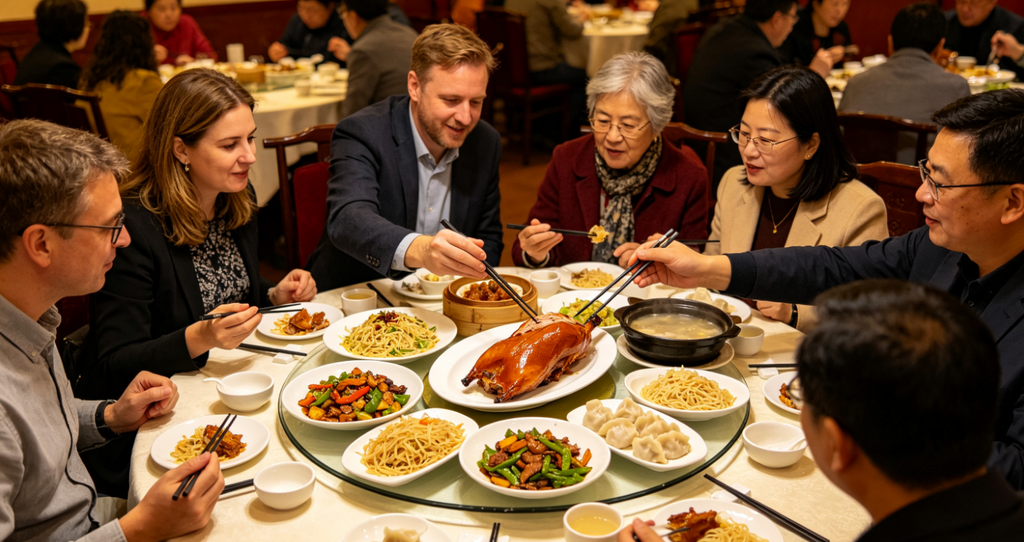
Food in Beijing is also strongly connected with social relationships.
Chinese meals are often shared rather than served as individual courses. Several dishes may be placed in the center of the table, allowing everyone to sample different flavors.
This makes the dining experience fundamentally different from a Western meal where each person may order a separate main course.
In group settings, ordering several dishes with contrasting flavors is common.
For example, a meal might combine:
- One meat dish
- One vegetable dish
- One noodle or rice-based staple
- A cold appetizer
- Soup or another shared dish
The exact combination depends on the restaurant and group.
The principle is more important than the formula: Chinese dining often values variety and sharing rather than one large individual entrée.
10. How to Order Food in Beijing as a First-Time Visitor
Understanding a few basic dining habits can make eating in Beijing considerably easier.
Look at the menu before ordering
Restaurants may have very different styles. A traditional Beijing restaurant, neighborhood noodle shop, hotpot restaurant, and modern Chinese restaurant can have completely different menus.
Do not order only famous dishes
If every meal consists of Peking duck and dumplings, you will experience only a small part of Beijing cuisine.
Mix iconic dishes with ordinary local foods.
Share several dishes
If you are traveling with others, sharing allows you to experience more flavors without ordering excessively.
Consider portion sizes
Chinese restaurant portions can vary substantially. Start with a reasonable number of dishes and order additional food if necessary.
Ask about unfamiliar ingredients
Some traditional dishes contain fermented ingredients, offal, strong herbs, or textures unfamiliar to international visitors.
If you have dietary restrictions or allergies, communicate them clearly before ordering.
11. Where Should You Experience Beijing Food?
There is no single “best” place to eat Beijing food.
Different environments reveal different aspects of the city’s culinary culture.
Traditional restaurants
These are useful for experiencing classic dishes in a more formal setting.
Peking duck is particularly suitable for this type of restaurant experience because preparation and presentation are important parts of the meal.
Neighborhood restaurants
Small local restaurants can provide a more everyday experience.
They are often better places to explore noodles, dumplings, buns, simple stir-fries, and inexpensive local meals.
Markets and snack areas
These can be useful for discovering traditional snacks and casual foods.
However, food markets can vary significantly in quality and hygiene. Visitors should use normal food-safety judgment, particularly with foods that have been sitting unrefrigerated for long periods.
Breakfast shops
One of the most overlooked ways to experience Beijing is through breakfast.
Instead of beginning every day at a hotel buffet, consider trying a local breakfast shop at least once. Morning food offers a different perspective on how residents actually eat.
12. Beijing Food Culture vs. Other Chinese Regional Cuisines
A useful way to understand Beijing cuisine is to compare it with other major Chinese culinary traditions.
| Culinary Tradition | Typical Characteristics |
|---|---|
| Beijing / Northern China | Wheat staples, savory sauces, noodles, dumplings, lamb and hearty flavors |
| Sichuan | Chili, Sichuan peppercorn, bold and complex spicy flavors |
| Cantonese | Fresh ingredients, lighter seasoning, steaming and delicate preparation |
| Shanghai / Jiangnan | Sweet-savory flavors, rice-based foods, seafood and seasonal ingredients |
| Northwestern China | Wheat foods, lamb, noodles, cumin and strong savory flavors |
These categories are broad rather than absolute.
Modern Beijing contains restaurants representing virtually every major Chinese regional cuisine. Therefore, eating “Chinese food in Beijing” does not necessarily mean eating traditional Beijing food.
This distinction is especially important for international visitors who want to experience the city’s local culinary identity.
13. How to Experience Beijing Food More Deeply
The best approach is to build your food experience around contrast.
Instead of asking only, “What is the most famous Beijing dish?” ask:
- What would an ordinary Beijing resident eat for breakfast?
- Which foods developed from northern wheat culture?
- Which dishes are connected with the imperial capital?
- Which foods reflect Beijing’s Muslim communities?
- Which dishes are seasonal?
- Which foods are traditionally shared?
- Which flavors are unfamiliar to me?
These questions transform eating from a checklist into cultural exploration.
For travelers planning their first visit, Beijing private tours can also be useful when you want food experiences combined with historical neighborhoods, traditional markets, or local cultural sites. A knowledgeable local guide can explain the context behind foods that may otherwise appear simply as unfamiliar dishes on a menu.
14. Traditional Foods Worth Trying
If you are creating your own Beijing food list, start with a combination of iconic dishes and everyday foods.
Peking Duck
Best for understanding Beijing’s formal dining tradition and culinary craftsmanship.
Zhajiangmian
A good introduction to northern wheat-based noodle culture.
Jiaozi
Dumplings are deeply embedded in northern Chinese food traditions and are especially associated with family gatherings and festivals.
Baozi
Steamed stuffed buns are common breakfast or casual meal choices.
Lamb Dishes
These reflect both northern culinary traditions and Beijing’s Muslim food culture.
Traditional Snacks
Try a few local snacks if you are interested in historical food traditions, particularly those associated with old neighborhoods and markets.
The goal is not to try everything.
A better strategy is to select foods representing different cultural roles.
15. Common Mistakes First-Time Visitors Make
Mistake 1: Assuming all Chinese food in Beijing is Beijing food
Beijing is an international metropolis with restaurants from across China and around the world.
Mistake 2: Eating only at famous restaurants
Famous restaurants are useful, but small neighborhood establishments can reveal more about everyday dining.
Mistake 3: Expecting every traditional dish to taste familiar
Traditional Chinese flavors can be very different from Chinese food served internationally.
Mistake 4: Treating food as separate from history
Many dishes make more sense when you understand where they came from and who traditionally ate them.
Mistake 5: Trying too many dishes at once
A smaller number of thoughtfully selected foods often creates a better experience than ordering an enormous list.
16. A Simple Food Plan for First-Time Visitors
If you have only a few days in Beijing, you do not need an elaborate food itinerary.
A simple approach could look like this:
Day 1 — Iconic Beijing
Try Peking duck and explore a traditional restaurant environment.
Day 2 — Everyday Food
Have a local breakfast, try zhajiangmian for lunch, and eat at a neighborhood restaurant for dinner.
Day 3 — Snacks and Regional Influences
Explore traditional snacks and try a lamb or Muslim-style dish.
This structure creates a broader understanding of Beijing food than repeatedly visiting famous restaurants.
For travelers building broader Beijing travel experiences, food can also be combined naturally with hutong walks, historic neighborhoods, markets, temples, and traditional cultural sites.
17. How to Find Authentic Beijing Food
“Authentic” is not always synonymous with old, famous, or expensive.
A restaurant can be modern and still serve traditional food. A historic restaurant can adapt its recipes for contemporary customers. A small neighborhood restaurant may preserve everyday food traditions that never became internationally famous.
Instead of searching for one definition of authenticity, look for signs of cultural continuity:
- Traditional recipes or techniques
- Long-established local dishes
- Ingredients associated with northern cuisine
- Neighborhood customer bases
- Foods connected with local festivals or customs
- Clear links to specific communities or historical traditions
This approach provides a more realistic way to understand Beijing cuisine.
18. Final Thoughts: Understanding Beijing Through Food
Food is one of the easiest ways to understand Beijing because the city’s culinary traditions connect geography, history, migration, family life, religion, and social customs.
The most famous dishes provide an introduction, but they are only the beginning.
Peking duck can show you the formal side of Beijing dining. Zhajiangmian can introduce northern noodle culture. Traditional snacks can reveal older neighborhood traditions. Muslim cuisine demonstrates the city’s cultural diversity. Shared meals show how food functions as a social experience.
A good Beijing food culture guide should therefore encourage curiosity rather than provide a simple list of dishes.
If you approach Beijing food with an interest in where a dish came from, who traditionally ate it, how it is prepared, and when it is normally served, even a simple bowl of noodles can tell you something meaningful about the city.
And that is what makes eating in Beijing more than a part of sightseeing—it becomes a way of understanding Beijing itself.