
Which Great Wall Is Best for Families with Children?
For most families visiting Beijing with children, Mutianyu is the best section of the Great Wall. It offers cable car access, relatively convenient visitor facilities, several ways to explore the wall, and the option of returning by cable car instead of walking all the way down.
Badaling is another good choice, particularly for families who prefer travelling by high-speed train and want a more straightforward journey from central Beijing.
However, choosing the right section is only the first decision. Parents should also consider how far their children can comfortably walk, which way they will return, whether a stroller or baby carrier is practical, and what to do if a child becomes tired halfway through the visit.
For families with toddlers or younger children, the most important rule is simple: plan your way down before deciding how far to walk up.
1. Mutianyu vs. Badaling: Which Is Better for Families?

Both Mutianyu and Badaling are suitable for family visits, but they offer different experiences.
| Family consideration | Mutianyu | Badaling |
|---|---|---|
| Overall family suitability | Excellent | Very good |
| Access from Beijing | Private car, taxi or organised tour | High-speed train or road transport |
| Cable car access | Yes | Yes |
| Alternative descent | Toboggan, depending on route and eligibility | Cable car or walking |
| Walking difficulty | Varies by route; many steep steps | Varies by section; some steep slopes and steps |
| Visitor facilities | Restaurants, toilets and service areas | Extensive visitor facilities |
| Best for | Flexible family visits and scenic experiences | Families preferring convenient train access |
Choose Mutianyu if:
- You are visiting with toddlers or primary-school children.
- You want to use a cable car to reduce the amount of climbing.
- You prefer a less complicated walking route with a clear return option.
- Your children are interested in the toboggan ride and meet its operating requirements.
- You want more flexibility to adjust the length of your visit.
Choose Badaling if:
- Your family prefers travelling by high-speed train.
- You want to avoid a long road journey.
- Your children are comfortable walking on steps and uneven surfaces.
- You prefer a well-developed scenic area with extensive visitor facilities.
For most first-time family visitors, Mutianyu is the more flexible option. Badaling can be more convenient for families who prioritise train access.
For a broader comparison of sections, transport options and visitor considerations, see our Great Wall guide.
2. The Best Mutianyu Routes for Families with Children
One common mistake is assuming that the cable car and toboggan are at the same location. They are not.
At Mutianyu, the main cable car operates near Watchtower 14, while the chairlift and toboggan operate near Watchtower 6. These facilities are operated separately, and their tickets are not interchangeable.
This difference matters when planning a family visit.
Route A: Cable Car Up and Down at Watchtower 14
Best for: Toddlers, younger children, grandparents and families who want the least complicated route.
Take the cable car from the lower station to the Great Wall near Watchtower 14.
From there, you can:
- Enjoy the views around Watchtower 14.
- Walk a short distance along the wall if your children have enough energy.
- Return to Watchtower 14.
- Take the cable car back down.
This is the most predictable option for families because you do not need to cross the wall to reach another exit facility.
You can decide how far to walk after arriving at the top. If your child becomes tired, simply turn around and return to the cable car station.
Do not assume that every section of the wall is equally easy. Even near the cable car, there are steps, uneven surfaces and changes in elevation.
Route B: Chairlift Up and Toboggan Down at Watchtower 6
Best for: Families with older children who are confident walking and meet the toboggan operator’s requirements.
This route uses the chairlift near Watchtower 6 to reach the wall. After exploring the nearby section, you return to Watchtower 6 and descend by toboggan if it is operating and everyone is eligible to ride.
The advantage is that you do not need to walk from Watchtower 14 to Watchtower 6.
This is important because the distance between the two areas involves additional walking and changes in elevation. For a tired child, that extra section can turn an enjoyable visit into an exhausting one.
Before choosing this route, remember:
- The toboggan is subject to operating conditions and may close in unsuitable weather.
- Children must meet the operator’s age, height and riding requirements.
- Younger children may need to ride together with an eligible adult.
- The toboggan is not a guaranteed way down for every child.
If your child is too young or does not meet the riding requirements, plan to return by the chairlift rather than relying on the toboggan.
Route C: Cable Car at Watchtower 14, Walk to Watchtower 6, Toboggan Down
Best for: Older children and teenagers who are comfortable with longer walks and uneven steps.
This route starts with the cable car to Watchtower 14. You then walk along the wall towards Watchtower 6 before descending by toboggan.
It can be an enjoyable way to experience more of Mutianyu, but it is not simply a short walk between two stations.
Allow approximately 2–2.5 hours for the wall section as a planning estimate, depending on walking speed, stops, crowd levels and the condition of your children.
The route involves:
- Repeated uphill and downhill steps.
- Uneven stone surfaces.
- Sections where children may need to hold an adult’s hand.
- More physical effort than a short visit around Watchtower 14.
Do not choose this route just because your child wants to try the toboggan. If your child becomes tired near Watchtower 14, it is usually better to return to the cable car station than to continue walking solely to reach the slide.
Which Route Should You Choose?
| Your family situation | Recommended route |
|---|---|
| Baby or toddler | Route A |
| Child who gets tired easily | Route A |
| School-age child who wants a toboggan ride | Route B, if eligible |
| Older child with good walking stamina | Route C may be suitable |
| Family with grandparents | Route A |
| Uncertain weather or limited time | Route A |
The safest strategy is to choose a route based on the least physically capable person in your group, not the strongest adult.
3. What If Your Child Gets Tired Halfway Through?
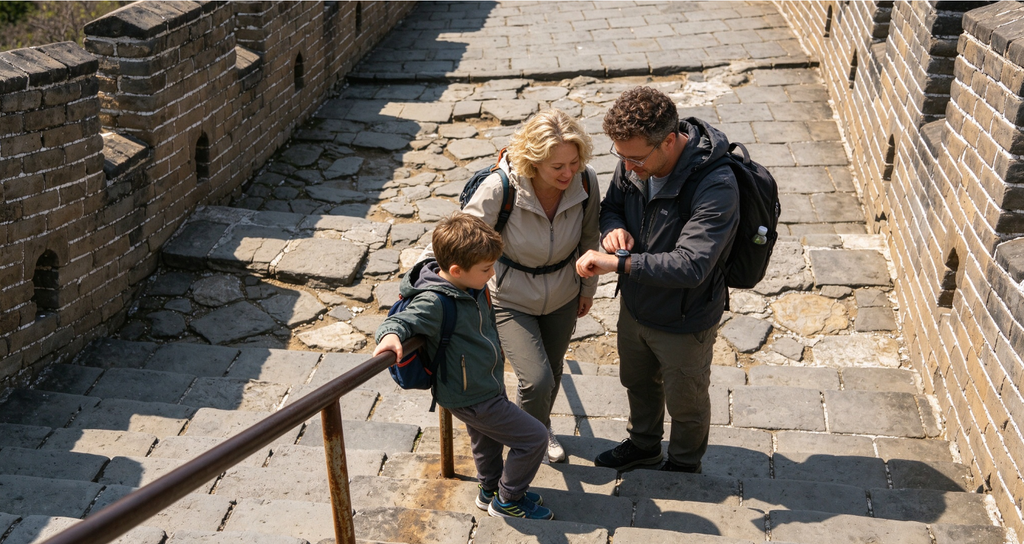
This is one of the most important things parents should understand before visiting Mutianyu.
There is no regular shuttle service that picks visitors up from every watchtower. You should not assume that you can simply walk to the next tower and find a vehicle or ride waiting there.
Your return plan depends on where you are.
If you are near Watchtower 14
Return towards Watchtower 14 and take the cable car down.
This is why Route A is the most predictable choice for younger children. You can keep the walking distance short and return along the same section.
If you are near Watchtower 6
If you started from Watchtower 6, return to the chairlift station. Use the toboggan only if your child meets the requirements and the ride is operating.
If your child is too tired to continue safely, do not force the journey just to reach the toboggan.
If you are walking between Watchtower 14 and Watchtower 6
This is where advance planning matters most.
The two facilities are at different locations. If your child becomes exhausted in the middle of the route, you may still need to walk to the nearest suitable station.
Before starting this crossing, consider whether your child can comfortably complete the entire route, including the final descent to the chosen facility.
If your child has difficulty walking, is injured or cannot continue safely, contact scenic-area staff for assistance. Do not attempt to carry an exhausted child over a long, steep section without considering your own safety.
My recommendation: Families with children under primary-school age should generally avoid committing to the full Watchtower 14-to-6 crossing unless the child is already used to longer hikes.
4. How Much Walking Can Children Handle?
There is no universal age limit for walking on the Great Wall. Children’s fitness, hiking experience, weather conditions and willingness to walk all make a difference.
The following are practical planning suggestions, not official scenic-area age restrictions.
| Child’s age | Suggested approach |
|---|---|
| Under 3 | Keep the visit short and use a baby carrier where appropriate. |
| 3–5 | Focus on a small section near the cable car or chairlift station. |
| 6–9 | Consider a moderate walk with frequent breaks. |
| 10–12 | A longer route may be possible if the child is active and comfortable with stairs. |
| Teenagers | More extensive routes may be suitable, depending on fitness and weather. |
Remember that walking on the Great Wall is different from walking on a flat pavement.
Children need to manage:
- Uneven stone steps.
- Steep staircases.
- Changes in step height.
- Slippery surfaces.
- Exposed sections with strong wind or direct sunlight.
A child who happily walks several kilometres in a city may still find the Great Wall challenging.
Do not judge the route only by its distance. Elevation changes and repeated steps are often more tiring than the total number of metres walked.
5. Should You Bring a Stroller or Baby Carrier?
For most sections of the Great Wall at Mutianyu, a stroller is not practical.
The wall has steep steps, uneven stone surfaces and narrow passages. Even if a stroller is useful in the lower visitor area, it will not be suitable for most walking sections on the wall.
A baby carrier is usually the better option for families travelling with infants or toddlers.
However, it is important to choose the right carrier and prepare for the physical effort.
Check the carrier before your trip
A carrier with proper waist and shoulder support can distribute the child’s weight more evenly.
Before travelling, make sure:
- The carrier fits the adult comfortably.
- The child can sit securely.
- The waist belt supports most of the weight.
- You can walk for a reasonable period without back or shoulder pain.
Do not assume that you can comfortably carry a toddler for several hours just because you can carry them around the house.
Consider your own balance
Carrying a child changes your centre of gravity. On steep stairs, this makes balance particularly important.
Hold handrails where available, move slowly and avoid rushing through crowded sections.
If two adults are travelling together, consider taking turns carrying the child.
Prepare for summer and winter
In summer, a child sitting against an adult’s back can become hot quickly. Choose breathable clothing, bring water and take regular breaks in shaded areas when available.
In winter, bulky clothing can affect how a carrier fits. Check that the child is properly secured and that the straps are not restricted by thick coats.
A carrier does not make icy steps safe. If the wall is slippery, reduce the walking distance or reconsider the visit.
6. Can Children Ride the Mutianyu Toboggan?
The Mutianyu toboggan is one of the attractions many children look forward to. However, it is not suitable for every child.
Published ticket listings commonly state that:
- Children under 3 are not permitted to ride.
- Children under 10 or below 1.5 metres may not ride alone and may need to share a double sled with an eligible adult.
- Additional restrictions may apply depending on the operator and operating conditions.
These are reference rules reported by ticket listings, not a substitute for the operator’s current official requirements.
Before purchasing tickets, confirm the latest rules directly with the toboggan operator, especially if your child is close to an age or height threshold.
I could not verify a reliable current official maximum weight limit, so it is better to ask the operator rather than rely on an unconfirmed number.
Also remember that:
- The toboggan may close because of rain, snow, ice or other unsuitable conditions.
- The operator may impose additional safety restrictions.
- Children must be able to follow the staff’s instructions.
- A toboggan ticket does not replace the need to plan a backup descent.
If the toboggan is a major reason for choosing Mutianyu, do not leave the decision until your family has already crossed a long section of the wall.
7. Toilets, Food and Rest Areas at Mutianyu
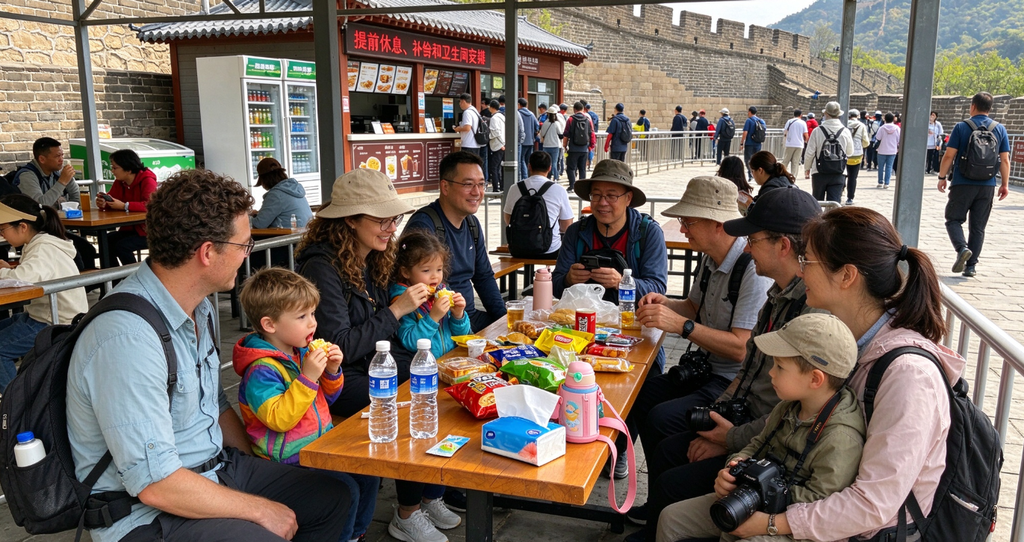
Parents should plan toilet breaks and meals before starting the walk.
Mutianyu has visitor facilities in the lower service area and around the cable car facilities. Toilets are available at several service locations, but you should not expect a toilet at every watchtower.
Useful places to look for facilities include:
- The main visitor service area.
- The shuttle bus drop-off and commercial area.
- The lower and upper cable car stations.
- Areas near the cable car platform.
It is a good idea to let children use the toilet before going up.
Where can you eat?
There are restaurants and food outlets in the visitor area and nearby village.
Options in the area include:
- Yisonglou.
- Great Wall Hotel Restaurant.
- Mu Coffee.
- Shops and food outlets along the commercial street.
Availability and opening hours can vary, so check locally when you arrive.
For families with young children, eating before or after the wall visit is usually easier than trying to arrange a full meal during the walk.
What should you bring?
Pack a small bag with:
- Drinking water.
- Easy-to-eat snacks.
- Wet wipes and tissues.
- A small rubbish bag.
- Any essential child medication.
- A light jacket or extra clothing, depending on the season.
Avoid carrying too much food. The aim is to have enough for a short break, not to turn the visit into a heavy hiking expedition.
Please take all rubbish back down with you and use the designated bins.
8. Weather Tips for Families Visiting the Great Wall
Weather can change how difficult the Great Wall feels, especially for young children.
Summer: Heat and strong sunlight
The wall has exposed sections with limited shade.
Bring:
- Sun hats with chin straps, so they are less likely to blow away.
- Sunscreen.
- Plenty of drinking water.
- Lightweight, breathable clothing.
Stone surfaces can become very hot under direct sunlight. Avoid letting children sit or lie directly on sun-heated masonry.
Try to visit earlier in the day and take breaks when children become uncomfortable.
Winter: Cold wind and slippery steps
Winter visits require more preparation.
The wall is exposed to wind, and temperatures can feel colder than in central Beijing.
Bring warm layers, gloves and suitable footwear.
Pay particular attention to:
- Icy steps.
- Frozen or slippery stone surfaces.
- Cold wind on exposed watchtowers.
- Reduced comfort when carrying a baby in bulky winter clothing.
If there is ice or severe weather, do not insist on completing a long route. Some facilities may also suspend operations in unsuitable conditions.
Spring and autumn: Often more comfortable, but still prepare
Spring and autumn can offer pleasant walking conditions, but wind and sudden temperature changes are still possible.
A light jacket is useful, especially for children who become cold when they stop walking.
9. How to Visit Badaling with Children by High-Speed Train

Badaling is particularly convenient for families who want to avoid a long road journey.
High-speed trains run from Beijing North Railway Station to Badaling Great Wall Railway Station. The journey commonly takes around 30–40 minutes, depending on the train.
However, travelling with children requires more preparation than simply arriving at the station before departure.
Step 1: Plan your journey to Beijing North Railway Station
Beijing North Railway Station is connected to Xizhimen Station, served by Beijing Subway Lines 2, 4 and 13.
If you are travelling with a stroller, large luggage or several children, consider taking a taxi or arranging a private transfer to the station.
Allow enough time for the journey from your hotel. Traffic conditions and the distance between your hotel and the station can vary considerably.
Step 2: Arrive early
For families, I recommend arriving at Beijing North Railway Station around 40–50 minutes before departure.
This is a practical buffer, not an official railway requirement.
You will need time for:
- Finding the correct entrance.
- Security screening for passengers and luggage.
- Checking your train and boarding gate.
- Moving through the station with children.
- Reaching the platform before boarding closes.
Do not plan to arrive at the last minute. Railway boarding gates close before departure, and missing the train can disrupt your entire day.
Step 3: Prepare passports and train tickets
Foreign visitors should use the same valid travel document used when booking their train tickets.
Keep passports accessible because identity checks may be required.
It is also sensible to reserve both the outbound and return journeys in advance, particularly during weekends and public holidays.
Step 4: Get from Badaling station to the Great Wall
Badaling Great Wall Railway Station is located underground.
After leaving the station, follow the signs towards the scenic area.
The walk from the station exit to the north cable car station is approximately 2–3 minutes.
However, the main hiking entrance is farther away, at roughly 800 metres from the station. Walking there can take around 10–15 minutes, depending on your pace and the route.
These are different destinations, so make sure you follow the signs for the entrance or cable car you actually intend to use.
Step 5: Plan your return train
Do not book your return train too close to your planned departure from the Great Wall.
You will need time to:
- Walk back to the railway station.
- Pass security.
- Navigate the underground station.
- Reach the correct boarding gate.
With children, it is better to have a comfortable buffer than to rush through the station after a tiring day.
For more information about getting around Beijing, read our Beijing transport guide.
10. Should Families Visit the Great Wall Independently or Join a Private Tour?
Both options can work, but the best choice depends on your children’s ages, your transport preferences and how much flexibility you need.
Independent travel
Travelling independently can work well if:
- Your children are older and comfortable with public transport.
- You are confident using Beijing’s transport system.
- You have already booked your train tickets or planned your road transfer.
- You are happy to manage the day’s schedule yourself.
The main advantage is flexibility. You can decide when to start, how long to walk and when to return.
The disadvantage is that parents must manage all the transport, ticketing and route decisions themselves.
Private tour
A private tour can be more convenient for families with toddlers, grandparents or several children.
Depending on the service, it may offer:
- Hotel pickup and drop-off.
- Flexible departure times.
- A more manageable schedule.
- Help coordinating tickets and transport.
- The option to return earlier if children become tired.
The main advantage is reduced logistical pressure. Parents can focus more on their children instead of navigating every part of the journey.
However, confirm exactly what is included before booking. Not every tour includes cable car tickets, toboggan tickets or meals.
11. A Practical Family Schedule for Mutianyu
For families with younger children, a shorter visit is often more enjoyable than trying to explore every section.
Here is a sample schedule for a family using the cable car at Watchtower 14.
| Time | Activity |
|---|---|
| 7:30–8:30 | Leave central Beijing, depending on your location |
| 9:00–9:30 | Arrive at Mutianyu and complete ticket arrangements |
| 9:30–10:00 | Take the shuttle and cable car |
| 10:00–11:30 | Explore the wall around Watchtower 14 |
| 11:30–12:00 | Return by cable car |
| 12:00–13:00 | Lunch and rest |
| 13:00 onwards | Return to Beijing or continue with another family-friendly activity |
This is an example rather than a fixed timetable. Actual travel time depends on traffic, queues, ticket arrangements and your family’s walking speed.
If your children are very young, do not feel that you must spend several hours on the wall. A shorter visit with enough breaks can be much more enjoyable.
12. Frequently Asked Questions
Is Mutianyu or Badaling better for families with young children?
Mutianyu is generally the better choice for families with young children because the cable car allows you to reach the wall without climbing the entire hillside. You can also keep the walking distance relatively short by returning to Watchtower 14.
Badaling is a good alternative for families who prefer high-speed train access.
Can I take a stroller onto the Great Wall?
A stroller is not recommended for the main walking sections of the Great Wall. The steps are steep and uneven, making it difficult and potentially unsafe to push a stroller.
A suitable baby carrier is usually more practical for infants and toddlers.
Is the Mutianyu toboggan suitable for small children?
Not necessarily. Published ticket listings commonly state that children under 3 cannot ride, while children under 10 or below 1.5 metres may need to ride with an eligible adult.
These requirements must be confirmed with the operator before purchasing tickets.
Can we take the cable car down if our child gets tired?
Yes, if you return to the cable car station near Watchtower 14. The important point is that you must be able to reach the correct station.
There is no regular shuttle pickup at every watchtower, so do not assume that you can leave the wall from any point.
Are there toilets on the Great Wall?
There are toilets at several visitor service areas and around the cable car facilities at Mutianyu. However, there are not toilets at every watchtower.
Take children to the toilet before starting a longer walk.
How long should families spend at Mutianyu?
Around 3–4 hours is a reasonable overall planning estimate for many family visits, including transport within the scenic area, time on the wall and breaks.
Families with toddlers may prefer a shorter visit, while older children may enjoy spending longer exploring.
Is the Great Wall safe for toddlers?
It can be visited with toddlers, but parents must supervise them closely.
The wall has steep steps, uneven surfaces and exposed edges. Hold your child’s hand where appropriate, avoid crowded or slippery sections and do not let young children run ahead.
A baby carrier may be useful, but adults should also consider their own balance and physical ability.
What should we do if the toboggan is closed?
If the toboggan is closed, you need to use another available descent option.
At Mutianyu, the chairlift and toboggan are associated with the Watchtower 6 area, while the main cable car is near Watchtower 14. They are separate facilities.
Check the available operating options before committing to a route that depends on the toboggan.
Final Recommendation: Plan the Descent Before the Climb
For most families visiting Beijing, Mutianyu offers the best balance of scenery, accessibility and flexibility.
The most reliable choice for families with younger children is to take the cable car to Watchtower 14, explore a manageable section and return by the same cable car.
Families with older children can consider the chairlift and toboggan route near Watchtower 6, or a longer walk between Watchtower 14 and Watchtower 6 if everyone is physically prepared.
Badaling is worth considering if high-speed train access is your priority.
Above all, remember that a successful family visit is not about walking the longest distance or reaching the most watchtowers. It is about choosing a route that everyone can enjoy and making sure you have a safe, realistic way back down.