
What Is Zhajiangmian and How Is It Served?

Zhajiangmian (炸酱面), or Beijing fried soybean sauce noodles, is a traditional northern Chinese noodle dish made with wheat noodles, a rich fermented soybean sauce, and a selection of vegetable toppings called cai ma (菜码). The sauce commonly contains diced pork and fermented soybean paste, while the vegetables add freshness and crunch.
But Zhajiangmian is more than noodles with meat sauce. It has a distinctive place in Beijing’s everyday food culture. Historical accounts trace its development to the late Qing Dynasty, and its popularity grew because it was practical, filling, affordable, and easy to prepare at home. Traditional diners also pay attention to details such as the sauce, seasonal vegetables, garlic, and whether the noodles are served hot or cooled.
For visitors to Beijing, understanding these details makes the dish much more interesting than simply ordering a bowl of noodles. It also helps explain why local people regard Zhajiangmian as one of their familiar everyday meals.
1. What Is Zhajiangmian? Understanding Beijing’s Signature Noodle Dish
The Chinese name Zhajiangmian consists of three elements:
- Zha (炸): Frying or cooking the sauce in oil.
- Jiang (酱): Fermented sauce or paste, usually soybean-based.
- Mian (面): Noodles.
The defining ingredient is the zhajiang, a thick sauce made by cooking fermented soybean paste with oil and commonly pork. It is served over cooked wheat noodles with fresh or lightly prepared vegetables.
Unlike Lanzhou beef noodle soup, Zhajiangmian is not normally served in a bowl of broth. It is a mixed noodle dish: diners combine the sauce, noodles, and vegetable toppings before eating.
A typical Beijing-style serving includes:
- A bowl of wheat noodles.
- A portion of fried soybean sauce, often containing diced pork.
- Several vegetable toppings, such as cucumber, soybean sprouts, and radish.
- Garlic or other optional seasonings.
The dish is usually savory and salty, with a distinctive fermented soybean aroma. Its flavor is balanced by the freshness of the vegetables rather than by a large quantity of broth or a sweet sauce.
2. The History of Beijing Zhajiangmian: Did It Really Exist for Hundreds of Years?
Beijing Zhajiangmian is often described as an old traditional dish, but its history is more recent than many visitors might expect.
Historical accounts cited by Chinese food and cultural publications suggest that Beijing-style Zhajiangmian did not exist in its familiar form during the early and middle Qing Dynasty. Its emergence is generally placed in the late Qing period.
2.1 The Earlier Dish: Liang Lanrou Mian
One account, discussed in Wang Yongbin’s book Zatan Laobeijing (《杂谈老北京》), traces an early predecessor to a restaurant called Longsheng Restaurant (隆盛饭店), which reportedly operated on Longfusi Street in Beijing during the Daoguang period of the Qing Dynasty.
The restaurant was known for a noodle dish called liang lanrou mian (凉烂肉面).
Its preparation was different from modern Zhajiangmian:
- Pork was cooked until tender.
- Yellow daylily, wood ear mushrooms, and mushrooms were added to the sauce.
- The seasoning included ingredients such as Sichuan pepper and star anise.
- Freshly pulled noodles were cooked and cooled with well water.
- Garlic and shredded cucumber were added before serving.
The noodles were therefore closer to a chilled noodle dish with a meat-based topping than to the modern fermented soybean sauce noodles familiar today.
According to this historical interpretation, the later Beijing Zhajiangmian developed from this earlier noodle tradition. However, this account should be understood as a historical explanation rather than definitive proof of a single inventor or an exact date of invention.
A useful reference discussing this account is A Bowl of Zhajiangmian: Its History and Beijing Food Culture.
2.2 When Did Zhajiangmian Become Popular?
Although its development is associated with the late Qing period, Zhajiangmian became particularly widespread in Beijing during the twentieth century.
One important factor was practicality.
By the later 1960s and 1970s, as access to flour improved, noodles became a more regular part of everyday meals for many households. Meat and vegetables could be more difficult to obtain consistently, so a small amount of minced pork cooked with soybean paste offered a practical way to prepare a flavorful topping.
The ingredients were relatively accessible, the sauce could be prepared in advance, and the noodles could be cooked quickly.
This helps explain why Zhajiangmian became such a familiar home-style meal.
It was not originally a luxurious imperial dish. Its cultural importance came from ordinary kitchens, neighborhood noodle shops, and the everyday eating habits of Beijing residents.
3. Why Is Zhajiangmian Called a Beijing Family Staple?
Zhajiangmian is often described as one of Beijing’s kanjia fan (看家饭), meaning a dependable household staple or a dish a family knows how to prepare well.
Its popularity was closely connected to convenience.
An account in the Jingzhao Geography Gazetteer (《京兆地理志》), quoted in a discussion published by People’s Weekly, describes Zhajiangmian as a convenient meal for people traveling between towns and villages.
The important idea is the word bian (便), meaning convenient.
The dish had several practical advantages:
- Simple ingredients: Wheat noodles, fermented soybean paste, and a modest amount of meat or other toppings.
- Easy preparation: The sauce could be cooked in advance, while noodles were prepared when needed.
- Flexible ingredients: Families could use vegetables available in different seasons.
- Filling portions: Wheat noodles provided a substantial everyday meal.
- Suitable for different settings: It could be eaten at home, in a neighborhood restaurant, or while traveling.
This practical character is a major reason Zhajiangmian became associated with Beijing’s everyday food culture.
It was not necessary to visit a prestigious restaurant to enjoy it. A household could make its own sauce, prepare noodles, and use whatever seasonal vegetables were available.
That is what makes Zhajiangmian a genuine everyday Beijing dish rather than simply a restaurant specialty.
Reference: People’s Weekly: The History and Traditional Details of Beijing Zhajiangmian.
4. What Makes Authentic Beijing Zhajiangmian Special?
The character of Zhajiangmian comes from the relationship between three elements: the sauce, the noodles, and the vegetable toppings.
A bowl may look simple, but traditional preparation involves several choices that affect its flavor and texture.
4.1 The Sauce: Fermented Yellow Soybean Paste and Sweet Bean Sauce
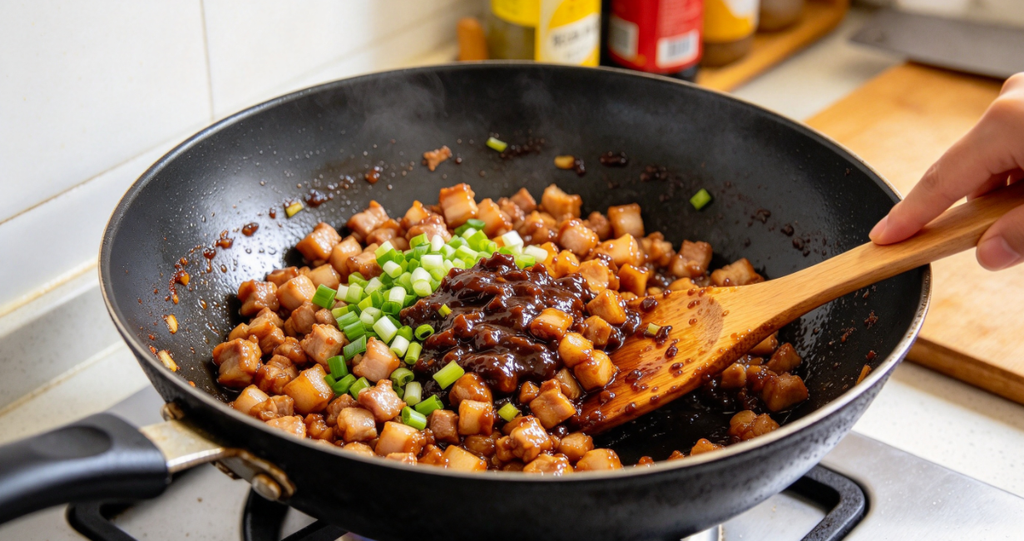
The sauce is the heart of Beijing Zhajiangmian.
A common traditional approach combines:
- Gan huangjiang (干黄酱): Dry fermented yellow soybean paste, which provides the deep, concentrated soybean flavor.
- Tianmianjiang (甜面酱): Sweet wheat-based fermented sauce, which adds sweetness and helps balance the saltiness.
- Pork: Often fatty and lean pork cut into small cubes.
- Oil, spring onion, and ginger: Used to develop the aroma and cook the sauce.
Some recipes use a ratio of approximately 2 parts yellow soybean paste to 1 part sweet bean sauce. This is a useful example of a traditional flavor balance, not a universal rule. Other cooks use different proportions or additional sauces.
Why combine the two?
Yellow soybean paste provides a strong fermented and savory flavor, but using it alone can make the sauce excessively salty or dry. Sweet bean sauce can soften that intensity and create a more rounded taste.
Pork also contributes richness. As the meat cooks, its fat combines with the sauce and helps create a thick, aromatic topping.
4.2 Why Is the Sauce Cooked Slowly?
Good Zhajiang sauce is not simply raw soybean paste poured over noodles.
The paste needs to be cooked in oil so that its raw fermented aroma develops into a deeper, more rounded flavor. The pork should also cook thoroughly and release some of its fat.
Traditional recipes often emphasize:
- Using diced rather than finely minced pork.
- Cooking the meat until aromatic.
- Adding the prepared sauce gradually.
- Keeping the heat relatively low.
- Stirring regularly to prevent sticking or burning.
- Cooking until the sauce becomes thick and glossy.
Some Beijing restaurants and traditional cooking accounts describe their methods as san zha san ao (三炸三熬), referring to repeated frying and simmering stages.
However, this is not a universal technical standard followed by every household or restaurant. The central principle is to cook the sauce thoroughly and develop its flavor without burning it.
4.3 The Noodles: Hand-Pulled, Hand-Cut, or Machine-Made?
Wheat noodles are the foundation of the dish.
Traditional home-style preparations may use hand-rolled or hand-cut noodles, while restaurants use different noodle-making methods depending on their style and volume.
The important qualities are:
- A firm but pleasant texture.
- Enough strength to hold the thick sauce.
- A surface that allows the sauce to coat the noodles.
- A texture that remains enjoyable after mixing.
The noodles are not supposed to disappear beneath a watery broth. Their texture is an essential part of the experience.
5. What Are Cai Ma? The Vegetable Toppings That Define Beijing Zhajiangmian
Cai ma (菜码) refers to the vegetables prepared to accompany the noodles.
These toppings are not just decoration. They provide freshness, different textures, and seasonal variety to balance the rich soybean sauce.
Common toppings include:
| Chinese name | English name | How it contributes |
|---|---|---|
| 黄瓜 | Cucumber | Fresh, cool, and crunchy |
| 黄豆芽 | Soybean sprouts | Crisp and mildly nutty |
| 萝卜 | Radish | Adds a fresh, slightly peppery taste |
| 芹菜 | Celery | Provides a distinctive aromatic flavor |
| 青蒜 | Green garlic shoots | Adds a strong, fresh garlic flavor |
| 香椿 | Chinese toon shoots | Offers a distinctive seasonal aroma |
| 毛豆 | Edamame | Adds a soft, slightly sweet texture |
| 豌豆 | Green peas | Adds color and mild sweetness |
The selection changes according to the restaurant, household, and season.
5.1 Wen Chi vs. Wu Chi: Two Traditional Ways of Eating Zhajiangmian

One particularly interesting aspect of Beijing food culture is the distinction between wen chi (文吃) and wu chi (武吃).
These expressions describe different styles of enjoying Zhajiangmian.
Wen chi: The elaborate way
Wen chi uses a more extensive selection of vegetable toppings.
A carefully prepared serving may include:
- Shredded cucumber.
- Blanched soybean sprouts, sometimes called qiaocai (掐菜).
- Green garlic or minced garlic.
- Finely chopped celery.
- Chinese toon shoots when in season.
- Edamame.
- Green peas.
The vegetables are prepared separately and arranged around the noodles. The result is a colorful, varied bowl with several textures and flavors.
Wu chi: The simple, hearty way
Wu chi is much less elaborate.
Instead of several small dishes of vegetables, the meal may be accompanied by just:
- A whole cucumber.
- A few cloves of garlic.
The idea is to enjoy the noodles directly and eat cucumber or garlic between mouthfuls.
This style reflects the dish’s everyday character: it does not always need a carefully arranged presentation to be satisfying.
5.2 Why Is Garlic Traditionally Served With Zhajiangmian?
Garlic is an important accompaniment in traditional Beijing eating habits.
It provides a sharp, pungent contrast to the rich soybean sauce and pork. Some people mix minced garlic into the noodles, while others eat individual cloves alongside the noodles.
A familiar old Beijing saying is:
“吃面没有蒜,不如吃碗饭。”
It means that eating noodles without garlic is hardly worth it compared with having a bowl of rice.
The saying expresses how strongly garlic is associated with the traditional noodle-eating experience. However, it is a cultural preference, not a requirement. Visitors who dislike raw garlic can simply leave it aside.
6. How Is Zhajiangmian Served: Hot Noodles or Cold Noodles?
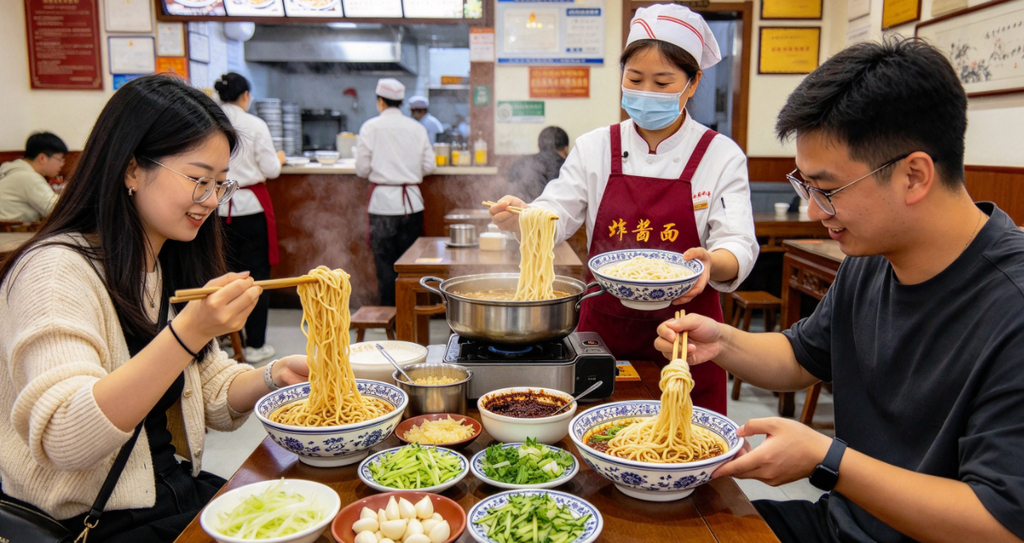
Beijing Zhajiangmian can be served in two familiar styles: guo tiao (锅挑) and guo shui (过水).
They differ mainly in what happens to the noodles after cooking.
| Style | Preparation | Texture | Best suited to |
|---|---|---|---|
| Guo tiao (锅挑) | Noodles go directly from the boiling water into the bowl | Warm, soft, and often more starch-rich | Cold weather or people who prefer hot noodles |
| Guo shui (过水) | Noodles are cooled with water after boiling | Cooler, firmer, and more refreshing | Warm weather and summer meals |
Guo Tiao: Hot Noodles Straight From the Pot
The term guo tiao literally describes noodles being lifted directly from the cooking pot into the serving bowl.
They are not cooled in water first.
This produces a warm bowl of noodles with a softer texture. Some diners also feel that the surface starch helps the sauce cling to the noodles.
Guo Shui: Noodles Cooled After Cooking
With guo shui, cooked noodles are cooled with water before serving.
This creates a cooler and often firmer texture, which can be especially pleasant during Beijing’s hot summer months.
The traditional seasonal preference is often summarized as:
- Cold weather: hot noodles, or guo tiao.
- Hot weather: cooled noodles, or guo shui.
When ordering, you can ask:
- 锅挑儿 (guo tiao): Hot noodles, not rinsed in cold water.
- 过凉水 (guo liang shui): Noodles cooled with water.
Not every restaurant offers both options, so it is worth checking before ordering.
7. How Do You Eat Zhajiangmian Properly?
The usual way to eat Zhajiangmian is to combine the noodles, sauce, and vegetables.
If the ingredients are served separately, follow these steps:
- Add some sauce. Start with a moderate amount because fermented soybean sauce can be quite salty.
- Add the vegetable toppings. Choose cucumber, soybean sprouts, radish, or whichever toppings are available.
- Mix thoroughly. Use chopsticks to turn and lift the noodles until the sauce coats them evenly.
- Taste before adding more sauce. Adjust the seasoning according to your preference.
- Add garlic if you like. Mix in a little minced garlic or eat it separately.
- Enjoy while fresh. The noodles are best eaten soon after mixing.
Should You Mix All the Vegetables Together?
Yes, mixing the vegetables with the noodles is the usual approach.
However, there is no need to add everything at once. If this is your first time trying Zhajiangmian, start with a small amount of sauce and a few vegetable toppings.
This helps you understand the flavor without making the noodles too salty.
8. Where Can You Eat Zhajiangmian in Beijing?
If you want to try Beijing Zhajiangmian, choosing a restaurant with a clear focus on local noodles is a good starting point.
Three options offer different experiences: a well-known specialist noodle shop, a restaurant with a strong traditional Beijing atmosphere, and a neighborhood-style noodle shop.
8.1 Fangzhuanchang No. 69 Zhajiangmian (方砖厂69号炸酱面)
Best for: Visitors who want to try a well-known Beijing Zhajiangmian specialist.
Fangzhuanchang No. 69 is one of Beijing’s best-known Zhajiangmian brands. Its signature dish features pork sauce, wheat noodles, and a selection of vegetable toppings.
The restaurant has received repeated Bib Gourmand recognition in the Michelin Guide. Its inclusion in the 2026 Beijing Michelin Guide was also reported by local media.
What makes it worth considering:
- A strong focus on Zhajiangmian rather than a broad menu of unrelated dishes.
- A signature pork-based fried soybean sauce.
- Fresh vegetable toppings.
- A recognizable Beijing noodle-shop experience.
Location: No. 1 Fangzhuanchang Hutong, Dongcheng District, Beijing.
It is a practical choice if you are visiting the hutong areas around central Beijing. Popular meal times can be busy, so consider arriving outside the lunch rush.
8.2 Haiwanju (海碗居)
Best for: Visitors who want a more traditional Beijing restaurant atmosphere.
Haiwanju is known for its large bowls of Zhajiangmian and its traditional Beijing-style presentation.
Its signature serving is associated with several small dishes of vegetable toppings, often including cucumber, soybean sprouts, green garlic, and other seasonal vegetables.
The restaurant is also known for its Beijing-style dining atmosphere, including traditional decor and the lively welcome of restaurant staff.
What makes it worth considering:
- A generous serving style.
- Multiple vegetable toppings.
- Traditional Beijing restaurant atmosphere.
- Other local dishes and snacks on the menu.
Location: No. 11 Zengguang Road, Haidian District, Beijing (main restaurant).
This is a good choice if you want to combine Zhajiangmian with a broader introduction to Beijing-style food culture.
8.3 Guoertiao Noodle Shop (锅儿挑)
Best for: Visitors looking for a casual neighborhood noodle-shop experience.
Guoertiao is a small noodle shop near the Yonghegong area. Its name refers to the local way of serving noodles directly from the cooking pot without cooling them in water.
The shop is known for its noodle dishes, including Zhajiangmian and Beijing-style noodles with other toppings.
Its appeal is different from a larger traditional restaurant:
- A casual neighborhood setting.
- A focus on everyday noodle dishes.
- A local atmosphere rather than a formal dining experience.
- Convenient access for visitors exploring the Yonghegong and nearby hutong areas.
Location: No. 19 Zangjingguan Hutong, Beixinqiao Subdistrict, Dongcheng District, Beijing.
The shop has also been featured in local Beijing reporting about neighborhood food businesses.
Which Restaurant Should You Choose?
| Restaurant | Main appeal | Suitable for |
|---|---|---|
| Fangzhuanchang No. 69 | Well-known Zhajiangmian specialist | First-time visitors seeking a signature bowl |
| Haiwanju | Large servings and traditional Beijing atmosphere | Visitors interested in local dining culture |
| Guoertiao | Casual neighborhood noodle shop | Travelers exploring the Yonghegong area |
Restaurant branches, opening hours, menus, and prices can change. Check the current branch information before setting out.
9. Is Zhajiangmian Suitable for Foreign Visitors?
Yes. Zhajiangmian is generally approachable for international visitors who enjoy noodles and savory sauces.
However, its fermented soybean flavor may be unfamiliar if you have never tried traditional Chinese fermented foods.
A few details are worth knowing before ordering.
Is It Spicy?
Traditional Beijing Zhajiangmian is usually savory rather than spicy.
The main flavor comes from fermented soybean paste and pork. Chili oil may be available separately, but it is not essential to the dish.
Does It Contain Pork?
Most traditional meat-based versions contain pork in the sauce.
If you do not eat pork, ask whether the restaurant can prepare an alternative. Some restaurants may offer egg-based or other versions, but this should be confirmed before ordering.
Is It Vegetarian?
Do not assume that the dish is vegetarian because it contains many vegetables.
The sauce may contain pork, pork fat, or other animal-derived ingredients. Confirm both the sauce and the noodles if you have strict dietary requirements.
Is the Sauce Very Salty?
It can be. Fermented soybean paste is naturally concentrated, so the sauce is normally used in moderation.
Ask for the sauce separately if you want more control over the seasoning.
What If You Do Not Like Raw Garlic?
Simply leave it out. Garlic is a traditional accompaniment, but diners do not have to eat it.
10. Common Mistakes When Trying Zhajiangmian
Expecting a soup-based noodle dish
Zhajiangmian is generally served without broth. The noodles are coated with sauce rather than floating in soup.
Adding too much sauce immediately
The sauce can be salty and concentrated. Start with a small amount and add more after tasting.
Assuming all vegetable toppings are raw
Some vegetables are served raw, while others may be blanched or otherwise prepared.
Thinking every restaurant uses the same recipe
The balance of yellow soybean paste, sweet bean sauce, pork, and seasonings varies between cooks and restaurants.
Assuming it is a luxury or ceremonial dish
Zhajiangmian’s cultural significance comes largely from its role as an everyday meal. Its appeal lies in practicality, familiarity, and flavor rather than expensive ingredients.
Ignoring the seasonal noodle style
If you prefer hot noodles, ask whether the restaurant serves guo tiao. If you want a cooler bowl, ask about guo shui.
11. Frequently Asked Questions About Zhajiangmian
What is Zhajiangmian made of?
Zhajiangmian is made with wheat noodles, fermented soybean sauce, and vegetable toppings. The traditional meat-based sauce commonly includes diced pork, yellow soybean paste, and sometimes sweet bean sauce.
Is Zhajiangmian originally from Beijing?
Beijing Zhajiangmian is closely associated with the city’s local food culture. Historical accounts commonly place its development in the late Qing Dynasty, although the precise origin and identity of its inventor are not definitively established.
How old is Beijing Zhajiangmian?
It is generally described as having developed during the late Qing period, giving the dish a history of roughly a century or more rather than several centuries. Its widespread popularity grew during the twentieth century.
Why is Zhajiangmian important to Beijing culture?
It became an everyday household staple because it was convenient, filling, and relatively economical. Families could prepare the sauce in advance and use seasonal vegetables with freshly cooked noodles.
What is the difference between wen chi and wu chi?
Wen chi is the more elaborate style, with several vegetable toppings such as cucumber, soybean sprouts, celery, and green garlic. Wu chi is the simpler style, often accompanied by just cucumber and garlic.
Why is garlic served with Zhajiangmian?
Garlic adds a pungent contrast to the rich soybean sauce. It is a familiar traditional accompaniment, although it is optional.
What is guo tiao Zhajiangmian?
Guo tiao means noodles are transferred directly from boiling water into the bowl without being cooled in water. The result is a warm noodle dish.
What is guo shui Zhajiangmian?
Guo shui refers to noodles that are cooled with water after boiling. The result is a cooler, firmer noodle texture, often preferred in warm weather.
Is Zhajiangmian the same as Dandan Noodles?
No. Beijing Zhajiangmian uses fermented soybean sauce and vegetable toppings. Sichuan Dandan Noodles generally feature a different seasoning profile, often including chili oil and Sichuan pepper.
Where should tourists try Zhajiangmian in Beijing?
Fangzhuanchang No. 69 is a well-known specialist option, Haiwanju offers a traditional Beijing restaurant atmosphere, and Guoertiao provides a more casual neighborhood noodle-shop experience.
Conclusion: Zhajiangmian Is More Than a Bowl of Noodles
Zhajiangmian is one of Beijing’s most recognizable everyday dishes, but its appeal is not simply its soybean sauce or wheat noodles.
Its history reflects the development of urban food culture during the late Qing period and the twentieth century. Its traditional preparation shows how much attention Beijing cooks give to sauce, noodles, garlic, and seasonal vegetable toppings. Its popularity also reflects a practical food culture built around convenience, affordability, and familiar home cooking.
For international visitors, trying Zhajiangmian is a chance to experience a dish that represents everyday Beijing rather than formal banquet cuisine.
Start with a traditional bowl, add the sauce gradually, try the vegetable toppings, and decide whether you prefer hot guo tiao or cooled guo shui noodles. You will understand much more about Beijing food culture than you would from simply reading a menu.