
What to Eat in Beijing in One Day: A Practical Food Itinerary
If you have only one day to explore Beijing’s food, focus on four experiences: jianbing for breakfast, zhajiangmian for lunch, traditional Beijing snacks in the afternoon, and Peking duck for dinner. This combination introduces you to everyday breakfast culture, traditional noodle dishes, local desserts, and the city’s most internationally recognized specialty without requiring you to spend the entire day travelling between restaurants.
The key is not to eat as many dishes as possible. It is to choose a manageable combination, visit restaurants in a sensible order, and leave enough room for dinner. Some traditional foods are best experienced at specialist shops, while others are easy to find near residential streets or major attractions.
This guide provides a practical one-day eating plan, explains what to order, compares restaurant options, and shows how to adjust the schedule when you are travelling with children, older family members, or a limited amount of time.
1. Beijing Food Itinerary at a Glance
For most first-time visitors, this is a sensible starting schedule:
| Time | Meal | What to Try | Practical Approach |
|---|---|---|---|
| 7:30–9:00 AM | Breakfast | Jianbing | Buy one freshly made at a local breakfast stall |
| 11:30 AM–1:00 PM | Lunch | Zhajiangmian | Choose a specialist noodle restaurant |
| 2:00–3:30 PM | Afternoon snack | Wandouhuang, lvdagun or aiwowo | Share one or two small portions |
| 5:30–7:30 PM | Dinner | Peking duck | Choose a restaurant in advance and check its queue or reservation policy |
These times are planning suggestions, not fixed restaurant opening hours. Adjust them to your sightseeing schedule and the opening hours of the places you choose.
The most important planning rule is not to travel across Beijing for every meal. Choose breakfast near your hotel, have lunch near your daytime sightseeing area, and select a duck restaurant that is convenient for your evening plans.
If you are visiting the Forbidden City, Tiananmen Square, or the central hutong areas, you can build a food-focused day around central Beijing. If you are spending the day at the Summer Palace or another distant attraction, it may make more sense to eat near that area rather than return to the city centre for every meal.
2. Breakfast: Start with Jianbing, Not a Large Traditional Breakfast
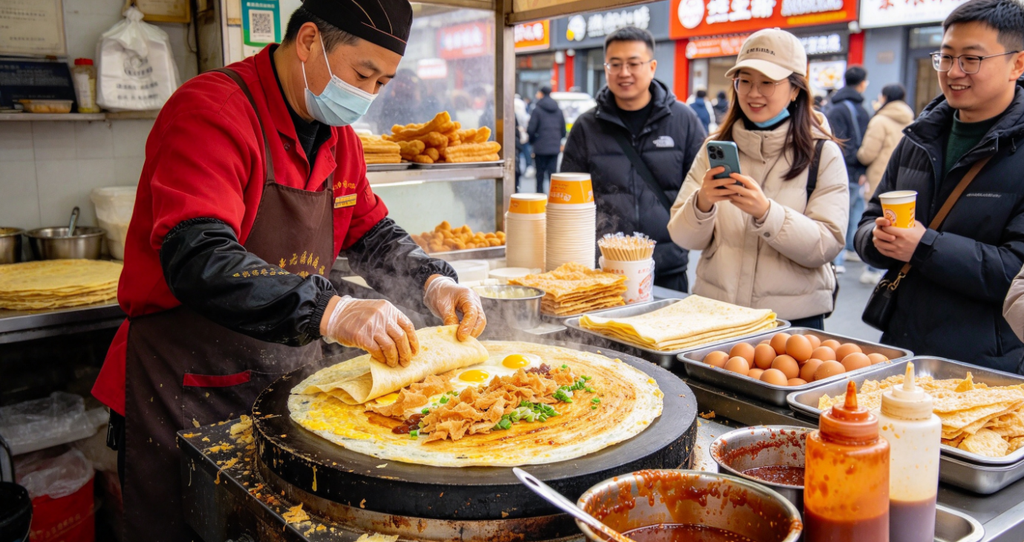
Jianbing is one of the most convenient ways to experience Beijing’s everyday breakfast culture. It is a savoury pancake cooked on a hot griddle, usually made with an egg, sauces, herbs, and a crispy element folded inside.
Jianbing is not exclusive to Beijing; similar breakfast pancakes are popular in several parts of northern China. However, it is widely available in Beijing and is an easy first choice for visitors.
What should you order?
A standard jianbing is usually enough for one person. Depending on the stall, you may be able to choose:
- Egg: A common part of the basic preparation.
- Crispy cracker (baocui): Adds crunch and contrast to the soft pancake.
- Youtiao: A fried dough stick that makes the pancake more filling.
- Sauces and seasonings: These vary by vendor and can make the finished pancake sweeter, saltier, or spicier.
If you are unfamiliar with the flavours, order a standard version first. Ask for less chilli or sauce if you prefer a milder breakfast.
Should you try douzhi?
Douzhi is a traditional Beijing fermented mung bean drink. Its sour, fermented aroma and distinctive flavour can be challenging for visitors who have never tried it.
It is worth sampling if you are interested in traditional local food, but it is not essential to a successful Beijing food itinerary.
A traditional pairing is:
- Douzhi: The fermented mung bean drink.
- Jiaoquan: A crispy fried ring.
- Pickled vegetables: Often served as an accompaniment.
Do not order a large portion simply because it is described as a local speciality. Try a small amount first, preferably with someone who also wants to taste it.
Where to try it: Lao Ciqikou Douzhi Shop is a well-known name associated with traditional Beijing douzhi. Check the current opening hours and branch information before making a special trip.
Breakfast decision: Jianbing or douzhi?
| Your Preference | Better Choice |
|---|---|
| You want a convenient breakfast | Jianbing |
| You enjoy trying unfamiliar fermented foods | A small serving of douzhi |
| You have a sensitive appetite in the morning | Jianbing without extra fried items |
| You want to experience traditional Beijing breakfast culture | Try both, but share the douzhi |
Practical tip: Do not make breakfast too heavy. You still have zhajiangmian and Peking duck ahead, and both are substantial meals.
3. Lunch: Try Zhajiangmian at a Specialist Restaurant
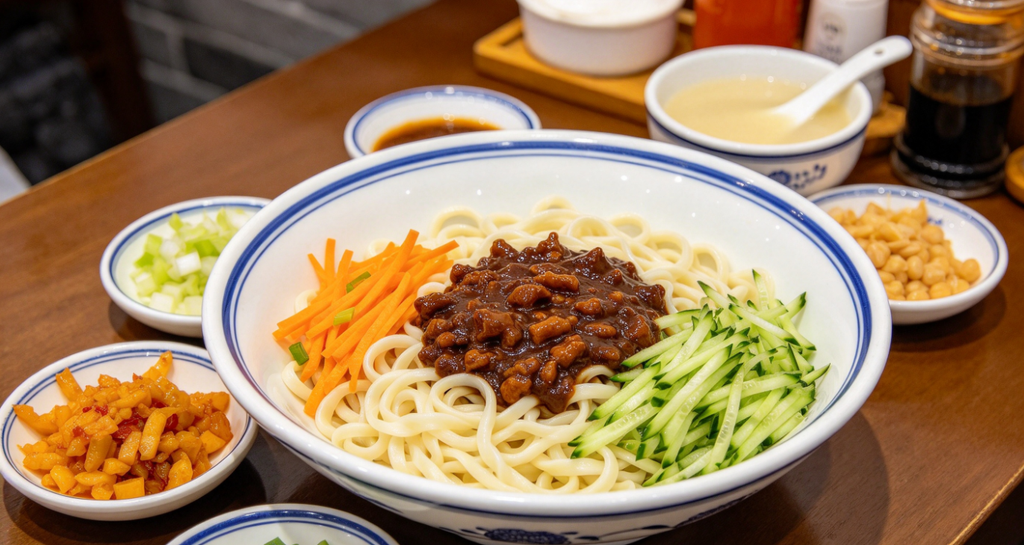
Zhajiangmian is one of the most recognizable traditional Beijing noodle dishes. It consists of wheat noodles topped with a savoury fermented soybean paste sauce, usually mixed with minced or diced pork, and served with fresh vegetables.
The quality of a bowl depends on the balance between the sauce, noodles, and toppings. A sauce that is too salty can overwhelm the noodles, while poorly prepared noodles can become sticky or clumped.
How to recognize a good bowl
When choosing a restaurant, pay attention to three things.
1. The sauce
The sauce should have a concentrated, savoury flavour. It is normally mixed into the noodles rather than poured over them and eaten separately.
2. The noodles
Freshly cooked noodles should have a pleasant, slightly firm texture. Some restaurants offer hot noodles, while others serve noodles cooled or rinsed after cooking.
3. The vegetable toppings
Traditional accompaniments can include cucumber, bean sprouts, radish, soybean sprouts, and other seasonal vegetables. They add freshness and balance to the rich sauce.
Where to eat zhajiangmian
Two established options visitors may consider are:
No. 69 Fangzhuanchang Zhajiangmian
This restaurant is known for its Beijing-style zhajiangmian and is frequently mentioned by visitors looking for a specialist noodle experience. It is a useful option if trying traditional noodles is one of your main food priorities.
However, popularity can mean queues during busy meal periods. If you have a tightly scheduled sightseeing day, avoid arriving at the busiest lunch time without checking the current waiting situation.
Haiwanju
Haiwanju is another established name associated with traditional Beijing noodles and local dishes. It can be an alternative if you want a restaurant setting rather than choosing an unfamiliar street-side shop.
Check the specific branch, menu, and current prices before visiting. Restaurant availability, queues, and branch conditions can change.
How much should you order?
Zhajiangmian is filling, particularly when served in a generous portion. If you are travelling as a couple, consider sharing a bowl and adding a small side dish rather than ordering two full meals.
A sensible order for two might include:
- One bowl of zhajiangmian to share.
- One light vegetable or cold side dish.
- Extra noodles or sauce only if you are still hungry.
If you are travelling alone, one regular bowl is usually enough for lunch.
Is zhajiangmian worth travelling across the city for?
Usually not if your schedule is tight.
A specialist restaurant can make the experience more memorable, but the time spent travelling and queuing may outweigh the difference between restaurants. If you are already near a good local noodle shop, choosing a convenient option is often more sensible than crossing several districts for one bowl.
Best approach: Prioritize the dish, then choose a reputable restaurant that fits your route.
4. Afternoon Snacks: Choose by Texture and Appetite
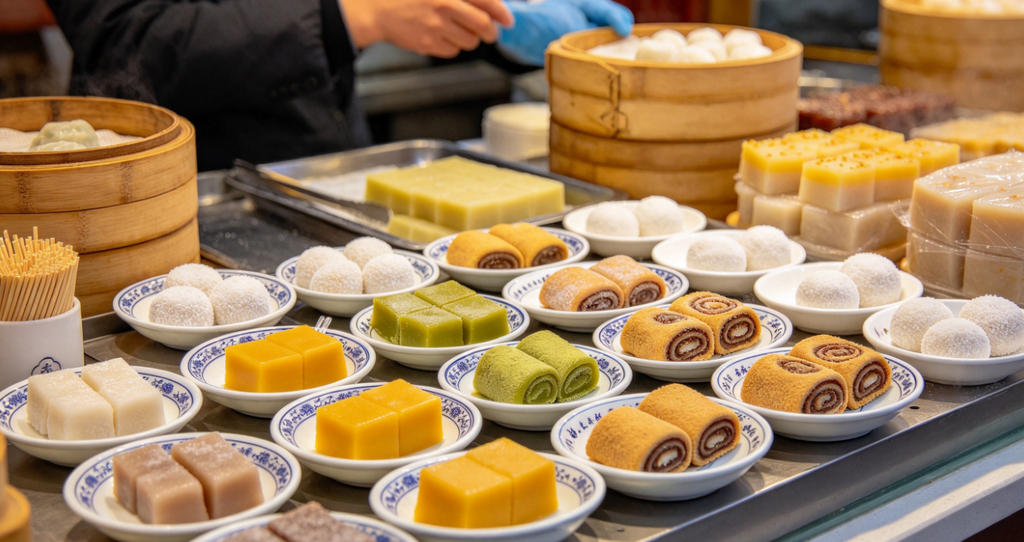
Traditional Beijing snacks are an important part of the city’s food culture. However, many are made with glutinous rice, beans, or sweetened ingredients, so they can be surprisingly filling.
Rather than ordering a large assortment, choose one or two items according to the textures you enjoy.
Three traditional snacks worth trying
Lvdagun (Rolling Donkey)
Lvdagun is made from glutinous rice dough rolled around a sweet red bean filling and coated in roasted soybean flour.
Its texture is soft and chewy, somewhat similar to mochi. Choose it if you enjoy sticky rice desserts and mild sweetness.
Aiwowo
Aiwowo consists of glutinous rice formed into small round cakes, commonly filled with ingredients such as sesame, nuts, or sugar.
It has a soft rice exterior and a textured filling. The exact ingredients can vary by shop.
Wandouhuang
Wandouhuang is a traditional sweet made from yellow pea purée. It is usually served chilled and has a smooth, delicate texture.
If you prefer desserts that are less chewy and more delicate, this may be the easiest of the three to try.
Which snack should you choose?
| Snack | Texture | Choose It If You Prefer |
|---|---|---|
| Lvdagun | Soft and chewy | Mochi-like desserts |
| Aiwowo | Soft exterior with a textured filling | Rice-based sweets with nuts or sesame |
| Wandouhuang | Smooth and delicate | Light, chilled desserts |
Where to try them
Huguosi Snacks is a well-known option for visitors interested in traditional Beijing snacks. Its menu may include several local-style items, making it convenient if you want to sample different foods in one place.
Before visiting, check the current branch address and menu. Not every branch necessarily offers the same selection.
For a first visit, order one or two small items to share. A large assortment may leave you too full for Peking duck.
What if you do not like sweet snacks?
You do not need to force yourself to eat traditional desserts. You can instead take a break at a tea shop or café, or simply use the afternoon to explore a hutong.
The purpose of this stop is to experience a different side of Beijing’s food culture, not to complete a checklist.
5. Dinner: Choose Your Peking Duck Restaurant Carefully

Peking duck is the meal worth planning in advance. It is one of Beijing’s signature dishes, and dinner is a convenient time to enjoy it without rushing between sightseeing stops.
The main challenge is choosing a restaurant that matches your budget, preferred atmosphere, and location.
Understand the main restaurant choices
Several established restaurants are associated with Beijing roast duck, but they offer different dining experiences.
Siji Minfu: A popular choice for visitors
Siji Minfu is widely known among visitors looking for Peking duck in a relatively accessible restaurant setting. It is often considered by travellers who want a recognizable Beijing duck experience without choosing the most formal or expensive option.
Some branches near major attractions can become particularly busy. Do not assume that a convenient location means a short wait. Check the branch’s current queue or booking arrangements before going.
Bianyifang: A historic closed-oven tradition
Bianyifang is associated with the closed-oven method of roasting duck. This differs from the more familiar open-hung-oven approach.
It is a worthwhile choice if you are interested in the history and different cooking traditions of Beijing roast duck. Consider it when the restaurant’s location also fits your itinerary.
Quanjude: A famous historic name
Quanjude is one of the best-known names in Beijing roast duck. For visitors interested in the history and reputation of the dish, it can be part of the experience.
However, brand recognition alone does not guarantee that it is the best choice for every traveller. Compare the current menu, location, expected waiting time, and total cost before deciding.
Da Dong: A more refined dining experience
Da Dong is associated with a more contemporary and refined approach to Peking duck. It may suit visitors who want a higher-end restaurant experience rather than a simple traditional meal.
It is generally better suited to travellers who have allocated a larger dinner budget.
Which restaurant should you choose?
| Your Priority | Restaurant to Consider | What to Check |
|---|---|---|
| A popular choice for first-time visitors | Siji Minfu | Branch queues and booking arrangements |
| Traditional closed-oven cooking | Bianyifang | Branch location and current menu |
| A famous historic name | Quanjude | Total meal cost and preferred branch |
| A more refined dinner | Da Dong | Budget, menu, and reservation availability |
These are starting points rather than guarantees of quality or value. Restaurant experiences can vary by branch, date, and service conditions.
How much Peking duck should you order?
Do not automatically order a large number of additional dishes before seeing the duck portion and the restaurant’s serving options.
For two people, one duck serving may be sufficient when accompanied by a small number of side dishes, although portions and restaurant recommendations vary.
A practical ordering strategy is:
- Ask how many people the duck portion is intended to serve.
- Check whether pancakes, sauces, and accompaniments are included.
- Order the duck first.
- Add one or two vegetables or side dishes.
- Decide whether you need anything else after the duck arrives.
If you are dining with children or people who prefer lighter food, ask about smaller portions or alternative dishes.
Should you reserve Peking duck in advance?
If dinner is an important part of your one-day food plan, checking reservations or queue arrangements in advance is sensible.
This is particularly important when:
- You are visiting during a weekend or public holiday.
- You want to eat at a branch near a major attraction.
- You have a fixed evening sightseeing or performance schedule.
- You are travelling with a larger group.
If a restaurant does not accept reservations, check whether it has a queue-number system and how early you should arrive.
Do not build your entire evening around an assumed waiting time. Leave some flexibility in the schedule.
6. What Should You Skip If You Only Have One Day?
A good food itinerary is also about deciding what not to eat. Some traditional dishes are interesting, but they may not be the best use of limited appetite or time.
Baodu: Best for people who enjoy offal
Baodu consists of quickly cooked beef or lamb tripe, usually served with a dipping sauce.
Its appeal is the crisp, chewy texture. It is not a soft meat dish, so visitors unfamiliar with offal may find it challenging.
Try it if you already enjoy tripe or want to explore traditional Beijing food beyond the most familiar dishes.
Chaogan: A distinctive traditional stew
Chaogan is a thick, savoury dish traditionally made with pork liver and intestines, with starch used to thicken the broth.
Despite the name, it is not a typical dry stir-fry. Its texture and strong offal flavour make it a specialist choice.
If you are not comfortable eating liver or intestines, there is no need to include it in a one-day itinerary.
Tanghulu: Enjoy it if you see it, but do not prioritize it
Tanghulu is fruit coated in a hardened sugar shell. It is visually appealing and easy to find in many Chinese cities.
It can be a fun snack, but it is not the most distinctive use of your limited time in Beijing. If you are choosing between tanghulu and a traditional Beijing snack you have never tried, the latter may offer a more locally focused experience.
Oversized traditional snack platters
Some restaurants around popular tourist areas sell assorted snack platters designed to let visitors sample many items at once.
These can be convenient, but the selection, freshness, and value vary. A large platter is also not necessarily the best way to understand individual dishes.
If you want to try traditional snacks, choose a shop with a clear menu and order a small number of items individually.
7. How to Arrange the Food Stops Around Your Sightseeing Route
The biggest practical mistake is treating every restaurant as a separate destination. Beijing is a large city, and travelling between districts can take much longer than expected during busy periods.
Use your sightseeing route to determine where to eat.
Option A: A central Beijing sightseeing day
If you are visiting central Beijing, use this general structure:
- Breakfast: Choose a jianbing stall near your hotel.
- Morning: Visit your planned central attraction.
- Lunch: Find a zhajiangmian restaurant in or near the area where you finish sightseeing.
- Afternoon: Try traditional snacks at a convenient shop or take a break in a nearby hutong.
- Dinner: Choose a Peking duck restaurant that is convenient for your evening plans.
This approach avoids unnecessary journeys between meals.
Option B: A day around the Forbidden City and central hutongs
If your sightseeing is concentrated around the Forbidden City and nearby central areas, prioritize restaurants that fit the same general area.
Do not assume that the closest famous restaurant will have the shortest queue. A branch a little farther away may be more convenient overall if it saves waiting time.
Also remember that the Forbidden City has its own visitor arrangements and opening schedule. Plan your admission and sightseeing time first, then fit meals around it.
Option C: A day at the Summer Palace or another distant attraction
If you spend much of the day outside central Beijing, do not return to the city centre just to eat one particular noodle dish.
Have breakfast near your accommodation, eat lunch near your sightseeing destination, and return to a convenient area for dinner.
The extra time spent travelling across the city can easily be more valuable than the difference between two similar restaurant options.
How much time should you allow?
Use these as planning allowances rather than guaranteed durations:
| Activity | Suggested Time Allowance |
|---|---|
| Buying and eating jianbing | 20–30 minutes |
| Lunch at a noodle restaurant | 45–75 minutes |
| Afternoon snack stop | 20–40 minutes |
| Peking duck dinner | 90–120 minutes |
| Extra time for queues and transfers | Add a flexible buffer |
The dinner allowance is especially important. Peking duck is not a meal to squeeze into a short gap between attractions.
For wider route and transport planning, consult this Beijing travel guide before finalizing your sightseeing schedule.
8. How to Adjust the Itinerary for Different Travellers
The same food plan does not work equally well for everyone. Adjust the number of dishes and restaurant choices to the people travelling with you.
If you are travelling as a couple
Sharing is one of the easiest ways to try more foods without over-ordering.
A practical approach is:
- One jianbing each, or share one if you have a light appetite.
- One bowl of zhajiangmian to share, with a small side dish.
- One or two traditional snacks in the afternoon.
- One Peking duck serving suitable for two, with a small number of sides.
Ask the restaurant about portion sizes before ordering.
If you are travelling with children
Avoid making every stop a challenge involving unfamiliar flavours.
A child-friendly approach might be:
- Jianbing with mild seasoning.
- Noodles with sauce served separately, if available.
- A small portion of a familiar dessert.
- Peking duck with pancakes and accompaniments.
Douzhi, offal dishes, and strongly flavoured foods are optional. There is no need to include them just to make the itinerary more traditional.
If you are travelling with older family members
Prioritize comfortable seating, manageable walking distances, and restaurants where you can sit down without a long wait.
A busy specialist shop may be interesting, but it is not worth standing in a long queue if someone in your group has difficulty doing so.
Choose a convenient restaurant with a suitable menu and allow more time for meals.
If you have dietary restrictions
Traditional Beijing dishes can contain ingredients that are not obvious from their names.
Before ordering, check:
- Whether a dish contains pork, beef, lamb, or other meat.
- Whether sauces contain ingredients you avoid.
- Whether noodles or snacks contain wheat or other allergens.
- Whether a dish is prepared with shared cooking equipment.
For strict dietary requirements, do not rely on a dish’s appearance or a translated menu alone. Confirm the ingredients with the restaurant.
9. Common Mistakes When Eating in Beijing for One Day
Mistake 1: Trying to visit every famous restaurant
A restaurant can be excellent and still be a poor choice for your itinerary if it requires a long detour or an unpredictable queue.
Choose one priority restaurant for the day. Keep the other meals flexible.
Mistake 2: Eating too much at lunch
A large bowl of noodles followed by several desserts can make dinner uncomfortable.
Share dishes where practical and keep the afternoon snack small.
Mistake 3: Choosing restaurants only because they are near a tourist attraction
Convenience is useful, but location alone does not tell you whether a restaurant offers the dish you want.
Check the current menu, branch details, and recent operating information before visiting.
Mistake 4: Assuming every traditional food will suit your taste
Douzhi, chaogan, and baodu have distinctive flavours or textures. They are worth trying if you are curious, but they are not compulsory.
Mistake 5: Leaving Peking duck until the last minute
A popular restaurant may have a queue or require advance arrangements. Check dinner options earlier in the day rather than deciding after your afternoon sightseeing.
Mistake 6: Ignoring the distance between restaurants
A meal that looks close on a map may still involve a slow journey, especially during peak traffic or when changing transport modes.
Group your food stops by area instead of following a list of famous names across the city.
10. Frequently Asked Questions
What is the must-eat food in Beijing if I only have one day?
Peking duck is the most internationally recognized Beijing dish and is worth prioritizing if you have one day. For a more complete experience, also try jianbing for breakfast and zhajiangmian for lunch.
Can I try Beijing’s traditional food in one day?
Yes. A manageable plan is jianbing, zhajiangmian, one or two traditional snacks, and Peking duck. You do not need to try every traditional dish to get a good introduction to Beijing food.
Where should I eat Peking duck in Beijing?
Siji Minfu, Bianyifang, Quanjude, and Da Dong are established names to consider. They differ in cooking tradition, atmosphere, price positioning, and dining experience. Compare the current menu, branch location, and waiting arrangements before choosing.
Is Beijing street food safe for foreign tourists?
Food safety depends on the individual vendor and food-handling conditions. Choose busy stalls where food is cooked fresh in front of you, observe cleanliness, and avoid food that has been sitting uncovered for a long time. If you have allergies or dietary restrictions, ask about ingredients before ordering.
How much should I budget for one day of eating in Beijing?
Your total depends heavily on your Peking duck restaurant, portion sizes, drinks, and whether you choose casual shops or more formal restaurants. A simple noodle lunch and street breakfast will generally cost less than a full-service duck dinner.
Check current menus and prices before visiting rather than relying on old online estimates. For a realistic budget, calculate the duck dinner first, then add your breakfast, lunch, snacks, drinks, and transport.
Is one day enough to explore Beijing’s food culture?
One day is enough to try several representative dishes, but not enough to experience the full range of Beijing cuisine. If food is a major reason for your visit, consider adding a dedicated food experience or a local dining stop to a longer itinerary.
You can explore options for Beijing cultural tours if you want to combine local food with a more guided introduction to the city’s traditions.
Final Recommendation: Keep the Menu Short and the Route Practical
For a first-time visitor, the best one-day Beijing food plan is not the one with the most dishes or the longest list of famous restaurants.
It is the one that balances four experiences:
- Breakfast: Fresh jianbing from a convenient local stall.
- Lunch: A good bowl of zhajiangmian at a reputable noodle restaurant.
- Afternoon: One or two traditional snacks, chosen according to your preferred texture.
- Dinner: Peking duck at a restaurant that fits your budget and evening route.
Choose restaurants by location as well as reputation, check current opening and queue arrangements, and avoid filling up before dinner.
That is how to make one day of eating in Beijing feel like a satisfying introduction to the city’s food culture rather than a rushed checklist.