
Best Peking Duck Restaurants in Beijing for First-Time Visitors
If you are visiting Beijing for the first time, the best Peking duck restaurant is not necessarily the most famous one. Your decision should depend on three things: where you are sightseeing, how much you want to spend, and how long you are willing to wait.
For most first-time visitors, Siji Minfu is a strong all-round choice for traditional roast duck and a lively Beijing dining experience. However, its Forbidden City branch can attract substantial queues. If you are travelling with older parents or have only one evening available, choosing a less congested branch or a different restaurant may be more sensible.
The five restaurants worth comparing are:
- Siji Minfu (四季民福): A popular all-round choice, particularly for first-time visitors.
- Quanjude Hepingmen (全聚德和平门店): Best for combining roast duck with a famous culinary heritage experience.
- Bianyifang (便宜坊): Best for visitors interested in traditional closed-oven roast duck.
- Da Dong (大董): Best for a more refined, modern interpretation of Peking duck.
- Liqun Roast Duck (利群烤鸭店): Best for travelers who value an old Beijing hutong atmosphere more than modern dining comfort.
This guide explains which restaurant makes sense for different travel situations, what you actually get for your money, how to manage queues, and how to enjoy Peking duck in the right order.
1. Which Peking Duck Restaurant Should You Choose?
Start with your location and travel constraints rather than restaurant rankings.
| Your Situation | Best Starting Choice | Why |
|---|---|---|
| First-time visitor who wants classic roast duck | Siji Minfu | Good balance of food, location and price |
| Finishing sightseeing near the Forbidden City | Siji Minfu Nanchizi, if the queue is manageable | Convenient location and palace-side setting |
| Near Wangfujing | Siji Minfu Dengshikou or Da Dong Wangfujing | Convenient for shopping and central hotels |
| Near Qianmen or Dashilan | Bianyifang Xianyukou or Quanjude | Both fit naturally into a historic Beijing itinerary |
| Interested in food history | Quanjude Hepingmen | Historic restaurant and museum experience |
| Want the traditional closed-oven technique | Bianyifang | A different approach to roasting duck |
| Prefer a premium dinner | Da Dong | More contemporary presentation and dining environment |
| Want a hutong courtyard meal | Liqun | Traditional neighborhood atmosphere |
| Travelling with older parents | A restaurant with manageable access and confirmed seating | Avoid an uncertain two-hour queue after sightseeing |
| Budget around ¥150 per person | Consider Bianyifang or a carefully planned Siji Minfu meal | Premium restaurants may exceed the budget |
The price column is a guide to choosing where to investigate, not a promise that a full duck meal will fit every budget. Your final bill depends on how many people share the duck, the portion size, side dishes, drinks and branch-specific menu prices.
The most important rule: location comes before reputation
Beijing is large. A restaurant that is excellent on paper may be a poor choice if it requires crossing the city during the evening rush.
If you finish visiting the Forbidden City, look at Nanchizi, Wangfujing and Qianmen before considering restaurants in distant districts.
If you are already near Qianmen, Quanjude Hepingmen and Bianyifang Xianyukou are more logical candidates.
For a single dinner, saving 40 minutes of transport and avoiding a long queue may be more valuable than choosing a restaurant that appears slightly higher in an online ranking.
2. Siji Minfu (四季民福): Best All-Round Choice, but Choose the Branch Carefully
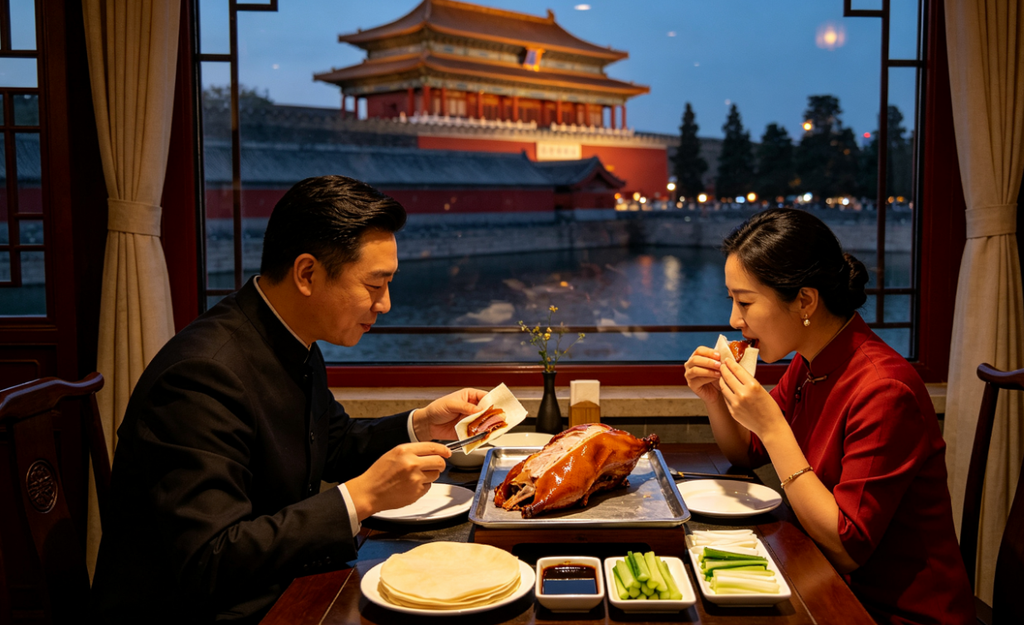
Best for: First-time visitors, couples, families and travelers who want classic Beijing roast duck without paying for a luxury dining experience.
Siji Minfu is one of the most frequently recommended roast duck brands in Beijing. It serves traditional hanging-oven-style duck alongside familiar Beijing dishes, and its central branches are convenient for sightseeing.
Its biggest advantage is the overall experience: crisp duck skin, sliced duck served at the table, traditional pancakes and sauces, and a menu that includes other local specialties.
But there is one important problem: the most convenient branch for sightseeing is not necessarily the best branch for your dinner schedule.
Which Siji Minfu branch should you visit?
Three branches worth comparing are Nanchizi, Dengshikou and Dongsi Shitiao.
| Branch | Location | Main Advantage | Queue Consideration |
|---|---|---|---|
| Nanchizi (南池子店) | Beside the Forbidden City’s eastern moat | Best for combining duck with Forbidden City sightseeing | Strong tourist demand, especially around dinner and weekends |
| Dengshikou (灯市口店) | Wangfujing area | Convenient for Wangfujing hotels and shopping | Popular central location; do not assume it is quiet |
| Dongsi Shitiao (东四十条店) | Dongcheng, near Dongsi Shitiao | Alternative away from the immediate Forbidden City sightseeing area | May avoid some palace-area visitor concentration, but queues are still possible |
Nanchizi is the branch I would be most cautious about choosing without checking the queue first.
Its location beside the Forbidden City moat makes it particularly attractive to visitors who want to combine sightseeing and dinner. That convenience also concentrates demand.
Dengshikou is useful if you are staying around Wangfujing. It is not automatically a quiet alternative, because it also serves a busy shopping and hotel district.
Dongsi Shitiao is worth checking if you are willing to travel a little farther from the main tourist area. It is a reasonable alternative, but there is not enough reliable public data to claim that it consistently has the shortest waiting time.
Do not treat these branches as having fixed queue rankings. Demand changes with the day, weather, holidays, tour groups and meal period.
How does Siji Minfu’s queue system work?
Siji Minfu is generally better approached as a queue-based restaurant than as a place where you can simply arrive at 7 p.m. and expect an immediate table.
Depending on the branch and current arrangements, customers may be able to obtain a queue number through the restaurant’s WeChat service or a Chinese restaurant platform.
A practical approach is:
- Search for the official Chinese restaurant name, 四季民福烤鸭店.
- Find the exact branch you intend to visit.
- Check whether remote queue registration is available that day.
- Enter the correct party size.
- Monitor the queue rather than relying on the original estimated waiting time.
- Return to the restaurant before your number is called.
Some branches or periods may require on-site registration instead.
Do not rely on a fixed online release time. Online guides circulate suggested release times, but these are not a reliable guarantee for every branch, weekday or holiday. Check the actual queue interface on the day you plan to eat.
What happens if you miss your queue number?
Do not assume that a missed number will automatically be protected.
Siji Minfu previously published queue-management rules requiring customers to use their own registration and stating that missed numbers could become invalid. Those historical rules are a reason to take the queue seriously, but the exact current handling may vary.
Before leaving the restaurant area, ask staff:
- How many numbers are ahead of us?
- When should we return?
- What happens if our number is called while we are away?
- Can the queue number be restored if we miss it?
If you are travelling with parents, avoid walking far away once your number is approaching.
When should you visit Siji Minfu?
For a more comfortable experience:
- Consider a weekday rather than a weekend.
- Try arriving near opening time if your sightseeing schedule permits.
- Avoid making a popular branch your only dinner option during a public holiday.
- Check the queue before travelling from the Forbidden City.
- Keep another restaurant nearby as a backup.
If you are visiting Nanchizi, do not insist on getting a window table overlooking the moat. The view is attractive, but waiting much longer for a particular seat rarely makes sense after a full day of sightseeing.
How much should you budget?
A planning allowance of approximately ¥150–200 per person is reasonable for many typical Siji Minfu meals, but this is not a guaranteed menu price.
For two people, check whether a half duck is available. For larger groups, a whole duck shared with vegetables and additional dishes may offer better value.
Confirm whether pancakes, sauces and accompaniments are included or charged separately.
My recommendation: Choose Siji Minfu for your first Peking duck meal, but select the branch according to your actual location and queue. Do not automatically travel to Nanchizi just because it is the most famous-looking branch.
3. Quanjude Hepingmen (全聚德和平门店): What Are You Paying Extra For?
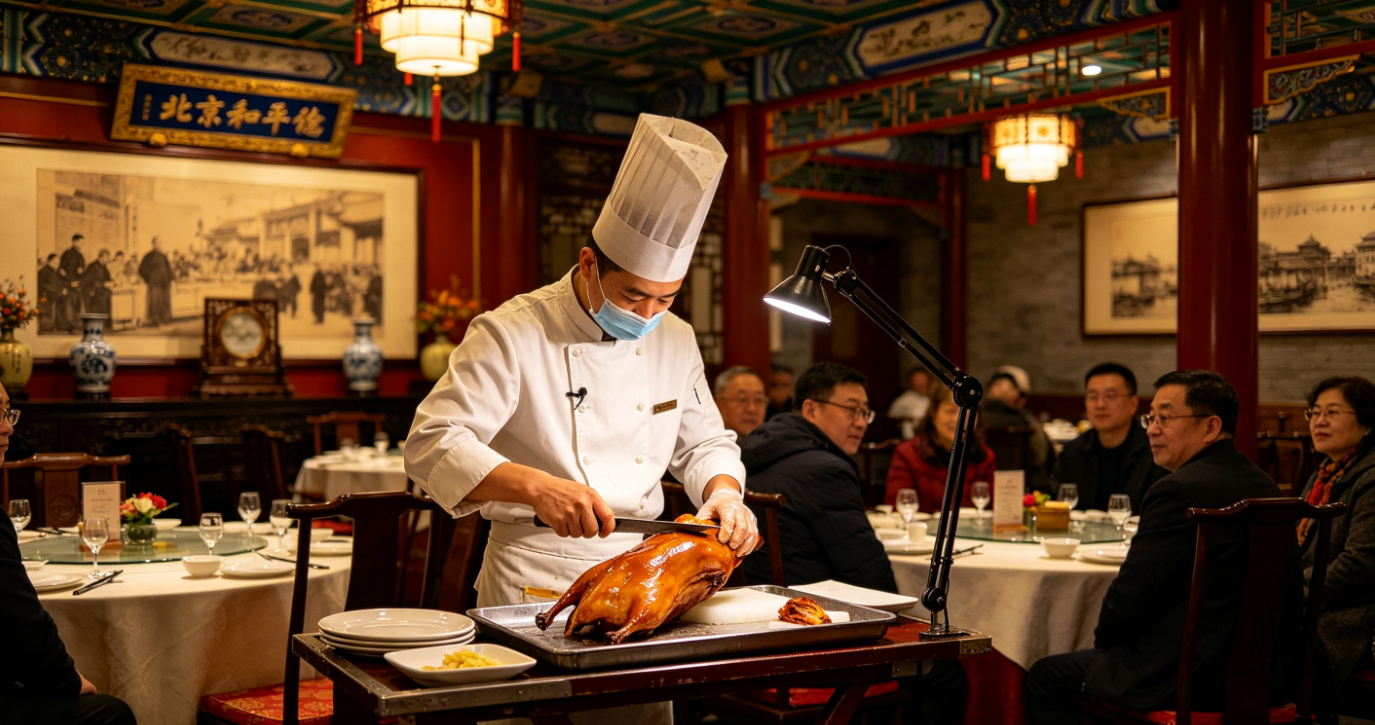
Best for: Travelers interested in Beijing’s food heritage, traditional hanging-oven roasting and the history of a famous restaurant brand.
Quanjude was founded in 1864 and is one of the best-known names in Beijing roast duck.
However, the important question is not simply whether Quanjude is famous.
It is whether the additional cost is worth paying for the experience you want.
What makes Quanjude different?
Quanjude’s traditional hanging-oven method uses an open oven and hardwood fuel to roast the duck.
The technique is associated with a crisp, golden skin and a characteristic roasted aroma.
At the Hepingmen branch, visitors can experience more than a meal.
The restaurant has a long-established association with traditional duck preparation, including the work of specialist chefs who carve the roasted duck before serving it.
The Hepingmen location also has a Quanjude museum on its seventh floor.
The museum displays historical materials, photographs and objects related to the restaurant’s history and traditional duck-making heritage. Beijing tourism information lists the museum as a free attraction, with published opening hours of Tuesday to Sunday, 9:00–18:00. Check the current schedule before visiting.
Sources:
- Xinhua: Quanjude’s traditional hanging-oven duck and carving techniques
- Beijing Tourism: Quanjude Museum
What are you actually paying for?
Think of the additional cost as paying for three things:
1. The restaurant’s heritage
Quanjude has a recognizable place in Beijing’s culinary history. For travelers interested in traditional Chinese dining, that background has value.
2. The duck-carving experience
Watching a trained chef slice the duck and arrange the meat is part of the classic dining ritual.
This is not exclusive to Quanjude, but it is an important part of the traditional roast duck experience.
3. The museum and cultural setting
The Hepingmen branch gives you the opportunity to combine dinner with a short visit to the restaurant’s history exhibition.
This is the part that makes Hepingmen more interesting than simply choosing another Quanjude branch.
Is Quanjude worth it if you only care about taste?
Not necessarily.
If your only goal is to eat a satisfying roast duck meal, Siji Minfu or Bianyifang may offer a better match for your preferences and budget.
Quanjude’s historical reputation does not automatically mean that every visitor will prefer its duck to the alternatives.
But if you want to understand how a famous Beijing roast duck institution presents its culinary heritage, the extra cost becomes easier to justify.
How much should you budget?
Use approximately ¥180–300 per person as a broad planning range for a traditional Quanjude meal, but confirm the current menu and duck price before visiting.
A larger meal with extra dishes and drinks can cost more.
If you are on a strict ¥150-per-person budget, Quanjude Hepingmen would not be my first recommendation.
My recommendation: Choose Quanjude Hepingmen when the cultural experience matters as much as the food. If you only want the best practical dinner for your money, compare other restaurants first.
4. Bianyifang (便宜坊): Choose It for Its Cooking Method, Not for Maximum Crispiness
Best for: Food enthusiasts, visitors interested in traditional cooking methods and travelers who want to understand a different style of Beijing roast duck.
Bianyifang is closely associated with the traditional closed-oven roasting technique known as 焖炉烤鸭 (mèn lú kǎo yā).
Its Xianyukou branch is a convenient option if you are exploring Qianmen and the old commercial streets around Dashilan.
Recommended branch:
Bianyifang Xianyukou Branch (便宜坊鲜鱼口店)
65–77 Xianyukou Street, Dongcheng District, Beijing.
The Beijing municipal tourism website introduces Bianyifang’s traditional closed-oven technique and lists its Xianyukou location.
See: Beijing Tourism – Bianyifang.
What is the difference between closed-oven and hanging-oven roast duck?
The two techniques create different roasting environments.
Hanging-oven roast duck, associated with Quanjude, is roasted in an open oven with the duck suspended above or near the heat source.
Closed-oven roast duck, associated with Bianyifang, uses a heated oven whose walls retain and radiate heat after the fire is extinguished. The duck cooks in this enclosed environment rather than being directly exposed to an open flame.
The difference matters because the cooking method influences the skin texture and the overall eating experience.
Is Bianyifang’s duck as crispy as Quanjude’s?
If your main expectation is extremely crisp skin with a pronounced crackling texture, you should understand the difference before choosing Bianyifang.
Hanging-oven duck is generally the stronger choice for people who prioritize crisp skin.
Bianyifang’s closed-oven duck is valued for its own roasting characteristics and tender meat, but its skin may not deliver the same crispness that some visitors expect from a hanging-oven duck.
That does not make it inferior. It simply means the two restaurants should not be judged by exactly the same standard.
| What You Want | Better Starting Choice |
|---|---|
| Maximum emphasis on crisp skin | Hanging-oven restaurant such as Quanjude or Siji Minfu |
| Traditional closed-oven technique | Bianyifang |
| A comparison of different roasting traditions | Try both styles on separate meals |
| A more familiar first-time duck experience | Siji Minfu |
Which Bianyifang branch should you choose?
The Xianyukou branch is especially convenient for visitors exploring Qianmen.
It allows you to combine lunch or dinner with a visit to the historic commercial area without making a separate cross-city journey.
How much should you budget?
Bianyifang is worth considering if your budget is around ¥150 per person, particularly if you are sharing the duck and ordering side dishes carefully.
However, confirm the current price of the duck, portion size and any additional charges before ordering. Do not assume that the entire meal will fit your budget simply because the restaurant is often positioned as a more economical alternative.
My recommendation: Choose Bianyifang if you are curious about Beijing’s traditional closed-oven technique. Avoid choosing it solely because you expect the crispest possible duck skin.
5. Da Dong (大董): Is There a More Affordable Way to Try Its Signature Duck?
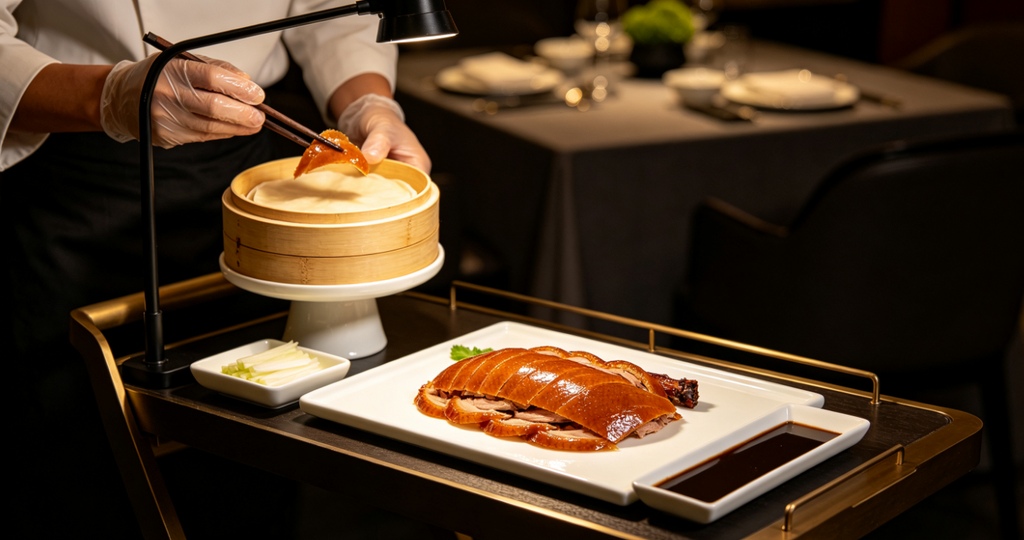
Best for: Travelers who prefer modern Chinese dining, couples celebrating a special occasion and food enthusiasts curious about a lighter-style roast duck.
Da Dong is known for its modern interpretation of Peking duck, particularly its signature lean-style duck, often marketed as 酥不腻.
The concept emphasizes crisp skin and a less greasy overall impression.
For some visitors, this is a welcome alternative to traditional roast duck, which can feel rich because of the fat beneath the skin.
What makes Da Dong different?
Da Dong combines roast duck with a more contemporary approach to Chinese restaurant presentation.
The menu is broader than roast duck alone, and the restaurant is positioned at a higher price level than many traditional duck restaurants.
This can make it a good choice for a special occasion, but a less obvious choice for someone who simply wants to try Peking duck once.
Does Da Dong offer an affordable lunch option?
This is a question worth asking before rejecting the restaurant completely.
A published restaurant listing for the Wangfujing branch gives an average spending reference of around ¥349 per person. That is a useful indication of its premium positioning, but it is not a fixed minimum charge.
I could not verify a current official menu that guarantees a particular low-cost lunch set or half-duck price across Da Dong branches.
Instead of assuming that a ¥100–150 option exists, contact the branch and ask:
- Is a half duck available?
- Can I order the signature duck without a large set menu?
- Are there weekday lunch combinations?
- Are pancakes and accompaniments included?
- Is there a minimum order for the duck?
If the restaurant offers a suitable half-duck or lunch arrangement, two people may be able to try the signature duck without ordering a large banquet-style meal.
However, the final bill still depends on the branch and additional dishes.
Is Da Dong worth paying more for?
Choose Da Dong if you are specifically interested in its lighter-style duck and more refined restaurant environment.
If your main priority is simply eating traditional Beijing roast duck, the extra cost may not be necessary.
My recommendation: Da Dong is an optional premium experience, not a required stop on a first Beijing trip. Ask about the smallest practical duck order before booking.
6. Liqun Roast Duck (利群烤鸭店): Hutong Atmosphere Comes with a Comfort Trade-Off

Best for: Travelers who enjoy traditional neighborhoods, informal local restaurants and unusual dining environments.
Liqun Roast Duck is located inside a traditional hutong courtyard near Qianmen.
Its appeal is different from that of a large, polished restaurant chain.
Visitors come for the courtyard atmosphere, the older neighborhood setting and the feeling of eating in a more traditional Beijing environment.
But it is important not to romanticize the experience.
What is the actual dining environment like?
Liqun is a small, traditional restaurant rather than a modern dining hall.
The space can feel crowded, and tables may be close together. Service is more straightforward than at an upscale restaurant, and the atmosphere can become noisy during busy periods.
The courtyard setting is part of its character, but it also means comfort can vary depending on where you sit and the weather.
In summer, ask whether an air-conditioned indoor table is available. Do not assume every seating area has the same cooling conditions.
Some visitor reports also describe less convenient toilet arrangements, with facilities outside the main dining courtyard in the surrounding hutong area. If you are travelling with older parents or anyone with limited mobility, confirm the arrangement before committing to the restaurant.
Is Liqun suitable for older travelers?
It depends on their expectations.
It may be enjoyable for parents who like traditional neighborhoods and do not mind simple surroundings.
It is a less suitable choice if they expect:
- Comfortable, spacious seating.
- Quiet surroundings.
- Modern facilities.
- Consistently attentive restaurant service.
- Easy access to all facilities without leaving the courtyard.
For a relaxed dinner after a full day of sightseeing, Siji Minfu or Da Dong may be more comfortable choices.
Is the food worth the inconvenience?
Liqun is worth considering if you specifically want a traditional hutong dining experience.
But if you only want to eat good Peking duck, there is no reason to accept an uncomfortable setting simply for the sake of atmosphere.
My recommendation: Liqun is best for travelers willing to exchange some modern comfort for a distinctive neighborhood experience. It should not be the automatic recommendation for families with older parents.
7. Where Should You Eat If You Have Only One Dinner in Beijing?
This is the most important decision for many first-time visitors.
You may have spent the day visiting the Forbidden City, Tiananmen Square and nearby attractions. By the time you finish sightseeing, you have one evening available for Peking duck.
You do not want to waste it travelling across the city or standing in a queue for several hours.
Use the following scenarios to choose.
Scenario A: You finish at the Forbidden City, are travelling with parents and have a budget of ¥150 per person
This is a situation where Siji Minfu Nanchizi sounds ideal, but may not be the best practical choice.
The location is convenient, but the queue can be unpredictable. If your parents are tired after sightseeing, waiting for a long time is a poor trade-off.
My decision process would be:
- Check the Nanchizi queue before leaving the Forbidden City.
- If the wait is manageable, stay nearby and enjoy the convenient location.
- If the queue is too long, consider a different Siji Minfu branch only if the additional journey makes sense.
- If you are willing to travel towards Qianmen, compare Bianyifang Xianyukou.
- Avoid choosing Da Dong or Quanjude simply because of their reputation if ¥150 per person is a strict limit.
Bianyifang is a particularly sensible alternative for someone who wants a traditional restaurant and is willing to accept the different closed-oven style.
If your parents prioritize comfort over food history, choose a branch with confirmed seating and accessible facilities rather than insisting on a famous name.
Scenario B: You are staying near Wangfujing and want a classic duck meal
Start with Siji Minfu Dengshikou.
It is convenient for the Wangfujing area, but check the queue before walking over.
Da Dong Wangfujing is an alternative if you prefer a more refined experience and have a higher budget.
Do not assume the Da Dong menu will fit a modest budget without checking its smallest duck order.
Scenario C: You are exploring Qianmen and Dashilan
Compare Bianyifang Xianyukou and Quanjude.
Choose Bianyifang if you want to understand the closed-oven technique and prefer to control the budget.
Choose Quanjude Hepingmen if you are interested in the heritage experience, the carving tradition and the museum.
If the museum is important to you, remember that its published opening hours are different from restaurant dinner hours. You may need to visit the exhibition before dinner.
Scenario D: You have a special occasion and want a memorable meal
Da Dong is the most natural premium choice in this comparison.
Quanjude Hepingmen is a different kind of special experience: less about modern luxury and more about the history and ritual of a famous Beijing restaurant.
Choose according to whether you value contemporary dining or culinary heritage.
8. How to Eat Peking Duck: The Best Order for First-Time Visitors
The way you eat Peking duck can make a real difference to the experience.
Do not immediately put every ingredient into a pancake.
A better approach is to taste the duck in stages, starting with the skin while it is still hot.
Step 1: Eat the Crispy Skin First
When the duck is freshly carved, the restaurant may serve a few pieces of skin separately.
Pick up a piece while it is still warm and try it on its own.
If white sugar is provided, lightly dip the skin into it.
This traditional combination allows you to taste the crisp skin and rendered duck fat without the flavor being covered by sauces or vegetables.
You do not have to use sugar if you prefer the natural flavor.
Step 2: Try the Duck Meat on Its Own
Next, taste a slice of duck meat without wrapping it in a pancake.
Some restaurants provide garlic sauce, soy-based condiments or other accompaniments.
If garlic sauce is available, try a small amount with the duck. Its stronger flavor contrasts with the richness of the meat.
This is a useful way to understand the difference between the skin, meat and fat rather than tasting everything together immediately.
Step 3: Make a Traditional Pancake Wrap
Now try the familiar Beijing roast duck wrap.
You will usually receive:
- Thin wheat pancakes.
- Sweet bean sauce.
- Sliced scallions.
- Cucumber strips.
- Sliced roast duck.
To assemble it:
- Take a warm pancake.
- Spread a small amount of sweet bean sauce.
- Add two or three slices of duck.
- Add scallion and cucumber.
- Fold the bottom of the pancake upward.
- Fold or roll the sides inward and eat.
Start with a little sauce. Too much can overpower the duck.
Step 4: Try Garlic and Other Condiments
Some restaurants offer crushed garlic, garlic sauce or other condiments for a different flavor combination.
Try a second wrap with garlic and cucumber if available.
You can also ask the chef or server which combinations are traditional at that restaurant.
Step 5: Decide What to Do with the Duck Frame
After the chef has sliced the duck, the remaining frame may be prepared as:
- Duck soup.
- Salt-and-pepper duck bones.
- Fried duck frame.
- Another restaurant-specific duck dish.
Not every restaurant offers the same preparation, and additional processing charges may apply.
Ask before ordering:
“Can you prepare the remaining duck frame as soup or salt-and-pepper duck?”
This is particularly useful when sharing a whole duck with several people.
For a visual explanation of the traditional eating sequence, see CCTV’s introduction to how to eat Beijing roast duck.
9. Practical Tips Before Visiting a Peking Duck Restaurant
A little preparation can save you considerable time.
Save the Chinese Restaurant Name
English names may appear differently across mapping and booking applications.
Save the Chinese name and branch address before leaving your hotel.
| Restaurant | Chinese Name |
|---|---|
| Siji Minfu | 四季民福烤鸭店 |
| Quanjude | 全聚德 |
| Bianyifang | 便宜坊 |
| Da Dong | 大董烤鸭店 |
| Liqun Roast Duck | 利群烤鸭店 |
Confirm Whether You Can Order Half a Duck
A whole duck may be too much for two people if you also want to try other Beijing dishes.
Ask whether the branch offers half a duck or smaller portions.
Do not assume every restaurant or branch provides the same options.
Check What Is Included in the Duck Price
The advertised duck price may not include every accompaniment.
Before ordering, confirm:
- Whether pancakes are included.
- Whether sauces and vegetables are included.
- Whether extra pancakes cost more.
- Whether duck-frame preparation carries an additional charge.
- Whether there is a minimum order.
This helps prevent a meal from exceeding your budget unexpectedly.
Prepare a Backup Payment Method
Mobile payments are widely used in Beijing, but international card acceptance varies between businesses.
Before visiting a restaurant, make sure you have a working payment method.
For more practical information about Beijing dining, local dishes and what to expect when ordering, see our Beijing food guide.
Ask About Dietary Restrictions Clearly
If you have food allergies or dietary restrictions, explain them before ordering.
Chinese restaurant kitchens may share utensils, cooking oil and preparation surfaces. A vegetable dish is not automatically vegetarian, and a dish without visible meat may still contain meat stock or animal fat.
Use a written translation of serious allergies and confirm the information with staff.
10. Common Mistakes When Choosing a Peking Duck Restaurant
Choosing the Most Famous Branch Without Checking the Queue
A famous restaurant can still be the wrong choice if you have limited time.
Check the actual branch queue before travelling.
Assuming All Roast Duck Tastes the Same
Hanging-oven and closed-oven duck are different styles.
If crisp skin is your priority, consider a hanging-oven restaurant. If you are interested in the closed-oven tradition, Bianyifang offers a different experience.
Spending More Without Knowing What You Are Paying For
Quanjude and Da Dong appeal to different kinds of diners.
Do not pay a premium for history if you only care about taste, and do not choose a premium restaurant without checking its smallest practical order.
Ignoring the Needs of Older Family Members
A long queue, cramped seating or inconvenient facilities can turn an otherwise good dinner into an exhausting experience.
Choose the restaurant that fits the people travelling with you, not just the food ranking.
Ordering Too Much
Peking duck is rich and filling.
For two people, one duck or a smaller portion with one or two side dishes may be sufficient. Ask about portion size before adding more dishes.
11. Frequently Asked Questions About Peking Duck Restaurants in Beijing
What is the best Peking duck restaurant in Beijing for first-time visitors?
Siji Minfu is a strong all-round choice because of its classic roast duck, central locations and relatively accessible price range.
However, choose the branch according to its current queue and your sightseeing route. The Forbidden City branch is not automatically the best option for every visitor.
Which Siji Minfu branch has the shortest queue?
There is no reliable fixed ranking of Nanchizi, Dengshikou and Dongsi Shitiao by waiting time.
Nanchizi attracts strong tourist demand because of its Forbidden City location. Dengshikou is also popular because it serves the Wangfujing area. Dongsi Shitiao is worth checking as an alternative, but it can still be busy.
Check the live queue for each branch before travelling.
What time should I get a queue number at Siji Minfu?
There is no single guaranteed release time that applies to every branch and every day.
Check the restaurant’s current WeChat queue service or the relevant Chinese restaurant platform. If remote registration is unavailable, ask staff about on-site registration.
What happens if I miss my Siji Minfu queue number?
A missed number may become invalid, and you may need to register again.
Ask the specific branch about its current grace period and return instructions before leaving the area.
Is Quanjude worth visiting?
Yes, if you are interested in its culinary heritage and traditional hanging-oven roast duck.
The Hepingmen branch is particularly interesting because it combines the restaurant experience with a museum about the brand’s history.
If you only want a good-value duck meal, compare other restaurants before choosing Quanjude.
Is Bianyifang’s duck less crispy?
Its closed-oven cooking method produces a different result from hanging-oven roast duck.
If your priority is the strongest possible crisp-skin experience, a hanging-oven restaurant such as Siji Minfu or Quanjude is a safer starting point.
Is Da Dong too expensive for a first-time visitor?
Not necessarily, but it is a premium option.
Check whether the branch offers half portions, a smaller duck order or a lunch menu before deciding. Do not assume a low-cost set menu is available without confirming the current menu.
Is Liqun Roast Duck suitable for families?
It can suit families who enjoy traditional neighborhood restaurants and do not mind a simple environment.
However, its courtyard setting, potentially crowded seating and less modern facilities may not be ideal for older travelers or anyone who prioritizes comfort.
How many people can share one Peking duck?
One whole duck is commonly shared by two to four people, depending on appetite and the number of additional dishes.
For two people, ask whether half a duck is available if you want to order other dishes as well.
What should I eat first when trying Peking duck?
Start with the crispy skin while it is hot, optionally dipped lightly in white sugar.
Then try the duck meat on its own or with garlic sauce. After that, make traditional pancake wraps with sweet bean sauce, scallions and cucumber.
Do Peking duck restaurants in Beijing accept foreign bank cards?
Acceptance varies by restaurant and payment terminal.
Mobile payment apps are widely used, but visitors should not assume every branch accepts every international card directly. Prepare a working mobile payment option and a backup payment method.
Final Recommendation: Choose the Restaurant That Fits Your Evening
There is no need to visit the most famous roast duck restaurant simply because it appears at the top of a list.
For most first-time visitors, Siji Minfu is a practical starting point. But if its most convenient branch has a long queue, choose another restaurant rather than losing an entire evening.
Use this final guide:
- Choose Siji Minfu for a balanced first Peking duck experience.
- Choose Quanjude Hepingmen if you want the heritage, carving tradition and museum experience.
- Choose Bianyifang if you want to explore traditional closed-oven roast duck.
- Choose Da Dong if you want a more refined and modern dining experience.
- Choose Liqun if you value hutong atmosphere more than modern comfort.
Before making your decision, check three things: the restaurant’s exact branch, the current queue and the total cost of the meal.
If you want to experience more of Beijing’s local food culture beyond roast duck, a guided Beijing food tour can also help you discover traditional dishes and neighborhood restaurants.
The best Peking duck dinner is not necessarily the most famous one. It is the one that lets you enjoy the food, understand the tradition and finish the evening without unnecessary travel or waiting.