
The Best Beijing Itinerary for First-Time Visitors
Planning a first trip to Beijing can be surprisingly difficult. The city has imperial palaces, historic hutongs, UNESCO-listed sites, modern landmarks, museums, parks, shopping districts, and the Great Wall—all spread across a huge metropolitan area.
The challenge is not simply deciding what to see. It is deciding what to see together, in what order, and how much time to leave between major attractions.
For most first-time travelers, a well-designed itinerary should combine Beijing’s historic core with one or two larger excursions rather than trying to cover every famous attraction. The most efficient approach is to organize each day around a geographical area or a coherent historical theme.
This guide provides a practical Beijing itinerary for first-time visitors, including a recommended five-day schedule, shorter alternatives, transportation strategy, attraction planning, and ways to adjust the trip without turning it into a race from one landmark to another.
Quick Answer: How Many Days Do You Need in Beijing?
For a first visit, 4–5 full days is a strong starting point.
A useful structure is:
| Trip Length | What You Can Realistically Cover |
|---|---|
| 2 days | Imperial Beijing highlights |
| 3 days | Historic center + one major additional area |
| 4 days | Historic center + Great Wall + imperial garden |
| 5 days | Major landmarks + Great Wall + hutongs + slower cultural experiences |
| 6–7 days | Core attractions plus museums, neighborhoods, food, and day trips |
If Beijing is part of a larger China trip, three days can work. If Beijing is your main destination, five days gives first-time visitors considerably more flexibility.
The important point is that adding days should not simply mean adding more attractions. Extra time is most valuable when it allows you to slow down, explore neighborhoods, account for travel time, and leave room for weather or reservation changes.
Why First-Time Beijing Itineraries Are Easy to Overload
Beijing looks deceptively manageable on a map.
Many of its most famous attractions appear relatively close together, particularly around the historic center. But individual attractions can take several hours, entrances can be far apart, security procedures can consume time, and walking distances inside large palace and park complexes can be substantial.
The Palace Museum, for example, is itself a major half-day experience rather than a quick photo stop. Beijing’s official tourism information recommends allowing at least half a day for the Palace Museum, while Tian’anmen Square is generally treated as a separate sightseeing experience.
The Great Wall creates another planning problem. Badaling and other Great Wall sections are outside the central city, so treating a Great Wall visit as if it were another downtown attraction usually creates an exhausting day.
This leads to a simple planning principle:
One major attraction does not necessarily equal one hour of sightseeing.
A better itinerary accounts for:
- travel between neighborhoods
- entrance and security procedures
- walking inside large sites
- meal breaks
- photography time
- weather
- opening hours
- reservation requirements
- physical energy
That is why the best itinerary is rarely the one with the longest attraction list.
The Best 5-Day Beijing Itinerary for First-Time Visitors
For travelers who have enough time, five days provides a useful balance between Beijing’s imperial heritage, the Great Wall, traditional neighborhoods, and modern city life.
The itinerary below is intentionally organized by geographical clusters, reducing unnecessary cross-city travel.
Day 1: Tian’anmen Square, Forbidden City & Jingshan
Morning: Tian’anmen Square
Begin your trip in the historic center.
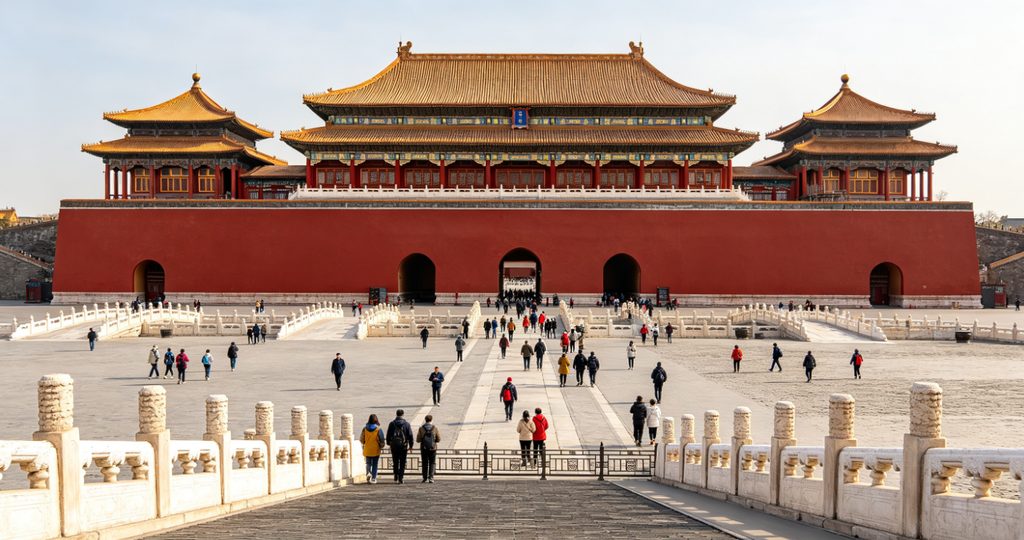
Tian’anmen Square provides useful geographical and historical context for understanding the old city before entering the Forbidden City.
Allow roughly 1–2 hours depending on whether you simply visit the square or spend more time around the surrounding monuments and entrances.
Reservations may be required, so check current official requirements before your visit.
Late Morning to Afternoon: Palace Museum
Continue north into the Forbidden City, officially the Palace Museum.
This should be one of the longest sightseeing blocks of your first day rather than something squeezed between several unrelated attractions.
The Palace Museum was the imperial palace of the Ming and Qing dynasties and remains one of Beijing’s defining historical sites. Current official information lists real-name advance reservations and seasonal opening hours, so visitors should confirm the latest rules before traveling.
Instead of trying to inspect every building, concentrate on the main central axis and then choose a few side areas based on your interests.
Late Afternoon: Jingshan Park
After leaving the Forbidden City, walk or take a short ride to Jingshan Park.
This is an important addition to the itinerary because it changes your perspective.
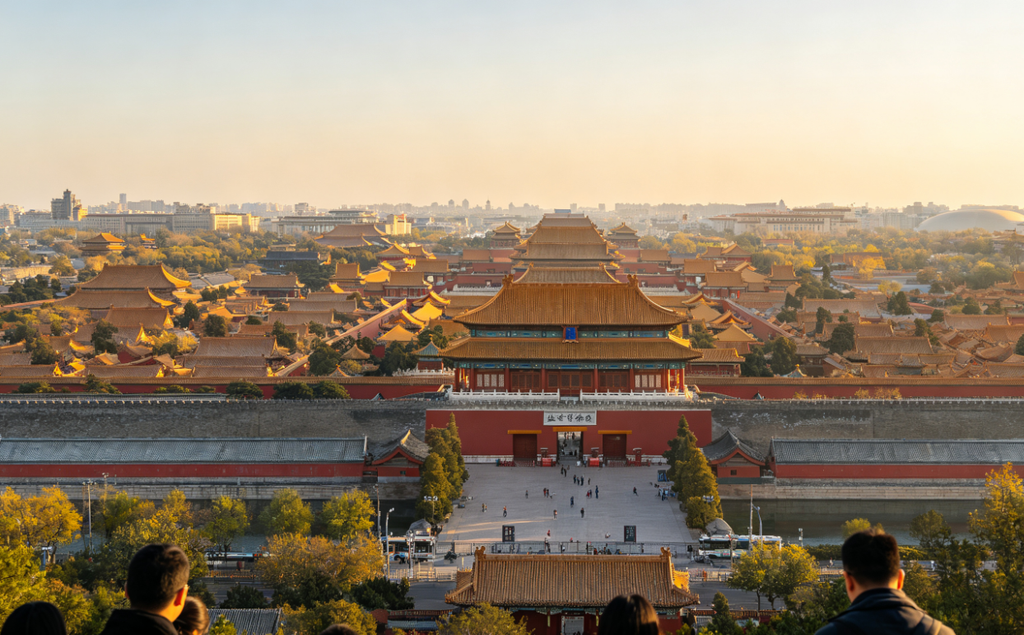
Inside the Forbidden City, you experience the palace from ground level. From Jingshan, you can look back across the enormous imperial complex and understand its relationship with the surrounding old city.
Evening
Keep your first evening relatively flexible.
Good options include:
- Wangfujing
- Donghuamen area
- Qianmen
- a nearby local restaurant
- an early night after a long walking day
Planning logic: Day 1 concentrates on Beijing’s imperial center instead of mixing the Forbidden City with attractions on the opposite side of the city.
Day 2: Temple of Heaven, Qianmen & Old Beijing
Day 2 should shift from imperial government to ritual culture and urban life.
Morning: Temple of Heaven
Start early at the Temple of Heaven.
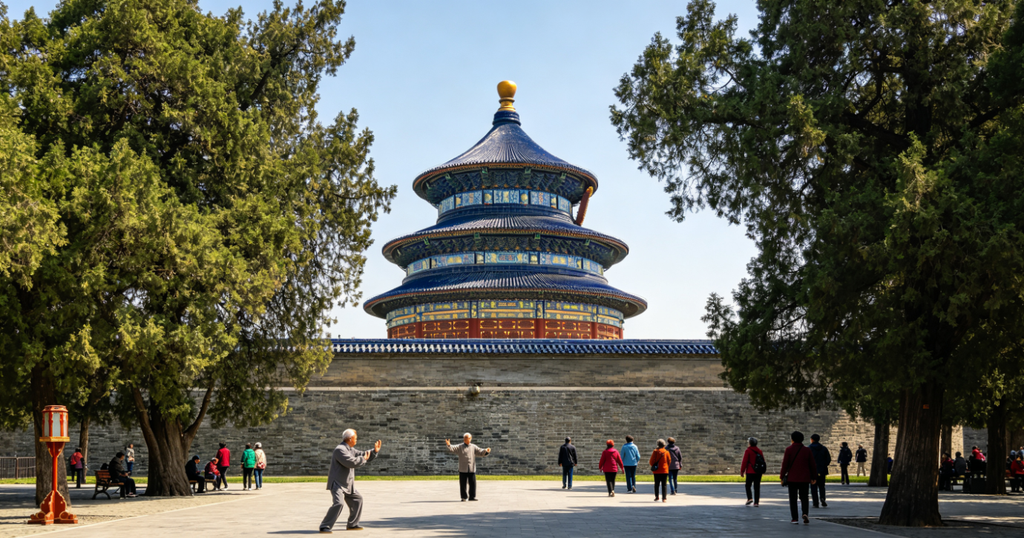
The site was used by Ming and Qing emperors for ceremonies associated with worshipping Heaven and praying for good harvests. The complex is much larger than the famous Hall of Prayer for Good Harvests, so allow enough time to walk between its principal structures.
The official site currently lists seasonal opening schedules and notes that several major enclosed attractions are closed on Mondays except public holidays, making the day of your visit worth checking in advance.
Morning is particularly useful here because the surrounding park also offers a glimpse of everyday Beijing life.
You may see:
- local residents exercising
- group dancing
- traditional games
- singing
- tai chi
- informal social activities
This gives you a different understanding of Beijing than the palace museums do.
Afternoon: Qianmen & Dashilar
From the Temple of Heaven, continue toward Qianmen.
Qianmen is especially useful for first-time visitors because it combines historic streets, commercial activity, traditional brands, restaurants, and access to the southern section of Beijing’s Central Axis.
Beijing’s official Central Axis route connects Tian’anmen Square, Zhengyangmen, Qianmen Street, and the Temple of Heaven, making these areas naturally compatible rather than separate sightseeing targets.
Evening: Explore Rather Than Schedule
Do not fill every evening with another major attraction.
Use this time for:
- Peking duck
- Beijing snacks
- traditional tea
- a hutong walk
- shopping
- photography
This creates a better contrast with the highly structured sightseeing of Day 1.
Day 3: The Great Wall as a Full-Day Excursion
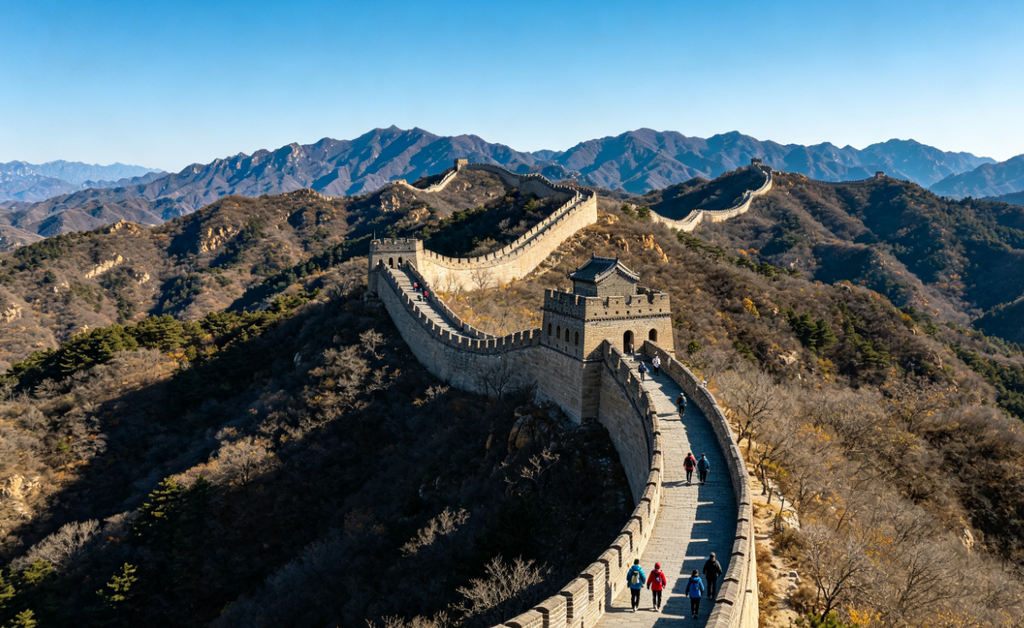
The Great Wall deserves its own day.
Trying to combine the Great Wall with the Forbidden City, Temple of Heaven, or Summer Palace is one of the most common itinerary mistakes for first-time visitors.
Badaling is one of the most accessible and famous sections from Beijing, while Mutianyu offers another popular option with a different sightseeing environment.
Beijing’s official tourism guidance treats the Great Wall as a full-day excursion, recommending an early departure and return later in the day.
Badaling or Mutianyu?
The choice depends on your priorities rather than a universal ranking.
Choose Badaling if you prioritize:
- easy recognition
- major historical significance
- strong transport connections
- a classic first-time Great Wall experience
Consider Mutianyu if you prioritize:
- mountain scenery
- a somewhat different visual environment
- combining the visit with nearby rural areas
Badaling’s official tourism information currently lists seasonal opening hours and advance ticketing arrangements, so check the latest operating conditions before departure.
Suggested Schedule
Early morning: Leave central Beijing
Morning: Arrive at the Great Wall
Late morning–early afternoon: Hiking and sightseeing
Afternoon: Return toward Beijing
Evening: Dinner and rest
Do not underestimate the physical effort. Even travelers who are comfortable walking around downtown Beijing may find a Great Wall day considerably more demanding because of stairs, slopes, exposure to weather, and extended walking.
Day 4: Summer Palace & Beijing’s Imperial Garden Culture
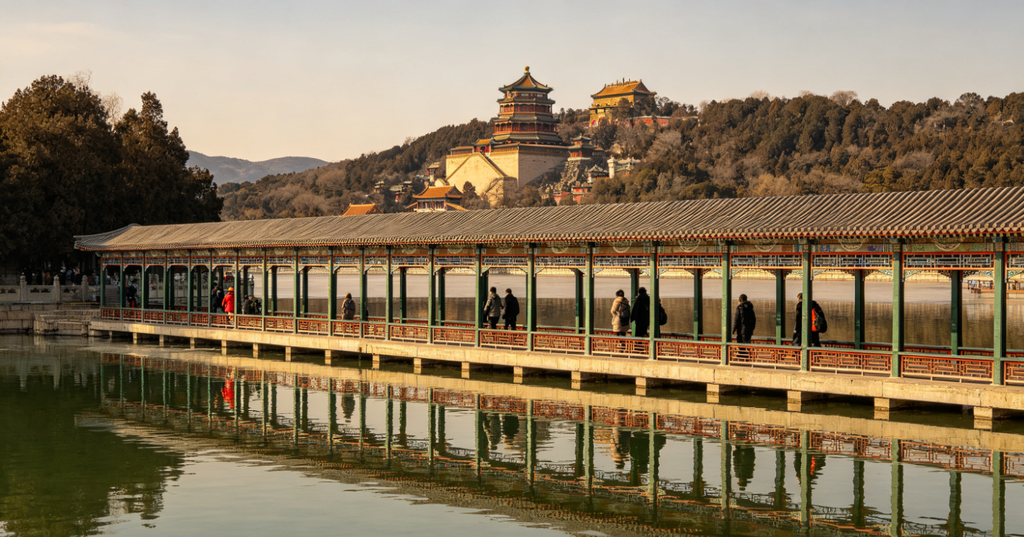
After the physical intensity of the Great Wall, Day 4 can be deliberately slower.
Morning: Summer Palace
The Summer Palace offers a very different expression of imperial Beijing.
Instead of monumental palace architecture concentrated around a central axis, the experience revolves around:
- Kunming Lake
- Longevity Hill
- gardens
- pavilions
- corridors
- viewpoints
- water landscapes
Beijing’s official tourism information describes the Summer Palace as a major imperial garden complex combining architecture, gardens, water, and landscape design.
Because of its size, rushing through the site defeats much of its value.
Choose a route based on your interests rather than attempting every corner.
Afternoon: Old Beijing Neighborhood
Return toward the central districts and spend the afternoon somewhere more intimate.
Good choices include:
- Shichahai
- Houhai
- hutongs around the Drum and Bell Towers
- Nanluoguxiang and surrounding lanes
The purpose is not to check another famous attraction off your list.
It is to experience scale.
The Forbidden City shows Beijing at the scale of an empire.
The hutongs show Beijing at the scale of a neighborhood.
That contrast is one of the most useful experiences for a first-time traveler.
Evening: Hutong Dining
This is a good evening for exploring local food rather than booking another major attraction.
Try dishes such as:
- Peking duck
- zhajiangmian
- jiaozi
- baozi
- Beijing-style hotpot
- traditional snacks
Day 5: Modern Beijing, Museums or a Flexible Cultural Day
The fifth day should remain flexible.
This is one of the biggest differences between a practical itinerary and a sightseeing checklist.
Instead of deciding months in advance that every hour must be occupied, use Day 5 to respond to your interests.
Option A: Olympic Area
Visit the area around:
- National Stadium
- National Aquatics Center
- Olympic Forest Park
This gives you a completely different view of Beijing’s urban development and modern architecture.
Option B: Museums
Choose a museum according to your interests rather than attempting several in one day.
Possible themes include:
- Chinese history
- art
- archaeology
- science
- contemporary culture
Option C: Central Axis Exploration
For travelers who want more historical depth, continue exploring Beijing’s Central Axis.
Beijing’s official tourism routes now highlight the Central Axis as a major cultural route connecting landmarks including the Bell and Drum Towers, Forbidden City, Tian’anmen area, and Temple of Heaven.
This approach is particularly useful for travelers who want to understand how Beijing developed as a planned imperial capital, rather than simply collecting individual attractions.
Option D: Keep the Day Empty
This may sound counterintuitive, but leaving a half-day or even a full day unplanned can improve a first trip.
Use it for:
- returning to a favorite neighborhood
- shopping
- food
- photography
- unexpected discoveries
- weather-related changes
- attractions that required reservations
How to Adjust the Itinerary for a 3-Day Beijing Trip
Not everyone has five days.
If you only have three full days, eliminate the temptation to visit every major attraction.
A practical structure is:
Day 1
Tian’anmen Square → Forbidden City → Jingshan
Day 2
Temple of Heaven → Qianmen → hutongs
Day 3
Great Wall
This gives you three distinct experiences:
- imperial Beijing
- historic urban Beijing
- the Great Wall and surrounding mountains
The Summer Palace can be added if your schedule allows, but it is better to experience three major areas properly than rush through five.
For travelers with limited time, this kind of geographic clustering is more important than simply increasing the number of attractions.
How to Adjust Itinerary for Four Days
Four days gives you enough room to add the Summer Palace without making the trip excessively dense.
A balanced structure is:
| Day | Main Area | Focus |
|---|---|---|
| Day 1 | Tian’anmen + Forbidden City | Imperial history |
| Day 2 | Temple of Heaven + Qianmen + hutongs | Traditional Beijing |
| Day 3 | Great Wall | Mountain + military history |
| Day 4 | Summer Palace + northern Beijing | Imperial gardens |
This is probably the most useful structure for travelers who want the major highlights but cannot stay five or more days.
How to Adjust Itinerary for Six or Seven Days
With six or seven days, resist the idea that you must add another famous attraction every morning.
Instead, increase depth.
You can divide the extra time among:
Central Beijing
Explore:
- Bell and Drum Towers
- Shichahai
- hutongs
- Beihai Park
- Jingshan
- Qianmen
- historic neighborhoods
Cultural Experiences
Consider:
- Chinese tea
- calligraphy
- traditional handicrafts
- cooking experiences
- local markets
- food-focused walks
Museums
Give one museum an entire half-day rather than visiting several for an hour each.
Modern Beijing
Explore:
- Olympic venues
- contemporary architecture
- shopping districts
- modern art areas
Flexible Day
Keep one day available for weather, reservations, shopping, or spontaneous exploration.
This is where a longer stay becomes more comfortable rather than simply more crowded.
How to Organize Beijing Attractions Without Wasting Time
The most important planning technique is geographical clustering.
Instead of thinking:
“I want to visit these ten attractions.”
Think:
“Which attractions naturally belong together?”
For example:
Central Imperial Cluster
Tian’anmen Square → Forbidden City → Jingshan
Southern Historic Cluster
Temple of Heaven → Qianmen → Dashilar
Northern Historic Cluster
Drum Tower → Bell Tower → hutongs → Shichahai
Western Imperial Cluster
Summer Palace → nearby gardens and cultural sites
Suburban Excursion
Great Wall → return to Beijing
This approach reduces unnecessary movement and makes your days easier to adjust.
How to Get Around Beijing During the Itinerary
Understanding how to get around Beijing is important because transportation is not simply about finding the cheapest option.
For central sightseeing, the subway is usually the backbone of the trip. Beijing’s official tourism guidance describes the subway as a fast and convenient way to travel around the city, while taxis and ride-hailing services can be useful for longer or less convenient journeys.
A useful rule is:
Use the subway for:
- central districts
- predictable travel
- avoiding road traffic
- major sightseeing corridors
Use taxis or ride-hailing for:
- early morning departures
- late-night returns
- luggage
- attractions far from convenient subway stations
- situations where several people are traveling together
Use organized transport for:
- Great Wall excursions
- private sightseeing days
- travelers with limited mobility
- families who value door-to-door convenience
The goal is not to use one transportation method all day. Combining different modes according to the day’s geography is often more efficient.
Should First-Time Visitors Book Private Tours?
A private tour is not automatically necessary for Beijing.
Its value depends on what kind of trip you want.
A self-guided itinerary works well for travelers who:
- enjoy independent exploration
- are comfortable using public transportation
- prefer flexible timing
- want to spend longer at selected attractions
A Beijing private tours experience can be useful when you want:
- private transportation
- a local guide
- easier Great Wall logistics
- help coordinating multiple attractions
- more flexibility for families or groups
- less time dealing with navigation
The key distinction is not simply price.
It is how much planning and logistics you want to handle yourself.
For example, using public transportation around central Beijing can be straightforward, while a private vehicle becomes more useful when a day involves several suburban locations.
Reservation Strategy for a First Beijing Trip
One of the most important itinerary improvements is to separate attractions into three categories.
Category 1: Reserve Early
These are attractions where availability can affect the entire day’s schedule.
The Palace Museum is a good example. Official guidance requires advance real-name reservations, and the museum operates with specific opening schedules.
Category 2: Check Before Going
These include attractions where:
- opening hours change seasonally
- certain areas may close on particular days
- special exhibitions affect admission
- weather may influence the experience
Category 3: Keep Flexible
Neighborhood walks, restaurants, shopping streets, parks, and many outdoor activities can often be moved around.
This hierarchy prevents a common mistake: making a completely rigid itinerary around attractions that do not actually require fixed scheduling.
A Better Way to Think About First-Time Beijing Itinerary Planning
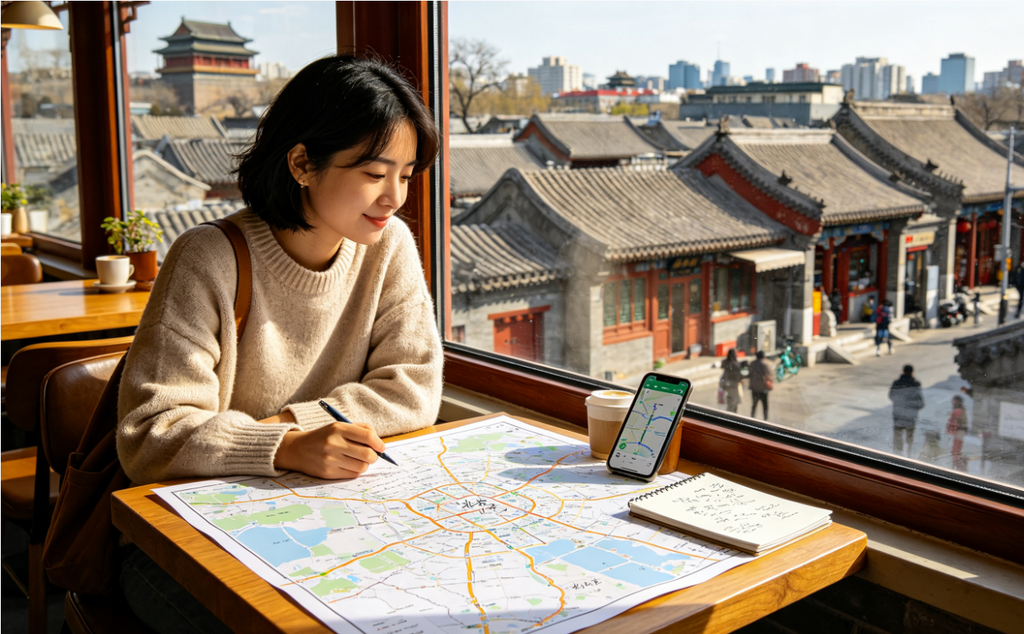
Good first-time Beijing itinerary planning is less about maximizing attractions and more about managing four variables:
1. Geography
Do not repeatedly cross the city.
2. Time
Allow realistic travel and entry time.
3. Energy
A Great Wall hike and the Forbidden City are both demanding experiences. Putting them back-to-back can make the trip unnecessarily tiring.
4. Experience
Mix monumental attractions with ordinary neighborhoods.
A trip consisting entirely of museums and palaces may teach you about historical Beijing but tell you relatively little about contemporary daily life.
A stronger itinerary alternates between:
monument → neighborhood → garden → food → historic site → modern city
This creates a more varied travel experience.
Common First-Time Beijing Itinerary Mistakes
Mistake 1: Trying to See the Great Wall in Half a Day
The Great Wall is outside central Beijing and deserves enough time for transportation and hiking.
Mistake 2: Scheduling Too Many Major Attractions
Three major attractions in one day can look impressive on paper but leave little time for actually experiencing them.
Mistake 3: Ignoring Opening Days
The Palace Museum and some enclosed attractions at the Temple of Heaven have specific operating schedules. Always check current information before locking in the day.
Mistake 4: Treating Beijing Like a Compact European Capital
Beijing is geographically enormous.
Two attractions that appear close on a tourist map may still involve substantial travel time.
Mistake 5: Forgetting Recovery Time
Five consecutive days of early mornings, long walks, stairs, crowds, and subway transfers can become exhausting.
A slower afternoon can improve the overall trip more than another landmark.
Mistake 6: Planning Only Famous Attractions
The most memorable parts of a first trip may come from experiences between the major landmarks:
- a hutong
- a local restaurant
- a neighborhood market
- a park
- a traditional tea shop
- an evening walk
These moments provide context that a checklist of famous sites cannot.
A Practical Daily Rhythm
Rather than scheduling every minute, use a loose structure.
Morning
Put the day’s most important attraction here.
This is often the best time for major historical sites and outdoor activities.
Midday
Have lunch and allow a short break.
Afternoon
Choose a second major attraction or a neighborhood exploration.
Evening
Keep the schedule flexible.
This structure is especially useful because Beijing’s most important attractions can involve substantial walking.
Final Recommended Itinerary
For most first-time travelers staying five full days, this is a strong framework:
| Day | Morning | Afternoon | Evening |
|---|---|---|---|
| 1 | Tian’anmen Square | Forbidden City + Jingshan | Wangfujing / flexible |
| 2 | Temple of Heaven | Qianmen + Dashilar | Hutong / local food |
| 3 | Great Wall | Great Wall | Return + rest |
| 4 | Summer Palace | Northern Beijing / hutongs | Shichahai |
| 5 | Olympic area / museum | Central Axis / flexible | Food or shopping |
The schedule is intentionally not overloaded.
The objective is to understand Beijing through several layers: imperial power, religious tradition, historic neighborhoods, mountain landscapes, gardens, and modern urban life.
For travelers staying only three days, remove the Summer Palace and flexible day. For four days, add the Summer Palace. For six or seven days, keep the five-day structure and use the additional time for museums, neighborhoods, food, or slower cultural experiences.
Final Takeaway
The best Beijing itinerary for first-time visitors is not necessarily the one containing the most attractions.
A successful first trip should make the city’s geography and history easier to understand while leaving enough time to actually enjoy each place.
Start with the imperial center, explore traditional urban Beijing, dedicate a full day to the Great Wall, experience an imperial garden, and then use additional days to explore beyond the standard tourist checklist.
Most importantly, build the itinerary around areas and experiences rather than isolated landmarks.
That approach reduces unnecessary travel, makes transportation easier to manage, leaves room for unexpected discoveries, and gives first-time visitors a much clearer sense of what Beijing actually feels like.