
Beijing Food You Won’t Find Anywhere Else
Quick Answer
Some Beijing foods are famous internationally, but their importance goes beyond popularity. Certain dishes and snacks are closely connected to the capital’s history, northern Chinese food traditions, old neighborhoods, Muslim communities, imperial cuisine, and everyday urban life.
Peking duck is the obvious example, but it is not the only food that gives Beijing a distinct culinary identity. Zhajiangmian, jianjiao, douzhi, aiwowo, tanghulu, donkey rolls, traditional hot pot styles, and a range of old Beijing snacks reflect different layers of the city.
The interesting question is not simply what food is Beijing famous for. It is why certain foods developed in Beijing, what makes them distinctive, and whether the experience can really be separated from the city where they evolved.
What Makes a Food Uniquely Beijing?
A food does not have to be literally impossible to find elsewhere to be uniquely associated with Beijing.
Modern restaurants have carried Beijing dishes throughout China and overseas. Peking duck restaurants, for example, can be found in many major cities. Beijing-style noodles and traditional snacks have also traveled far beyond the capital.
What makes a food particularly Beijing is often a combination of:
- local ingredients and northern agricultural traditions
- historical influences from the imperial capital
- techniques associated with northern Chinese cooking
- Muslim culinary traditions that developed in the city
- old neighborhood food culture
- seasonal eating habits
- specific preparation methods
- the environment in which the food is normally eaten
This distinction matters.
A dish can be reproduced elsewhere, while the complete food culture surrounding it remains strongly connected to Beijing.
That is why travelers should look beyond a restaurant’s menu when exploring local cuisine.
1. Zhajiangmian: Beijing’s Signature Noodle Logic
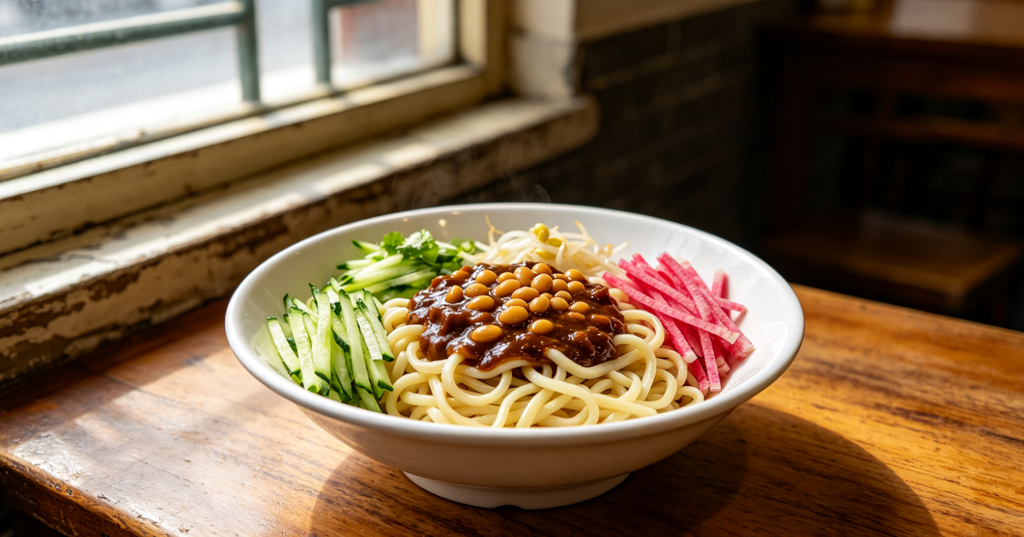
Few foods explain northern Chinese eating habits as clearly as zhajiangmian, or Beijing-style noodles with fermented soybean paste.
The dish appears simple: noodles, a savory fermented sauce, and a selection of vegetables.
But its simplicity is deceptive.
Traditional Beijing zhajiangmian is built around contrast. The fermented soybean paste provides intense salty and savory flavors, while fresh vegetables add crispness and freshness. The noodles provide the neutral base that brings the components together.
This structure reflects an important feature of northern Chinese food.
Wheat-based staples historically played a major role in northern diets, where wheat was more suitable than rice in many agricultural areas. Noodles therefore became more than a convenient carbohydrate. They became a framework for combining sauces, vegetables, meat, and seasonal ingredients.
Beijing’s version developed its own identity through the use of fermented soybean paste and a particular assortment of vegetable toppings.
The result is not a heavily complicated dish.
It is a carefully balanced everyday meal.
For visitors, that makes zhajiangmian especially valuable. Unlike dishes designed primarily for celebrations or restaurants, it gives you an idea of what a traditional northern Chinese noodle meal can look like.
2. Douzhi: A Taste of Old Beijing That Divides Visitors
If there is one traditional Beijing food that illustrates the difference between local identity and international popularity, it is douzhi.
Douzhi is a fermented mung bean drink associated strongly with Beijing’s traditional food culture.
Its flavor can be surprising to visitors.
It is sour, fermented, earthy, and quite different from the sweet fruit drinks or dairy-based beverages that international travelers may expect.
That is precisely why it matters.
Douzhi is not famous because it is universally appealing. Its importance comes from its historical place within Beijing’s everyday food traditions.
It is traditionally associated with other old Beijing breakfast and snack foods, including fried dough-based foods.
This combination demonstrates something important about culinary heritage: traditional food does not always develop according to modern ideas of universal taste.
People continue eating certain foods because they belong to a familiar local food system.
For travelers interested in food history, douzhi can therefore be more revealing than another internationally recognizable dish.
You are not simply tasting a drink.
You are encountering a flavor that carries a distinctly local memory.
3. Beijing-Style Zhajiangmian and the Culture of Northern Wheat Foods
Zhajiangmian deserves a second look because it represents a much larger culinary pattern.
Beijing food developed within the northern Chinese wheat belt, where noodles, buns, dumplings, pancakes, and other flour-based foods became central to everyday eating.
This helps explain why traditional Beijing food can feel structurally different from cuisines associated with southern China.
Rice is not absent from Beijing, of course. Modern Beijing is a national and international food city. But traditional northern food culture often gives wheat-based staples a much more prominent role.
That broader context is easy to miss when travelers approach Beijing cuisine only through famous dishes.
A bowl of noodles can therefore tell you something about geography, agriculture, migration, and historical eating habits at the same time.
This is one reason traditional food is worth experiencing in neighborhoods rather than treating every dish as an isolated attraction.
4. Aiwowo: A Small Dessert With a Long History
Aiwowo is a traditional Beijing snack made primarily with glutinous rice and fillings such as sesame, sugar, or other ingredients depending on the version.
Its soft texture and relatively delicate sweetness make it very different from many Western desserts.
More importantly, it belongs to a category of traditional Beijing snacks that developed around the city’s long history as an imperial and commercial center.
Traditional snacks in Beijing often reveal a different side of the city’s culinary history from restaurant dishes.
They were influenced by palace food, street vendors, neighborhood shops, seasonal customs, and different communities living in the capital.
Aiwowo is therefore useful for understanding how food can move between social settings.
A snack may begin as part of an elite or ceremonial food tradition, become available through commercial food culture, and eventually become recognized as part of local culinary heritage.
That layered history is one of the reasons Beijing’s traditional snacks deserve more attention than their small size suggests.
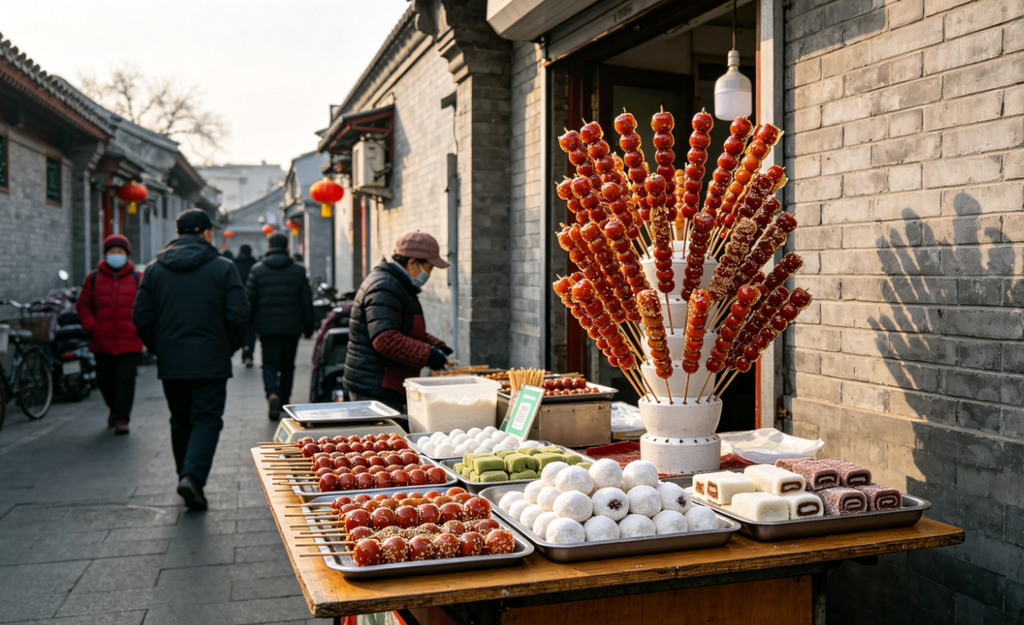
5. Tanghulu: The Winter Snack That Became a Beijing Icon
Tanghulu consists traditionally of fruit coated in a hardened layer of sugar syrup and served on a skewer.
Today, versions of tanghulu are widely available throughout China.
So why associate it with Beijing?
Part of the answer lies in its strong connection with northern winter food culture and its visibility in traditional Beijing streets, markets, and tourist areas.
The combination of bright fruit and transparent sugar coating creates a distinctive winter image.
Historically, hawked snacks like this also demonstrate the importance of portability in urban food culture.
A snack does not require a dining room.
It can be purchased while walking through a market, neighborhood, festival, or commercial street.
That relationship between food and movement is particularly relevant when exploring historic Beijing.
The food becomes part of the urban experience rather than a separate restaurant stop.
6. Donkey Rolls: A Dessert With an Unusual Name
The traditional snack often translated as donkey roll is known in Chinese as lüdagun.
Despite its unusual English name, the food contains no donkey meat.
The name refers to its appearance and traditional presentation rather than its main ingredient.
The snack typically combines glutinous rice with sweet red bean filling and a coating of soybean flour.
Its texture is soft and chewy, while the soybean flour adds a dry, nutty character.
Like several traditional Beijing snacks, it demonstrates the importance of texture in Chinese food.
Western visitors sometimes evaluate unfamiliar desserts primarily through sweetness.
Traditional Beijing snacks often operate differently.
Sweetness may be moderate, while texture, aroma, temperature, and the relationship between filling and outer layer contribute just as much to the experience.
That makes these snacks useful for travelers who want to understand Beijing food rather than simply identify familiar flavors.
7. Beijing’s Muslim Food Traditions
One of the most important layers of Beijing food culture is its long-established Muslim culinary tradition.
Beijing has historically been home to Muslim communities, particularly the Hui population, whose food traditions have influenced the city’s restaurant and street-food culture.
This creates an important distinction between Beijing cuisine as a narrow category and food culture in Beijing as a city.
Not every important food eaten in Beijing originated exclusively within Han Chinese culinary traditions.
Beijing’s food culture developed through migration, trade, religious communities, imperial institutions, military movement, and commercial exchange.
Muslim restaurants and traditional dishes therefore represent an essential part of the city’s culinary landscape.
For visitors, exploring this layer can reveal how Beijing became a capital where different food traditions interacted rather than a city with one uniform cuisine.
8. Peking Duck Is Famous — But the Experience Is More Specific Than the Dish
Peking duck is undoubtedly one of Beijing’s most internationally recognizable foods.
But travelers sometimes approach it as if ordering the dish automatically provides the complete experience.
It does not.
The preparation, roasting, carving, serving style, pancakes, sauces, vegetables, and sequence of eating all contribute to the experience.
The dish also reflects Beijing’s historical connection with court and restaurant cuisine.
Modern Peking duck restaurants range from highly formal dining rooms to more accessible establishments. This means that the same basic dish can create very different experiences depending on the restaurant and context.
For visitors building a food-focused trip, Peking duck should therefore be understood as one component of Beijing cuisine rather than its entire definition.
A useful Beijing trip planner should leave room for both famous restaurant dishes and ordinary local foods.
The contrast between them often reveals more about the city than eating several versions of the same famous dish.
9. Beijing Hot Pot Has Its Own Identity
Hot pot is not exclusive to Beijing.
China has numerous regional hot pot traditions, each shaped by local ingredients, cooking methods, and eating habits.
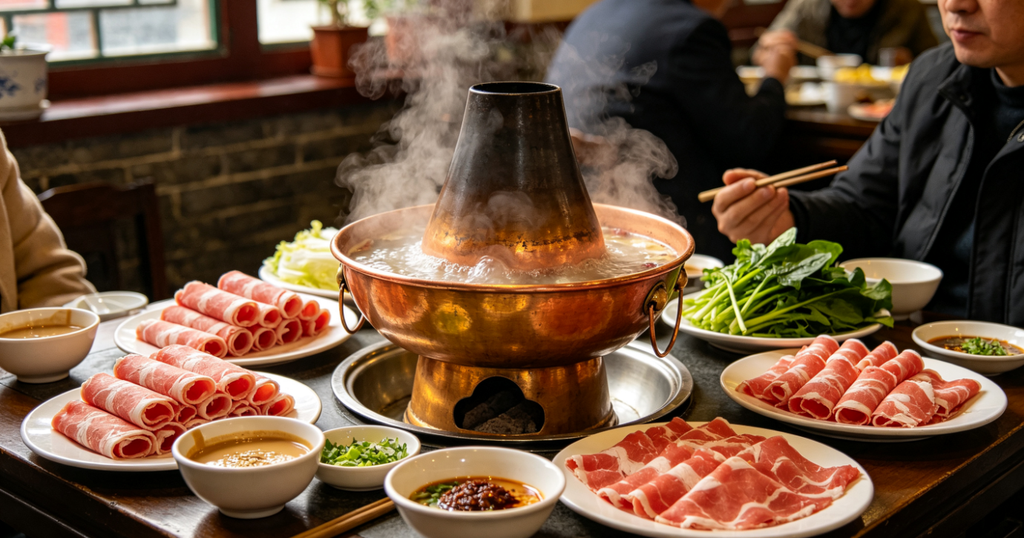
Beijing’s traditional hot pot is particularly associated with the use of a copper pot and a relatively restrained broth, allowing the quality and flavor of the ingredients to remain central.
Thinly sliced lamb is particularly important in the traditional style.
The simplicity of the broth creates a very different dining experience from heavily seasoned hot pots in other parts of China.
This is an important distinction for food travelers.
When comparing regional Chinese cuisines, the question should not always be which version has the strongest flavor.
Sometimes the culinary identity lies in restraint.
Beijing’s traditional hot pot illustrates how cooking equipment, ingredients, seasoning, and social dining habits can combine to produce a recognizable regional style.
10. Old Beijing Breakfast Is a Culinary Category of Its Own
Breakfast may be one of the most revealing ways to experience local food culture.
Tourists often focus on famous dinner dishes because they are easier to research.
But breakfast reveals what people eat when food is part of ordinary life rather than sightseeing.
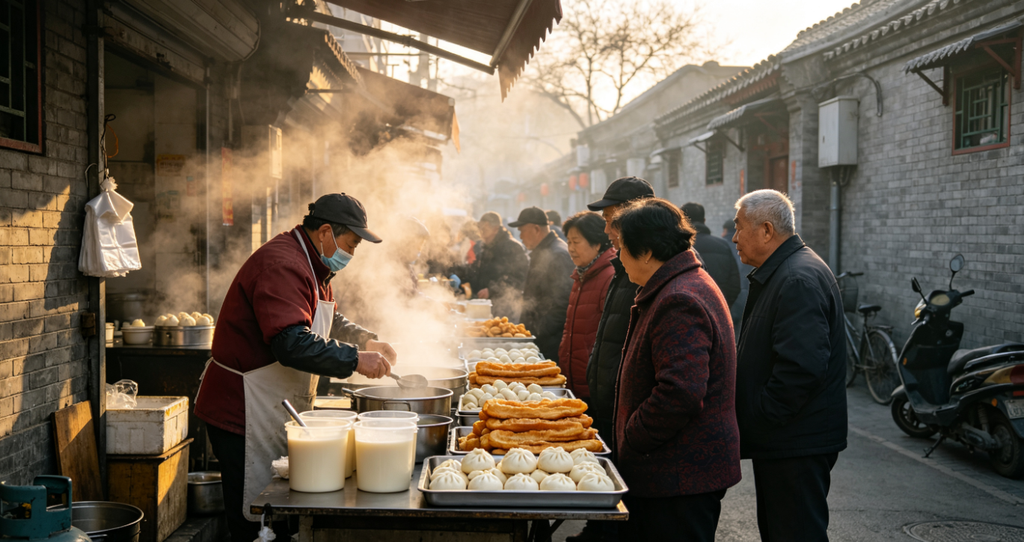
Traditional Beijing breakfast culture includes a range of wheat-based foods, fried dough products, soybean-based drinks, steamed or baked items, and other inexpensive foods designed for everyday consumption.
This creates a different relationship between traveler and city.
A formal dinner can feel like an event.
Breakfast can feel like participation in a routine.
That distinction is particularly useful for understanding Beijing’s traditional food culture.
If you want to experience traditional Beijing foods efficiently, breakfast can also be a practical part of the day because it allows you to explore local food without dedicating several hours to a restaurant meal.
11. Beijing Food Is Closely Connected to Its Neighborhoods
One of the biggest mistakes food travelers make is assuming that Beijing cuisine can be understood entirely through famous restaurants.
The city is too large and historically layered for that approach.
Different neighborhoods have different relationships with food.
Historic districts preserve traditional snack shops and older restaurant traditions. Commercial areas contain modern interpretations of Chinese cuisine. Markets reveal inexpensive everyday foods. Residential neighborhoods may offer restaurants serving regional Chinese cuisines brought to Beijing by migrants.
This means food exploration should sometimes follow urban geography rather than a restaurant ranking.
Instead of asking:
Which restaurant has the most famous dish?
A more useful question can be:
What kind of food culture developed in this part of Beijing?
That question naturally connects food with history and place.
12. What Food Is Truly “Nowhere Else”?
It is worth being precise about the phrase “you won’t find anywhere else.”
Very few modern Beijing dishes are literally impossible to find outside Beijing.
Recipes travel.
Restaurants open in other cities.
Tourism spreads regional food across the country.
Online food delivery makes geographical boundaries even less meaningful.
What is difficult to reproduce elsewhere is the combination of food, place, history, and social context.
A bowl of Beijing-style noodles can be prepared in another city.
A Beijing neighborhood breakfast routine is harder to reproduce.
A traditional snack can be recreated elsewhere.
The experience of buying it in an old Beijing district, walking through a historic neighborhood, and seeing how local residents use the same food is much harder to duplicate.
This distinction is important for anyone researching what food is Beijing famous for.
Famous food tells you what visitors recognize.
Local food culture tells you why those foods matter.
13. How to Build a More Authentic Beijing Food Experience
You do not need to spend every meal searching for obscure traditional snacks.
Instead, create variety.
A balanced food-focused visit could include:
One internationally famous dish
For example, Peking duck.
One everyday northern staple
Such as zhajiangmian.
One traditional breakfast
Choose something from an older local breakfast tradition.
One traditional snack
Try a small dessert or street-style snack.
One regional culinary tradition within Beijing
Muslim cuisine is one example.
One communal meal
Traditional Beijing hot pot can provide a different social experience.
This approach creates contrast.
You experience formal restaurant culture, everyday food, snacks, historical traditions, and communal dining rather than repeating the same type of meal.
14. Don’t Judge Traditional Beijing Food Only by Familiarity
Some visitors enjoy Beijing food immediately.
Others encounter flavors that require adjustment.
Fermented soybean products, strong savory sauces, chewy textures, wheat-based staples, and unfamiliar breakfast foods may not resemble what a traveler normally eats at home.
That does not automatically mean the food is better or worse.
It means the culinary system is different.
A useful approach is to separate three questions:
Do I like the flavor?
This is personal preference.
Is this historically important in Beijing?
This is a question of culinary context.
Does this help me understand local food culture?
This is a question of cultural experience.
A food can score differently on all three.
You might dislike a fermented drink but still find it fascinating. You might love Peking duck but learn less about everyday Beijing eating from it than from a simple bowl of noodles.
Keeping these questions separate makes food exploration more interesting.
15. The Foods Worth Looking for Are Not Always the Most Photogenic
Social media naturally favors visually distinctive foods.
Colorful fruit skewers, elaborate Peking duck presentations, decorated desserts, and fashionable restaurants are easy to photograph.
But some of Beijing’s most meaningful foods look ordinary.
A bowl of noodles.
A simple breakfast.
A steamed or baked wheat-based snack.
A small neighborhood restaurant.
A traditional hot pot meal.
These foods may not look spectacular in a photograph, but they can reveal more about how Beijing’s food culture developed.
For travelers interested in culinary history, visual appeal should therefore not become the main selection criterion.
The most memorable meal may be the one that explains something about the city.
16. Food Can Also Change How You Explore Beijing
Food does not need to be a separate category from sightseeing.
A traditional breakfast can introduce a neighborhood before the day’s major attractions.
A snack can provide a short break during a walking route.
A restaurant can become the reason to explore a historic district after sunset.
A local food market can reveal another side of an area that looks primarily tourist-oriented.
This creates a more integrated travel experience.
Instead of:
attraction → restaurant → attraction → restaurant
you can think in terms of:
place → food → neighborhood → history → everyday life
That approach is particularly valuable in a city as large and historically layered as Beijing.
17. A Practical Food Strategy for First-Time Visitors
If you have only a few days, do not try to eat everything.
Focus on contrasts.
For example:
| Food experience | What it reveals |
|---|---|
| Peking duck | Formal Beijing restaurant tradition |
| Zhajiangmian | Northern wheat-based food culture |
| Traditional breakfast | Everyday eating habits |
| Douzhi or another old snack | Local historical taste |
| Beijing hot pot | Communal northern dining |
| Muslim cuisine | Beijing’s multicultural food history |
| Traditional dessert | Snack and seasonal traditions |
The goal is not to collect dishes.
The goal is to build a mental map of Beijing through food.
This is also why a good Beijing trip planner should treat meals as part of the city’s geography rather than simply inserting restaurants between attractions.
18. Why Beijing Food Is Best Understood as a Historical Layer
Beijing has been a political and cultural center for centuries.
Its food reflects that history.
Imperial cuisine contributed prestige and techniques.
Northern agricultural traditions shaped staple foods.
Migration brought new ingredients and cooking traditions.
Religious communities developed their own culinary institutions.
Street vendors and neighborhood shops made traditional foods accessible.
Modern restaurants transformed old dishes for contemporary diners.
Tourism then carried Beijing foods beyond the city.
The result is not one fixed cuisine.
It is a layered food culture.
That is perhaps the most important idea to take away from Beijing’s traditional foods.
Some dishes are ancient.
Some are relatively modern.
Some are strongly associated with the capital.
Others became important because Beijing absorbed traditions from elsewhere.
Together, they show how a city changes without completely abandoning its culinary memory.
19. What Should You Eat If You Want the Most Distinctively Beijing Experience?
If your goal is not simply to eat famous Chinese food but to understand Beijing through its cuisine, prioritize local context over rarity.
Look for foods that demonstrate at least one of these characteristics:
- strong historical association with Beijing
- northern wheat-based ingredients
- traditional fermentation
- old breakfast culture
- imperial or restaurant traditions
- Muslim culinary heritage in the capital
- neighborhood food culture
- seasonal eating
- traditional preparation methods
This gives you a more meaningful definition of local food.
The most distinctive food is not necessarily the strangest dish.
It is often the dish that connects the greatest number of things: place, people, history, ingredients, and everyday life.
Final Takeaway
Beijing food you won’t find anywhere else is best understood as a combination of distinctive dishes and the environment in which those dishes developed.
Peking duck may be the international symbol, but zhajiangmian reveals northern wheat culture. Traditional breakfast reveals everyday life. Douzhi and old snacks preserve flavors that many visitors have never encountered. Beijing hot pot demonstrates a restrained northern style, while Muslim food traditions reveal the city’s long history of cultural exchange.
The most rewarding approach is therefore not to search for a single “most authentic” dish.
Explore several layers of Beijing food: famous restaurant cuisine, ordinary neighborhood meals, traditional snacks, breakfast culture, regional traditions, and foods connected to historic communities.
That combination gives you something a menu alone cannot provide — a way of understanding Beijing through what its people have cooked, sold, shared, and eaten across generations.