
How Beijing Food Differs from Other Chinese Cuisine
Quick Answer
Beijing food differs from many other Chinese regional cuisines because it developed at the intersection of northern agricultural traditions, imperial culture, migration, military history, and life in a long-standing political capital.
Its traditional food culture often places greater emphasis on wheat-based staples, fermented sauces, lamb, simple but substantial flavors, and foods designed for northern climates than many southern Chinese cuisines.
But there is an important qualification: Beijing cuisine is not a completely isolated regional system.
The city has absorbed culinary traditions from Shandong, Hebei, Shanxi, Inner Mongolia, Muslim communities, the imperial court, and migrants from across China. Modern Beijing is therefore both a regional food culture and a national culinary crossroads.
That is why understanding Beijing food requires more than memorizing famous dishes.
You need to understand why those dishes developed in Beijing in the first place.
1. Beijing Food Begins With Geography
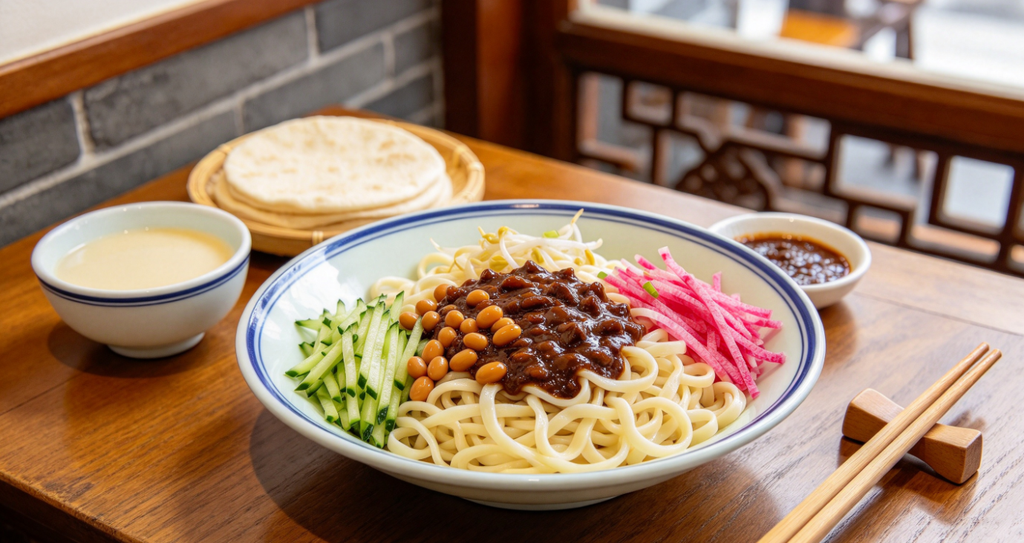
The most fundamental difference between regional Chinese cuisines is often geography.
China is enormous.
Its climate ranges from tropical and subtropical environments in the south to much colder continental conditions in the north. Agricultural systems, available ingredients, preservation techniques, and staple foods developed differently across these environments.
Beijing sits in northern China, and its traditional food culture reflects that setting.
Historically, wheat and other grains were important staples in northern diets, while rice became more dominant in many southern regions.
That difference appears immediately on the table.
Traditional Beijing food has a strong relationship with:
- noodles
- buns
- dumplings
- pancakes
- steamed flour products
- wheat-based snacks
- fermented soybean products
This does not mean Beijing people do not eat rice.
Modern Beijing is a cosmopolitan city where almost every regional Chinese cuisine is available.
The distinction is historical.
Traditional northern food culture developed around a different agricultural foundation from the rice-centered traditions found in many southern regions.
That foundation continues to influence Beijing’s culinary identity.
2. Wheat vs. Rice Changes More Than the Main Dish
It is tempting to reduce the difference to:
Northern China eats wheat, southern China eats rice.
Reality is much more complicated.
But the distinction is still useful because staple grains influence the structure of meals.
In a wheat-oriented food culture, flour can become the basis for many different foods.
One ingredient can become:
- noodles
- dumpling wrappers
- steamed buns
- pancakes
- stuffed breads
- fried dough
- pastries
- snacks
This creates a food culture in which the staple itself can become part of the culinary identity.
For visitors, this is one of the easiest ways to notice the difference between traditional Beijing food and cuisines from southern China.
Instead of rice being the neutral foundation around which dishes are arranged, wheat-based foods frequently occupy the center of the meal.
3. Beijing Food Is Generally Less About Extreme Spice
One of the most obvious contrasts for international travelers is seasoning.
When people think about Chinese food, they may immediately think of the intense heat of Sichuan cuisine or the bold chili-based flavors associated with several southwestern and central Chinese traditions.
Traditional Beijing food generally follows a different path.
Chili is not absent.
Modern Beijing restaurants can certainly serve extremely spicy food.
But traditional Beijing cuisine is not defined by chili heat.
Instead, flavor may come from:
- fermented soybean paste
- soy sauce
- scallions
- garlic
- sesame
- vinegar
- ginger
- aromatic spices
- slow cooking
- roasting
- the natural flavor of meat and vegetables
This can make Beijing food appear relatively restrained compared with cuisines in which chili, Sichuan peppercorn, or other strong spices dominate the flavor profile.
The distinction is not “bland versus flavorful.”
It is a difference in where the flavor intensity comes from.
4. Fermentation Plays an Important Role
Fermentation is one of the hidden foundations of traditional northern Chinese food.
Fermented soybean products are particularly important.
They can provide saltiness, umami, aroma, and depth without requiring large amounts of fresh spices.
Beijing-style zhajiangmian is a good example.
Its defining sauce is based around fermented soybean paste, producing a concentrated savory flavor that is balanced by noodles and fresh vegetables.
This differs significantly from cuisines in which sauces are built primarily around fresh chilies, fermented chili pastes, citrus, seafood, or aromatic herbs.
Fermentation also reflects historical food preservation.
Before modern refrigeration, fermentation was not simply a way to make food taste interesting.
It was a practical technology.
It extended shelf life and transformed ingredients into forms that could be stored and used over longer periods.
The flavor traditions survived even after the original preservation necessity became less important.
5. Beijing Cuisine Has a Strong Northern Savory Profile
Traditional Beijing food tends to favor savory, salty, aromatic, and fermented flavors.
Scallions are particularly important in northern cooking.
Garlic, soybean paste, sesame, vinegar, and soy-based seasonings can also play significant roles.
This creates a flavor profile that can feel more direct than some southern cuisines.
The food does not necessarily depend on dozens of spices.
Instead, a smaller number of ingredients can be used to create depth.
This is particularly noticeable in traditional noodles and meat dishes.
For travelers, the difference can be subtle at first.
But after eating several regional Chinese cuisines, the contrast becomes clearer.
6. Beijing Food Has a Strong Relationship With Meat
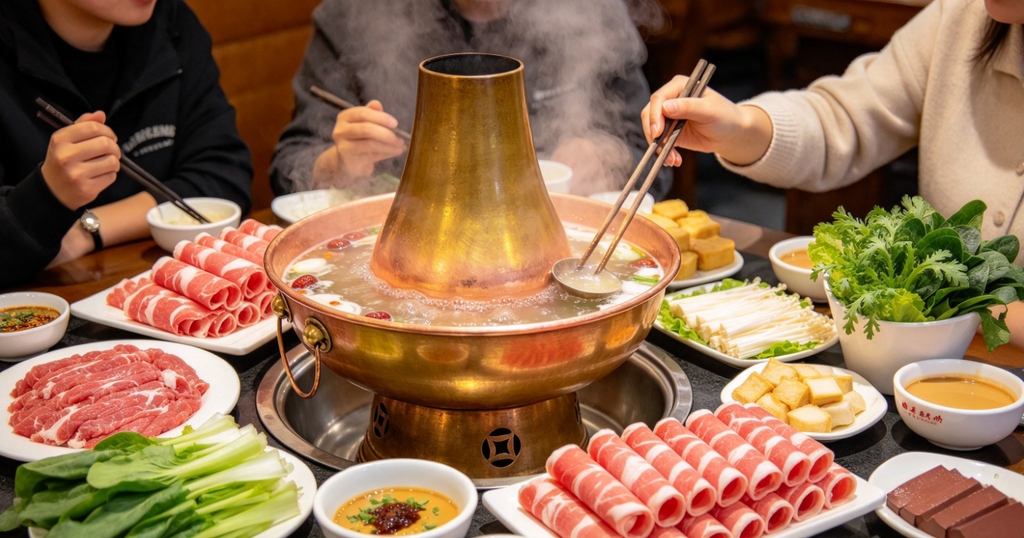
Northern geography also influenced the role of meat.
Lamb is particularly important in traditional Beijing food culture, partly because of the historical relationship between the capital and northern pastoral regions.
This helps explain the cultural importance of Beijing-style hot pot.
The traditional form is relatively simple.
Thinly sliced lamb is cooked in a copper pot with a comparatively restrained broth, allowing the flavor of the meat to remain prominent.
This differs from Sichuan hot pot, where the broth itself can become a dominant component through chili, Sichuan peppercorn, and other spices.
The contrast illustrates a broader principle:
Two Chinese cuisines can use the same cooking format while creating completely different eating experiences.
Hot pot is not one standardized national dish.
It is a family of regional traditions.
7. Peking Duck Reflects a Different Culinary Philosophy
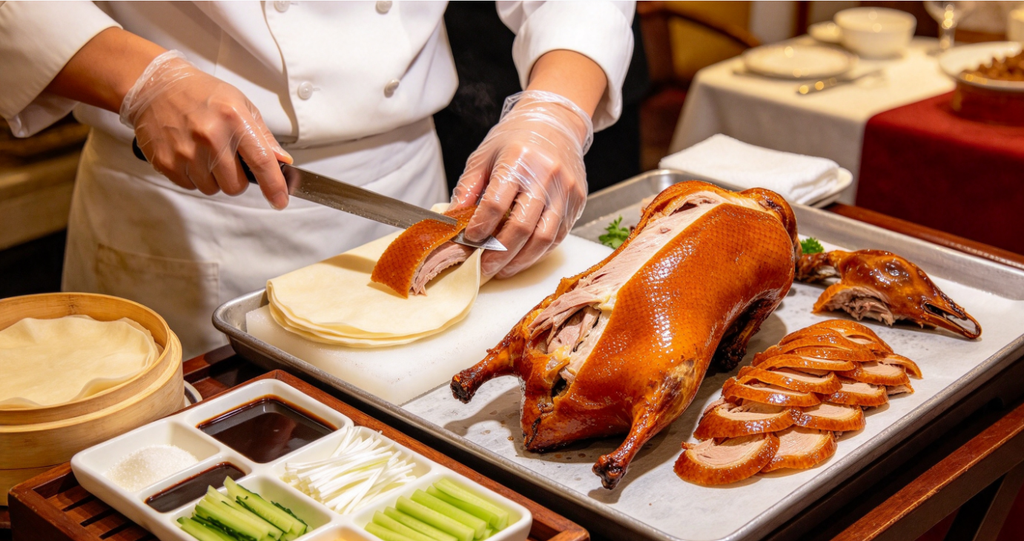
Peking duck is often treated as simply Beijing’s most famous dish.
It is more useful to understand it as an example of Beijing’s historical restaurant and roasting traditions.
The emphasis is placed on:
- carefully prepared poultry
- crisp skin
- roasting technique
- thin pancakes
- sauces
- scallions
- controlled presentation
The dish is not built around extreme spice.
Its appeal comes from technique, texture, aroma, and the combination of several components.
This makes it quite different from cuisines in which the main attraction is a heavily seasoned sauce or fiery cooking method.
The technique itself becomes part of the flavor experience.
That emphasis on preparation and presentation is one reason Beijing food cannot be reduced to simple northern home cooking.
8. Beijing’s Imperial History Matters
Another major difference is Beijing’s long role as an imperial capital.
Food in Beijing was influenced by the needs of the imperial court.
This created sophisticated culinary traditions involving:
- formal banquets
- specialized ingredients
- elaborate preparation
- presentation
- professional cooks
- ceremonial dining
Not every traditional Beijing dish is an imperial dish.
That would be an oversimplification.
But the existence of the imperial court helped shape the city’s food economy.
Ingredients, cooks, techniques, and culinary preferences circulated between elite institutions and the broader city.
Over time, some foods associated with higher-status dining entered restaurant culture and eventually became part of the wider identity of Beijing cuisine.
This historical pathway is less obvious in cities whose culinary identity developed primarily through local agricultural communities rather than serving as the political center of a major empire for centuries.
9. Beijing Cuisine Is Closely Connected to Shandong Food
If you want to understand Beijing food historically, it is important not to imagine the cuisine as developing in isolation.
Shandong cuisine, or Lu cuisine, had a particularly important influence on northern Chinese cooking and Beijing’s restaurant tradition.
Chefs and culinary practices from Shandong contributed to the development of Beijing’s professional cooking culture.
This helps explain similarities involving:
- wheat-based staples
- seafood and meat preparation
- clear and savory flavors
- roasting
- frying
- braising
- strong use of scallions
The relationship demonstrates why regional Chinese cuisine should not be understood as a collection of completely separate boxes.
Food traditions travel with people.
When chefs migrate, they bring techniques with them.
When restaurants develop in major cities, different regional traditions interact.
Beijing is a particularly strong example of this process.
10. Beijing Food Also Reflects Muslim Culinary Traditions
Another important difference is the role of Muslim food culture.
Beijing has long been home to Muslim communities, particularly the Hui population.
Their culinary traditions contributed another major layer to the city’s food landscape.
This influence is visible in restaurants, meat dishes, noodles, lamb-based foods, breads, and other preparations.
The importance of this tradition shows why it is inaccurate to describe Beijing food as one uniform cuisine.
The capital has historically brought together people from different regions and communities.
Food was one of the places where these cultural exchanges became visible.
For travelers, exploring Beijing’s Muslim food traditions can therefore provide a more complete picture of the city than focusing only on imperial or famous restaurant dishes.
11. Beijing Food Is Different From Sichuan Cuisine in a Fundamental Way
The comparison with Sichuan cuisine is particularly useful because both are internationally famous.
Sichuan cuisine is strongly associated with:
- chili
- Sichuan peppercorn
- complex spice combinations
- numbing and spicy flavors
- fermented chili-based ingredients
- intense aromatic profiles
Traditional Beijing cuisine operates differently.
Its flavor foundation is more likely to involve:
- fermented soybean products
- soy sauce
- scallions
- garlic
- sesame
- vinegar
- roasting
- braising
- wheat-based staples
This does not mean every Beijing dish is mild or every Sichuan dish is extremely spicy.
Regional cuisines contain enormous internal diversity.
The comparison simply illustrates two different historical approaches to building flavor.
12. Beijing Food vs. Cantonese Cuisine
Cantonese cuisine developed in southern China under very different environmental and historical conditions.
It is particularly known for:
- seafood
- dim sum
- lighter seasoning
- emphasis on ingredient freshness
- steaming
- delicate sauces
- soups
- Cantonese barbecue traditions
Beijing’s traditional food culture is more strongly associated with northern wheat staples and robust savory flavors.
The difference is not simply about ingredients.
It is about culinary priorities.
Cantonese cooking often emphasizes allowing high-quality ingredients to remain recognizable.
Traditional northern cooking frequently makes stronger use of sauces, flour-based staples, fermentation, and cooking methods suited to northern ingredients.
Both approaches can be sophisticated.
They simply evolved under different circumstances.
13. Beijing Food vs. Jiangnan Cuisine
Jiangnan cuisine comes from the region around the lower Yangtze River, including areas associated with Jiangsu and Zhejiang.
Its food traditions developed in a wetter, warmer region with abundant waterways, rice agriculture, freshwater fish, and different agricultural resources.
Compared with traditional Beijing food, Jiangnan cuisine often places greater emphasis on:
- rice
- freshwater fish
- seasonal vegetables
- delicate textures
- subtle sweetness
- refined presentation
Beijing’s northern food culture has a stronger relationship with wheat, lamb, fermented sauces, and hearty flour-based staples.
Again, these differences are not absolute.
Modern restaurants blur them.
But historically, geography explains much of the contrast.
14. Beijing Food vs. Yunnan Cuisine
Yunnan provides another fascinating comparison.
Its mountainous geography and biodiversity produced a food culture featuring a wide range of:
- mushrooms
- herbs
- flowers
- mountain vegetables
- fermented ingredients
- distinctive local spices
Yunnan cuisine can therefore feel much more ingredient-diverse and aromatic to visitors.
Beijing’s traditional food culture developed in a very different environmental setting.
This demonstrates an important principle in Chinese cuisine:
regional food is often a record of local ecology.
What grows naturally, what can be transported, what can be preserved, and what animals are available all influence what eventually becomes “local cuisine.”
15. Beijing Food vs. Hunan Cuisine
Hunan cuisine is another useful contrast.
Hunan food is known for bold flavors, chili, acidity, smoked ingredients, and substantial seasoning.
Beijing cuisine does not have the same historical dependence on chili as a defining flavor.
Instead, traditional Beijing food frequently derives depth from fermentation, roasting, sauces, meat, and wheat-based staples.
Modern Beijing restaurants certainly serve Hunan dishes.
But those foods should not automatically be classified as traditional Beijing cuisine.
This distinction becomes increasingly important in a modern capital city where regional restaurants from across China operate side by side.
16. Beijing Is Both a Regional Cuisine and a National Food Hub
This may be the most important distinction of all.
When people ask how Beijing food differs from other Chinese cuisine, they sometimes assume Beijing has one fixed culinary identity.
Modern Beijing does not.
You can find restaurants specializing in:
- Sichuan cuisine
- Cantonese cuisine
- Hunan cuisine
- Yunnan cuisine
- Xinjiang food
- Shaanxi noodles
- Shanxi dishes
- Northeast Chinese food
- Shanghai cuisine
- Fujian cuisine
Beijing’s position as the capital has made it a place where China’s regional cuisines meet.
Therefore, “Beijing food” can mean two different things:
Traditional Beijing cuisine
Food historically associated with the capital and its surrounding northern culinary culture.
Food eaten in Beijing
The enormous collection of regional cuisines available within the modern city.
These should not be confused.
17. Traditional Beijing Snacks Reveal the Difference Best
If you want to understand the city’s historical food identity, traditional snacks can sometimes be more informative than expensive restaurants.
Old Beijing snacks include foods based on:
- wheat
- rice flour
- glutinous rice
- beans
- fermented ingredients
- sugar
- sesame
- nuts
Some are sweet.
Some are savory.
Some are strongly fermented.
Some are associated with particular seasons or traditional celebrations.
They demonstrate how food functioned in everyday urban life.
This is one reason visitors should explore traditional Beijing foods rather than limiting themselves to famous restaurant dishes.
A small snack can preserve a culinary tradition that a modern fine-dining restaurant may reinterpret almost completely.
18. Beijing Breakfast Is Especially Different
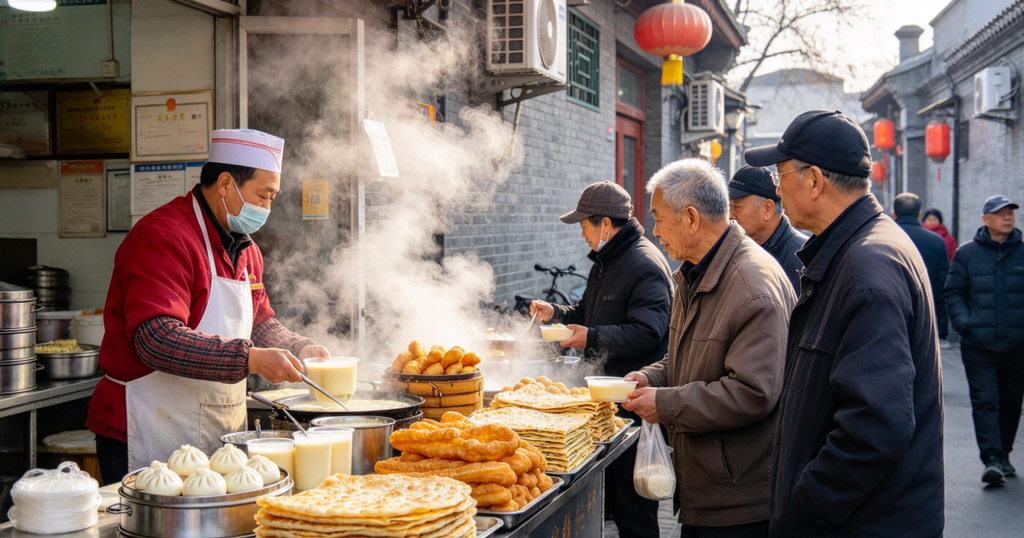
Breakfast offers another way to see the distinction.
In many Western travel itineraries, breakfast is treated as a practical meal before sightseeing.
In Beijing’s traditional food culture, breakfast can be a meaningful culinary category in its own right.
Traditional breakfast foods may include:
- fried dough
- soybean-based drinks
- noodles
- steamed flour products
- savory pancakes
- stuffed buns
- other inexpensive street and neighborhood foods
The emphasis on flour, beans, and savory flavors reflects northern food traditions.
Breakfast also reveals something that restaurant cuisine can hide:
how ordinary people eat.
A formal Peking duck dinner tells you about restaurant culture.
A neighborhood breakfast can tell you much more about daily life.
19. Seasonality Also Shapes Beijing Food
Beijing’s climate has four distinct seasons.
Traditional food culture developed around these changes.
Winter encouraged warming, hearty foods and preserved ingredients.
Summer created demand for lighter foods and seasonal produce.
Autumn brought particular fruits, vegetables, and festival-related foods.
Spring introduced another set of seasonal ingredients.
This contrasts with regions where warmer climates allow certain ingredients to be available throughout much of the year.
Seasonality also helps explain why traditional Chinese food culture often contains so many specialized snacks and dishes.
Food was historically connected to the calendar.
Eating something at the appropriate time of year could be part of cultural practice rather than simply a matter of preference.
20. Beijing Food Is Often More Historical Than “Regional”
There is a subtle but important distinction between Beijing and some other famous Chinese food regions.
Some cuisines are strongly identified with a particular natural environment.
Beijing’s food identity is also deeply connected to political history and migration.
For centuries, people came to Beijing because it was the capital.
Officials arrived.
Soldiers arrived.
Merchants arrived.
Chefs arrived.
Workers arrived.
Religious communities developed.
Restaurants served travelers from across the empire.
As a result, Beijing cuisine absorbed outside influences continuously.
Its identity is therefore partly regional and partly metropolitan.
This is one reason Beijing food can contain both very old local traditions and dishes shaped by people from elsewhere.
21. What Travelers Often Get Wrong About Beijing Food
There are several common misconceptions.
“Peking duck is Beijing cuisine.”
It is an important part of Beijing’s culinary identity, but it represents only one layer.
“Beijing food is all heavy northern food.”
Traditional northern influences are important, but the modern city contains cuisines from across China.
“Beijing food is not spicy.”
Traditional Beijing cuisine is not defined by intense chili heat, but modern Beijing restaurants certainly include spicy cuisines.
“Northern Chinese food is basically the same everywhere.”
Northern regions have significant differences in ingredients, techniques, and local traditions.
“Authentic food must be difficult to find.”
Not necessarily.
Some of the most representative foods can be found in ordinary neighborhood restaurants and traditional snack shops.
Understanding these distinctions helps travelers make better food choices.
22. How to Experience Beijing Food Without Eating the Same Thing Repeatedly
A common mistake is to build a food itinerary around famous dishes only.
That can produce several meals that are visually impressive but culturally repetitive.
A better approach is to create contrast.
For example:
Breakfast: traditional northern-style breakfast
Lunch: Beijing-style noodles
Snack: traditional local dessert or fermented specialty
Dinner: Peking duck
Another evening: Beijing-style hot pot
Additional meal: Muslim cuisine in Beijing
This approach allows you to experience different layers of the city’s food culture.
You are not simply collecting famous dishes.
You are comparing different culinary traditions within one city.
23. How Food Can Help You Understand Beijing’s History
Food is particularly useful because it makes abstract history tangible.
The capital’s relationship with northern frontier regions can be seen in lamb dishes and other northern foods.
The imperial court can be seen in formal culinary traditions.
Migration can be seen in regional restaurants.
Religious communities can be seen in Muslim food culture.
Agricultural geography can be seen in wheat-based staples.
Urbanization can be seen in breakfast shops and neighborhood restaurants.
Modern globalization can be seen in the enormous range of international and regional cuisines available today.
In this sense, food is not merely something to eat between attractions.
It is a historical source.
24. What Should Visitors Look For on a Food-Focused Beijing Trip?
Rather than asking only:
“What is the best Beijing restaurant?”
ask a series of broader questions.
What is the staple?
Is the meal based around noodles, bread, rice, meat, or vegetables?
Where does the flavor come from?
Fermentation, spices, fresh herbs, sauces, roasting, or the ingredients themselves?
What historical community is connected to the dish?
Imperial, northern, Muslim, migrant, neighborhood, or modern?
Is the food everyday or ceremonial?
A breakfast snack tells a different story from a banquet.
Is the dish truly Beijing-specific or simply popular in Beijing?
This final question is particularly important in a national capital.
25. The Biggest Difference: Beijing Food Tells a Story About a Capital
Ultimately, the biggest difference is not one ingredient or cooking technique.
It is the city’s role in Chinese history.
Beijing has been a political capital, military center, commercial hub, cultural center, and destination for migrants from across China.
Its food reflects all of those roles.
That is why Beijing cuisine can seem simultaneously:
- northern
- traditional
- imperial
- urban
- diverse
- wheat-oriented
- historically layered
- increasingly cosmopolitan
Trying to reduce it to one flavor profile misses the most interesting part.
Beijing food is a record of how a capital absorbs and transforms culinary traditions.
Final Takeaway
The key Beijing food differences are rooted in geography, history, agriculture, migration, and the city’s long role as an imperial and modern capital.
Traditional Beijing food has strong northern characteristics: wheat-based staples, fermented soybean products, savory sauces, lamb, roasting, noodles, dumplings, buns, pancakes, and substantial everyday foods.
At the same time, Beijing’s cuisine cannot be separated completely from outside influences.
Shandong culinary traditions, Muslim food culture, imperial cooking, northern regional cuisines, and centuries of migration all contributed to the city’s food identity.
That is why Beijing differs from Sichuan, Cantonese, Jiangnan, Hunan, Yunnan, and other Chinese culinary traditions without existing in complete isolation from them.
For travelers, the best way to understand the difference is not to compare dishes only by taste.
Compare ingredients, staple foods, seasoning, cooking techniques, historical influences, and eating contexts.
If you plan Beijing trip around these contrasts, food becomes more than another item on your itinerary. It becomes a way to understand why Beijing developed the culinary identity it has today.
And if you explore both Beijing local dishes and the wider regional cuisines available throughout the city, you will see an important distinction: Beijing is not only a place with its own food traditions. It is also one of the places where China’s many culinary traditions meet.