
Best Beijing Foods to Try in One Day: A Food Itinerary
What Are the Best Beijing Foods to Try in One Day?
If you have only one day to explore Beijing through food, prioritize variety rather than quantity.
The most effective food itinerary combines four different experiences: a traditional Beijing breakfast, a substantial northern-style lunch, one or two small local snacks, and a signature dinner such as Beijing roast duck. This approach lets you experience everyday eating, traditional flavors, and formal dining without spending the entire day eating.
A practical one-day sequence is:
Breakfast → local snack → noodles or dumplings → traditional sweet → roast duck dinner
The exact dishes can change according to your location, dietary preferences, and appetite. What matters most is giving each meal a different role.
That is the easiest way to experience the best Beijing foods to try in one day without turning the trip into a checklist of oversized meals.
1. How to Choose Beijing Foods When You Have Only One Day
Beijing has far more traditional foods than one visitor can realistically eat in a single day.
Instead of asking:
“What are all the famous foods in Beijing?”
ask:
“Which foods give me the most different experiences in one day?”
This changes how you build the itinerary.
A useful selection framework is:
| Food role | What to choose | Why it matters |
|---|---|---|
| Everyday | Beijing breakfast | Shows ordinary morning eating |
| Local staple | Zhajiangmian, dumplings, or another northern-style main | Adds substance and regional character |
| Traditional snack | Tanghulu, bao du, or another small-format food | Introduces unfamiliar flavors without filling you up |
| Traditional sweet | Wandou huang or another local dessert | Adds texture and flavor contrast |
| Signature | Beijing roast duck | Provides a memorable formal dining experience |
This structure is more useful than simply ranking five famous dishes.
You are building a food sequence, not a restaurant list.
2. Start With a Traditional Beijing Breakfast
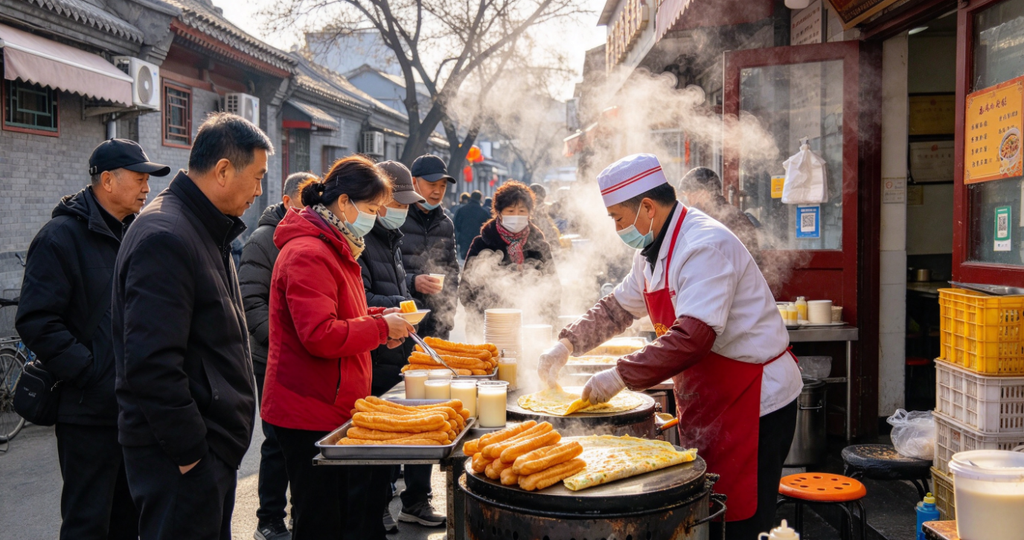
Breakfast is one of the most useful places to begin because it shows a side of Beijing that visitors can easily miss.
Instead of heading directly to a major attraction, consider starting the morning with a small local breakfast.
Common options include:
- Jianbing — a thin savory breakfast crepe prepared with egg, sauces, herbs, and crisp elements.
- Youtiao — fried dough sticks commonly eaten with soy milk or other breakfast foods.
- Douzhi — a fermented mung-bean drink strongly associated with traditional Beijing breakfast culture.
- Zhima shaobing — a sesame-coated baked flatbread with a crisp exterior.
- Baozi — steamed filled buns that are convenient and substantial.
You do not need to order everything.
For two people, sharing two or three different items is often a better strategy than ordering a complete breakfast for each person.
Best approach for first-time visitors
If you are unfamiliar with Beijing breakfast, start with something approachable such as jianbing, youtiao, baozi, or sesame flatbread.
If you are interested in more traditional flavors, douzhi provides a very different experience.
The goal is not to prove how adventurous you are.
It is to understand how breakfast functions in the city.
3. Why Beijing Breakfast Is Worth Including
A formal restaurant can tell you about Beijing’s culinary heritage.
A neighborhood breakfast shop can tell you something different: how food fits into everyday life.
Morning food is usually practical.
People eat quickly before work, school, errands, or sightseeing. Small shops and food stalls often prioritize convenience rather than elaborate presentation.
That makes breakfast particularly useful for travelers who want to see Beijing beyond its major monuments.
If your first sightseeing area is in the historic center, choose breakfast somewhere reasonably close to your route rather than crossing the city for a single famous breakfast shop.
The setting matters almost as much as the dish.
4. Late Morning: Choose a Small Snack Instead of Another Meal
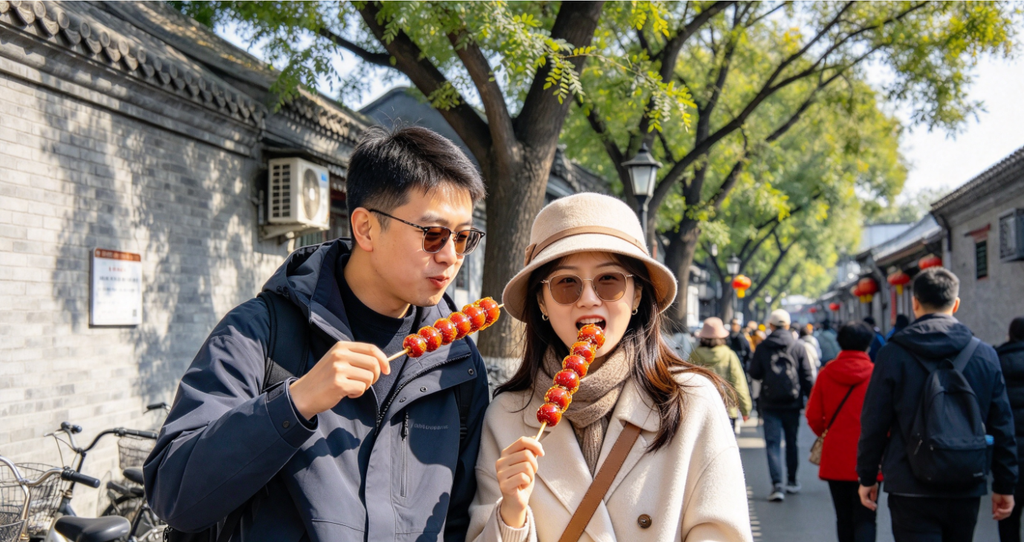
After breakfast, resist the temptation to immediately try another full dish.
A one-day food itinerary works better when the late morning or early afternoon is reserved for small-format tasting.
Possible choices include:
Tanghulu
Tanghulu consists of fruit coated in a hardened sugar shell, usually served on a skewer.
Its appeal comes from the contrast between crisp caramelized sugar and fruit.
Because it is small and portable, it works well while walking through a historic neighborhood.
Bao Du
Bao du uses thinly sliced tripe that is quickly cooked and served with a flavorful dipping sauce.
It represents a more traditional side of Beijing snack culture and may appeal particularly to adventurous eaters.
Luzhu Huoshao
This hearty combination of braised ingredients and wheat-based bread is associated with traditional Beijing food culture.
Its strong flavors and substantial character make it better suited to travelers who want to explore beyond familiar dishes.
Wandou Huang
Wandou huang is a soft pea-based traditional sweet.
It provides useful contrast after savory breakfast and lunch foods and can be shared in a small portion.
The principle is simple:
Use snacks to explore more of Beijing without using up the appetite needed for dinner.
5. What Should You Eat for Lunch in Beijing?
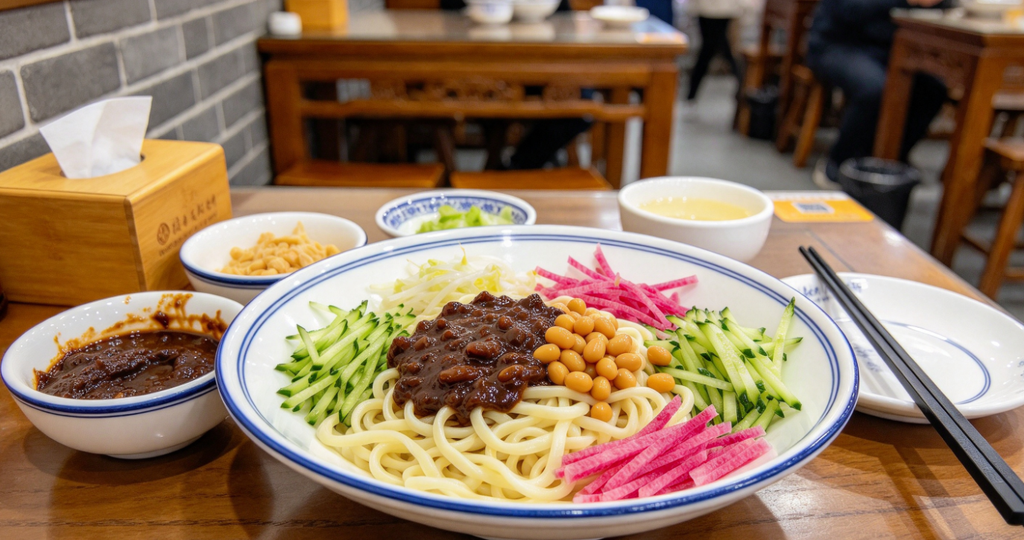
Lunch should provide the day’s main everyday or northern-style meal.
Good choices include:
- Zhajiangmian
- Jiaozi
- Other noodle dishes
- Stuffed flatbreads
- Northern-style wheat-based dishes
Among these, zhajiangmian is particularly useful for a one-day itinerary.
Beijing-style zhajiangmian combines wheat noodles with a savory fermented soybean-based sauce and vegetable accompaniments.
The dish is relatively straightforward, but it demonstrates several characteristics of northern Chinese eating:
- wheat-based noodles;
- concentrated savory flavor;
- fresh vegetable accompaniments;
- contrasting textures;
- and a meal structure very different from a formal roast-duck dinner.
This makes it a strong lunch choice when your goal is variety.
6. Why Zhajiangmian and Roast Duck Work Well Together
The value of zhajiangmian becomes clearer when it is compared with roast duck.
They represent different dining experiences.
Zhajiangmian:
- everyday-oriented;
- relatively simple;
- noodle-based;
- practical;
- suitable for lunch.
Roast duck:
- associated with specialist restaurants;
- presentation-focused;
- designed for sharing;
- more ceremonial;
- better suited to a longer dinner.
This contrast is important.
If every meal is a famous restaurant experience, you may learn less about ordinary Beijing eating.
Including one everyday staple and one signature dish creates a more complete picture.
This is also where exploring Beijing local dishes can be more useful than relying exclusively on tourist restaurant rankings.
7. Save Beijing Roast Duck for Dinner
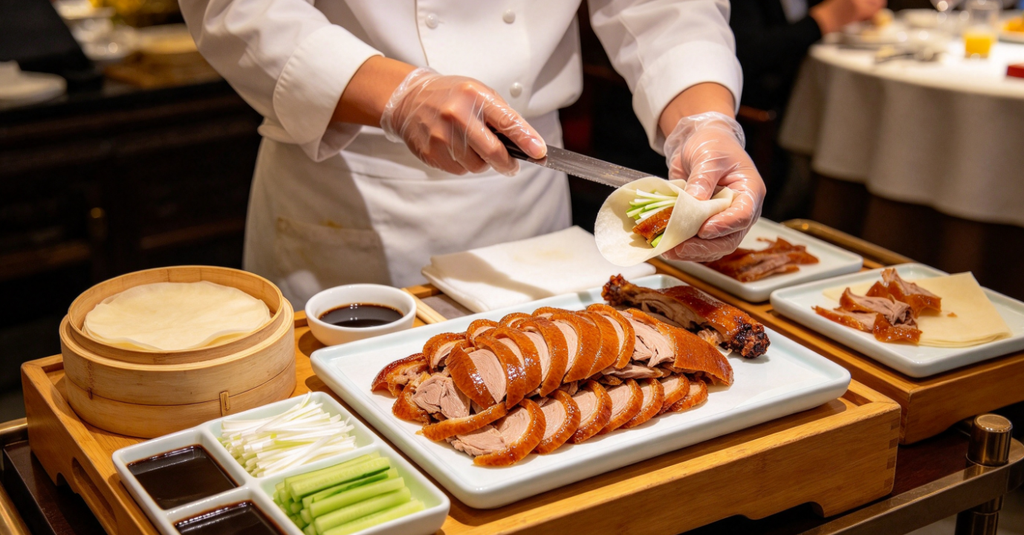
For many first-time visitors, roast duck is the natural centerpiece of the evening.
It is not simply another meat dish.
It is usually experienced as a complete dining format involving carving, pancakes, sauces, vegetables, and different ways of serving the duck.
That gives dinner a different pace from breakfast or lunch.
If you only have one day to explore Beijing food, dinner is therefore a logical place for the most substantial culinary experience.
What makes roast duck different?
A roast-duck meal can involve:
- Presentation of the cooked duck
- Carving at or near the table
- Thin pancakes
- Sauces and condiments
- Fresh vegetables such as cucumber and scallions
- Additional preparations or side dishes
The experience is partly about the food itself and partly about how the meal is served and shared.
8. How Much Should You Order for Roast Duck?
One common mistake is ordering too many dishes at dinner after eating throughout the day.
Roast duck already comes with several accompanying elements.
Depending on the restaurant, you may also see:
- additional duck preparations;
- vegetables;
- soup;
- noodles;
- appetizers;
- desserts.
For a one-day food itinerary, start with the roast duck and one or two complementary dishes.
Then add more only if necessary.
This is particularly important if you have already sampled breakfast, snacks, and lunch.
The objective is to finish the day satisfied—not too full to enjoy the final meal.
9. Should You Visit Famous Restaurants or Local Food Shops?
You do not have to choose one or the other.
The strongest one-day food itinerary usually combines one everyday food experience with one signature restaurant experience.
| Experience | Best for | Example |
|---|---|---|
| Neighborhood shop | Everyday food culture | Breakfast |
| Traditional snack shop | Local specialties | Bao du or tanghulu |
| Casual restaurant | Regional staples | Zhajiangmian |
| Specialist restaurant | Signature experience | Roast duck |
A famous restaurant can be worthwhile because of its history, cooking technique, reputation, or role in Beijing’s culinary identity.
A small neighborhood establishment can be equally valuable because it shows how food functions in ordinary life.
The question is therefore not simply:
“Which restaurant is the most famous?”
A better question is:
“Which food experience adds something that the other meals do not?”
10. Which Traditional Beijing Foods Are Easiest for First-Time Visitors?
Not every traditional food has the same accessibility for international travelers.
Some flavors and textures can be unfamiliar, particularly foods involving fermentation, organ meats, strong aromas, or dense traditional preparations.
That does not mean you should avoid them.
Instead, organize foods by adaptation level.
Easy to approach
- Jianbing
- Baozi
- Dumplings
- Noodles
- Roast duck
- Sesame flatbreads
More distinctive
- Traditional fermented flavors
- Strongly seasoned snacks
- Certain braised dishes
- Foods with unfamiliar textures
More adventurous
- Organ meats
- Strongly fermented foods
- Dishes with intense aromas
- Highly traditional specialty preparations
This gives travelers control.
You can try one unfamiliar food without making the entire day dependent on whether you like it.
11. How Should You Plan Food Stops Around Beijing Sightseeing?
Food should fit into your sightseeing geography.
Beijing is large enough that crossing the city repeatedly for individual dishes can consume valuable travel time.
Instead, choose food stops near places you already plan to visit.
A useful pattern is:
Breakfast near your accommodation → morning sightseeing → local snack → lunch near the next area → afternoon sightseeing → light dessert → dinner
This makes food part of the route rather than a separate transportation problem.
When you plan Beijing trip around geographic clusters, meals can also provide natural breaks between major attractions.
The goal is not to find the theoretically best restaurant in every category.
It is to find a good food experience that fits naturally into the day.
12. A Practical One-Day Beijing Food Itinerary
The following schedule provides variety while protecting your appetite.
| Time | Food | Role |
|---|---|---|
| 7:30–9:00 | Jianbing + soy milk, youtiao, or baozi | Everyday breakfast |
| 10:30–11:00 | Tanghulu or another small snack | Local tasting |
| 12:30–13:30 | Zhajiangmian or dumplings | Substantial lunch |
| 15:00–16:00 | Wandou huang or another small traditional sweet | Flavor contrast |
| 18:00–20:00 | Beijing roast duck | Signature dinner |
| After dinner | Tea or a neighborhood walk | Slow down |
The exact timing should remain flexible.
If your sightseeing schedule changes, move the food stops with it.
The sequence matters more than following the clock precisely.
13. How to Choose Between Beijing Foods When You Have Limited Appetite
If you cannot eat large portions, prioritize foods according to the experience they add.
Use this decision rule:
| If you want… | Prioritize… |
|---|---|
| Everyday Beijing life | Local breakfast |
| A northern staple | Zhajiangmian or another wheat-based dish |
| Traditional snack culture | Tanghulu, bao du, or another local snack |
| A traditional sweet | Wandou huang |
| A signature Beijing meal | Roast duck |
| Maximum variety | Small shared portions |
| More adventurous flavors | One traditional specialty |
This is more useful than trying to complete a fixed list.
A food itinerary should be adaptable to appetite, location, weather, and personal taste.
14. What Should You Skip If You Only Have One Day?
A limited food itinerary needs a cut list.
Consider skipping:
Foods that are too similar
Two noodle dishes may provide less variety than one noodle dish plus a snack.
Foods that are too filling
A large lunch can make your dinner experience significantly worse.
Foods requiring a major detour
A famous food is not necessarily worth an hour of additional transportation.
Foods with weak local relevance
If a dish is common throughout China and does not offer a particularly strong Beijing connection, it may be lower priority.
Foods you already know you dislike
Travel is an opportunity to explore, but there is no requirement to eat something you genuinely cannot enjoy.
The best itinerary maximizes experience per bite, not the number of dishes consumed.
15. How to Order More Efficiently at Traditional Restaurants
Menus can be challenging when you do not recognize the dish names.
Instead of translating every item, use a few practical clues.
Identify the main ingredient
First determine whether the dish is primarily noodles, meat, vegetables, seafood, or an organ-based preparation.
Look at the cooking method
Roasted, braised, boiled, steamed, and fried foods can have very different textures.
Check whether dishes are designed for sharing
Many traditional restaurant meals are better approached as shared dishes rather than individual portions.
Ask about strong flavors
If you are sensitive to fermentation, spice, or intense aromas, clarify the preparation before ordering.
Order gradually
Start with fewer dishes.
You can always add another.
This approach is particularly useful during a one-day food itinerary because appetite is a limited resource.
16. Why the Setting Is Part of the Food Experience
Beijing food does not exist in one single type of restaurant.
You might experience:
Morning: a small neighborhood breakfast shop
Lunch: a casual noodle restaurant
Afternoon: a snack while walking through a historic district
Dinner: a specialist roast-duck restaurant
These settings are different, and that difference adds meaning to the food.
A breakfast eaten quickly on the way to sightseeing tells you something different from a long roast-duck dinner.
For travelers interested in local culture, the surroundings can therefore be part of the culinary experience.
17. How Food Can Improve Your Beijing Itinerary
Food can act as a pacing system for sightseeing.
Instead of scheduling attractions continuously from morning to night, use meals and snacks as natural transition points.
For example:
Breakfast → historic sightseeing → snack → lunch → museum or neighborhood → dessert → dinner
This structure creates natural pauses.
It also helps prevent a common travel problem: spending too much energy early in the day and reaching the evening exhausted.
A well-designed food route therefore supports the sightseeing itinerary rather than competing with it.
18. How to Handle Different Food Preferences in a Group
Traveling with family or friends can make food planning more complicated.
One person may want familiar noodles.
Another may want to try traditional snacks.
Someone else may be specifically interested in roast duck.
The easiest solution is shared variety.
Instead of ordering a full portion for every person, choose several dishes that can be tasted collectively.
This approach works particularly well for:
- couples;
- families;
- small groups;
- travelers with different levels of culinary curiosity.
It also reduces the risk of committing an entire meal to a food that only one person enjoys.
19. What Are the Best Beijing Foods to Try in One Day?
If you want a simple priority list, use this five-part structure:
- One Beijing breakfast — such as jianbing, youtiao, baozi, or sesame flatbread.
- One substantial northern-style dish — such as zhajiangmian or dumplings.
- One traditional snack — choose a small portion.
- One traditional sweet — such as wandou huang.
- One signature dinner — for many first-time visitors, Beijing roast duck is the natural choice.
This gives you five different food roles without requiring five full meals.
If your appetite is limited, the snack and dessert can be shared.
20. A Simple Rule for Building Your Own One-Day Food Route
You can reduce the entire planning process to five questions:
1. What will I eat for breakfast?
Choose something connected to everyday Beijing life.
2. What will represent a northern-style staple?
Choose noodles, dumplings, or another wheat-based main.
3. What small food will I try while sightseeing?
Choose one traditional snack.
4. What will provide flavor contrast?
Choose a small traditional sweet or light snack.
5. What deserves the evening meal?
Choose roast duck or another substantial Beijing dining experience.
This framework allows you to adjust the actual dishes without losing the structure of the day.
21. Frequently Asked Questions
What food is Beijing most famous for?
Beijing is particularly associated with roast duck, but its food identity also includes traditional breakfasts, zhajiangmian, dumplings, wheat-based staples, and a wide range of local snacks and sweets.
What should I eat in Beijing if I only have one day?
Prioritize a traditional breakfast, one northern-style main dish, one or two small snacks, a traditional sweet, and a signature dinner such as roast duck.
Is Beijing roast duck worth trying?
For most first-time visitors interested in local food, yes. It provides not only a distinctive dish but also a complete dining experience involving preparation, carving, pancakes, sauces, and shared eating.
Should I try Beijing breakfast?
Yes. Breakfast provides a useful view of everyday food culture and is generally easier to fit around sightseeing than a long restaurant meal.
What is a good lunch in Beijing?
Zhajiangmian, dumplings, and other northern-style wheat-based dishes are practical choices because they provide a substantial meal without requiring the longer format of a formal dinner.
How many Beijing foods can you realistically try in one day?
Most travelers will have a better experience with four to six food experiences in small or moderate portions than with a long list of full meals.
Should I visit famous restaurants or small local shops?
Ideally, both. Use smaller establishments for everyday or snack experiences and reserve at least one meal for a restaurant that provides a distinctive Beijing dining experience.
Final Takeaway
The best Beijing foods to try in one day are not simply the ten dishes most often mentioned on tourist lists.
A stronger approach is to build a day around different culinary roles:
- Breakfast for everyday life
- A northern-style staple for a substantial meal
- Traditional snacks for exploration
- A local sweet for contrast
- Roast duck or another signature dinner for the evening centerpiece
The most important principle is to maximize variety without exhausting your appetite.
You do not need to eat everything Beijing is famous for.
You need enough carefully chosen food experiences to understand how the city eats across different times, settings, and social contexts.
When food is planned alongside sightseeing, geography, and energy levels, a one-day food itinerary becomes more than a list of dishes.
It becomes a way to experience Beijing itself—one meal, snack, and neighborhood at a time.