
Which Great Wall Section Near Beijing Should You Visit? A Practical Decision Guide
There is no single best Great Wall section near Beijing. The right choice depends on three practical questions: how you will get there, how much walking your group can manage, and what kind of Great Wall experience you want.
For most first-time visitors, Mutianyu is a balanced choice, with restored Ming-era walls, mountain scenery and cable-car access. Badaling is worth considering if you prefer established rail connections and extensive visitor facilities. Jinshanling is better suited to people who genuinely want a longer hike, while Simatai is particularly attractive when combined with an evening visit to Gubei Water Town.
Huanghuacheng offers a different experience centred on the Wall and its reservoir landscape. Juyongguan is a historic fortified pass with a more concentrated architectural setting.
Instead of ranking these destinations, this guide helps you eliminate unsuitable choices. It looks at the transport arrangements, physical demands, common planning mistakes and realistic travel situations that can make one section a better choice than another.
1. Answer Three Questions Before Choosing a Section
You do not need to compare every attraction in detail. Start by identifying your biggest limitation.
Question 1: How much transport complexity can you accept?
The distance from central Beijing is only part of the journey. You also need to consider the departure point, transfers, the final connection to the entrance and the return journey.
| Section | Typical transport approach | Main planning consideration |
|---|---|---|
| Badaling | High-speed rail or bus | Train availability, station access and return tickets |
| Mutianyu | Private transfer, organised transport or public transport with a transfer | The final connection from Huairou |
| Jinshanling | Tourist bus on operating dates or private transfer | Fixed departure and return arrangements |
| Simatai | Private transfer or organised excursion | Night-tour timing and Gubei Water Town arrangements |
| Huanghuacheng | Usually easier with private transport or an organised excursion | Longer road journey and local access |
| Juyongguan | Road transport or a combination of public transport and local connection | Confirm the final connection to the entrance |
If you want the simplest independent rail journey, start with Badaling. If you are comfortable arranging a transfer or hiring a vehicle, Mutianyu becomes a strong alternative.
Mutianyu is reachable by public transport, but the journey requires more coordination. The Beijing municipal government’s guidance describes taking Express Bus 916 from Dongzhimen to Huairou Beidajie, followed by a local bus connection. This is workable, but it is not a single direct ride from central Beijing. Check the latest local service arrangements before departure.
For Jinshanling, do not build your day around a tourist bus until you have confirmed that it operates on your travel date. A scheduled excursion is different from a frequent public bus: missing the departure can leave you with limited alternatives.
Simatai is best considered together with Gubei Water Town, particularly if you want to visit the Wall at night. Huanghuacheng is also easier to plan when you have a vehicle or a confirmed excursion.
Elimination rule: If you dislike transfers, have a fixed return deadline or are travelling with people who cannot wait comfortably, prioritise a route with a confirmed return connection. Do not choose a remote section simply because it appears quieter.
Question 2: How much climbing can everyone manage?
A cable car can reduce the effort required to reach the Wall. It does not make the Wall itself flat or step-free.
This is especially important for families with young children, older visitors and anyone with knee, balance or mobility limitations.
| Walking ability | Sections worth considering | What to check |
|---|---|---|
| Limited walking ability | Mutianyu or Badaling with a suitable cable-car route | Steps and slopes after reaching the Wall |
| Comfortable with short walks and breaks | Mutianyu, Badaling or selected areas of Huanghuacheng | Walking distance and return route |
| Comfortable with repeated climbs | Juyongguan or longer routes at Mutianyu and Badaling | Steep sections and cumulative fatigue |
| Regular hill walker | Jinshanling or Simatai | Uneven terrain, elevation changes and route length |
For a group travelling with older parents, the key question is not simply whether a cable car exists. It is what happens after the cable car reaches the Wall.
Check the following before choosing:
- Where does the cable car arrive?
- How far is the nearest suitable viewing area?
- Are there steep steps between the arrival point and the section you want to visit?
- Can you turn back without completing a long circuit?
- Is there a practical place to rest?
Mutianyu illustrates why these details matter. Its enclosed cable car reaches the Wall around Tower 14, while the chairlift and toboggan system operate around Tower 6. Combining a cable-car ascent with a toboggan descent therefore involves walking between different access areas.
At Badaling, the North and South sections also have different access arrangements. A cable-car ticket for one side does not mean you can move easily between both sides.
Elimination rule: If one person in your group struggles with repeated steep steps, choose the route around that person’s ability. Do not let the strongest walker set the day’s target.
Question 3: What do you actually want to see?
The six sections do not offer interchangeable experiences.
- Mutianyu: A balanced visit with restored Wall scenery, mountain views and visitor facilities.
- Badaling: A famous, well-developed section with established transport connections.
- Jinshanling: A longer hiking experience with varied watchtowers and mountain scenery.
- Simatai: A dramatic mountain setting associated with Gubei Water Town and night visits.
- Huanghuacheng: The distinctive landscape of the Wall meeting a reservoir.
- Juyongguan: A fortified pass that helps visitors understand the Wall’s defensive architecture.
This distinction matters. Someone who wants to walk along a recognisable restored stretch may not enjoy spending most of the day around a reservoir. A visitor interested in photography and a longer hike may find a heavily developed tourist area less satisfying.
Choose the experience first, then decide how much transport and physical effort you are willing to accept.
2. Six Great Wall Sections: Their Real Advantages and Limitations
Mutianyu: A balanced choice for a first Great Wall visit
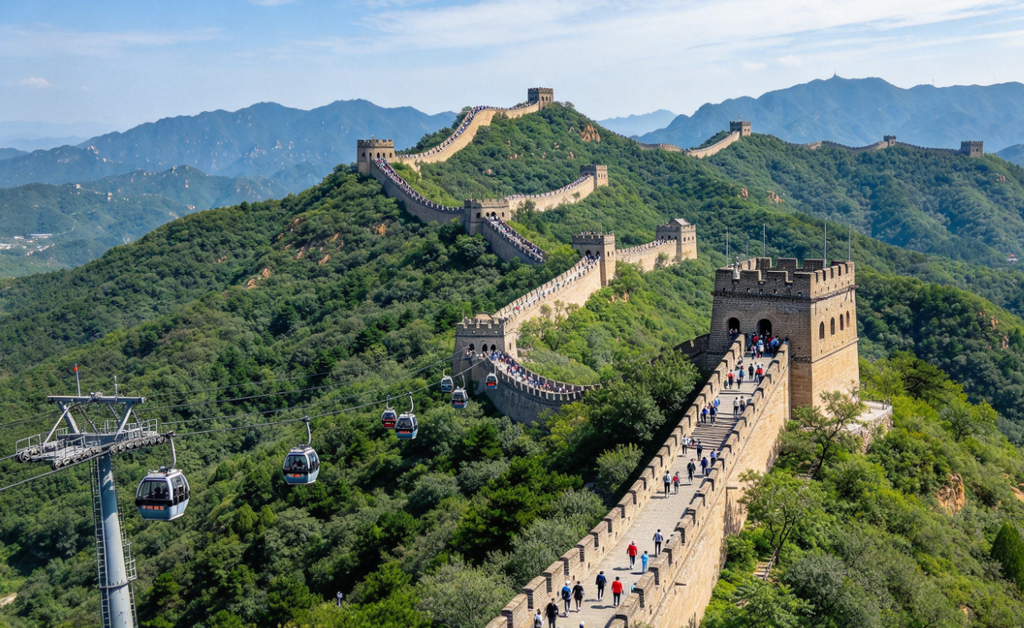
Mutianyu is a strong option for visitors who want restored Ming-era architecture, mountain scenery and a range of visitor facilities. It is particularly worth considering for first-time visitors and families who want some flexibility over how much of the Wall they walk.
The Beijing municipal government identifies Mutianyu as a restored Ming-era section and lists facilities including a cable car and an alpine slide. Its official visitor information also describes the area’s high vegetation coverage.
The biggest planning mistake is confusing the cable car, chairlift and toboggan routes.
The enclosed cable car reaches the Wall around Tower 14. The chairlift and toboggan operate around Tower 6. These are separate systems and access points.
If you want to go up by cable car and descend by toboggan, you need to walk along the Wall between the two areas. That route may involve more steps and time than expected.
For a relaxed visit, consider using the same cable-car system for the ascent and descent. You can then decide how far to walk after reaching the Wall, without making the return journey dependent on reaching a different access point.
The toboggan should be treated as an optional activity. Weather, maintenance and operating restrictions can affect whether it is available. Do not make it the only return plan.
Transport considerations
Public transport is possible through Express Bus 916 and a local transfer in Huairou. This can suit independent travellers who are comfortable navigating a multi-stage journey.
A private vehicle is often more convenient for families, particularly when several people are travelling together. It reduces the need to coordinate transfers, but road congestion can still affect the journey. Confirm the pickup time, waiting arrangements and return plan before setting off.
Who should reconsider Mutianyu?
- Visitors who want to avoid all steep walking.
- Travellers who do not want to arrange a transfer or private vehicle.
- Experienced hikers whose main priority is a long, less-developed route.
Decision: Choose Mutianyu if you want a balanced first visit and are comfortable arranging the transport connection.
Badaling: The practical option for independent rail travellers
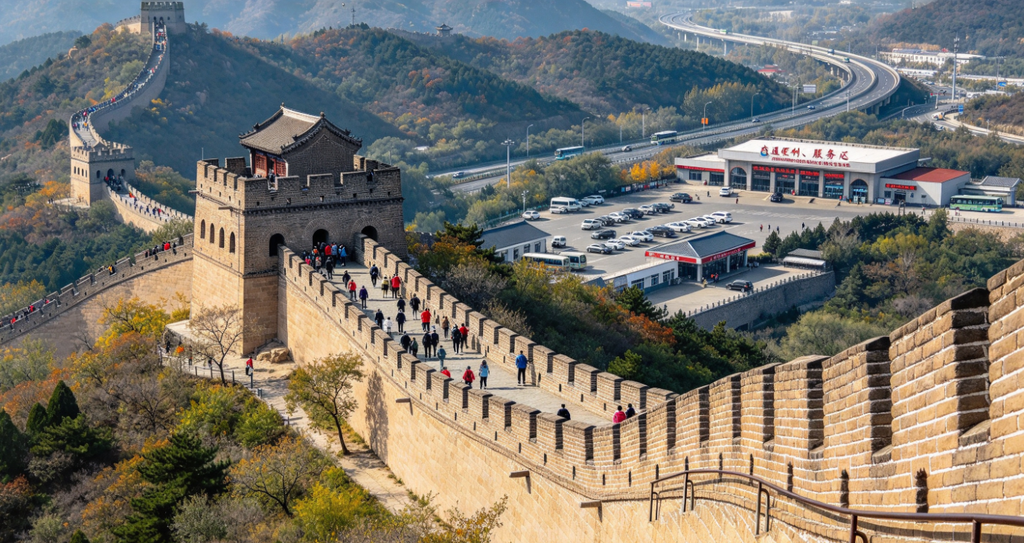
Badaling is one of the best-known Great Wall sections and has substantial visitor infrastructure. Its established rail and bus connections make it attractive to travellers who want to organise the visit independently.
Its main disadvantage is the possibility of heavy visitor traffic, especially during weekends, public holidays and popular travel periods.
The biggest planning mistake is assuming that arriving at the railway station means you have reached the Wall entrance.
You still need to leave the station, follow the correct pedestrian route, reach the attraction access area and complete the entrance process. If you plan to use a cable car, allow additional time for that part of the visit.
A practical rail-based itinerary should account for:
- Travelling from your hotel to Beijing North Railway Station or Qinghe Railway Station, depending on your train.
- Finding the correct platform and boarding your booked train.
- Walking from Badaling Great Wall Station towards the attraction entrance.
- Completing ticket checks and any required security procedures.
- Allowing time for cable-car queues if you intend to use one.
- Returning to the station with enough time for your booked train.
Do not choose a return train so close to your planned departure from the Wall that a queue or slower walking pace could make you miss it.
What about Bus 877?
Bus 877 from the Deshengmen area is another established way to reach Badaling. It can be useful if the bus departure point suits your hotel location, but the road journey is affected by traffic. Check the current departure and return arrangements rather than relying on an old timetable found in a travel article.
Who should reconsider Badaling?
- Visitors who strongly dislike crowds.
- Travellers seeking a quieter hiking experience.
- People who expect to avoid queues simply by arriving early.
Decision: Choose Badaling if independent transport and established facilities matter more to you than finding a quieter section.
Jinshanling: Choose it for hiking, not convenience
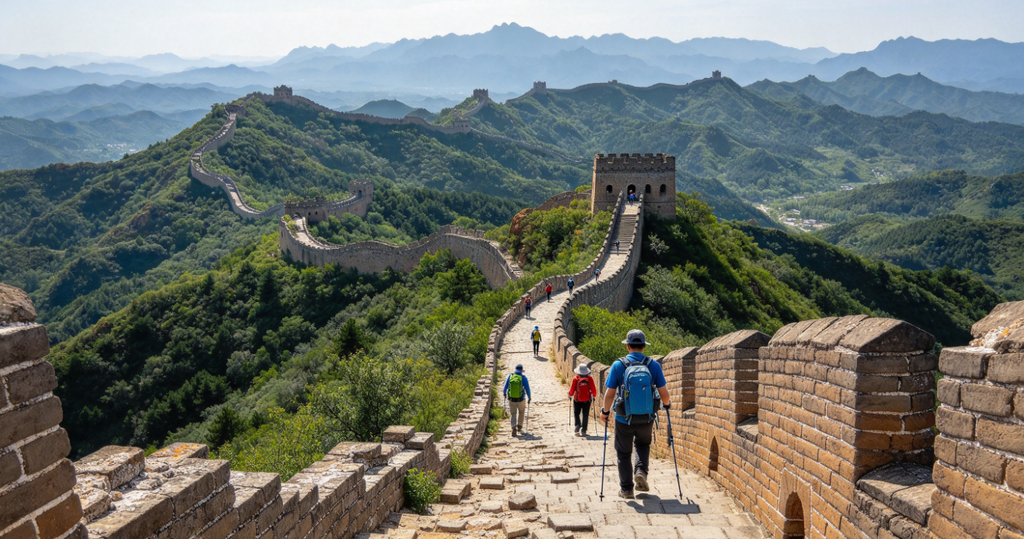
Jinshanling is particularly attractive to people who want to walk along the Wall rather than spend most of their visit around a heavily developed tourist area.
Its watchtowers, mountain scenery and varied sections make it a strong option for photography and longer hikes. However, the physical demands and transport arrangements are more important here than at Badaling or Mutianyu.
The biggest planning mistake is underestimating the walking effort.
Jinshanling involves repeated climbs and descents along uneven terrain. There is no comparable cable-car shortcut to reduce the initial effort. Even visitors who exercise regularly may find a long route tiring, especially in hot weather.
A better approach is to decide on a realistic walking target before entering.
- Occasional walkers should consider a shorter out-and-back route.
- Regular hikers can plan a longer walk but should allow time for breaks.
- Groups with different fitness levels should agree on a turnaround point.
- Visitors travelling in hot weather should carry sufficient drinking water and avoid pushing their pace.
Do not assume that completing the longest possible route is the best way to experience Jinshanling. A shorter walk with time to appreciate the watchtowers and landscape can be more enjoyable.
Transport is the second major limitation.
Direct tourist-bus services from Beijing have been available, but their operation and schedules need to be confirmed for the intended date. A service with a fixed departure and return time requires more discipline than a destination with frequent transport options.
Before booking, confirm:
- Whether the service operates on your travel date.
- The exact departure and boarding point.
- Whether the fare includes the return journey.
- The return meeting time and location.
- What happens if you miss the scheduled return.
Do not assume that travelling to a nearby railway station will solve the last part of the journey. You may still need a local transfer.
Who should avoid Jinshanling?
- Visitors with limited walking ability.
- Families with very young children who cannot manage extended steps.
- Travellers with only a few hours available.
- Anyone who is uncomfortable with a fixed return schedule.
Decision: Choose Jinshanling when hiking is the main purpose of the day, not when you simply want a convenient introduction to the Great Wall.
Simatai: Best considered as part of a Gubei Water Town visit
Simatai has a distinctive mountain setting and is closely associated with Gubei Water Town. For many visitors, the attraction is the combination of the town, the surrounding landscape and the opportunity to see the Wall in the evening.
The biggest planning mistake is treating the night visit as an ordinary same-day excursion from central Beijing.
Simatai’s night visit operates under specific access and ticketing arrangements. The official Gubei Water Town information distinguishes between daytime and night visits and explains that access to the Wall is restricted to designated areas.
This means you should plan the evening around the town and the available transport arrangements rather than assuming you can add a night visit at the end of a normal Beijing sightseeing day.
A more relaxed itinerary is:
- Travel to Gubei Water Town early enough to explore the town.
- Check the current Simatai night-tour ticket and cable-car arrangements.
- Visit the designated Wall area during the permitted evening period.
- Stay overnight in or near the town, or confirm a reliable return arrangement before travelling.
The night experience does not mean that every part of Simatai is accessible after dark. Routes and access areas are restricted for safety reasons.
Who should reconsider Simatai?
- Visitors who have only one day and must return to central Beijing at a fixed time.
- Travellers who want a long, uninterrupted hiking route.
- Families who do not want to manage an evening schedule.
Decision: Choose Simatai if Gubei Water Town and the evening atmosphere are important parts of your trip. If your only objective is a straightforward daytime Great Wall visit, compare Mutianyu and Badaling first.
Huanghuacheng: Choose it for the reservoir landscape

Huanghuacheng is different from the better-known restored visitor sections because the Great Wall meets the reservoir landscape. Parts of the Wall are submerged in the water, creating the distinctive scenery that makes this destination attractive to photographers.
The biggest planning mistake is expecting a conventional Great Wall hiking experience.
Huanghuacheng’s appeal is the combination of water, mountains, the Wall and viewpoints around the reservoir. Depending on the facilities operating on your visit date, boat rides and other recreational activities may also be available.
These activities are optional extras. They should not replace checking the actual walking route, terrain and facilities before departure.
If your main goal is to spend several hours walking along a continuous restored stretch of the Wall, Mutianyu or Badaling may be a better match.
For families, the lakeside environment can provide variety, but do not assume every path is suitable for a stroller or wheelchair. Confirm accessibility arrangements with the attraction if they are important to your group.
Who should reconsider Huanghuacheng?
- First-time visitors whose main priority is a classic restored Wall walk.
- Travellers who want the simplest public-transport journey.
- Visitors who are not particularly interested in reservoir scenery.
Decision: Choose Huanghuacheng if you want a different landscape and are happy for the water scenery to be as important as the Wall itself.
Juyongguan: A fortified pass, not an automatically easy walk
Juyongguan is a historic fortified pass rather than simply another stretch of mountain wall. Its defensive layout and architectural features make it interesting for visitors who want to understand the military role of the Great Wall.
It is a good option for travellers interested in the relationship between the mountain pass, the surrounding terrain and the defensive structures.
The biggest planning mistake is confusing a compact attraction with an easy walk.
Juyongguan still involves steps, slopes and changes in elevation. A shorter or more concentrated route does not necessarily mean a low-effort visit.
Before entering, check the available route and decide how much of the attraction you intend to cover. Do not commit to a full circuit simply because it looks manageable on a map.
Transport also deserves attention. A railway line serving the wider area does not automatically mean the station is beside the attraction entrance. Check the complete connection, including the final bus, taxi or walking section.
Who should reconsider Juyongguan?
- Visitors who want a long, continuous ridge hike.
- Travellers who expect a flat or step-free historic site.
- Anyone choosing it only because they assume it is easier than Badaling.
Decision: Choose Juyongguan when its fortified-pass history and architecture interest you. If your priority is a straightforward first Great Wall visit, compare it with Mutianyu and Badaling.
3. Which Section Fits Your Actual Travel Situation?
A generic ranking is less useful than matching the attraction to the circumstances of your trip.
| Your situation | First section to consider | Why it may fit | Main limitation |
|---|---|---|---|
| First visit to Beijing, one full day | Mutianyu | Balanced scenery, restored Wall and access facilities | Transport requires planning |
| First visit, prefers rail | Badaling | Established railway connections | Crowds and return-ticket timing |
| Travelling with older parents | Mutianyu or Badaling | Cable-car options can reduce the initial climb | Steps remain after reaching the Wall |
| Travelling with young children | Mutianyu | Flexible visit length and visitor facilities | Avoid overly ambitious routes |
| Solo traveller on a tight budget | Badaling | Practical public-transport options | Check the full return journey |
| Experienced hiker | Jinshanling | Longer walking routes and varied scenery | Physical effort and fixed transport options |
| Interested in night photography | Simatai | Evening experience combined with Gubei Water Town | More complicated return arrangements |
| Already visited a classic restored section | Huanghuacheng | Different reservoir landscape | Not primarily a long Wall hike |
| Interested in military architecture | Juyongguan | Historic fortified-pass setting | Walking route still involves elevation changes |
If you are staying near Dongzhimen
Badaling and Mutianyu are both worth comparing, but their journeys work differently.
For Mutianyu, Dongzhimen is relevant because Express Bus 916 departs from this area. However, the local transfer in Huairou remains part of the journey. If you are travelling with children or older relatives, compare the effort and time involved in this connection with the cost of a private transfer.
For Badaling, check whether the train departure point and schedule fit your hotel location. Do not assume that a nearby bus stop automatically makes the bus the faster option.
If you are staying near Xizhimen
Badaling is worth considering because Beijing North Railway Station is accessible from the Xizhimen area.
However, proximity to the station does not guarantee a convenient train. Check the actual departure time, ticket availability and return options before choosing the attraction.
If the available train schedule does not fit your day, compare the complete journey with Mutianyu rather than choosing Badaling based only on the station’s location.
If you are travelling with older parents
Prioritise a route that allows everyone to enjoy the Wall without feeling pressured to complete a long circuit.
Mutianyu and Badaling are usually the first sections to investigate because both offer cable-car options. Before booking, check the route after the cable-car arrival point and agree on a realistic walking distance.
Avoid plans that require your group to cross between different cable-car or toboggan access areas. A route that looks convenient for a younger traveller can be exhausting for someone with knee or balance problems.
If anyone in the group has significant mobility limitations, contact the attraction directly about current accessibility arrangements. Do not assume that a cable car makes the entire visit accessible.
If you have one day and must catch an evening flight
This is not the day to choose a remote section simply because it looks quieter.
Start by comparing Badaling and Mutianyu, then calculate the complete return journey:
- Hotel to departure point.
- Journey to the attraction.
- Entrance and access time.
- Time on the Wall.
- Return journey to central Beijing.
- Transfer to the airport.
Allow a substantial buffer for road congestion, queues and transport delays. If your flight is important and the schedule is tight, visiting the Great Wall on a different day is the safer option.
If you want to avoid crowds
A less famous section may offer a different atmosphere, but quieter scenery is not the only factor that matters.
Jinshanling and Simatai may appeal to visitors who want to move away from the busiest visitor areas. However, both require more transport planning. If the additional journey leaves you with less time on the Wall, the trade-off may not be worthwhile.
For a first visit, consider Mutianyu on a weekday and avoid major Chinese public holidays where possible. If you choose Badaling, plan your entry and transport carefully rather than assuming that arriving early guarantees an empty Wall.
4. How Much Time Should You Allow?
The time spent walking on the Wall is only one part of the day. Your schedule also needs to include transport, entrance procedures, access facilities and the return journey.
| Section | How to plan your day | Why |
|---|---|---|
| Badaling | Reserve most of a day | Rail or bus travel, station access, queues and walking |
| Mutianyu | Reserve most of a day | Road or bus transfer, access facilities and time on the Wall |
| Jinshanling | Plan a full-day hiking excursion | Longer travel and more demanding walking |
| Simatai | Consider an overnight stay | Night-tour timing and Gubei Water Town arrangements |
| Huanghuacheng | Plan a relaxed day trip | Travel, lakeside walking and optional activities |
| Juyongguan | Allow enough time for your chosen route | Steps and elevation changes can extend the visit |
These are planning categories, not guaranteed journey times. Your actual schedule depends on your hotel, transport, season, traffic, walking speed and the facilities operating on the day.
A useful rule is to plan the return journey before deciding how long to stay on the Wall.
If you have a fixed tourist-bus return, that departure is your deadline. If you have booked a train, work backwards from the train time. If you have a private vehicle, agree on the pickup point and time with the driver before starting your walk.
5. What Can Change Your Plan on the Day?
Even a carefully planned Great Wall visit can be affected by weather, transport and physical conditions. The more remote the section, the more important it is to have a backup plan.
Rain, snow and strong wind
Wet or icy steps can be more dangerous than they appear in photographs. A route that feels manageable in dry weather may become uncomfortable or unsafe after rain or snow.
Cable cars, chairlifts and toboggans may also be suspended because of weather or maintenance.
If conditions deteriorate:
- Ask attraction staff which facilities and routes remain open.
- Do not continue onto exposed or slippery sections just to complete your planned route.
- Use the safest available return route.
- Ask about alternative access or ticket arrangements if a ride is suspended.
Treat the Mutianyu toboggan as an optional activity, not as an essential part of your return plan.
A missed bus or train
A missed departure can have a much greater impact at a remote section than at a well-connected attraction.
Before leaving your hotel, save the following information:
- The departure location in your map application.
- The return departure time.
- The attraction’s main entrance and exit.
- The name of the railway station or bus stop in Chinese.
- A backup transport option.
If you are using a direct tourist bus, confirm whether the return service is tied to your original booking. Do not assume you can board another bus later.
If you miss a train, check the railway operator’s current change and refund rules rather than assuming your ticket can be used on any later service.
Payment or mobile-network problems
International visitors should not assume that every attraction, driver or small vendor can process an overseas bank card directly.
Prepare more than one payment method. Set up an appropriate mobile-payment option before the trip, carry some cash as a backup and keep booking confirmations accessible offline.
If a payment fails at an attraction, ask the official ticket office whether it accepts another payment method or whether tickets can be purchased through an official counter. Avoid relying on a stranger’s phone or an unofficial ticket seller.
Someone in your group becomes too tired
Agree on a turnaround point before starting the walk. If one person becomes tired, the group should not feel obliged to complete the original route.
At sections with more complicated terrain, returning along the same route may be safer than continuing towards a distant exit.
For families, a shorter visit that everyone enjoys is usually better than a longer route that leaves one person exhausted.
6. Common Mistakes When Choosing a Great Wall Section
Choosing the quietest section without checking transport.
A quieter attraction can require a longer journey and a more restrictive return schedule. Compare the whole day, not just the time spent on the Wall.
Assuming a cable car makes the Wall accessible to everyone.
Cable cars reduce the initial climb, but many sections still involve steep steps and uneven surfaces. Check the walking route after the ride.
Combining too many activities in one visit.
At Mutianyu, combining a cable-car ascent, a long walk and a toboggan descent can create an unnecessarily demanding route. At Simatai, adding a night visit without planning the rest of the evening can create transport problems.
Booking transport before checking attraction arrangements.
A bus or train schedule may not align with the opening hours, access facilities or return arrangements at the attraction. Check both sides of the journey before paying.
Treating all Great Wall sections as interchangeable.
Badaling and Mutianyu are popular restored visitor sections. Jinshanling is more hiking-oriented. Simatai is closely associated with Gubei Water Town and its night experience. Huanghuacheng is distinctive for its reservoir scenery. Juyongguan is a fortified pass.
Choose according to the experience you want, not simply the name that appears most often in travel articles.
7. Final Decision: Which Great Wall Section Should You Visit?
Use this elimination sequence if you are still undecided:
- Need an established rail-based option? Start with Badaling.
- Want a balanced first visit with cable-car access? Start with Mutianyu.
- Want a proper hike and can manage a longer day? Choose Jinshanling.
- Want an evening experience and can stay overnight? Choose Simatai with Gubei Water Town.
- Want the Wall-and-water landscape? Choose Huanghuacheng.
- Want to explore a historic fortified pass? Choose Juyongguan.
For most first-time visitors, Mutianyu and Badaling are the two sections worth comparing first. Mutianyu offers a balanced scenic visit, while Badaling is attractive if its rail connections fit your hotel location and schedule.
If you are travelling with older relatives or children, prioritise a manageable route and a reliable return journey over the number of watchtowers you can reach.
If you are still deciding between public transport, a private vehicle and an organised excursion, read our Beijing transport guide before finalising your route. If you prefer to have the journey arranged, compare the available Great Wall tours from Beijing.
The best section is the one that matches your group’s physical ability, transport arrangements and available time. You do not need to visit the most remote or most famous section to have a worthwhile Great Wall experience.
Frequently Asked Questions
Which Great Wall section is best for first-time visitors?
Mutianyu is a strong all-round choice because it combines restored Ming-era architecture, mountain scenery and visitor facilities such as cable cars. Badaling is another practical option, particularly for travellers who prefer established rail connections and a well-developed attraction.
Is Badaling or Mutianyu easier to reach from Beijing?
Badaling has established rail and bus connections, making it attractive for independent travellers. Mutianyu can be reached by public transport using Express Bus 916 and a local transfer in Huairou, or by private vehicle. The easier option depends on your hotel location, train availability and willingness to transfer.
Which Great Wall section is best for older people?
Mutianyu and Badaling are usually the first sections to consider because both offer cable-car access. However, neither should be described as completely step-free. Check the route after the cable-car arrival point and choose a walking distance that everyone in the group can manage.
Which Great Wall section is best for hiking?
Jinshanling is a strong choice for visitors who want a longer hike and varied mountain scenery. It is more physically demanding than a short visit to Badaling or Mutianyu, so plan your route and return transport carefully.
Can I visit Simatai Great Wall at night and return to Beijing on the same day?
Do not assume that a same-day return will be convenient. It depends on the current night-tour schedule and your confirmed transport arrangements. The night visit is closely connected with Gubei Water Town, so an overnight stay is generally the more relaxed option.
Is Huanghuacheng worth visiting if I have never seen the Great Wall?
Yes, if you are particularly interested in the landscape where the Wall meets the reservoir. However, if your main goal is to walk along a classic restored section, Mutianyu or Badaling may be a more suitable first visit.
Is Juyongguan easier than Badaling?
Not necessarily. Juyongguan is a concentrated fortified-pass attraction, but its routes still involve steps and changes in elevation. A smaller or more compact attraction is not automatically easier for visitors with limited mobility.
Can I visit two Great Wall sections in one day?
It is generally better to visit one section properly rather than trying to combine two distant destinations. Different sections can involve substantial travel time, leaving little time for walking and sightseeing. Combining two sections is only worth considering when the route, access arrangements and available time have been carefully checked.
Do I need to book Great Wall tickets in advance?
Booking requirements differ by section and can change. Check the official attraction information for your intended date, especially for services with limited capacity or special night-tour arrangements. Do not assume that the ticketing rules for Badaling also apply to Simatai or other sections.