
Can You Use Foreign Credit Cards in Beijing? A Practical Payment Setup Guide
Yes, you can use foreign credit cards in Beijing, but relying on a physical Visa or Mastercard alone is not a reliable payment strategy. International cards work at many major hotels, shopping areas, tourist facilities, and transport services, but acceptance still varies between merchants and payment terminals.
For a smoother trip, prepare three payment layers before departure:
- A physical international bank card: Use it at participating hotels, department stores, major merchants, ATMs, and eligible public transport gates.
- A mobile payment app linked to your foreign card: Use Alipay or WeChat Pay for QR-code payments at participating restaurants, shops, and smaller businesses.
- RMB cash: Keep it as a backup when card terminals, mobile apps, internet connections, or bank verification fail.
The most important preparation is to test your mobile payment setup before leaving home. Some overseas banks reject card-linking requests, and international SMS verification can be difficult when you are already traveling. If a transaction is declined because your bank has blocked it, repeatedly trying the same card can make the situation worse.
This guide explains how foreign card acceptance works in Beijing, how to prepare your payment methods, and exactly when to switch to another payment option.
1. Why Foreign Credit Cards Do Not Work Everywhere in Beijing
Foreign card acceptance in Beijing has improved significantly, but it is not universal.
The reason is partly structural: China’s everyday retail payment environment has developed around QR-code mobile payments, while international card acceptance requires compatible acquiring services, payment terminals, merchant registration, and settlement arrangements.
A merchant may accept Alipay and WeChat Pay every day but have limited experience processing overseas-issued Visa, Mastercard, or American Express cards.
Beijing’s Foreign Card Acceptance Has Improved
The local payment environment is more developed than it was several years ago.
According to Beijing government information:
- In 2024, the valid-merchant coverage rate for Visa, Mastercard, and other overseas cards among the first batch of designated key merchants exceeded 80%.
- By the end of July 2025, approximately 18,000 key merchants across Beijing had implemented foreign-card acceptance.
- Beijing has continued developing payment service demonstration areas and improving foreign-card acceptance at tourist destinations, shopping districts, hotels, and transport hubs.
These figures are encouraging, but their scope matters. They refer to designated key merchants or specific merchant categories, not every restaurant, street stall, neighborhood shop, and independent business in Beijing.
Official sources:
- Beijing government: Payment convenience for foreign visitors
- Beijing government: Foreign-card acceptance improvements in 2025
Why Small Businesses May Still Prefer QR-Code Payments
A physical international card transaction involves more than simply having a Visa or Mastercard logo on a terminal.
The merchant needs a suitable acquiring arrangement, compatible payment equipment, and the ability to process the relevant international transaction.
Merchant costs have also been a factor. In July 2024, Chinese government reporting stated that the fees associated with overseas bank-card transactions had previously been around 2.5%–3%, compared with approximately 0.6% for domestic bank-card transactions. The overseas-card rate was subsequently reduced to around 1.5%.
These are historical industry figures reported during the 2024 fee adjustment, not a universal current rate for every merchant or card transaction.
The important point is that payment costs and acquiring arrangements can influence whether a small business actively supports foreign cards. A merchant may find QR-code payments easier to manage than maintaining international card acceptance.
This helps explain why a foreign visitor may encounter the following situation:
- A large hotel accepts a physical Visa card.
- A major department store accepts Mastercard.
- A neighborhood restaurant accepts QR payments but cannot process a foreign physical card.
- A street-food vendor prefers a mobile payment app or cash.
This is not necessarily a problem with your card. It may simply be a difference in the merchant’s payment infrastructure.
2. Build a Three-Layer Payment System Before Traveling

The safest approach is to prepare three payment methods in a specific order rather than depending on one card or app.
| Payment Layer | Main Purpose | When to Use It | Backup |
|---|---|---|---|
| Physical foreign bank card | Card-terminal payments and eligible transport gates | Hotels, major stores, selected restaurants, transport | Another international card |
| Alipay or WeChat Pay linked to a foreign card | QR-code payments | Restaurants, shops, daily purchases | The other app or physical card |
| RMB cash | Emergency and small-value payments | Small merchants, technical failures, offline situations | ATM withdrawal or currency exchange |
Layer 1: Prepare Two Physical Bank Cards if Possible
Bring at least one Visa or Mastercard and, if available, a second card from a different payment network.
For example:
- Primary card: Visa.
- Backup card: Mastercard or another supported international network.
Using two cards from different networks can help if a merchant terminal does not support one network or your issuing bank blocks a transaction.
Before departure, check the following with your bank:
- Are overseas purchases enabled?
- Are online and card-not-present transactions enabled?
- Is contactless payment available?
- Does the bank require travel notifications?
- What are the foreign transaction and cash-withdrawal fees?
- Can the bank send verification codes to your registered mobile number while you are abroad?
- Does the card have daily transaction or contactless limits?
Also make sure you know your card PIN. A contactless payment may work at one terminal, while another transaction may require chip-and-PIN verification.
Layer 2: Set Up Alipay Before Leaving Home
For many international visitors, Alipay is one of the most useful ways to pay for everyday purchases in Beijing.
You can generally link eligible overseas-issued cards, including supported Visa, Mastercard, American Express, JCB, and other networks, subject to platform and issuer requirements.
A typical setup process is:
- Download Alipay from your phone’s official app store.
- Register your account.
- Complete any identity verification requested by the platform.
- Open the bank-card section.
- Add your international credit or debit card.
- Complete the verification process.
- Test the payment setup where possible before departure.
Once the card is linked successfully, you can use the app to scan a merchant’s collection QR code or show your own payment code.
However, successful card linking does not guarantee that every payment will be approved. Transaction limits, merchant acceptance, card eligibility, and bank security controls can still affect individual purchases.
Layer 3: Prepare RMB Cash
Cash is not the main payment method for many urban purchases, but it remains an important backup.
It is especially useful when:
- A merchant cannot process your foreign card.
- Your payment app cannot connect to the internet.
- Your phone battery runs out.
- Your bank blocks a transaction.
- You need to pay at a small business that does not accept your preferred digital payment method.
Keep some smaller RMB notes rather than relying entirely on large banknotes.
3. Why You Should Link Your Foreign Card Before Arriving in Beijing

Setting up Alipay or WeChat Pay at home is not just a convenience. It reduces the number of problems you may need to solve while traveling.
Foreign card linking requires authorization from the issuing bank. Chinese government guidance specifically warns that some overseas banks may reject the request because their systems cannot recognize the connection information or because of their risk-control procedures.
Official guidance: A Guide to Working and Living in China as Business Expatriates.
There are several practical reasons why setup can become more difficult after arrival.
Reason 1: Your Issuing Bank May Block the Card-Linking Request
Adding a foreign card to a Chinese payment platform is not always treated like an ordinary in-store purchase.
The platform and the issuing bank need to complete the relevant verification and authorization steps. Some banks may identify the request as an unfamiliar online or cross-border transaction.
For example, a bank may:
- Block the card-linking authorization.
- Require an additional security confirmation.
- Decline an online verification transaction.
- Restrict transactions initiated through a payment service it does not recognize.
The correct response is to check the bank’s notification or contact its card-security department. Do not assume that repeatedly submitting the same card details will resolve the issue.
Reason 2: SMS Verification May Be Difficult While Traveling
Some card issuers use SMS codes or other verification methods to confirm card ownership.
If you rely on your home mobile number, international roaming can introduce practical problems:
- SMS delivery may be delayed.
- Your phone may not connect to the correct roaming network.
- Your SIM may not support the required roaming service.
- Your bank may send the code to an old or inactive number.
- Your phone may not receive messages when the SIM is disabled.
This is why you should test your bank’s verification process before departure.
Keep your home SIM active if you need it for bank verification, and check with your mobile operator that international SMS reception is available.
If your bank offers app-based approval or another authentication method, make sure it is working before your trip.
Reason 3: A Small Verification or Authorization Transaction May Fail
Some card-verification processes involve an authorization request or a small temporary transaction.
If your bank blocks that request, the card-linking process may stop even though the card itself works for ordinary purchases.
Do not assume that a declined verification request means the card is permanently unusable in China.
Instead:
- Check whether your bank has blocked an online or cross-border authorization.
- Confirm that the card is enabled for international online transactions.
- Complete any security approval requested by the issuer.
- Contact the payment platform if the bank confirms that it has not blocked the request.
- Try a different eligible card if the original card cannot be authorized.
The exact verification process varies by platform and card issuer. There is no universal verification amount or guaranteed approval procedure.
A Practical Pre-Departure Checklist
| Preparation | Why It Matters |
|---|---|
| Install Alipay and WeChat | Avoid first-time setup at a busy checkout |
| Add your primary foreign card | Confirm that the issuer authorizes the connection |
| Keep your registered SIM active | Receive bank verification messages |
| Enable international transactions | Reduce avoidable bank declines |
| Check your card PIN | Some terminals require chip-and-PIN |
| Prepare a second card | Avoid depending on one issuer |
| Save your bank’s international contact number | Get help if the bank blocks a transaction |
| Carry some RMB cash | Maintain a payment option when digital methods fail |
4. Why the Same Visa Card May Work Through Alipay but Fail at a POS Terminal
This is one of the most confusing situations for foreign visitors.
You may present a Visa card at a restaurant, receive a decline message, and then successfully pay at the same restaurant by scanning its QR code through Alipay using the same Visa card.
This can happen because the two transactions do not necessarily follow the same payment route.
Physical Card Payment and Mobile Wallet Payment Are Different Transactions
When you insert or tap a physical Visa card, the payment is processed through the merchant’s card terminal and acquiring arrangement.
When you use Alipay with a linked foreign card, the transaction is initiated through the mobile payment platform and its supported payment-processing arrangements.
The merchant may be able to accept Alipay QR payments but may not have a compatible physical international-card terminal.
The issuing bank may also apply different security checks to the two transaction types. Merchant category information, transaction routing, online-payment controls, and fraud-risk assessment can all affect the result.
Therefore, a physical-card decline does not automatically mean that the same card cannot be used through a mobile wallet.
Example: A Restaurant Payment
Imagine that you are eating at a small restaurant in Beijing.
You first try to pay by tapping your physical Visa card. The terminal cannot process it because the merchant does not support that card transaction.
You then open Alipay, scan the restaurant’s collection QR code, and select your linked Visa card.
The payment may succeed because the restaurant supports Alipay and the wallet can process the transaction through its own arrangements.
This does not mean Alipay can bypass every bank restriction. If the issuing bank has blocked the card or the wallet transaction itself is declined, the payment may still fail.
How to Interpret Different Results
| What Happens | Likely Explanation | What to Do |
|---|---|---|
| POS terminal says card not supported | Merchant terminal or acquiring limitation | Use Alipay, WeChat Pay, or cash |
| POS terminal displays a bank decline | Issuing bank may have rejected the transaction | Check your banking app before trying again |
| Physical card fails but Alipay succeeds | Different merchant acceptance and processing routes | Continue with the successful wallet method |
| Both physical card and mobile wallet fail | Possible issuer restriction, card issue, or account verification problem | Switch to another card and investigate the original decline |
| Payment app cannot add the card | Issuer authorization or platform verification failed | Contact the bank or payment platform |
The key lesson is that a physical-card failure and a mobile-wallet failure are not necessarily the same problem.
5. What to Do When a Foreign Card Is Declined: Switch Methods, Do Not Keep Retrying

Not all payment failures have the same cause.
The most important distinction is between a merchant-side acceptance problem and a bank-side security decline.
Type 1: Merchant or Terminal Does Not Accept Your Card
This is a payment acceptance problem.
Typical signs include:
- The cashier says the terminal does not support your card network.
- The terminal displays a message indicating that the card type is not accepted.
- The merchant can accept QR-code payments but not international physical cards.
In this situation, the card may be perfectly valid.
What to do:
- Stop trying the same physical card at that terminal.
- Ask whether Alipay or WeChat Pay is accepted.
- Use your linked card through the supported wallet.
- If mobile payment is unavailable, use RMB cash.
There is no reason to contact your bank immediately if the merchant simply does not accept the card network.
Type 2: The Issuing Bank Declines the Transaction
This is different. Your bank may have identified the transaction as unusual or blocked it under its fraud-prevention controls.
Possible signs include:
- Your banking app displays a declined transaction.
- You receive a fraud alert or security notification.
- The bank confirms that it blocked the transaction.
- Several different merchants reject the same card in a short period.
What to do:
- Stop retrying the same card.
- Open your banking app and check the transaction status.
- Look for a security alert or request for authorization.
- Contact your bank through its official app or international telephone number.
- Use a different card while the issue is being resolved.
If your bank has blocked the card, repeating the same transaction may create more failed attempts or trigger additional security controls.
The safer rule is: when the issuer has declined or flagged the transaction, switch to another card instead of repeatedly retrying the original one.
Payment Failure Decision Table
| Situation | Recommended Response |
|---|---|
| Merchant does not accept your card network | Switch to Alipay, WeChat Pay, or cash |
| Terminal cannot read the card | Try another supported payment method |
| Bank app shows a fraud alert | Stop using that card and contact the bank |
| Card is blocked for overseas transactions | Ask the bank to authorize or enable overseas payments |
| Alipay cannot process the linked card | Check issuer authorization and wallet verification |
| Internet connection is unavailable | Use a physical card or RMB cash |
| Phone battery is empty | Use your physical card or cash |
| You are unsure whether the transaction went through | Check the bank and wallet transaction records before paying again |
If the payment status is unclear, do not immediately repeat the purchase. Check whether the first transaction was completed, reversed, or left as a pending authorization.
6. Can You Tap a Foreign Credit Card Directly on the Beijing Subway?
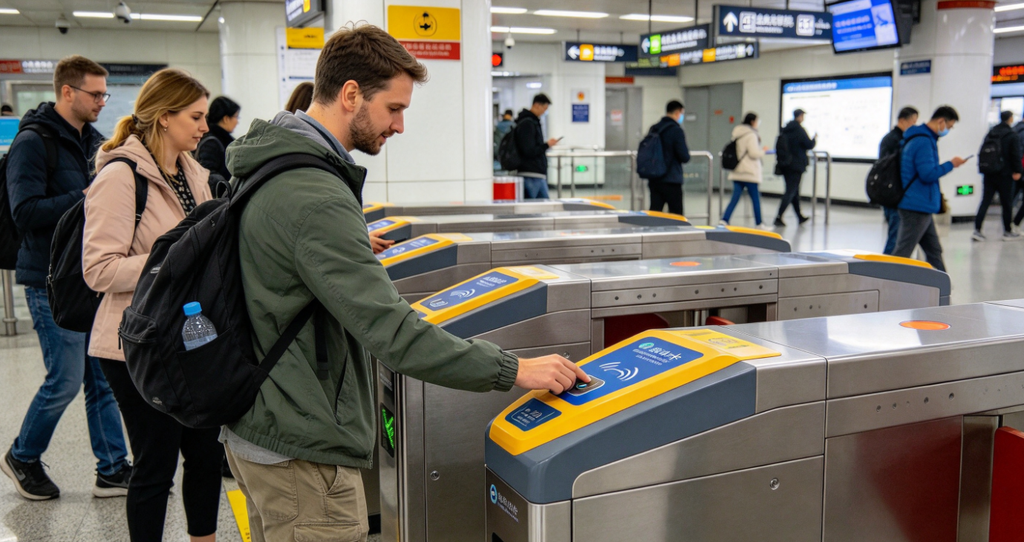
Yes. Beijing supports direct contactless payment with eligible overseas-issued bank cards on its urban rail network.
The service has expanded beyond the original Visa and Mastercard rollout.
According to Beijing government information published in June 2025, the city’s rail network supports contactless payment services for the five major card organizations:
- UnionPay
- Mastercard
- Visa
- JCB
- American Express
The June 2025 expansion covered 29 operating lines and 523 stations, as well as suburban railway Line S2.
Official source: Beijing Subway Supports Tap-and-Go with Five Major Overseas Card Networks.
This makes the subway one of the more convenient places to use an eligible physical international card.
How to Use a Foreign Card at the Fare Gate
- Check that your card belongs to a supported network.
- Make sure contactless payment is enabled on the card.
- Look for the relevant payment logo at the fare gate.
- Tap the card on the designated reader.
- Use the same card when exiting.
You do not need to buy a separate ticket or install a payment app if your card is eligible for direct gate payment.
Why Might a Contactless Card Still Fail at the Gate?
A card can support ordinary contactless retail payments but still encounter a problem during a transit transaction.
Possible reasons include:
- The card issuer declines the transaction.
- The card’s contactless function is disabled.
- The bank applies a security restriction to the transaction.
- The card has reached a transaction or spending limit.
- The card reader cannot process the particular card or mobile-wallet configuration.
- The card has been blocked after an earlier security alert.
Not every decline is caused by the subway system, and not every contactless card is automatically eligible.
There is no single Beijing-wide rule stating that every foreign card needs a special daily transit allowance. Check your own bank’s contactless and overseas transaction settings instead of assuming that a particular transit setting is required.
What to Do If Your Card Is Rejected at the Subway Gate
Do not repeatedly tap the same card if the gate continues to reject it.
Use this sequence:
- Check that you are tapping the correct contactless area.
- Confirm that the card is eligible for the service and that contactless is enabled.
- If the gate still rejects it, use a ticket machine or staffed ticket counter.
- Buy a single-journey ticket using a supported payment method.
- If the bank has declined the card, use a different card rather than repeating the same transaction.
Beijing’s official subway guidance states that ticket machines support multiple payment methods, including credit cards, Alipay, WeChat Pay, and cash, although the accepted card networks can vary by machine and station.
See the official Beijing Subway guide.
For a broader explanation of subway, airport, and local transport payment options, consult our Beijing transport guide.
7. How Much RMB Cash Should You Carry in Beijing?
The right amount depends on whether cash is only your backup or your main payment method.
For a typical visitor who has a working international card and mobile payment app, carrying approximately RMB 200–300 per person as an initial cash reserve is a reasonable planning estimate.
This can provide a useful buffer for small purchases, simple meals, and unexpected payment problems.
If you expect to rely mainly on cash because you cannot link an international card to a payment app, a more realistic starting budget may be RMB 500–800 per person per day.
These are practical budgeting estimates, not official spending requirements. Actual costs depend on your restaurant choices, transport use, shopping habits, and travel style.
Suggested Cash Planning
| Travel Situation | Suggested Cash Budget | Purpose |
|---|---|---|
| Mobile payment and foreign card both available | RMB 200–300 initially | Backup for small purchases |
| Mostly using cash | RMB 500–800 per day | Meals, transport, and daily purchases |
| Family traveling together | Adjust according to group size | Shared emergency reserve and small purchases |
| Remote excursions or limited payment access | Carry additional cash appropriate to the trip | Backup when fewer payment alternatives are available |
You do not need to carry your entire trip budget in cash.
Instead, keep a modest reserve and withdraw additional RMB if necessary.
Where Can You Get RMB?
Foreign visitors can obtain RMB through:
- ATMs displaying compatible international card-network logos.
- Bank branches offering foreign currency exchange.
- Authorized currency exchange counters.
- Airport exchange facilities and designated self-service machines.
Before withdrawing, check whether your bank charges a cash-advance fee, foreign withdrawal fee, or additional currency-conversion charge.
Use a debit card for cash withdrawals if that is more cost-effective under your bank’s terms.
8. What Fees Should Foreign Visitors Expect?
There are two different types of fees to understand: merchant-side card acceptance costs and consumer-side payment fees.
They should not be confused.
Merchant Card Acceptance Fees
Merchants pay fees to their acquiring institutions for processing card payments.
In July 2024, official reporting stated that the cost of accepting overseas bank cards had been reduced from approximately 2.5%–3% to around 1.5%.
The actual rate can vary according to the merchant’s acquiring agreement, card type, transaction arrangement, and other commercial factors.
This cost helps explain why international card acceptance has required additional investment and policy support in China.
It does not mean that every merchant charges foreign visitors an extra 1.5% when they use a card.
Mobile Payment Fees for Linked Foreign Cards
Alipay and WeChat Pay may apply service fees to certain transactions made with linked overseas bank cards.
Some government guidance has described a fee exemption for transactions of RMB 200 or less and a 3% service fee for transactions above that amount.
However, payment platform terms, eligible cards, transaction limits, and fee rules can change.
Before confirming a payment, check the actual fee displayed in the app. Do not assume that every transaction has the same charge.
Foreign Bank Fees
Your card issuer may also charge:
- Foreign transaction fees.
- Currency-conversion fees.
- Cash withdrawal fees.
- Cash-advance interest.
These are separate from any fee charged by Alipay, WeChat Pay, or the merchant’s payment service.
For a more accurate cost estimate, check your own bank’s international transaction policy before departure.
9. Which Payment Method Is Best for Different Travelers?
There is no single payment method that works best in every situation.
The right combination depends on your travel style and how comfortable you are with mobile apps.
| Traveler Type | Recommended Setup | Why |
|---|---|---|
| First-time visitor | Visa or Mastercard + Alipay + RMB cash | Covers most everyday payment situations |
| Business traveler | Two international cards + mobile wallet | Provides a backup for hotels, dining, and business expenses |
| Family with children | Two adults each carrying a payment method + cash | Avoids relying on one phone or one card |
| Older traveler | Physical card + cash, with mobile payment as an additional option | Reduces dependence on app setup |
| Short-stay tourist | Eligible contactless card + Alipay | Convenient for transport and everyday purchases |
| Visitor unable to link a foreign card | Physical cards + RMB cash + eligible alternative wallet | Avoids depending on an unsuccessful setup |
If you are traveling with family, do not keep every payment method on one person’s phone. A separate backup card and some cash can prevent unnecessary disruption if the main phone is lost, damaged, or out of battery.
10. Common Foreign Card Payment Mistakes to Avoid
Mistake 1: Assuming Every Merchant Accepts Visa or Mastercard
Major hotels and shopping centers may accept foreign cards, but small independent businesses may not.
Better approach: Use physical cards where international acceptance is confirmed, and keep a QR-payment alternative ready.
Mistake 2: Waiting Until Arrival to Link Your Card
You may need bank authorization, account verification, or an SMS security code.
Better approach: Install the app, link your card, and test the verification process before leaving home.
Mistake 3: Repeatedly Retrying a Card Blocked by the Bank
If your bank has flagged a transaction, repeated attempts can create more security problems.
Better approach: Check your banking app, contact the issuer, and switch to another card.
Mistake 4: Confusing Merchant Acceptance with Card Validity
A restaurant may reject your physical Visa card but accept Alipay linked to that same card.
Better approach: Understand that the physical POS route and mobile-wallet route are different payment arrangements.
Mistake 5: Assuming Every Contactless Card Works on Every Transit Gate
Beijing supports several overseas card networks, but individual cards must still meet the relevant eligibility and contactless requirements.
Better approach: Confirm your card’s network and contactless settings, and keep a backup ticket-payment method ready.
Mistake 6: Carrying No Cash
Mobile payment and card acceptance can both fail.
Better approach: Keep an initial RMB 200–300 reserve if you mainly use digital payments, and increase it if you expect to rely on cash.
Frequently Asked Questions
Can I use a US credit card in Beijing?
Yes. Eligible US-issued Visa, Mastercard, American Express, and other supported international cards can be used at participating merchants and services. Some can also be linked to Alipay or WeChat Pay.
Acceptance depends on the card network, merchant terminal, payment platform, and issuing bank.
Is Visa widely accepted in Beijing?
Visa acceptance has improved at designated hotels, shopping areas, major merchants, tourist sites, and transport services. However, it is not universal.
Smaller independent restaurants and street vendors may prefer QR-code payments or cash.
Can I use Mastercard on the Beijing subway?
Yes. Overseas-issued Mastercard cards are supported for Beijing’s contactless rail-payment service. The city’s broader service also covers other major card networks, including Visa, JCB, American Express, and UnionPay.
Check your card’s contactless function and the current official transport instructions.
Can I use the same Visa card for Alipay and physical card payments?
Yes, if the card is eligible and successfully linked to Alipay.
However, the two payment methods use different processing arrangements. A merchant may reject the physical card but accept the QR-code payment through Alipay.
Why is Alipay rejecting my foreign credit card?
Possible reasons include issuer authorization failure, an online transaction restriction, a verification mismatch, or the payment platform’s eligibility requirements.
Check your bank’s security notifications first. If the issuer has blocked the request, contact the bank before trying repeatedly.
Should I use Alipay or WeChat Pay in Beijing?
Both can be useful for international visitors. Alipay is a practical starting point for everyday QR-code payments, while WeChat Pay provides an additional option where supported.
You do not necessarily need both, but having a second payment method can be useful if one account encounters a problem.
Can I travel around Beijing using only a foreign credit card?
It is possible to use an eligible card for many major payments and public transport journeys, but relying exclusively on a physical card is not recommended.
Some merchants do not accept international physical cards, and an issuing bank can decline transactions unexpectedly.
Prepare a mobile payment option and a small amount of cash.
How much cash should I bring to Beijing?
If your international card and mobile payment app are working, RMB 200–300 per person is a reasonable initial backup reserve.
If you mainly rely on cash, plan around RMB 500–800 per person per day as a starting estimate, adjusting for your travel style.
Final Recommendation: Prepare the Payment System Before You Fly
Foreign credit cards are increasingly useful in Beijing, but the most reliable strategy is not to depend on one payment method.
Prepare your payment system in three layers:
- Physical card: Bring at least one international card and preferably a backup from another network.
- Mobile wallet: Link an eligible card to Alipay or WeChat Pay and complete verification before departure.
- RMB cash: Keep a small reserve for merchants, technical problems, and unexpected declines.
Most importantly, understand the difference between a merchant acceptance problem and a bank security decline.
If a merchant cannot accept your physical card, switch to a supported QR-payment method. If your bank has blocked the transaction, stop retrying the same card and use another payment method while contacting the issuer.
Preparing these options before arrival will make paying for hotels, restaurants, shopping, and public transport in Beijing much more straightforward.