
Where Can Foreign Tourists Exchange Money in Beijing? Do You Really Need RMB Cash?
Foreign tourists visiting Beijing do not necessarily need to exchange a large amount of money before arriving. If you have successfully linked an international bank card to Alipay or WeChat Pay, and your Visa or Mastercard works at major hotels, shopping centres and tourist attractions, you may only need RMB 200–300 in cash for emergencies during a three- or four-day visit.
However, if you have not set up mobile payments, your overseas cards are frequently declined, or you plan to visit smaller restaurants, traditional markets and independent shops, carrying more cash is a sensible backup.
The best approach is not simply to find the nearest currency exchange counter. It is to decide whether you need cash, how much you should carry, and which way of obtaining RMB offers the best overall value.
This guide explains how to make that decision, compares exchange options in Beijing, and shows you how to avoid expensive ATM conversion mistakes.
1. Do You Actually Need to Exchange Money Before Visiting Beijing?
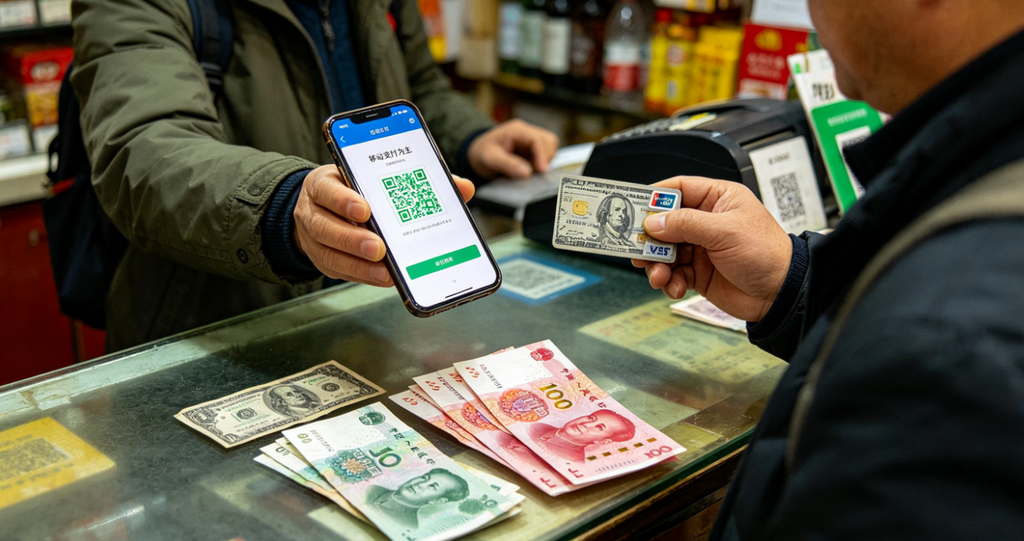
Before exchanging foreign currency, consider how you intend to pay during your trip.
China has a highly developed mobile payment system. Alipay and WeChat Pay are widely used for everyday purchases, including restaurants, taxis, shopping and many tourist services. Eligible international bank cards can be linked to these apps, allowing foreign visitors to pay without opening a Chinese bank account.
International bank cards can also be used directly at participating merchants, particularly major hotels, shopping centres and larger tourist businesses.
However, payment acceptance is not identical everywhere. A small independent restaurant, street-side shop or local market stall may be much more comfortable with QR-code payments than an overseas Visa or Mastercard.
When you may not need much cash
You can probably keep your cash reserve relatively small if all the following conditions apply:
- You have successfully registered and verified Alipay or WeChat Pay.
- Your overseas Visa or Mastercard is linked and working.
- You have tested at least one mobile payment transaction before travelling.
- Your hotel and major attraction tickets are already booked or paid for.
- You are staying for only three or four days.
- You have a backup bank card in case your primary payment method fails.
Under these circumstances, exchanging RMB 200–300 as emergency cash may be sufficient.
You may even decide not to exchange money in advance. You can use your mobile payment app for most purchases and withdraw or exchange a small amount later if necessary.
When you should carry more cash
A larger cash reserve is advisable if:
- You cannot successfully link an overseas bank card to Alipay or WeChat Pay.
- Your bank blocks overseas transactions or requires verification that may be difficult while travelling.
- You have only one international bank card.
- You plan to visit traditional markets, smaller restaurants or independent shops.
- You are travelling outside central Beijing or visiting places where payment alternatives may be less convenient.
- You prefer not to rely entirely on your smartphone.
Beijing merchants are required to accept RMB cash, but cash is less commonly used for everyday transactions than mobile payments. Some businesses may not have enough change for large banknotes, so smaller denominations are useful.
The practical conclusion: Do not exchange hundreds or thousands of dollars simply because you are visiting China. First establish whether your digital payment methods work, then exchange only the amount your payment arrangements require.
For more details on setting up overseas cards and mobile payments, see our guide to Alipay for foreigners.
2. How Much RMB Cash Should You Carry in Beijing?
Your cash requirement depends more on your payment arrangements than on the number of days you stay.
The following figures are practical planning estimates, not official spending requirements. They assume accommodation and major attraction tickets are paid separately.
| Travel situation | Suggested cash reserve |
|---|---|
| Mobile payments working, 3–4 days | RMB 200–300 |
| Mobile payments working, 5–7 days | RMB 300–500 |
| No reliable mobile payment, short visit | RMB 500–800 per person per day |
| Longer trip with limited card acceptance | Plan a larger reserve based on daily expenses |
Scenario A: You have working mobile payments
If Alipay or WeChat Pay works reliably and your international card is accepted at major businesses, cash is mainly a backup.
For a three- or four-day trip, RMB 200–300 can cover small purchases, unexpected transport costs or situations where electronic payments are unavailable.
You do not need to carry all your travel money in cash.
Scenario B: You cannot rely on mobile payments
If your mobile wallet is not working and your overseas card is frequently declined, you should prepare a much larger cash reserve.
A planning allowance of RMB 500–800 per person per day provides more flexibility for meals, local transport, small purchases and unexpected expenses. This is a contingency budget rather than a prediction that every visitor will spend that amount in cash.
If you expect to pay for hotels, long-distance transport or attraction tickets in cash as well, calculate those expenses separately.
Why you should carry some small banknotes
Try to keep a mixture of RMB 100, 50, 20, 10 and smaller notes.
Large banknotes are convenient for exchanging money, but they are not always practical for small purchases. A shop or taxi driver may have difficulty providing change for RMB 100.
You can ask a bank or exchange counter whether it can provide smaller denominations when you obtain your cash.
3. Which Currency Exchange Method Offers the Best Value?
Foreign visitors have several ways to obtain RMB in Beijing:
- Withdraw RMB from an ATM using a compatible UnionPay card.
- Withdraw RMB using an international Visa or Mastercard.
- Exchange foreign cash at a bank.
- Use a licensed foreign currency exchange agency.
- Exchange a small amount at the airport for immediate expenses.
There is no universal exchange-rate winner. Your actual cost depends on the card issuer, exchange provider, currency, transaction fee and exchange rate offered.
However, the following comparison provides a useful starting point.
| Method | Convenience | Cost considerations | Best for |
|---|---|---|---|
| UnionPay ATM withdrawal | High | Check issuer and ATM fees | Visitors with a compatible UnionPay debit card |
| International card ATM withdrawal | High | Foreign withdrawal fees and possible DCC | Visitors without UnionPay |
| Bank exchange | Medium | Compare the final amount received; availability varies | Larger cash exchanges |
| Licensed exchange agency | High in tourist areas | Compare its quoted rate and fees | Visitors who prefer exchanging physical cash |
| Airport exchange counter | Very high | Compare the actual rate and total fees | Small emergency amounts on arrival |
Why the airport is not always the cheapest option
Airport exchange counters are convenient because they are available when you arrive, but convenience does not guarantee the best exchange rate.
The difference between two exchange offers can become meaningful when you exchange a large amount.
For example, if one provider’s total exchange cost is 2 percentage points higher than another’s, exchanging USD 1,000 would cost approximately USD 20 more. At a 3-percentage-point difference, the additional cost would be approximately USD 30.
These are illustrative calculations, not verified average airport markups in Beijing. Actual differences vary by provider, currency and date.
Before exchanging money, ask:
- How many RMB will I receive for USD 100 or USD 1,000?
- Is there a separate service charge?
- Is the displayed exchange rate the final rate?
- Will I receive the full amount shown after all fees?
Compare the final RMB amount rather than relying on phrases such as “zero commission” or “no service fee”.
A sensible strategy is to exchange a small amount at the airport if you need immediate cash, then compare bank and licensed exchange rates in the city before exchanging a larger amount.
4. Can You Use a UnionPay Card to Withdraw RMB in Beijing?
Yes. UnionPay is particularly useful for visitors who have a UnionPay card issued outside mainland China.
UnionPay’s official guidance states that cash withdrawals using UnionPay cards are supported at ATMs throughout mainland China. This makes a compatible UnionPay debit card a convenient option for obtaining RMB without carrying a large amount of foreign cash.
If you already have a UnionPay card, check this option before exchanging physical currency.
Why UnionPay may be a better ATM option
UnionPay has an extensive domestic acceptance network in China. Its ATM coverage can make it easier to find a compatible machine than relying on an international card network alone.
For overseas visitors, this can be especially useful when:
- Your card has the UnionPay logo.
- Your issuing bank has enabled transactions in mainland China.
- Your card supports ATM cash withdrawals.
- You know your PIN and have checked your withdrawal limits.
However, acceptance does not mean every transaction is guaranteed to succeed. Your issuing bank may block overseas cash withdrawals, impose daily limits or charge its own fees.
Some dual-network cards also have routing restrictions. If your card carries both UnionPay and another payment-network logo, ask your bank which network will be used for ATM withdrawals in China.
Are UnionPay ATM withdrawals free?
Not necessarily.
The total cost may include:
- A cash withdrawal fee charged by your issuing bank.
- A foreign transaction or currency conversion fee.
- A surcharge displayed by the ATM operator, if applicable.
Some banks offer free or low-cost withdrawals, but this depends on the specific card and issuing bank. Do not assume that every UnionPay card is fee-free.
Before travelling, ask your bank:
- Can my card withdraw RMB from ATMs in mainland China?
- What is the withdrawal fee?
- Is there a foreign currency conversion fee?
- What is my daily withdrawal limit?
- Does my card require a separate overseas ATM activation?
For a short Beijing visit, a compatible UnionPay debit card may be one of the most convenient ways to obtain cash, particularly if its fees are lower than those of your other cards.
5. ATM Warning: Avoid Dynamic Currency Conversion (DCC)
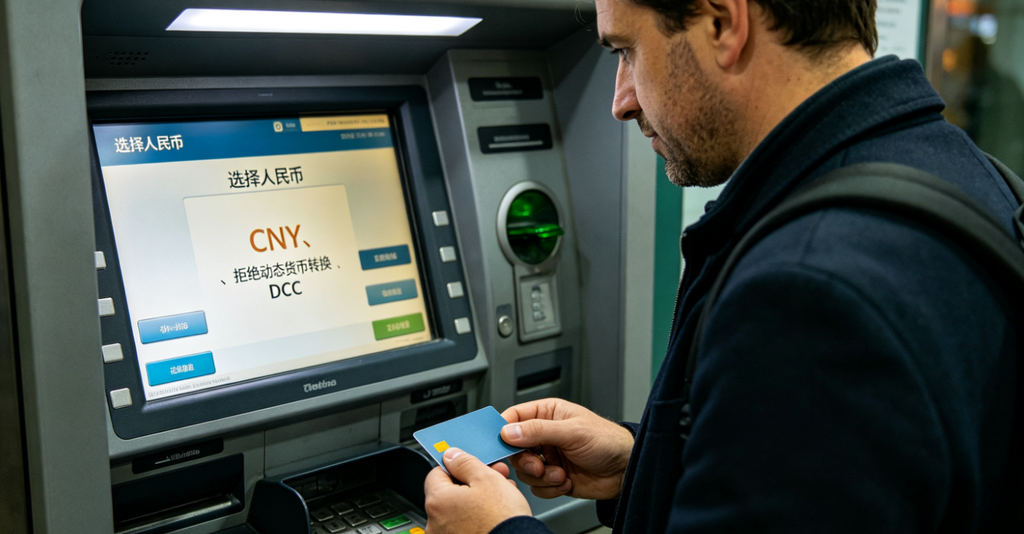
One of the most important things to understand when withdrawing RMB with an overseas bank card is Dynamic Currency Conversion (DCC).
DCC allows an ATM to convert your transaction into your home currency before submitting it to your card issuer.
For example, imagine you withdraw RMB 1,000 using a US-issued Visa card.
The ATM may display two options:
- Continue the transaction in RMB.
- Convert the withdrawal into US dollars using the ATM’s exchange rate.
The second option is DCC.
It may look convenient because you can see the amount in your home currency immediately. However, the ATM or its conversion provider may use an exchange rate that includes an additional markup or fee.
Which option should you choose?
<escape>When the ATM asks whether you want to be charged in your home currency or the local currency, choose RMB (CNY) and decline the ATM’s currency conversion.</escape>
Look for wording such as:
- “Continue without conversion”
- “Decline conversion”
- “Charge in local currency”
- “Proceed in CNY”
Avoid selecting:
- “Accept conversion”
- “Charge in USD”
- “Continue in your home currency”
The exact wording varies between ATM operators.
Why choosing RMB is usually better
When you choose RMB, the transaction is normally converted by your card network or issuing bank according to the applicable card terms.
When you accept DCC, the ATM’s conversion provider performs the conversion instead. Its exchange rate and any additional markup may be less favourable.
Choosing RMB does not guarantee a fee-free transaction. Your bank may still charge a foreign withdrawal fee or apply its own exchange-rate margin. However, declining DCC prevents you from automatically accepting an additional conversion offered by the ATM.
Visa explains that ATM and merchant DCC offers should display the exchange rate and additional charges and give cardholders a choice. You can read its official DCC guidance.
A simple ATM checklist
Before confirming an ATM withdrawal:
- Check the amount you want to withdraw in RMB.
- Check whether the ATM displays a separate operator surcharge.
- If offered a choice of currencies, select RMB or CNY.
- Decline conversion into your home currency.
- Review the final transaction amount before confirming.
- Keep the receipt and check your bank notification.
If the ATM does not clearly explain the exchange rate or currency choice, cancel the transaction and try another machine.
6. Where Can You Exchange Foreign Currency in Beijing?

If you decide to exchange physical cash, Beijing has several established options.
Option 1: Banks
Banks are a practical choice for visitors who want to exchange a larger amount of foreign currency.
Major Chinese commercial banks, including Bank of China, ICBC, China Construction Bank and Agricultural Bank of China, provide foreign currency services at designated branches.
However, not every branch handles every currency or keeps enough foreign cash available.
Call the specific branch before visiting.
Beijing’s official guidance recommends making a telephone appointment with the relevant branch to ensure that it has sufficient foreign currency in cash.
This is particularly important if you want to exchange:
- A large amount of US dollars or euros.
- Japanese yen or other less commonly requested currencies.
- A currency that may not be stocked at smaller branches.
- Foreign cash shortly before a weekend or public holiday.
For a large exchange or a less common currency, contact the branch at least one working day in advance where possible. Ask whether it can provide the required service, whether an appointment is necessary, and what identification documents you need.
Bring your original passport.
Option 2: Licensed foreign currency exchange agencies
Licensed exchange agencies are another option, especially in locations frequented by international visitors.
They may offer more convenient opening hours or a wider range of exchange services than some bank branches.
However, convenience does not automatically mean a better rate.
Before completing a transaction, compare the final amount of RMB you will receive with the amount offered by a bank or another licensed provider.
Always use an authorised exchange counter. Avoid exchanging money with strangers on the street, informal intermediaries or unverified online contacts.
Option 3: Airport exchange counters
Beijing Capital International Airport (PEK) and Beijing Daxing International Airport (PKX) both provide currency exchange services.
If you arrive without RMB, an airport exchange counter can help you obtain enough cash for your first journey, a meal or other immediate expenses.
You can also ask the airport’s Beijing Service counter for directions to available exchange facilities.
The best use of an airport exchange counter is usually convenience rather than assuming it offers the most competitive rate.
Exchange only what you need immediately unless you have compared its full exchange cost with other available options.
Option 4: Self-service currency exchange machines
Some locations in Beijing have self-service foreign currency exchange machines.
These can be convenient when you do not want to wait at a bank counter, but available currencies, operating arrangements and transaction limits vary.
Check the displayed exchange rate and fees before inserting your banknotes or confirming the transaction.
7. Where Are the Main Currency Exchange Locations in Beijing?
You do not have to visit a particular exchange counter if another authorised provider is closer to your hotel.
Nevertheless, the following locations are useful starting points.
Beijing Capital International Airport (PEK)
Capital Airport has foreign currency exchange services and other payment facilities for international arrivals.
If you need a small amount of RMB immediately after landing, this is one of the most convenient places to obtain it.
Beijing Daxing International Airport (PKX)
Daxing Airport also provides currency exchange services for international visitors.
If you are arriving at PKX, you do not need to travel into central Beijing before obtaining your first RMB.
Wangfujing Subway Station
Wangfujing is one of the most convenient central locations for visitors staying near the Forbidden City, Tiananmen Square and the city’s main shopping district.
An official Beijing payment-services announcement identified a currency exchange counter at Wangfujing Station on Line 8, near the passenger service centre on the north side of the station concourse, close to Exit E.
The published service information listed opening hours of 10:00–20:00 and support for more than 40 currencies. Operating arrangements can change, so confirm the current service before making a special journey.
Dongzhimen
Dongzhimen is another useful area to check when looking for authorised foreign currency exchange services.
It is a major transport interchange connecting subway lines and the Airport Express, making it convenient for visitors travelling between the airport and central Beijing.
However, do not assume that every bank or exchange business in the area offers the same currencies or services.
How to find a nearby exchange counter
The Beijing municipal government provides an English-language map with information layers for designated foreign exchange bank outlets, currency exchange kiosks and licensed exchange agencies.
You can use it to locate services near your hotel or travel destination:
Before visiting, confirm the provider’s current operating hours, available currencies and exchange requirements.
8. How to Exchange Money at a Bank in Beijing
If you have never exchanged foreign currency in China, the process is generally straightforward.
However, preparing the correct documents and checking availability beforehand can save time.
What should you bring?
Prepare:
- Your original passport.
- Foreign banknotes in good condition.
- Your intended exchange amount.
- Your preferred currency and approximate RMB requirement.
Some providers may have additional identification or transaction requirements.
What happens at the counter?
A typical bank exchange transaction follows these steps:
- Visit a bank branch that provides foreign currency exchange services.
- Present your passport and explain which currency you want to exchange.
- Ask for the current exchange rate and any service charges.
- Confirm the final amount of RMB you will receive.
- Complete the required identification and transaction procedures.
- Count your RMB before leaving the counter.
A useful question to ask is:
“How much RMB will I receive after all fees?”
This is more helpful than asking only for the displayed exchange rate.
What if the bank does not have enough cash?
The branch may not have enough RMB available for your requested transaction or may not support your currency.
This is why advance contact is important for larger exchanges.
If a branch cannot provide the service, ask whether another nearby branch can handle it rather than travelling between multiple banks without checking first.
9. Should You Exchange Cash or Withdraw RMB from an ATM?
For many international visitors, withdrawing RMB from an ATM can be more convenient than exchanging physical foreign banknotes.
However, the best choice depends on your bank card.
Choose ATM withdrawal if:
- Your card supports overseas cash withdrawals.
- The ATM displays your card’s payment-network logo.
- Your bank offers competitive withdrawal fees.
- You can decline DCC and withdraw in RMB.
- You do not want to carry large amounts of foreign cash.
Choose physical currency exchange if:
- You have foreign cash that you want to convert.
- Your bank card does not support ATM withdrawals in China.
- Your bank charges high overseas withdrawal fees.
- You want to avoid relying on a card.
- You need a specific amount of small RMB notes.
Compare the total cost, not just the exchange rate
For ATM withdrawals, consider:
- The exchange rate used by your card network or issuer.
- Your issuing bank’s withdrawal fee.
- Any foreign transaction fee.
- Any ATM operator surcharge.
- Whether the ATM offers DCC.
For physical exchange, consider:
- The provider’s exchange rate.
- Any commission or service charge.
- The final amount of RMB received.
- The time and transport cost required to reach the provider.
The cheapest option on paper may not be the most practical if it requires a long journey or several hours of waiting.
10. What Should You Do with Remaining RMB Before Leaving Beijing?
If you exchange too much money, you may have RMB left when your trip ends.
Do not wait until the airport departure queue to think about it.
You may be able to exchange eligible remaining RMB banknotes back into a foreign currency through an authorised exchange provider or at the airport, subject to its currencies, documentation and transaction rules.
However, exchanging money twice may create additional costs.
A better strategy is to obtain cash in smaller amounts as you travel rather than converting your entire budget at once.
Keep your exchange receipts where possible, especially if you expect to exchange a larger amount back before departure.
China’s official visitor guidance also states that each visitor may carry up to RMB 20,000 in cash when entering or leaving the country. This is a cash-carrying limit, not a recommendation to bring that amount.
11. How to Avoid Cash and Payment Problems in Beijing
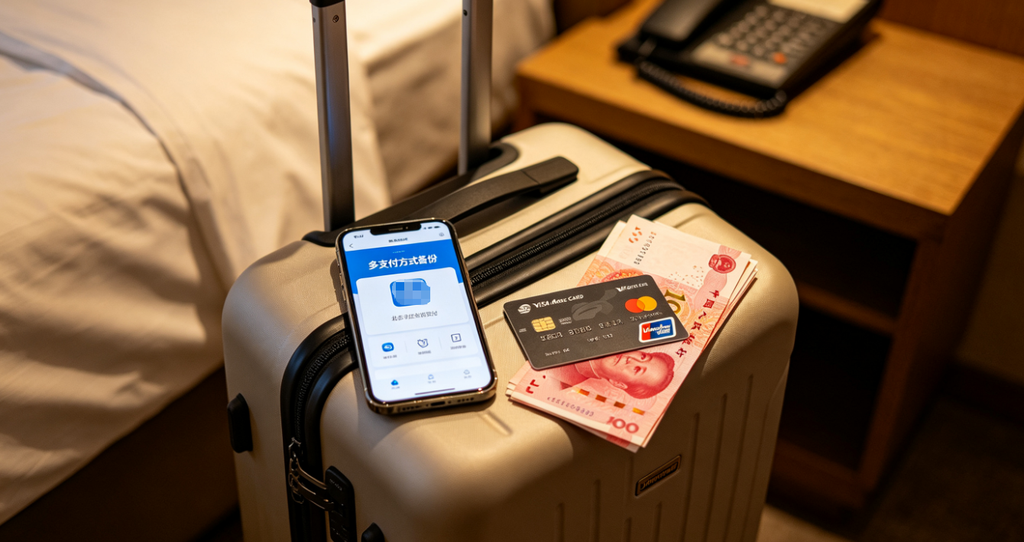
Even if you have prepared your payment methods, a few simple precautions can make everyday transactions easier.
Do not rely on only one payment method
Carry at least two payment options.
For example:
- Alipay linked to an overseas bank card.
- A physical Visa or Mastercard.
- A compatible UnionPay card, if available.
- A small amount of RMB cash.
If your mobile phone runs out of battery or your bank declines a transaction, you will still have alternatives.
Avoid carrying too much cash
There is no need to exchange your entire travel budget into RMB before arriving.
Keep most of your travel funds in your bank account and obtain cash when necessary.
Check your change
Counterfeit currency is not something most visitors need to worry about in ordinary transactions at established businesses. However, it is sensible to pay attention when receiving cash change, particularly when a transaction involves a large banknote.
Check that the notes are genuine and in acceptable condition before putting them away.
Using mobile payments can reduce the number of cash transactions and the need to receive change.
If you are unsure about a note, politely ask the merchant to check it or provide another note.
Avoid informal street exchanges
Never accept an exchange offer from someone approaching you on the street.
Use a bank, licensed exchange agency or authorised self-service machine. Informal transactions can expose you to counterfeit notes, incorrect exchange rates or scams.
Prepare your payment apps before departure
Do not wait until you arrive in Beijing to discover that your card cannot be verified.
Before travelling:
- Download Alipay or WeChat Pay.
- Register using your international phone number.
- Link an eligible overseas bank card.
- Complete any required verification.
- Check your bank’s overseas transaction settings.
- Keep your bank’s international customer-service number available.
If you plan to use the subway, taxis or airport transport, prepare a backup payment method as well. Our Beijing transport guide explains the main transport options and practical travel arrangements.
12. Frequently Asked Questions About Currency Exchange in Beijing
Can I visit Beijing without exchanging any money?
Yes. If your Alipay or WeChat Pay account works, your international bank card is accepted at the places you plan to visit, and you have a backup payment method, you may be able to complete a short trip without exchanging physical cash.
However, keeping a small RMB reserve is still sensible.
How much cash should I exchange for a three-day trip to Beijing?
If you have working mobile payments and a backup international card, RMB 200–300 is a reasonable emergency reserve for a three-day visit.
If you cannot rely on mobile payments, plan a substantially larger cash budget based on your accommodation, meals, transport and sightseeing expenses.
Is it better to exchange money at Beijing Airport or in the city?
Airport exchange counters are convenient for obtaining immediate cash, but they may not offer the best overall exchange rate.
For larger amounts, compare banks and licensed exchange agencies in the city. Always compare the final RMB amount after fees.
Can I withdraw RMB using a foreign Visa or Mastercard?
Yes. You can use an overseas Visa or Mastercard at an ATM that displays the corresponding payment-network logo.
However, your card must support overseas cash withdrawals, and your issuing bank may impose fees or withdrawal limits.
Can I use a foreign-issued UnionPay card at ATMs in Beijing?
Yes. UnionPay cards issued outside mainland China can be used at compatible mainland ATMs. UnionPay’s network has extensive ATM coverage in China, but you should confirm that your issuing bank has enabled overseas cash withdrawals and check its fees and limits before departure.
Should I choose USD or RMB when an ATM asks which currency to use?
Choose RMB (CNY), the local currency, and decline the ATM’s offer to convert the transaction into your home currency.
This normally allows your card network or issuing bank to handle the currency conversion instead of accepting the ATM operator’s DCC rate.
Do Beijing banks require an appointment for currency exchange?
Not every transaction requires an appointment, but calling ahead is recommended.
Beijing’s official guidance advises visitors to contact the specific bank outlet to make sure it has sufficient foreign currency in cash. Advance contact is particularly important for larger exchanges and less common currencies.
Can I exchange leftover RMB back into US dollars at the airport?
Some authorised exchange providers offer reverse currency exchange, but available currencies, rates and documentation requirements vary.
Check the service before relying on it, and avoid exchanging more RMB than you expect to use.
Is it safe to exchange money on the street in Beijing?
No. Use authorised banks, licensed foreign currency exchange agencies or official self-service exchange machines. Avoid informal street transactions, even if someone offers an attractive exchange rate.
Final Recommendation: Exchange Less, Compare More, and Keep a Backup
For most international visitors, the smartest way to handle money in Beijing is not to exchange a large amount of foreign currency before travelling.
Instead:
- Set up Alipay or WeChat Pay before departure.
- Confirm that your international bank card works in China.
- Check whether you have a compatible UnionPay card.
- Exchange RMB 200–300 for emergencies if your digital payments are working.
- If you need more cash, compare ATM withdrawal costs, bank rates and licensed exchange offers.
- When using an ATM, choose RMB and decline Dynamic Currency Conversion.
- Contact a bank in advance if you need a large amount or a less common currency.
The goal is simple: carry enough cash to feel prepared, but do not pay unnecessary exchange fees or spend valuable sightseeing time looking for the perfect exchange rate.