
How Easy Is It to Travel Beijing Using English?
Short answer: Traveling in Beijing using English is manageable for most international visitors. Major attractions provide English visitor information, subway stations display English names, and digital services have made transport, payments and ticket booking easier. However, English support is less predictable in small restaurants, traditional neighborhoods and everyday conversations. The main challenge is not simply finding your way around, but handling unexpected situations and understanding the cultural details behind the places you visit.
Beijing is not an English-speaking city, but it is increasingly accessible to international travelers. You can visit many major attractions independently with a suitable navigation app, a translation tool and some advance preparation.
The experience becomes more complicated when a booking system does not accept your phone number, a driver cannot understand your destination or you want to know the history behind a traditional courtyard rather than simply take a photograph.
This guide explains where English works, where you may encounter difficulties, how to prepare for common situations and when an English-speaking local guide can make a meaningful difference.
1. Is Beijing Easy to Visit If You Only Speak English?
For most major tourist activities, yes. Beijing has improved its services for international visitors, particularly in transportation, cultural attractions, accommodation and digital services.
You can generally expect English support in the following situations:
- Metro travel: Station names and many directional signs are displayed in English.
- Major attractions: Popular historical sites and museums provide varying levels of English information and visitor assistance.
- International hotels: Larger hotels are more likely to have English-speaking front-desk staff.
- Digital services: Some transport, payment and ticketing platforms offer English-language interfaces.
- Organized tours: Established operators serving international visitors generally provide English communication.
However, the situation changes outside the main tourist infrastructure.
A small restaurant may have a Chinese-only menu. A shopkeeper may not understand a question about a product. A taxi driver may recognize a destination written in Chinese but be unable to explain the route in English.
These situations are usually manageable with preparation, but they can consume time.
There is also an important difference between navigating a city and understanding it. Translation apps can help you order food or find an address, but they cannot automatically explain the historical significance of a palace, the layout of a traditional courtyard or the customs associated with a local neighborhood.
2. Where English Works Well in Beijing

Public transportation
The Beijing subway is one of the easiest transport systems for international visitors to use.
Stations display English names, and major stations provide bilingual directional information. Visitors can generally identify lines, transfers and exits without needing to read Chinese characters.
Payment has also become more convenient. According to the Beijing municipal government’s foreign-bank-card guidance, contactless payment using supported overseas Mastercard and Visa cards has been available across Beijing’s subway network since September 13, 2024.
This means eligible visitors can tap a supported card at the gate instead of buying a separate ticket for every journey. Check your card’s overseas payment settings and the instructions displayed at the station before relying on this method.
Buses are less straightforward. Although Beijing has improved bilingual public transport services, identifying the correct stop, understanding route changes and communicating with a driver can still be difficult for someone who speaks only English.
For most first-time visitors, the subway is the easier option.
Major attractions and museums
Beijing’s major attractions are generally better prepared for international visitors than ordinary neighborhood businesses.
Depending on the attraction, you may find:
- English directional signs.
- English visitor information.
- Multilingual audio guides.
- English ticketing information.
- Visitor-service staff who can help with specific questions.
However, English support varies considerably between locations. A famous palace may provide extensive English information, while a smaller historic building may have only limited translated descriptions.
There are also newer cultural services worth knowing about.
In September 2025, Beijing introduced free professionally narrated English audio guides at the first group of 12 participating museums through the upgraded Voice of Beijing digital cultural platform. Visitors can access the guides through on-site QR codes or the platform’s WeChat mini program.
The participating museums include:
- Confucius Temple and Imperial Academy Museum.
- Beijing Ancient Architecture Museum.
- Beijing Stone Carving Art Museum.
- Lao She Memorial.
- Museum of Chinese Gardens and Landscape Architecture.
The full participating list and access instructions are available in the official Beijing announcement about Voice of Beijing’s free English audio guides.
This is useful for independent visitors who want more historical context without booking a private guide. However, the service applies to the participating museums listed in the announcement, not every museum or attraction in Beijing.
Hotels and established visitor services
Larger international hotels and established hotels in central tourist areas are generally the easiest places to communicate in English.
You can usually request assistance with:
- Check-in and check-out.
- Breakfast and restaurant arrangements.
- Taxi bookings.
- Airport transfers.
- Directions to nearby attractions.
- Basic travel questions.
Smaller guesthouses and family-run accommodation may offer more limited English support.
Before booking, check recent guest reviews for comments about communication. If you expect to need help arranging transport or sightseeing, ask the property whether staff can assist in English.
Digital services for international visitors
Beijing has also developed digital services specifically for overseas travelers.
One important development is GO BEIJING, officially launched on April 28, 2026. According to the Beijing municipal government’s announcement, the platform brings together 39 services covering areas such as transport, accommodation, sightseeing, shopping and public services. It supports 16 languages, including English.
Its functions include access to ride-hailing, attraction ticketing, hotel bookings, international payment services and multilingual navigation.
This is a useful development for visitors who prefer to manage travel arrangements through a single platform. However, the availability of a service within an English-language interface does not guarantee that every transaction will work with every overseas phone number or bank card.
Complete registration and check the requirements of individual services before depending on the platform during your trip.
3. Where English Falls Short — and How to Handle It

The biggest language challenges usually occur outside the main tourist environment. Knowing where they are likely to happen makes independent travel much easier.
Restaurants and local food
Restaurants are among the most common places where English-speaking visitors encounter communication problems.
Larger restaurants in popular tourist areas may have English menus, photographs or staff who can communicate basic information. Small noodle shops, neighborhood restaurants and street-food stalls are less predictable.
A practical approach is to prepare before sitting down:
- Save photographs of dishes you want to try.
- Keep a Chinese translation app available.
- Learn a few common Chinese food names.
- Translate serious food allergies into a clear written message.
- Ask about ingredients when you are unsure.
For example, knowing the Chinese names of popular dishes can make ordering easier:
| Dish | Chinese name |
|---|---|
| Peking duck | 北京烤鸭 |
| Zhajiangmian | 炸酱面 |
| Hotpot | 火锅 |
| Dumplings | 饺子 |
| Mapo tofu | 麻婆豆腐 |
Pointing at a photograph may be enough to place a simple order, but it does not necessarily explain ingredients, cooking methods or dietary restrictions.
If food is an important part of your trip, a local food guide can offer more than translation. They can explain regional flavors, ingredients, dining customs and the differences between dishes that may look similar to foreign visitors.
For additional practical language strategies, see our guide to travel around Beijing without speaking Chinese.
Taxis and ride-hailing
Street taxis can be difficult for visitors who cannot speak Chinese. Some drivers understand common tourist destinations, but you should not assume every driver can communicate in English.
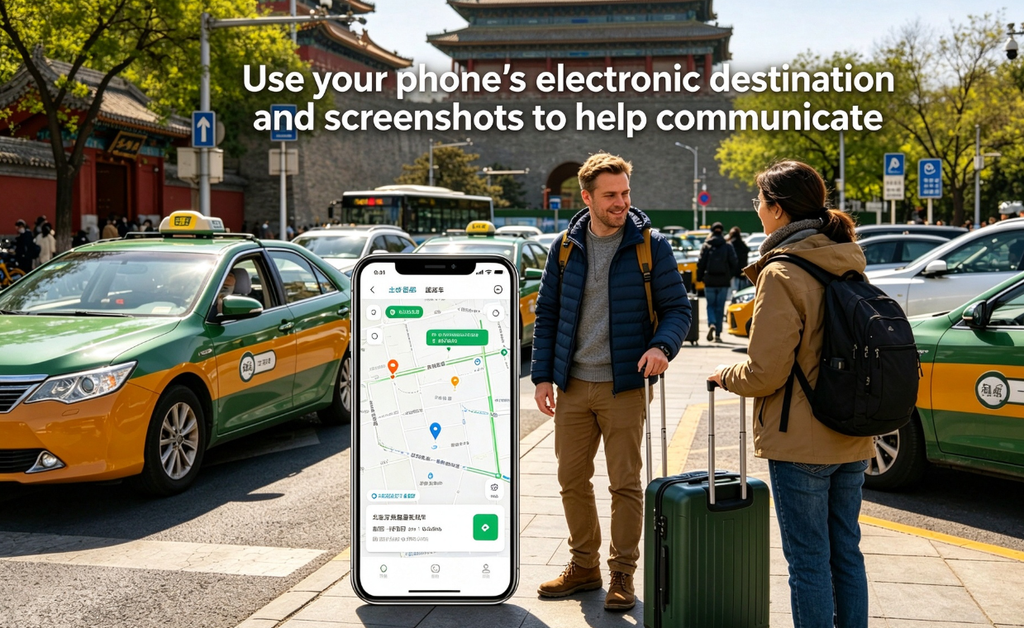
Using an established ride-hailing app is often easier because you can enter the destination electronically instead of explaining it verbally.
Before booking:
- Save your hotel’s Chinese name and address.
- Check the pickup location carefully.
- Confirm that the vehicle registration number matches the app.
- Use the in-app messaging function if the driver needs clarification.
- Keep a screenshot of your destination as a backup.
Pickup locations can still be confusing around large shopping centers, transport hubs and busy attractions. An English interface solves the language problem of entering an address, but it does not automatically solve every navigation problem.
Hutongs, local markets and residential neighborhoods
Traditional neighborhoods are where the difference between navigating Beijing and understanding Beijing becomes most noticeable.
In areas such as Shichahai, Nanluoguxiang and smaller hutong lanes, visitors encounter traditional courtyard houses, local shops, small restaurants and everyday neighborhood activities.
Main tourist streets may have English signs, but smaller lanes often have little translated information.
A translation app can help you understand a shop sign or ask a simple question. It cannot fully explain why traditional courtyard houses are arranged in a particular way, how a neighborhood developed or how local customs have changed.
For example, a visitor may recognize a traditional courtyard house but not understand the relationship between its central courtyard, main rooms, side buildings and orientation.
This is where a knowledgeable local guide can add value. The experience becomes more than walking through an attractive old neighborhood: you begin to understand how its architecture and layout reflect traditional family structures and urban life.
Ticket reservations and identity verification
Ticket booking deserves particular attention because English-language information does not guarantee that every booking system accepts an overseas phone number.
Some major attractions have dedicated English booking channels for international visitors.
The Palace Museum provides an English version of its official ticketing website. Foreign visitors can book using passport information and should bring the original valid identification document used for the reservation. The museum also states that it does not sell tickets on the day of the visit, so advance arrangements are essential.
You can check its official English visitor and ticket information.
Other attractions may use different booking procedures.
A Beijing government response published on June 20, 2025, addressed a visitor using a Singapore mobile number who was unable to complete online bookings. At that time, the response confirmed that foreign visitors could use the Palace Museum’s English website with their passports. For the Summer Palace, the response stated that online booking required a mainland Chinese mobile number, while foreign visitors could purchase tickets through staff-assisted booking at the entrance using valid identification.
This is a dated policy response, not a guarantee that the same restrictions remain unchanged today. Read the official 2025 government reply about Palace Museum and Summer Palace bookings, then verify the current arrangements before visiting.
A practical ticket-booking checklist:
- Check whether advance reservations are required.
- Confirm which identification documents are accepted.
- Use the attraction’s official booking channel where available.
- Check whether overseas phone numbers are supported.
- Keep the original passport used for booking.
- Confirm whether there is a separate entry or verification procedure for international visitors.
Do not assume that one booking method works for every attraction.
4. Getting Around Beijing Without Speaking Chinese
For most independent visitors, a small set of transport options is enough to manage the main tourist routes.
Subway: The easiest option for many visitors
The subway is generally the most straightforward transport choice for central Beijing sightseeing.
It is useful for:
- Traveling between major attractions.
- Reaching commercial districts.
- Avoiding road congestion.
- Making predictable journeys between stations.
Supported overseas bank cards can be used for contactless entry. Visitors should check their card compatibility and ensure overseas transactions are enabled.
Ride-hailing: Useful when station access is inconvenient
Ride-hailing is particularly useful when:
- Your hotel is not near a convenient subway station.
- You are traveling with children or older family members.
- You have luggage.
- You need to reach a destination with inconvenient public transport access.
- You are returning after a long sightseeing day.
The main advantage is that you can enter your destination electronically rather than explaining it verbally.
However, pickup locations can still be confusing. Check the map carefully and use the app’s messaging function if necessary.
BEIJING PASS: An alternative for transport and selected attractions
BEIJING PASS is a stored-value travel card designed to make transportation and selected purchases easier for international visitors.
The Beijing municipal government’s official BEIJING PASS introduction published on April 18, 2025 stated that the card could be used at 70 parks and other attractions, including the Summer Palace and Temple of Heaven, as well as designated commercial locations.
This figure should be understood in the context of that published guide. It should not be confused with every attraction in Beijing, the number of participating businesses or a separate list of municipal parks. Different lists and updates may use different categories and coverage dates.
For that reason, it is better to check the current participating-location information rather than rely on an old total when deciding whether to buy the card.
BEIJING PASS may be useful if you prefer a stored-value card rather than relying entirely on mobile payment applications. Before purchasing one, check its current use conditions, purchase locations, recharge arrangements and refund policy.
Keep a backup option
Even if you plan to use mobile payments and ride-hailing for almost everything, carry a physical international bank card and a small amount of RMB cash.
A phone can lose power, an app can fail to load or a payment can be declined.
Having another way to pay prevents a minor technical problem from disrupting your day.
For more information about routes, airport transfers and public transport, see our guide to Beijing transportation for foreign tourists.
5. Paying in Beijing With International Cards
Payment is another area that has become more convenient for international visitors, but preparation is still important.
Can foreigners use Alipay and WeChat Pay?
Yes. Alipay and WeChat Pay support the linking of eligible international bank cards, including major networks such as Visa and Mastercard.
The general setup process is:
- Download the relevant app.
- Register using an eligible mobile number.
- Complete any required identity verification.
- Link a supported international bank card.
- Follow the app’s instructions to make a payment.
You do not normally need a Chinese bank account simply to use these services with an eligible overseas card.
However, card compatibility, identity verification and individual account requirements can vary. Some foreign banks may decline a linking request, and some transactions may not be supported by a particular card.
Are there transaction limits or service fees?
Mobile payment limits and service fees depend on the platform’s current rules and the payment method used.
Rather than relying on an old fee figure, check the transaction details displayed in Alipay or WeChat Pay before confirming a payment.
Also consider whether your own bank charges foreign transaction fees or applies a different exchange rate.
Should you prepare more than one payment method?
Yes.
A practical payment setup for Beijing includes:
- Alipay or WeChat Pay linked to an eligible international card.
- One physical international bank card.
- A small amount of RMB cash.
- A second payment option if your primary card or app fails.
Do not assume every small vendor accepts every type of foreign-linked payment. A backup method is particularly useful in traditional neighborhoods and smaller businesses.
6. When Are English-Speaking Private Beijing Tours Worth Considering?

Independent travel in Beijing is entirely possible for many English-speaking visitors. The question is whether you want to spend part of your limited holiday managing language and logistics yourself.
An English-speaking guide can provide more than help with directions. The greatest value often comes from explaining things that are difficult to understand through signs, photographs or translation applications.
Understanding the history behind the attractions
At the Forbidden City, a visitor can follow the main route and photograph the famous halls without knowing much about their original functions.
A knowledgeable guide can explain the relationship between the palace layout, imperial authority, ceremonial traditions and the daily life of the court.
At the Temple of Heaven, for example, the arrangement of buildings and ceremonial spaces reflects historical ideas about the emperor’s relationship with heaven and the state.
These explanations turn a collection of impressive buildings into a connected historical experience.
Exploring hutongs beyond the main streets
Hutongs are not simply narrow streets with traditional-looking buildings.
Their layout, courtyard architecture and relationship with neighboring homes reveal aspects of Beijing’s urban history and everyday culture.
A local guide can explain what to look for, help you understand traditional building features and introduce neighborhood details that are easy to overlook when walking independently.
This is particularly useful for visitors interested in local life rather than only famous landmarks.
Reducing time spent solving practical problems
Depending on the service you choose, a private tour may include:
- An English-speaking local guide.
- A pre-arranged sightseeing route.
- Hotel pickup and drop-off.
- Private vehicle transport.
- Assistance with attraction reservations.
- Historical and cultural explanations.
- Help adapting the route to your group’s interests.
These services are not automatically included in every tour. Before booking, confirm exactly what is covered, particularly transport, entrance tickets, meals, guide services and additional charges.
Who benefits most from a private tour?
First-time visitors: A guide can help you understand the city and make your first sightseeing days easier to manage.
Families: Private transport and a flexible schedule can be useful when children need breaks or older family members cannot walk long distances.
Visitors with limited time: A carefully planned route can reduce unnecessary transfers and help prioritize the attractions that matter most.
Culture-focused travelers: A guide who can explain history, architecture and local customs can provide a deeper experience than signs and translation apps alone.
Visitors who prefer not to manage local apps: If you would rather have someone coordinate transport, tickets and communication, an organized private experience may be more comfortable.
When is independent travel the better choice?
A private tour is not essential for everyone.
If you are comfortable using navigation apps, can manage online bookings and prefer exploring at your own pace, independent travel may be a better fit.
You may also choose a guide for only one part of your trip, such as a Great Wall excursion or a historical walking tour, while exploring other areas independently.
The best choice depends on how much time you want to spend managing logistics and how much value you place on guided cultural interpretation.
7. How to Check Whether an English-Speaking Guide Is Actually Good
Not every service described as an English-speaking tour provides the same experience.
A guide may be able to communicate basic instructions but struggle to explain history, architecture or cultural details in English.
Instead of asking only whether the guide speaks English, ask for a practical demonstration of what they can explain.
Test the guide’s ability to explain a real attraction
Before booking, ask the operator to arrange a short English introduction to a landmark you intend to visit.
For example, you could ask:
- “Could you explain the original function of the Hall of Supreme Harmony and why it occupies such an important position in the Forbidden City?”
- “Could you explain why the main buildings in the Forbidden City are arranged along a north-south axis?”
- “What is the difference between the main ceremonial buildings and the residential areas of the palace?”
- “Could you explain how a traditional Beijing courtyard house is arranged and what its orientation tells us about traditional family life?”
These questions test more than pronunciation. They reveal whether the guide can organize historical information, explain architectural features and answer follow-up questions naturally.
You do not need a detailed academic lecture. What matters is whether the explanation is clear, accurate and easy for an international visitor to understand.
Ask how the guide handles questions
A good guide should be comfortable answering questions that are not part of a memorized introduction.
For example, ask what happens if you want to spend more time in a particular exhibition, change the walking route or explore a quieter hutong.
A guide who can adapt explanations to your interests is generally more valuable than someone who simply recites a fixed script.
Check professional experience and service responsibilities
Before booking, confirm the following:
| What to check | What to ask |
|---|---|
| English explanation | Can the guide explain a specific building or historical event in clear English? |
| Historical knowledge | Can the guide answer follow-up questions rather than only repeat a prepared introduction? |
| Professional qualifications | What relevant guiding qualifications and local experience does the guide have? |
| Guide and driver roles | Will the accompanying person be a professional guide, a driver or both? |
| Transport | Is a private vehicle included, and what are the pickup arrangements? |
| Attraction tickets | Are tickets included, or must they be purchased separately? |
| Itinerary flexibility | Can the route be adjusted to your interests and walking pace? |
| Additional charges | Are parking, tolls, meals and optional activities included? |
| Cancellation policy | What are the cancellation and refund conditions? |
One particularly important distinction is whether the service provides a genuine English-speaking guide or simply a driver who can communicate basic information.
If cultural explanation is your main reason for booking, this distinction matters.
8. Practical Preparation: An English-Only Travel Checklist
You do not need to learn Mandarin before visiting Beijing, but a little preparation can prevent many common problems.
On your phone
- Install a translation app that supports Chinese.
- Download or configure a navigation app suitable for use in China.
- Set up an eligible mobile payment method.
- Install the ride-hailing app you intend to use.
- Save your hotel’s Chinese name, address and phone number.
- Keep screenshots of important bookings and transport details.
For sightseeing
- Check ticket and reservation requirements.
- Confirm which identity documents are accepted.
- Save the official entrance location, not just the attraction name.
- Check available English audio guides or guided tours.
- Keep your original passport available when required.
For everyday situations
- Carry a physical payment card and some RMB cash.
- Keep your phone charged.
- Save important addresses offline or as screenshots.
- Prepare translated messages for food allergies or other essential requests.
- Avoid relying on spoken English when a written address or translated message is clearer.
A few simple Chinese phrases can also help:
| English | Chinese | Pinyin |
|---|---|---|
| Hello | 你好 | Nǐ hǎo |
| Thank you | 谢谢 | Xièxie |
| How much is it? | 多少钱? | Duōshao qián? |
| I don’t understand | 我听不懂 | Wǒ tīng bù dǒng |
| Please help me | 请帮我 | Qǐng bāng wǒ |
| Where is the subway station? | 地铁站在哪里? | Dìtiě zhàn zài nǎlǐ? |
You do not need perfect pronunciation. Showing the Chinese characters on your phone is often enough.
FAQ: Traveling in Beijing Using English
Can you travel around Beijing with English only?
Yes. Most major tourist activities can be managed with English signage, online services, translation apps and basic preparation. Communication can be more difficult in small restaurants, local markets, residential neighborhoods and unexpected situations.
Do Beijing subway stations have English signs?
Yes. Beijing subway stations display English station names and bilingual directional information. Eligible overseas Mastercard and Visa cards can also be used for contactless entry, subject to the card’s compatibility.
Do taxi drivers in Beijing speak English?
You should not assume they do. Using a ride-hailing app and entering the destination electronically is generally easier than explaining an address verbally. Save your hotel’s Chinese address as a backup.
Do I need a Chinese phone number to use Alipay or ride-hailing apps?
Not necessarily. Some services provide registration options for overseas mobile numbers. However, identity verification, card compatibility and individual account requirements vary. Check the current requirements before departure.
Can foreigners use international bank cards in Beijing?
Yes. International bank cards are accepted in many places, and eligible overseas cards can be linked to mobile payment services. Supported Mastercard and Visa cards can also be used for contactless subway entry. Carry a backup payment method because acceptance is not universal.
Is BEIJING PASS worth buying?
It depends on how you plan to travel. The card may be convenient if you want a stored-value option for public transport and selected participating attractions. Check the current participating-location list and the card’s terms before purchasing it.
Is Beijing suitable for first-time foreign visitors?
Yes. Major attractions, established hotels, public transport and digital services provide a workable environment for international travelers. Preparing your payment methods, ticket arrangements and transport apps in advance makes the experience smoother.
Is an English-speaking guide necessary in Beijing?
No. You can visit many major attractions independently. A guide becomes more valuable if you want historical explanations, cultural interpretation, help with local communication or a coordinated sightseeing experience.
Is a private Beijing tour worth the cost?
It depends on your priorities. If you mainly need transport between famous landmarks, independent travel may be sufficient. If you want an English-speaking local to explain the city’s history, help with practical arrangements and adapt the itinerary to your interests, a private tour may offer better value.
Final Verdict: Can You Travel Beijing Using English?
Yes. Beijing is increasingly accessible to international visitors, and you can manage most essential travel tasks without speaking Chinese.
The subway, international payment options, digital visitor services and English information at major attractions have made independent travel considerably easier. The remaining challenges are concentrated in everyday communication, some ticket-booking procedures and the cultural details that are not always explained in English.
If you are comfortable using translation and navigation apps, you can explore much of Beijing independently. If you want to understand the city’s history, communicate more easily with local people and spend less time coordinating daily arrangements, English-speaking private Beijing tours are worth considering.
The best approach is not necessarily to hire a guide for every day. Choose the level of assistance that matches your interests, schedule and travel style. That way, you can spend less time dealing with language barriers and more time experiencing Beijing.