
Can Foreign Tourists Easily Use Transportation in Beijing?
Introduction
For international visitors, getting around Beijing can seem complicated before arrival. The city is enormous, many signs contain Chinese characters, and everyday services may use payment methods that are unfamiliar to travelers from overseas. However, once you understand the main transport options and prepare a few essentials, traveling around the city is generally manageable.
The real challenge is not simply whether public transportation exists. It is knowing how to enter a station, pay for a journey, identify the correct exit, communicate with a driver, and handle situations when an app or payment method does not work as expected.
For most visitors, Beijing transportation for foreign tourists becomes much easier with three preparations: setting up a workable payment method, saving destinations in Chinese, and choosing the transport option that fits each journey. You do not need to speak fluent Mandarin, but you should not assume that every ticket machine, driver, or local service will be easy to use in English.
This guide explains the practical steps that help foreign tourists travel more confidently, including what to prepare before arrival, how to use different services, and what to do when problems arise.
1. Is Beijing Transportation Easy for Foreign Tourists?
In general, yes—with some preparation. Beijing has an extensive subway network, public buses, taxis, ride-hailing services, and airport connections. These options cover most major tourist areas, although convenience varies according to your hotel location, destination, time of day, and willingness to transfer between services.
The main difficulty is often the gap between having access to transportation and knowing how to use it independently.
Foreign visitors may encounter several obstacles:
- Payment apps that require setup before they can be used smoothly.
- Ticket machines or bus instructions that offer limited English support.
- Chinese-only street names or addresses in some situations.
- Drivers who cannot easily understand spoken English.
- Apps that require a local account, phone verification, or additional permissions.
- Station exits that lead to different sides of a large intersection or complex.
Most of these problems can be reduced through advance preparation. Download offline maps where available, save your hotel address in Chinese, confirm payment arrangements, and allow additional time for your first few journeys.
2. Can Foreigners Use the Beijing Subway?
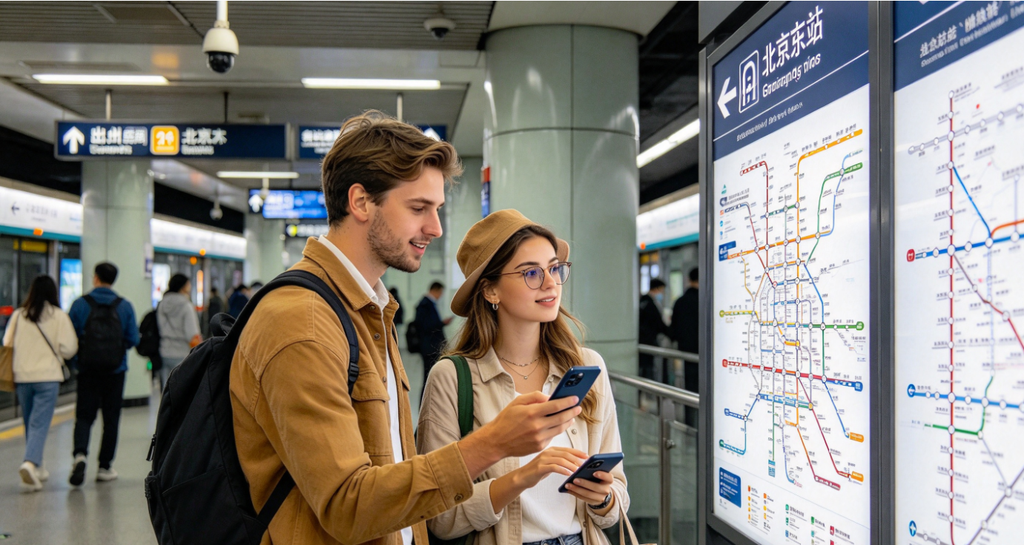
The subway is usually one of the most practical transport options for tourists. It serves many major attractions, commercial districts, railway stations, and connections to other parts of the city. Trains run frequently on many routes, although service hours and frequency vary by line and time.
How to enter a subway station
A typical journey involves the following steps:
- Find the station entrance and identify the correct line.
- Follow signs to the ticketing or entry area.
- Buy a ticket or use an accepted transit payment method.
- Pass through the security screening and fare gates.
- Follow the signs to the platform in your direction of travel.
- Check the station names and transfer signs before changing lines.
- Exit through the gate using the ticket or payment method required for your journey.
Many major stations have English-language signs, and station names are often shown in both Chinese and English. However, not every instruction or service counter will provide the same level of English support.
Should you buy a single-journey ticket or use a transit card?
A single-journey ticket may be sufficient if you only plan a few subway trips. For a longer stay, a suitable transit card or supported digital payment option may reduce the need to buy a separate ticket for each journey.
The best option depends on how often you expect to travel, which services you plan to use, and what payment methods are available to you. Check current ticketing rules and accepted payment options before relying on a particular app or card.
Do not assume that a payment method accepted by one transport service will automatically work across every subway line, bus, or regional rail service.
How to avoid getting lost underground
Beijing’s subway network is large, and a station may have multiple exits leading to different streets or landmarks. Choosing the wrong exit can add considerable walking time even when you have reached the correct station.
Before leaving the platform, check the exit signs and compare them with your destination on a map. If your hotel or attraction is on a particular side of a main road, identify the appropriate exit in advance.
For your first journey, it is sensible to allow extra time rather than scheduling a tight connection.
3. Can Foreign Tourists Pay for Public Transportation Easily?

Payment is one of the most important issues to resolve before traveling. China’s mobile payment ecosystem is widely used, but visitors should not assume that a foreign bank card, mobile wallet, or overseas transit app will work in every situation.
Prepare your payment options before arrival
Depending on the service and current rules, possible options may include:
- An international bank card accepted by the relevant ticket machine or payment service.
- A supported digital wallet or payment app configured for foreign visitors.
- A transit card or ticket purchased through an authorized channel.
- Cash where the specific service and transaction allow it.
Acceptance varies by transport operator, payment channel, card type, and transaction. A bank card that works at a hotel may not necessarily work directly at a subway fare gate.
Before departure, check the latest guidance from official transport operators and payment providers. If you intend to use a mobile payment app, complete as much of the registration process as possible while you still have access to your home mobile number and banking verification methods.
What if your payment app does not work?
Avoid relying on a single payment method. Keep an alternative available, such as another supported payment option or a way to purchase a ticket through an authorized channel.
If a transaction fails, check whether your card has been verified, whether the service supports international cards, and whether the app requires an additional setup step. Do not repeatedly attempt unfamiliar transactions without confirming the reason for the failure.
For buses in particular, verify the payment procedure before boarding. Payment rules can differ between services, and some buses do not provide change in the way visitors may expect.
4. Can Foreigners Take Taxis in Beijing Without Speaking Chinese?

Yes, but communication requires preparation. Taxis are useful when you have luggage, are traveling late, need to reach a destination away from a subway station, or want to reduce transfers.
The main challenge is that not every driver speaks English. Pronouncing an address in English may not be enough to identify the correct destination.
Save your destination in Chinese
Before leaving your hotel, save the Chinese name and address of your accommodation and major attractions. Showing the driver the written address is often more effective than trying to explain it verbally.
For complex destinations, include a nearby entrance, landmark, or building name. Large attractions, railway stations, and shopping complexes may have multiple drop-off points.
It is also useful to save your hotel’s phone number and contact information in case you need help communicating.
How to identify and pay for a taxi
Use a legitimate taxi service and confirm that the meter or applicable fare arrangement is being used. Follow the operator’s current payment instructions, and check which payment methods are accepted before beginning the journey when possible.
Keep your destination visible on your phone so you can verify that the driver understands where you want to go. If there is confusion, use a map or ask hotel staff to help confirm the destination before departure.
Taxis are not always faster than the subway. Traffic can be heavy during commuting hours, and a road journey may take substantially longer than expected.
5. Is Ride-Hailing a Better Choice for International Visitors?
Ride-hailing services can reduce some communication difficulties because the destination is entered in an app before the journey begins. They can also provide a digital record of the route and fare, depending on the service.
However, international visitors should check whether the selected platform can be registered and used with their overseas phone number, payment method, and device. App availability, language support, and international-card acceptance may change.
Before depending on a ride-hailing service:
- Confirm that you can create or access an account.
- Check whether your preferred payment method is supported.
- Enter the destination carefully and verify the Chinese address.
- Confirm the pickup location, especially outside stations and large attractions.
- Check the vehicle details before getting in.
- Follow the app’s instructions for payment and trip completion.
A major railway station or airport may have designated pickup areas. Following the app’s pickup instructions is important because a driver may not be able to stop directly outside every exit.
Ride-hailing can be convenient, but it is not a universal replacement for taxis or public transportation. Keep a backup plan in case account verification, mobile connectivity, or payment causes difficulties.
6. Are Beijing Buses Difficult for Foreign Tourists?
Buses can reach neighborhoods and destinations that are less convenient by subway, but they may require more preparation. Routes, stops, and payment procedures can be harder to interpret if you are unfamiliar with Chinese.
For a first-time visitor, the most important task is confirming the correct bus number, direction, boarding stop, and destination stop before getting on.
Use a reliable map or transport service to check the route. Save the Chinese names of your boarding and departure stops, and follow your progress during the journey if the app supports it.
Also check the payment rules. Some services require payment when boarding, while other arrangements may differ. Do not assume that the same ticketing procedure applies to all buses.
Buses can be worthwhile for short local journeys or routes with no convenient subway connection. If you are unfamiliar with the city and need to arrive at a specific time, the subway may be easier to manage.
7. What About Airport Transfers and Railway Stations?

Arriving in Beijing is often when visitors first encounter the city’s transport system. Choosing a suitable airport or railway-station transfer can make the first day significantly less stressful.
From the airport
Beijing’s airports have dedicated transport connections, with available options depending on the airport, terminal, time, and destination. These may include airport rail services, subway connections, buses, taxis, and prearranged transfers.
Before choosing, consider:
- Where your accommodation is located.
- Whether you have large or heavy luggage.
- How many people are traveling together.
- Your arrival time and the operating hours of the service.
- Whether your phone and payment methods will work immediately after landing.
A public transport journey may be economical, but it can involve stairs, transfers, and walking through large stations. A prearranged transfer may be more comfortable for families, groups, or travelers arriving after a long flight.
From railway stations
Beijing’s railway stations can be large and busy. Confirm the exact station name on your ticket, because similar place names can refer to different stations.
Plan the route from the station to your hotel before arrival. If you need a taxi or ride-hailing service, check the designated pickup area instead of assuming that the driver can meet you at any exit.
For train departures, allow enough time to navigate the station, locate the correct entrance, and complete any required checks.
8. How Can You Overcome the Language Barrier?
You do not need to learn Mandarin fluently to use Beijing’s transport system, but a few simple tools can make a significant difference.
Use maps with Chinese destination names
A map that displays Chinese place names can help you communicate with drivers and confirm station exits. Save your hotel, major attractions, and transport hubs before leaving your accommodation.
Where possible, keep both the English and Chinese names available. English may help you navigate station signs, while Chinese text may be more useful when communicating with a driver or local service provider.
Prepare essential phrases
A few simple phrases can help you ask for directions or confirm a destination:
- 请问地铁站在哪里? — Where is the subway station?
- 请带我到这个地址。 — Please take me to this address.
- 我想去这个地方。 — I would like to go to this place.
- 这个出口对吗? — Is this the correct exit?
You can also show a translated sentence on your phone instead of trying to pronounce it.
Download useful information in advance
Mobile data may be unavailable immediately after landing, and a connection may be unreliable in some underground areas. Save key addresses, booking details, route instructions, and offline maps where supported.
A screenshot of your hotel address and the route to your next destination can be useful if an app stops working.
9. What Should You Do When Something Goes Wrong?
Even a well-planned journey can involve a missed stop, a payment failure, or a confusing station exit. A simple fallback plan helps you recover without unnecessary stress.
If you take the wrong subway line
Check the station map and identify a transfer station that returns you to the correct route. Avoid leaving the paid area until you understand whether you can correct the journey within the station.
If you cannot pay
Ask station staff about the authorized ticketing options available at that station. If one payment method fails, use your prepared alternative rather than assuming the service is unavailable.
If a driver cannot understand your destination
Show the Chinese address and a map pin. If the destination remains unclear, ask hotel staff or another reliable local contact to help confirm it before continuing.
If your phone battery is low
Keep your hotel address, important reservations, and essential route information available offline. A portable charger can be particularly useful on long sightseeing days.
If you are unsure which exit to use
Pause before leaving the station and check the exit map. If needed, ask station staff to point you toward the appropriate exit. Walking back through a large intersection can take much longer than checking first.
10. How Should You Choose the Right Transport for Each Journey?
There is no single transport method that works best for every journey in Beijing. The practical choice depends on distance, luggage, time, traffic, payment readiness, and how comfortable you feel navigating the city.
| Situation | Practical choice | Why |
|---|---|---|
| Traveling between central districts | Subway, when a convenient line is available | Avoids much road traffic and offers clear station-to-station travel |
| Carrying heavy luggage | Taxi or prearranged transfer | Reduces transfers and walking |
| Reaching a destination far from a station | Taxi or ride-hailing, if available | Provides a more direct final connection |
| Exploring a nearby neighborhood | Walking or a suitable local bus | May be simpler than making multiple transfers |
| Traveling with several family members | Compare the total cost of a car and public transport | Convenience and cost depend on group size |
| Traveling to an airport or railway station | Plan around the exact terminal or station and departure time | Helps avoid confusion and missed connections |
If you want to compare routes in advance, use a Beijing transport guide as a starting point, then verify the latest schedules, fares, and payment requirements for the specific journey you intend to take.
For a broader overview of your options, the best ways to get around Beijing depend on the balance between cost, convenience, and flexibility—not simply which mode is fastest in ideal conditions.
11. A Practical Preparation Checklist for Foreign Tourists
Before arriving in Beijing, complete these steps:
- Confirm that your phone will have mobile data or another way to access essential information.
- Check the current payment and ticketing options for the services you expect to use.
- Save your hotel’s Chinese name, address, and contact details.
- Save the Chinese names and locations of your main attractions.
- Check airport or railway-station transfer options in advance.
- Identify at least one alternative payment method.
- Download offline maps or save screenshots of essential routes where possible.
- Allow extra time for your first subway journey and any major transfers.
- Check the latest operating hours and service notices before traveling.
- Keep a portable charger available during long sightseeing days.
You do not need to master every transport option before your trip. Focus first on the journeys you are most likely to take, especially the route from your arrival point to your accommodation and the route to your first major attraction.
Conclusion
Beijing’s transportation network is extensive, and foreign tourists can generally use it successfully without speaking fluent Chinese. The experience becomes much easier when you understand how ticketing works, prepare a reliable payment method, save destinations in Chinese, and know how to navigate stations and pickup points.
The biggest obstacle is often not transportation itself but uncertainty about the practical details. Preparing a few essentials before arrival can reduce that uncertainty and help you travel more independently.
For most visitors, the best approach is to use the subway for suitable journeys, choose taxis or ride-hailing when direct access is more useful, and plan airport or railway-station transfers carefully. With a backup payment option, saved addresses, and realistic travel times, Beijing is far more manageable than it may first appear.
Ultimately, Beijing transportation for foreign tourists is easiest when you plan around real travel conditions rather than expecting every service to work exactly as it does at home. A little preparation can make the difference between a stressful first journey and a confident start to your Beijing trip.
Frequently Asked Questions
Can foreign tourists use the Beijing subway without a Chinese phone number?
Possibly, depending on the ticket or payment method. A Chinese phone number is not necessarily required for every way of buying a subway ticket, but some apps or services may require phone verification. Check the current requirements of your chosen payment method before traveling.
Can I use an international credit card on Beijing public transportation?
Acceptance depends on the transport service, ticket machine, fare gate, and card type. Do not assume that an international card will work directly everywhere. Check official transport guidance and prepare an alternative way to pay.
Is English widely available on Beijing public transportation?
Major subway stations and many services provide English signs or announcements, but support varies. English may be less available in some bus services, taxi interactions, and smaller local settings. Chinese destination names and saved map locations are useful backups.
Is it safe for foreign tourists to take taxis in Beijing?
Using legitimate taxi services and following the applicable fare and payment procedures is the sensible approach. Confirm your destination before departure, keep it visible on your phone, and use reputable booking channels when available.
Should I use public transportation or book a private transfer?
Public transportation is often practical for journeys served by convenient subway connections. A private transfer may be more suitable for travelers with heavy luggage, families, groups, or complex schedules. Compare the total journey time and cost before deciding.
What is the most important thing to prepare before arriving in Beijing?
Prepare your payment options and save your accommodation’s Chinese address. These two steps can make the airport transfer, taxi journeys, and first day of sightseeing considerably easier.