
What Is the Great Wall of China? A Complete Guide for First-Time Visitors
Quick Answer
So, what is the Great Wall of China?
The Great Wall of China is a vast system of fortifications built and rebuilt by different Chinese states and dynasties over many centuries. Rather than being one continuous wall constructed at one time, it consists of walls, watchtowers, fortresses, gates, trenches and other defensive structures built across northern China.
The earliest defensive walls date back more than 2,000 years, while major sections were constructed or rebuilt during later dynasties, particularly the Ming dynasty.
Today, the Great Wall is one of China’s most important historical landmarks and one of the country’s most recognizable travel destinations.
But the Great Wall is much more than a long stone structure.
It represents centuries of military strategy, political history, engineering, trade, migration and interaction between different peoples across northern China.
For first-time visitors, understanding this history makes the experience of walking on the Wall far more meaningful.
The Great Wall Is Not One Single Wall
One of the biggest misconceptions about the Great Wall is that it is one continuous structure stretching across China.
It is better understood as a network of defensive systems.
Different states and dynasties built walls in different periods and locations.
Some sections connected with existing fortifications.
Others were rebuilt, extended or reinforced.
This means the Great Wall you see today is the result of many construction projects separated by centuries, rather than one enormous building project.
That distinction is important when deciding which section to visit.
The Badaling you visit today, for example, represents a very different historical and architectural experience from the more rugged landscapes of Jinshanling.
Why Was the Great Wall Built?
The main purpose of the Great Wall was military defense.
Northern China historically faced conflicts involving different nomadic and semi-nomadic groups.
Fortifications helped Chinese states monitor movement across strategic areas and protect important settlements, agricultural regions and transportation routes.
However, the Wall had several functions beyond simply stopping an invading army.
It could help authorities:
- Monitor movement
- Control strategic passes
- Protect important settlements
- Send military signals
- Control trade and travel routes
- Coordinate defensive forces
The Wall should therefore be understood as part of a much larger military and administrative system.
A wall by itself could not defend an entire frontier.
Watchtowers, garrisons, beacon systems, passes and troops were equally important.
When Was the Great Wall Built?
There was no single construction date.
The history of the Great Wall stretches across more than two millennia.
Early Defensive Walls
Before the unification of China, different states built defensive walls to protect their territories.
These early walls were often constructed using locally available materials.
Depending on the region, builders used:
- Rammed earth
- Stone
- Wood
- Other locally available materials
Many of these early structures no longer survive in the same form.
The Qin Dynasty
After China was unified under the Qin dynasty, earlier defensive walls were connected, repaired or expanded in some areas.
The emperor Qin Shi Huang is therefore strongly associated with the early development of the Great Wall.
However, it would be inaccurate to imagine that the modern Great Wall was built entirely during his reign.
The construction process continued through many later periods.
The Han Dynasty
During the Han dynasty, defensive systems expanded into areas farther west.
These fortifications were connected with China’s efforts to protect important routes and maintain control over frontier regions.
The Han period is particularly important for understanding the relationship between the Great Wall and the development of long-distance trade routes.
The Wall was not simply a barrier.
It was part of a broader frontier system.
The Ming Dynasty and the Great Wall You See Today
When most people picture the Great Wall, they are imagining sections built or extensively rebuilt during the Ming dynasty.
The Ming period saw major investment in frontier defense.
Many famous tourist sections around Beijing belong to this broader period.
Ming builders constructed impressive walls using:
- Bricks
- Stone
- Rammed earth
- Watchtowers
- Fortified passes
The result is the monumental architecture that attracts millions of visitors today.
What Does the Great Wall Look Like?
The appearance of the Great Wall changes dramatically depending on where you visit.
Some sections feature:
- Brick walls
- Stone foundations
- Watchtowers
- Fortified gates
- Steep stairways
- Mountain ridges
Other sections are much more weathered.
Some remote areas may appear as little more than earthen ridges or broken defensive structures.
This is another reason the phrase “the Great Wall” can be misleading.
There is no single visual experience.
Why Was the Great Wall Built on Mountains?
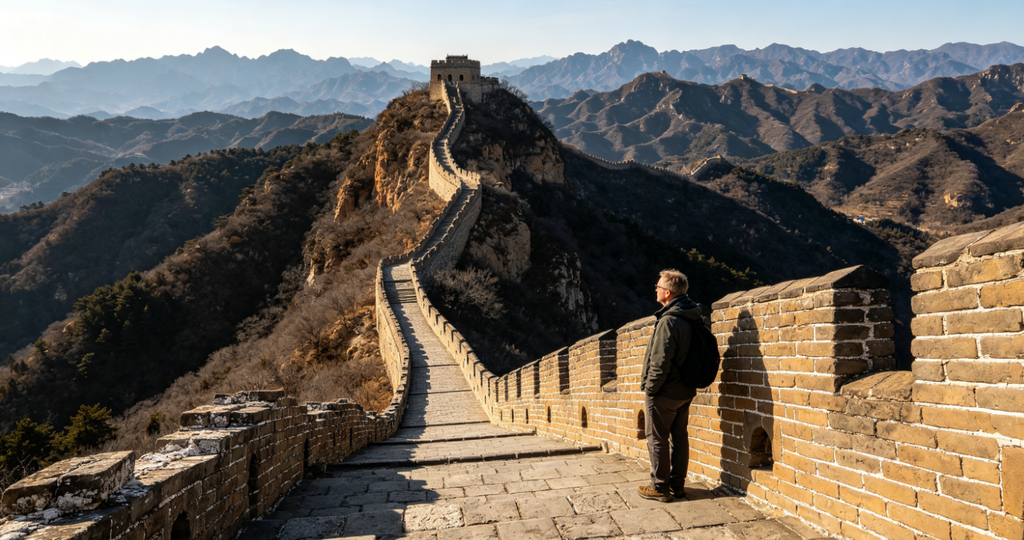
When you see photographs of the Great Wall winding over mountain ridges, the landscape can look almost too perfect to be practical.
But the location was strategic.
Mountains provided natural defensive advantages.
Building along ridges allowed defenders to:
- Observe surrounding terrain
- Monitor movement
- Control mountain passes
- Reduce the amount of additional fortification required
It also created a chain of elevated defensive positions.
The dramatic scenery visitors enjoy today is therefore closely connected to the military logic behind the Wall’s original construction.
How Long Is the Great Wall?
There is no simple answer because different measurement methods include different sections and associated defensive structures.
A major official survey of the Ming Great Wall measured thousands of kilometers, while broader assessments of the entire historical Great Wall system produce a much larger figure.
This is why statements such as “the Great Wall is exactly X kilometers long” can be misleading.
The more useful point for travelers is:
The Great Wall is a vast network extending across multiple regions of northern China, not one tourist attraction with a single entrance and endpoint.
Can You See the Great Wall From Space?
This is one of the most famous myths about the Great Wall.
The idea that the Great Wall can easily be seen from the Moon is incorrect.
Even from low Earth orbit, visibility depends on conditions such as:
- Lighting
- Weather
- Resolution
- Surrounding terrain
- The particular section
The Wall is relatively narrow compared with the enormous landscape surrounding it.
Its historical importance is real enough without relying on this myth.
Why Is the Great Wall Important to Chinese History?
The Great Wall represents much more than military architecture.
It reflects the changing relationship between agricultural societies, frontier communities and nomadic peoples across northern China.
Its history is connected with:
- Political expansion
- Military strategy
- Border administration
- Trade
- Migration
- Communication
- Regional development
Different dynasties had different priorities.
Some focused on expanding territory.
Others concentrated on defending existing borders.
Still others used fortifications to control strategic routes.
The Wall therefore changed together with China’s political and military circumstances.
The Great Wall as a Communication System
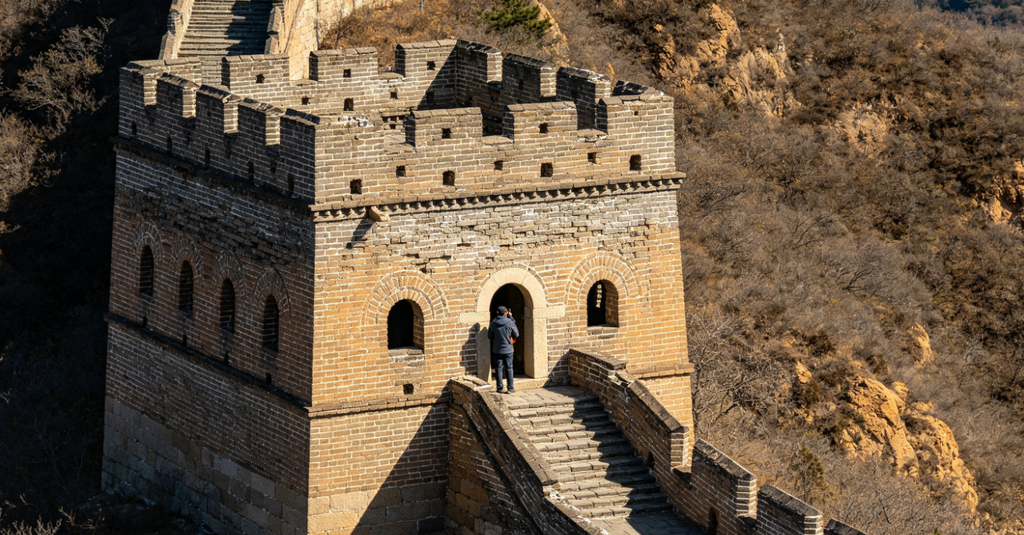
One of the most interesting aspects of the Wall is its communication network.
Watchtowers and beacon towers could be used to transmit signals over long distances.
This allowed information about potential threats to travel much faster than a messenger traveling on foot.
The system demonstrated an important principle of ancient military strategy:
Early warning could be as important as physical defense.
A fortress doesn’t have to stop an enemy immediately if it can give defenders enough time to prepare.
The Role of Watchtowers
Watchtowers were strategically positioned along many sections of the Great Wall.
They served multiple purposes.
They could provide:
- Observation points
- Defensive positions
- Communication locations
- Storage
- Shelter for soldiers
When walking along the Wall today, the watchtowers are among its most recognizable features.
Their spacing and position also reveal how carefully the defensive system was designed around the terrain.
The Great Wall and Trade
The Great Wall was not simply intended to separate China from the outside world.
Trade and cultural exchange continued across northern frontier regions.
Fortified passes could help authorities regulate movement rather than simply eliminate it.
This makes the Wall part of a more complicated historical picture.
It was simultaneously:
a defensive structure + communication system + border-control system + part of regional infrastructure.
Understanding this complexity gives you a better appreciation of why the Wall mattered historically.
Which Great Wall Sections Can Tourists Visit From Beijing?
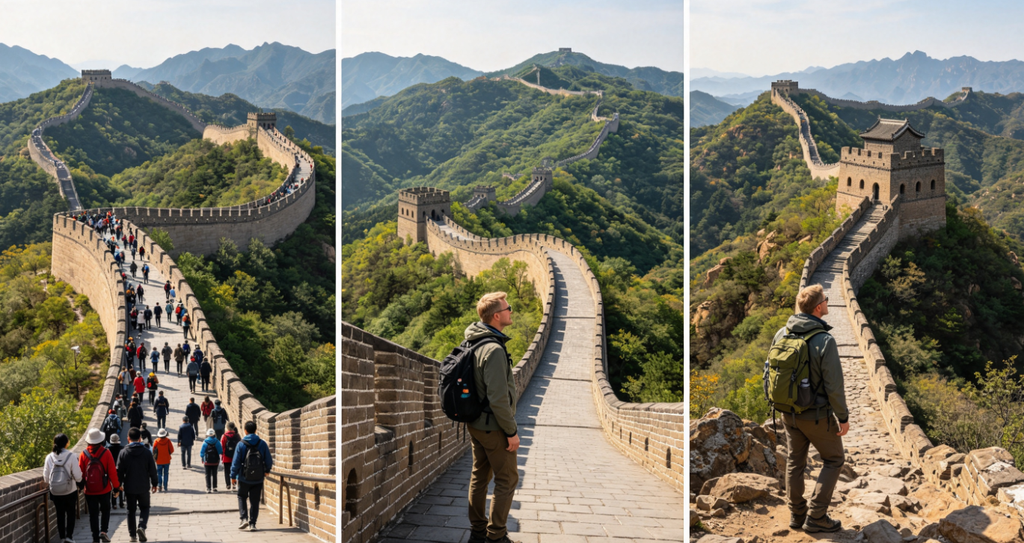
Beijing is one of the best bases for visiting several famous sections.
The three most relevant options for first-time visitors are:
- Badaling
- Mutianyu
- Jinshanling
They are not interchangeable.
Each provides a different balance of:
- Accessibility
- Crowds
- Hiking
- Restoration
- Scenery
- Travel time
Badaling Great Wall
Badaling is one of the most accessible and developed sections.
Its advantages include:
- Convenient transportation
- Extensive visitor facilities
- Well-restored architecture
- Clear walking routes
- Suitability for many first-time visitors
Its popularity can also mean larger crowds, particularly during peak travel periods.
Badaling can be a good choice if convenience is your highest priority.
Mutianyu Great Wall
Mutianyu is particularly popular with international travelers.
It offers:
- Dramatic mountain scenery
- Well-restored walls
- Watchtowers
- Hiking opportunities
- Visitor facilities
It can be a strong choice for travelers who want a balance between accessibility and a more scenic experience.
Families may also appreciate the available facilities, although the Wall still involves substantial walking and stairs.
Jinshanling Great Wall
Jinshanling offers a different experience.
It is farther from central Beijing and is particularly attractive to visitors interested in hiking and photography.
Compared with highly developed sections, parts of the landscape feel more rugged and expansive.
It is generally better suited to travelers who prioritize:
- Hiking
- Photography
- Fewer crowds
- Dramatic scenery
The additional travel time should be considered when planning the day.
Which Great Wall Section Should First-Time Visitors Choose?
There is no universally best section.
Instead, choose based on your priorities.
| Your Priority | Suggested Section |
|---|---|
| Easy access | Badaling |
| Scenic first visit | Mutianyu |
| Hiking | Jinshanling |
| Family convenience | Mutianyu / Badaling |
| Photography | Mutianyu / Jinshanling |
| More developed facilities | Badaling |
| More rugged experience | Jinshanling |
The important thing is to avoid choosing a section simply because someone says it is “the best.”
The best section is the one that matches your time, fitness level and travel style.
How Difficult Is Walking on the Great Wall?
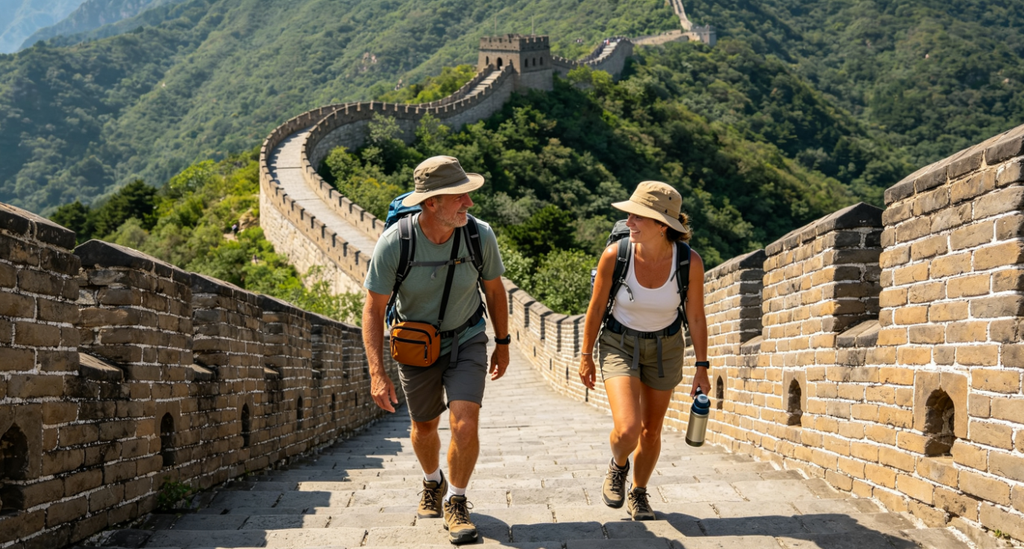
The difficulty varies significantly.
Some restored sections have relatively manageable paths.
Other areas involve:
- Steep stairs
- Uneven surfaces
- Long climbs
- Descents
- Narrow pathways
The Great Wall is therefore not simply a sightseeing platform.
It’s a physical experience.
Even visitors who are reasonably fit should bring:
- Comfortable walking shoes
- Water
- Sun protection
- Weather-appropriate clothing
How Much Time Do You Need?
A Great Wall visit can easily take most of a day when you include transportation.
A realistic schedule may involve:
Morning departure → travel to Wall → sightseeing/hiking → lunch → return to Beijing
Trying to combine the Great Wall with several major attractions in central Beijing on the same day often creates unnecessary pressure.
For most first-time visitors, treating the Great Wall as a dedicated day trip is more comfortable.
Should You Visit the Great Wall Independently or With a Tour?
Both approaches can work.
Independent Travel
Independent travel can suit visitors who:
- Enjoy planning transportation
- Want maximum flexibility
- Are comfortable navigating
- Prefer controlling their own schedule
Private or Organized Travel
A private option can be useful if you want:
- Door-to-door transportation
- Flexible departure times
- Less navigation
- Local guidance
- A more personalized itinerary
For travelers who want sightseeing and transportation coordinated, Beijing private tours can be particularly useful for combining the Great Wall with other Beijing experiences.
What Should You Bring?
A Great Wall visit doesn’t require a huge amount of equipment.
Bring:
- Comfortable walking shoes
- Water
- Sunscreen
- Hat
- Weather-appropriate clothing
- Phone
- Portable battery
- Small backpack
Avoid carrying unnecessary heavy luggage.
The Wall involves enough physical effort without adding extra weight.
What Should You Wear?
Your clothing should depend on the season.
Spring
Layered clothing is useful because temperatures can change during the day.
Summer
Choose lightweight clothing and bring sun protection.
Autumn
Comfortable layers work well, especially when temperatures change between morning and afternoon.
Winter
The Wall can be extremely cold and windy.
Warm layers, gloves and appropriate footwear are important.
When Is the Best Time to Visit the Great Wall?
Each season offers a different experience.
Spring
Comfortable temperatures and fresh vegetation can make hiking enjoyable.
Summer
The landscape is green, but heat and humidity can make climbing more tiring.
Autumn
Cooler temperatures and colorful landscapes make autumn particularly attractive for hiking and photography.
Winter
Snow and low crowds can create a dramatic atmosphere, but conditions can be cold and slippery.
The best season therefore depends on whether you prioritize:
comfortable hiking + scenery + fewer crowds + photography
rather than simply looking for one universal “best month.”
Why Weather Matters More on the Great Wall
Weather affects the Wall more than it affects many urban attractions.
Heat makes steep climbs harder.
Rain can make surfaces slippery.
Snow can create difficult walking conditions.
Strong wind can make exposed sections uncomfortable.
Before leaving Beijing, check the forecast and adjust your plans if necessary.
Flexibility is particularly valuable for Great Wall trips.
What Should You Eat During a Great Wall Day Trip?
A common mistake is spending too much time traveling for a meal.
For a Great Wall day trip, lunch should generally be convenient and close to your route.
You can also return to Beijing for a more substantial dinner.
If you’re planning several food experiences during your trip, use your Beijing food guide to understand what local dishes to prioritize on other days.
This lets you keep the Great Wall day focused on sightseeing rather than constantly traveling between restaurants.
Can You Combine the Great Wall With Other Attractions?
Yes, but be realistic.
The Great Wall itself can consume most of a day.
Trying to visit:
Great Wall + Forbidden City + Temple of Heaven + Summer Palace
in one day is generally too ambitious.
A better approach is to combine the Wall with something geographically compatible and relatively low-pressure.
For example:
Great Wall → nearby lunch → return to Beijing → relaxed dinner
is often more enjoyable.
Why the Great Wall Is Worth Visiting
Photographs cannot fully communicate the scale of the landscape.
Walking along the Wall gives you a different understanding of its construction.
You see:
- How steep the terrain is
- How watchtowers were positioned
- How far the landscape extends
- How difficult transportation must have been historically
- How the Wall follows mountain ridges
The physical experience makes the historical story easier to understand.
Great Wall Myths vs. Reality
| Myth | Reality |
|---|---|
| The Great Wall is one continuous wall | It is a network of structures built across different periods |
| It was built by one emperor | Many states and dynasties contributed |
| It can easily be seen from the Moon | This is a popular myth |
| Every section looks the same | Sections vary greatly |
| The Wall’s only purpose was defense | It also supported communication and border control |
| Visiting the Wall is easy | Some sections require significant hiking |
Knowing these facts can change how you experience the site.
Instead of seeing a giant wall, you begin to see a historical system shaped by geography, politics and military strategy.
The Great Wall as an Engineering Achievement
Building defensive structures across mountainous terrain required enormous organizational capacity.
Builders had to solve problems involving:
- Materials
- Transportation
- Terrain
- Labor
- Water
- Food supply
- Communication
- Maintenance
Some sections run along extremely steep ridges.
The Wall’s engineering significance therefore comes not simply from its length, but from the challenge of constructing and maintaining fortifications in difficult environments.
Why the Great Wall Has Survived for So Long
Not every part of the Wall has survived equally well.
Some sections have been heavily restored.
Others have deteriorated.
Natural erosion, weather, human activity and development have affected different areas in different ways.
This means the Great Wall should not be viewed as a perfectly preserved monument.
It is a historical landscape containing:
restored sections + partially preserved sections + ruins + surrounding archaeological remains.
How to Visit the Great Wall Responsibly
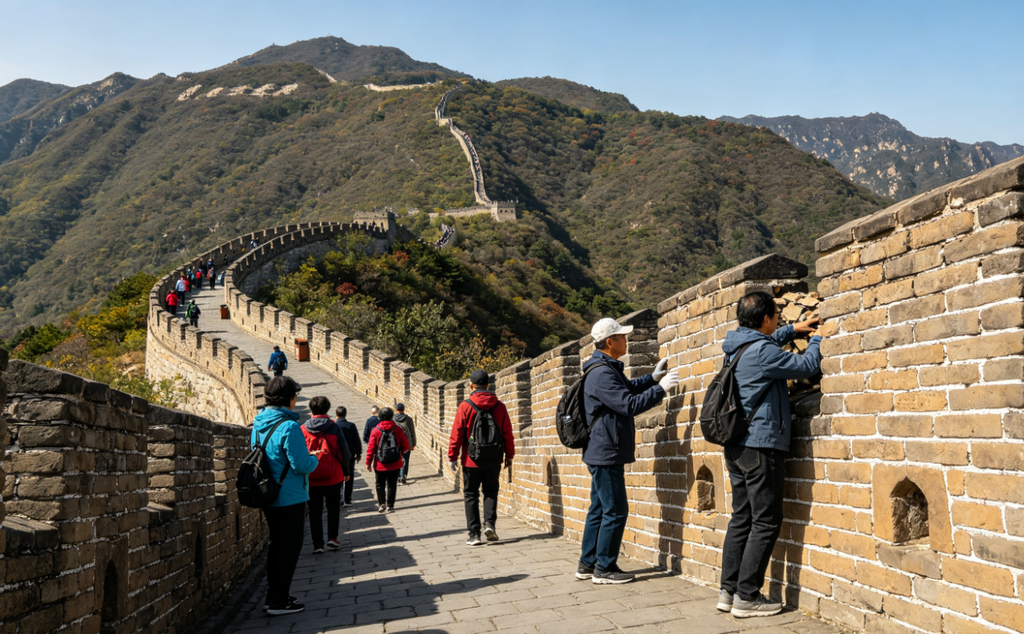
Visitors can help preserve the site by following basic principles.
Stay on Designated Paths
Avoid climbing damaged or restricted sections.
Don’t Remove Bricks or Stones
Even small pieces are part of the historical structure.
Take Your Trash With You
Remote areas can be difficult to maintain.
Respect Local Regulations
Some areas may be closed for conservation or safety reasons.
Don’t Treat Ruins Like Climbing Equipment
Historic structures are fragile.
Responsible tourism helps ensure that future visitors can experience the Wall as well.
How the Great Wall Fits Into a Beijing Trip
The Great Wall should be considered one of the major experiences of a Beijing trip rather than a quick sightseeing stop.
A balanced trip might include:
Central Beijing → Great Wall → Imperial gardens → Hutongs → Food and local culture
This creates a better contrast between:
- Imperial history
- Defensive architecture
- Everyday life
- Modern Beijing
Rather than spending every day visiting similar monumental sites, you experience different sides of the city.
A Sample Great Wall Day
Here’s a realistic structure:
7:00–8:00
Leave central Beijing.
Morning
Arrive at the Great Wall and begin exploring.
Late Morning
Continue hiking and sightseeing.
Lunch
Eat near the Great Wall or along your planned route.
Afternoon
Return toward Beijing.
Evening
Have a relaxed dinner and rest.
This schedule leaves enough flexibility for traffic, queues, weather and walking.
What First-Time Visitors Should Know Before Going
Before booking your Great Wall visit, answer five questions:
1. Which section?
Badaling, Mutianyu or Jinshanling?
2. How much hiking?
Do you want easy sightseeing or a more demanding hike?
3. How much time?
Can you dedicate most of a day?
4. How will you get there?
Public transportation, private vehicle or organized tour?
5. What else are you doing that day?
Avoid creating an unrealistic schedule.
These five decisions will make your visit much easier.
Is the Great Wall Worth Visiting on a Short Beijing Trip?
Yes.
Even with only three days in Beijing, the Great Wall can be worth dedicating a full day to.
However, you need to accept the trade-off.
A Great Wall day means less time for other urban attractions.
That’s why itinerary design matters.
Rather than trying to “fit in everything,” decide which experiences are most important to you.
Final Takeaway
So, what is the Great Wall of China?
It is not simply a giant wall stretching continuously across China.
It is a vast historical network of walls, watchtowers, fortresses, passes and communication structures built and rebuilt by different states and dynasties over more than two thousand years.
Its purpose evolved over time, but military defense, frontier control and communication were central to its development.
For modern travelers, the Great Wall offers something that few historical attractions can provide: the opportunity to physically experience the relationship between history, architecture and landscape.
If you’re visiting Beijing for the first time, choose your section according to your priorities rather than looking for one universally “best” section.
Choose Badaling for accessibility, Mutianyu for a balance of scenery and convenience, or Jinshanling for a more hiking-focused experience.
Give the visit enough time, wear comfortable shoes, check the weather, and don’t underestimate the walking involved.
Most importantly, don’t just photograph the Wall.
Look at where it was built, how it follows the mountains, where the watchtowers stand, and how the landscape would have influenced the people who designed and defended it.
That’s when the Great Wall stops being just a famous landmark and becomes a much more fascinating part of China’s history.