
How Long Is the Great Wall of China? Length, Sections & Facts
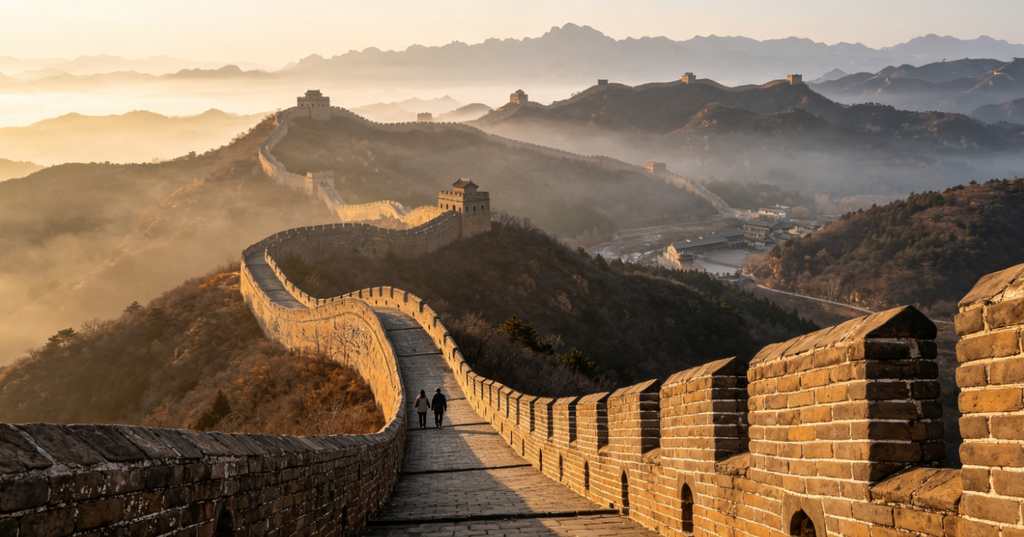
The Great Wall of China is often described as one enormous wall stretching across northern China. But the reality is more complicated—and much more interesting.
If you search for how long is the Great Wall of China, you will usually see the figure 21,196.18 kilometers (13,170.7 miles). This is the officially measured length of the entire Great Wall system, including walls, trenches, mountains, rivers and other natural defensive barriers incorporated into different periods of construction.
That number does not mean there is one continuous stone wall that you can walk from one end to the other.
The Great Wall is actually a vast defensive network built, rebuilt and extended over many centuries. Different sections belong to different historical periods, use different materials and offer very different experiences for visitors.
Understanding this distinction makes the famous number much easier to understand—and helps you plan a much more realistic Great Wall visit.
Quick Answer: How Long Is the Great Wall of China?
The officially surveyed Great Wall system measures approximately:
21,196.18 km (13,170.7 miles)
However, this figure covers more than the visible masonry walls tourists usually imagine.
The Great Wall system includes:
- Defensive walls
- Trenches
- Fortifications
- Passes
- Watchtowers
- Natural barriers
- Mountain ridges
- Rivers and other defensive features
It also includes remains from many different historical periods.
So when someone asks how long is the Great Wall of China, there are actually several possible answers depending on what is being measured.
For travelers, the more useful question is often:
How much of the Great Wall can I actually visit?
That answer is much smaller—and much more practical.
Why Is the Great Wall So Long?
The Great Wall wasn’t constructed as one project.
It developed over more than two thousand years.
Different Chinese states and dynasties built defensive walls for different purposes, while later rulers repaired, connected or extended earlier structures.
The earliest defensive walls date back to ancient periods before the unification of China.
After the Qin dynasty unified China, some earlier walls were connected and expanded.
Later dynasties continued to build and maintain frontier defenses.
The Ming Dynasty produced many of the best-preserved sections visitors see today.
This long construction history is the main reason the Great Wall should be understood as a system, rather than a single building.
The Great Wall Is Not One Continuous Wall
This is one of the most important facts to understand.
There are gaps between different sections.
Some parts have disappeared through erosion, agriculture, development or natural processes. Other sections survive only as earthworks or archaeological remains.
In some areas, mountains, cliffs, rivers and other geographical features were deliberately incorporated into the defensive system.
As a result, the Great Wall is better described as a network of defensive structures across northern China.
The famous image of a stone wall winding along mountain ridges represents only part of this much larger system.
What Does the 21,196 km Figure Actually Include?
The modern official measurement considers the Great Wall as a complex defensive system rather than simply measuring visible brick walls.
That distinction matters.
Imagine measuring only the masonry sections that remain standing today.
The number would be considerably different from the total historical Great Wall system.
The larger figure includes defensive works associated with different periods and regions.
It also reflects the fact that some defensive lines used natural geography rather than constructing a massive artificial wall across every kilometer.
This is why two sources may give apparently different numbers without either necessarily being wrong.
They may simply be measuring different things.
How Was the Great Wall Measured?
The modern total was not created by simply drawing a line across a map.
Researchers surveyed surviving sections and remains associated with different historical periods.
The process involved:
- Field surveys
- Historical records
- Geographic mapping
- Remote sensing
- Archaeological research
- GPS and other modern measurement techniques
This work helped researchers identify sections that are not immediately recognizable as the traditional “Great Wall.”
As a result, the official total is much more comprehensive than what most tourists encounter.
Why Do You Sometimes See a Much Shorter Number?
You may encounter other figures when researching the Great Wall.
This usually happens because sources are referring to different categories.
For example, one source might discuss:
the total Great Wall system
while another discusses:
the surviving Ming Dynasty wall
and another refers to:
a specific tourist section.
These are not interchangeable measurements.
The important thing is to check what the number represents before comparing it with another source.
How Long Is the Ming Great Wall?
The Ming Dynasty is particularly important for modern tourism because many of the most recognizable and accessible sections around Beijing were built or substantially rebuilt during this period.
The Ming Great Wall is often discussed separately from the complete historical Great Wall system.
This distinction is useful because most visitors traveling from Beijing aren’t visiting walls from every historical period.
They are usually visiting a specific Ming-era section.
That means the total 21,196 km figure provides historical context, but it isn’t a useful estimate of how much you’ll walk during your trip.
How Much of the Great Wall Can Tourists Visit?
Tourists can visit numerous sections of the Great Wall, but they are spread across different parts of northern China.
Near Beijing, several sections are especially well known.
Badaling
Badaling is one of the most accessible and developed sections.
It has extensive visitor infrastructure and is a common choice for first-time visitors who prioritize convenience.
Mutianyu
Mutianyu is known for its mountain scenery, restored wall and watchtowers.
It offers a good balance between accessibility and a more scenic hiking experience.
Jinshanling
Jinshanling is particularly attractive to visitors interested in hiking and photography.
Some routes provide a stronger sense of the surrounding landscape and changing condition of the wall.
These sections should not be treated as interchangeable.
The right choice depends on what you want from your visit.
Is the Great Wall the Same Length Everywhere?
No.
This is another reason the total length can be misleading for travelers.
A tourist section may include:
- A short accessible route
- Several watchtowers
- Steep stairways
- Mountain ridges
- Restored and unrestored areas
You might spend several hours on a section without covering anything close to the total length of the Great Wall.
The scale of the entire historical system and the scale of an individual tourist route are completely different.
How Far Do You Actually Walk on the Great Wall?
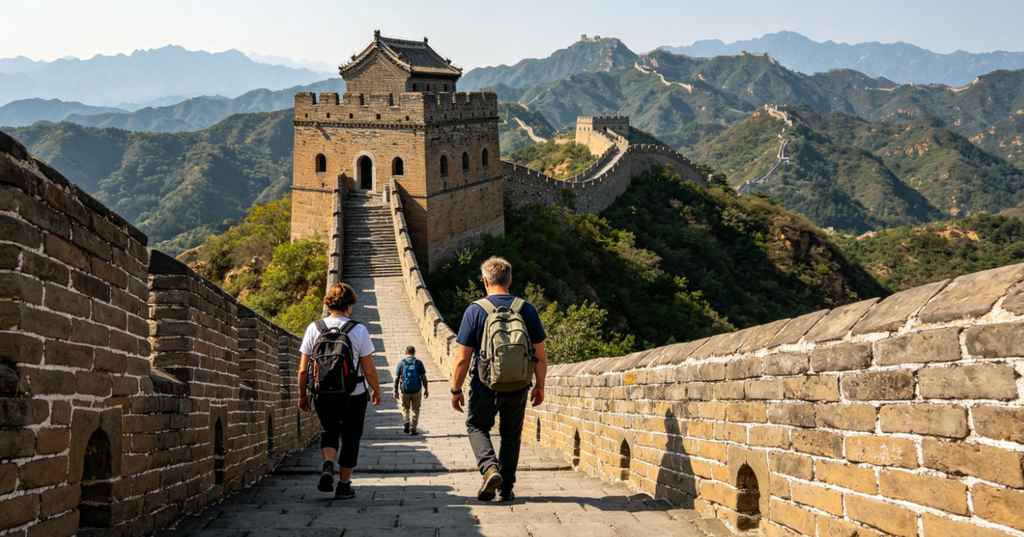
Your walking distance depends on the section and route you choose.
A short sightseeing visit may involve relatively little hiking.
A longer route can involve several kilometers of steep walking.
The difficulty isn’t determined by distance alone.
You also need to consider:
- Elevation changes
- Uneven steps
- Steep staircases
- Weather
- Heat or cold
- Your fitness level
- How frequently you stop
A route that looks short on a map can feel considerably longer once you’re climbing steep sections.
Why Does the Great Wall Feel Longer Than Expected?
The answer is elevation.
Many famous sections follow mountain ridges rather than flat land.
That means visitors aren’t simply walking horizontally.
You may repeatedly:
climb → descend → climb again → descend again
Some staircases are surprisingly steep.
The experience can therefore be physically demanding even when the total walking distance isn’t especially large.
This is why comfortable footwear and realistic scheduling matter more than the headline length of the Great Wall.
Does the Great Wall Run in a Straight Line?
No.
The wall follows the terrain.
Instead of crossing mountains directly, builders often constructed defensive lines along ridges and strategic passes.
The resulting route can:
- Curve around mountains
- Climb ridges
- Follow valleys
- Connect watchtowers
- Use natural barriers
This winding structure is one reason the Great Wall is so visually distinctive.
It also contributes to the difference between measuring a wall’s actual path and measuring the straight-line distance between two locations.
Why Were Watchtowers Important?
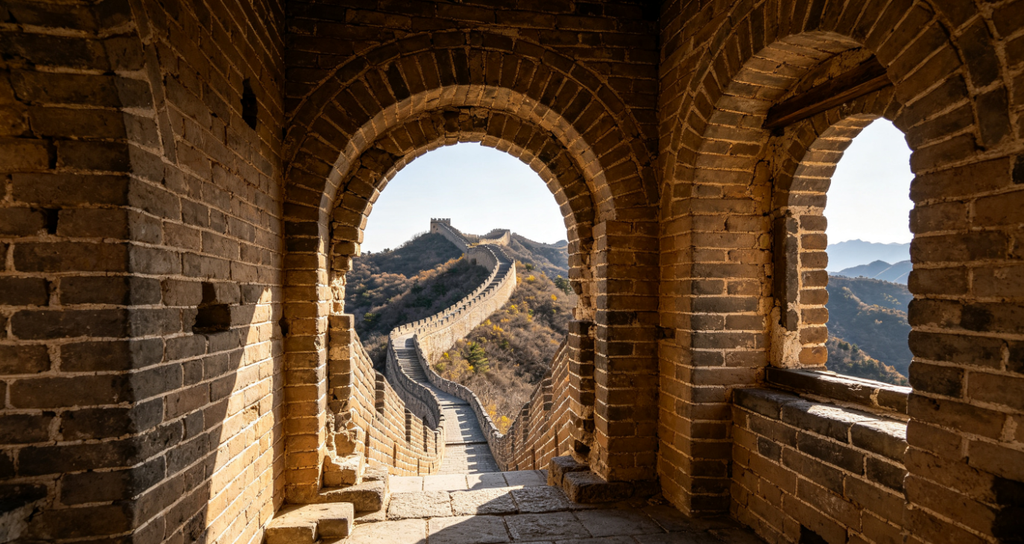
The Great Wall was not simply a physical barrier.
Watchtowers were an essential part of the defensive system.
They provided locations for:
- Observation
- Communication
- Troop movement
- Signaling
- Defensive operations
Their positions were closely related to geography.
From a modern tourist perspective, watchtowers also help explain why the Great Wall isn’t simply a long horizontal structure.
The wall was part of a broader military landscape.
Was the Great Wall Built to Stop Everyone From Crossing?
Not exactly.
The Great Wall wasn’t an impenetrable barrier.
Its purpose was more complex.
It could help:
- Control movement
- Protect strategic routes
- Monitor frontier activity
- Slow or channel military movement
- Support border defense
- Communicate information
Passes were particularly important because controlled gateways allowed authorities to regulate movement through strategically important locations.
So the Great Wall should be understood as part of a larger border-defense strategy rather than simply a giant fence.
Why Are Some Sections Made From Brick and Others From Earth?
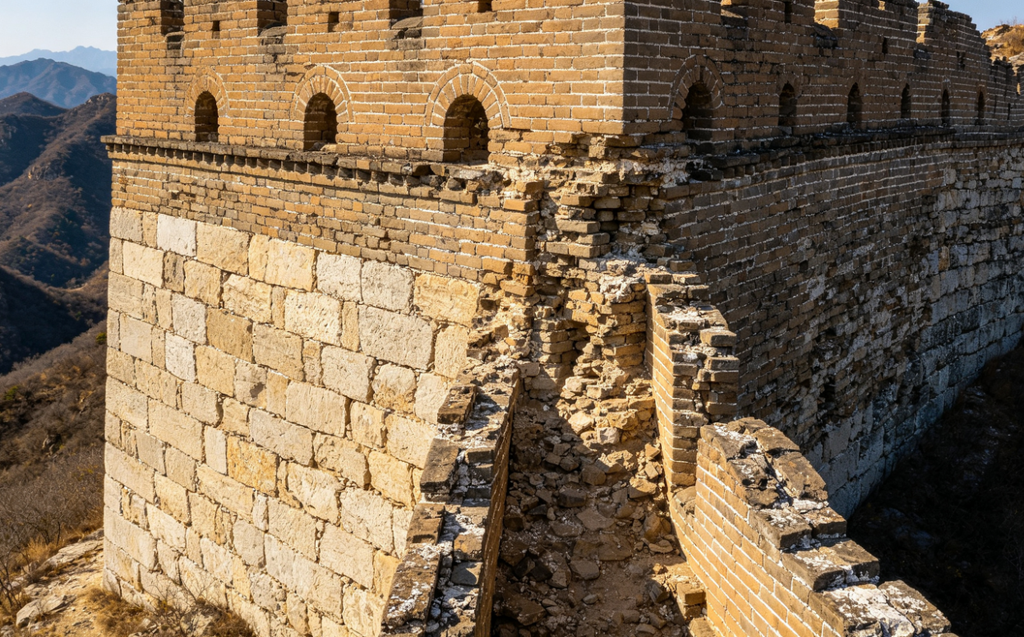
Materials depended heavily on location and historical period.
Builders used locally available materials such as:
- Rammed earth
- Stone
- Brick
- Wood in some temporary structures
Near Beijing, many well-preserved sections feature stone and brick construction.
In other regions, especially where suitable stone was scarce, rammed earth and other materials were more practical.
This creates significant differences in appearance across the Great Wall.
Is the Entire Great Wall Still Standing?
No.
Thousands of years of exposure have affected different sections in different ways.
Some areas remain remarkably well preserved.
Others are heavily weathered.
Some survive only as low walls, earthworks or archaeological traces.
Natural erosion, human activity, agricultural development and construction have all influenced what remains visible today.
This is another reason why “the Great Wall” should not be imagined as one perfectly preserved structure.
What Makes the Great Wall Near Beijing Special?
Beijing is particularly important for Great Wall tourism because several historically significant sections are within reach of the city.
This gives visitors an unusual opportunity:
a major international city + ancient defensive architecture + mountain landscapes
within the same trip.
However, “near Beijing” does not mean “in central Beijing.”
Transportation still requires planning.
This is particularly important if you’re staying in central districts and want to visit a less accessible section.
How Should You Choose a Great Wall Section?
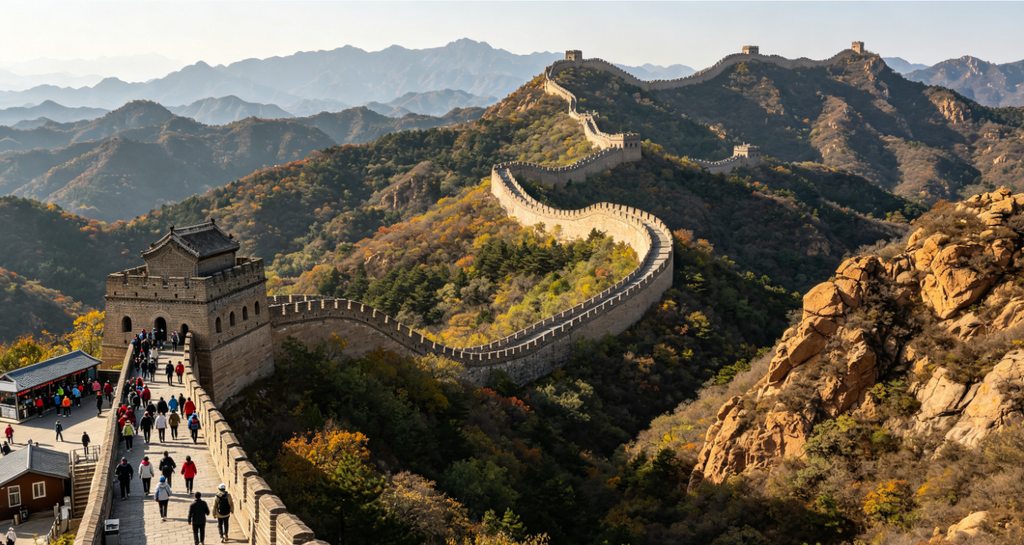
Start with your priorities.
Choose Badaling If You Value:
- Convenience
- Accessibility
- Developed facilities
- A straightforward first visit
Choose Mutianyu If You Want:
- Mountain scenery
- Restored architecture
- A strong balance between comfort and hiking
- A visually impressive experience
Choose Jinshanling If You Prefer:
- Longer hiking
- Photography
- More challenging terrain
- A less city-like atmosphere
There isn’t a universal “best” section.
The best section is the one that matches your available time, fitness and expectations.
How Long Should You Spend at the Great Wall?
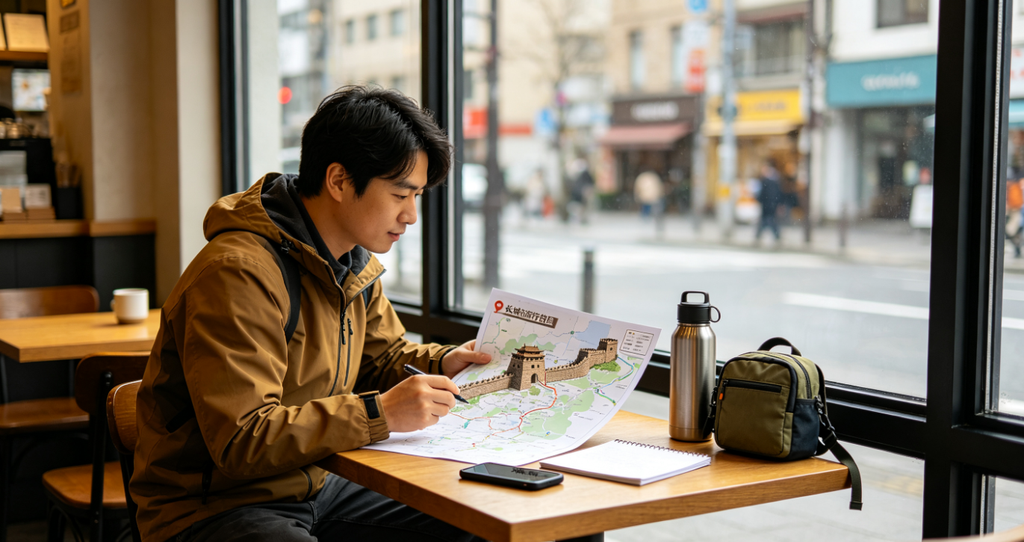
For most visitors traveling from Beijing, the Great Wall deserves a substantial portion of the day.
Don’t think of it as:
“Two hours at the Great Wall.”
Think of it as:
hotel → transportation → Great Wall → hiking → lunch → transportation → Beijing
The total experience can occupy most of a day.
This is especially true when traveling to sections farther from central Beijing.
Should You Visit the Great Wall in the Morning?
For many travelers, an earlier start has practical advantages.
You may benefit from:
- More comfortable temperatures
- More time for hiking
- Better flexibility
- Potentially lighter crowds depending on the date
- More time to deal with transportation delays
However, the ideal time depends on season, weather and the section you choose.
The important thing is to avoid creating an itinerary that leaves only a small amount of time for the wall itself.
What Should You Bring?
A Great Wall visit requires different preparation from a normal city sightseeing day.
Consider bringing:
- Comfortable walking shoes
- Water
- Weather-appropriate clothing
- Sun protection
- Portable battery
- Small backpack
- Snacks if appropriate
The exact requirements depend on the season and your planned hiking distance.
Can Children Visit the Great Wall?
Yes, but the choice of section matters.
Families should consider:
- Stair steepness
- Walking distance
- Weather
- Transportation time
- Rest opportunities
A section that is ideal for experienced hikers may not be appropriate for younger children.
For families, convenience and safety may be more important than choosing the longest possible hiking route.
Can Older Travelers Visit the Great Wall?
Yes, but again, route selection is important.
You don’t need to complete a long hike to experience the Great Wall.
A better strategy can be:
choose an accessible section + allow more time + take regular breaks.
The goal is to enjoy the architecture and landscape rather than prove how far you can walk.
How Does the Great Wall Fit Into a Beijing Itinerary?
The Great Wall works best when treated as one of the major experiences of your Beijing trip.
For example:
3-Day Trip
Day 1: Central Beijing
Day 2: Great Wall
Day 3: Local neighborhoods and culture
5-Day Trip
Day 1: Imperial Beijing
Day 2: Great Wall
Day 3: Summer Palace and nearby attractions
Day 4: Hutongs and food
Day 5: Flexible exploration
If you’re coordinating attractions, transportation and available time, a Beijing trip planner can help organize the route around your priorities rather than simply adding attractions one after another.
Should You Visit the Great Wall Independently or With a Tour?
Both approaches can work.
Independent Travel
Good for travelers who prefer:
- Flexibility
- Independent exploration
- Public transportation
- Controlling their own schedule
But you’ll need to handle:
- Transportation
- Tickets
- Timing
- Navigation
- Return arrangements
Organized or Private Tours
These can be useful when you want:
- Easier transportation
- Local guidance
- More efficient logistics
- Less planning responsibility
A selection of Beijing tours can be especially useful if the Great Wall is one part of a larger itinerary and you don’t want to coordinate every transportation detail yourself.
What Should First-Time Visitors Know Before Going?
The most important practical lesson is this:
Don’t judge your Great Wall visit by the total length of the Great Wall.
The 21,196 km figure describes an enormous historical system.
Your experience will involve only one specific section or route.
Instead, focus on:
- Which section you want to visit
- How difficult the route is
- How long transportation takes
- How much walking you’re comfortable with
- What the weather will be like
- How the visit fits into the rest of your Beijing itinerary
If this is your first trip to the city, the Beijing travel tips for first-time visitors guide can help with the broader practical issues around transportation, payments, food and daily planning.
Great Wall Length: The Numbers at a Glance
| Question | Answer |
|---|---|
| Official total Great Wall system | About 21,196.18 km |
| Approximate miles | About 13,170.7 miles |
| Is it one continuous wall? | No |
| Does the total include different dynasties? | Yes |
| Does it include more than masonry walls? | Yes |
| Are all sections preserved? | No |
| Can tourists visit the entire length? | No |
| Are Beijing’s tourist sections only a small part of the total? | Yes |
The table highlights why the headline figure should always be interpreted in context.
Great Wall vs. Tourist Section: What’s the Difference?
This distinction is worth remembering.
The Great Wall System
A vast historical defensive network spanning many regions and periods.
A Great Wall Section
A specific surviving portion that visitors can access.
A Tourist Route
The particular path you walk within that section.
These three concepts are often mixed together online.
Once you separate them, the different length figures become much easier to understand.
5 Common Misconceptions About the Great Wall
Myth 1: It’s One Continuous Wall
It isn’t.
The Great Wall consists of multiple defensive lines and structures from different periods.
Myth 2: You Can Walk the Entire Great Wall
Theoretically discussing the total length is very different from making it a practical hiking route.
The system is enormous and includes sections that are damaged, inaccessible or separated.
Myth 3: Every Section Looks the Same
It doesn’t.
Materials, preservation and landscape vary significantly.
Myth 4: The 21,196 km Figure Is the Distance Tourists Walk
It isn’t.
It refers to the complete historical Great Wall system as measured using a broad definition.
Myth 5: The Closest Section Is Automatically the Best
Not necessarily.
The best section depends on your priorities.
Why the Length of the Great Wall Matters
At first glance, knowing the Great Wall’s length may seem like a simple trivia question.
But the number tells us something important about Chinese history.
The Great Wall wasn’t a single construction project.
It represents centuries of changing political boundaries, military strategies, engineering methods and relationships between settled agricultural regions and frontier areas.
Its enormous scale also demonstrates how defensive infrastructure was shaped by geography.
Mountains, valleys and passes weren’t simply obstacles.
They became part of the defense system.
The Most Important Number Isn’t Always 21,196 km
If you’re researching the Great Wall for historical purposes, the total length is fascinating.
But if you’re planning a visit, a different set of numbers matters more:
- How far is the section from Beijing?
- How long does transportation take?
- How many kilometers will I actually hike?
- How much elevation will I climb?
- How long should I spend there?
- How difficult is the route?
These questions transform a historical statistic into useful travel planning.
Final Takeaway
So, how long is the Great Wall of China?
The officially measured Great Wall system is approximately 21,196.18 kilometers (13,170.7 miles).
But this number needs context.
The Great Wall is not one continuous structure built at one time. It is a huge defensive network containing walls, trenches, watchtowers, passes and natural defensive features constructed and modified across different historical periods.
For travelers, the more important question isn’t how many kilometers the entire system covers.
It’s which section you want to experience and how that section fits into your Beijing itinerary.
Badaling may suit travelers who prioritize convenience. Mutianyu offers a strong combination of scenery and accessibility. Jinshanling is more attractive to visitors looking for a longer and more challenging hiking experience.
Once you understand the difference between the total Great Wall system, a specific historical section, and the route you actually walk, the famous 21,196-kilometer figure makes much more sense.
And that distinction is exactly what makes the Great Wall more than just a very long wall: it is a layered historical landscape built over centuries.