
What Is Peking Duck and Why Is It Famous?
What Is Peking Duck?
What is Peking duck? Peking duck is a traditional Beijing dish made from duck roasted until its skin becomes glossy, golden-brown, and crisp while the meat remains tender and flavorful. It is typically served with thin wheat pancakes, sweet bean sauce, sliced scallions, and cucumber, allowing diners to combine the ingredients into small wraps.
Known in Chinese as 北京烤鸭 (Běijīng kǎoyā), Peking duck is more than a famous restaurant dish. Its preparation, carving, presentation, and shared dining style reflect a long culinary tradition associated with Beijing. The dish is also internationally recognized as one of the city’s signature foods. The Beijing municipal government’s cultural guide highlights its historic preparation methods and the long-standing reputations of restaurants such as Bianyifang and Quanjude.
For international visitors, understanding the dish means looking beyond its crispy skin. Its reputation comes from the combination of specialized roasting techniques, carefully balanced flavors, traditional serving customs, and its connection to Beijing’s food culture.
Why Is Peking Duck So Famous?
Peking duck has achieved international recognition for several reasons. Its distinctive texture, elaborate preparation, historical associations, and interactive presentation make it different from an ordinary roasted meat dish.
1. The Contrast Between Crispy Skin and Tender Meat

The defining feature of Peking duck is the contrast between its skin and meat.
The skin should be thin, crisp, and richly flavored, while the meat should remain moist and tender. Achieving both textures requires careful preparation before roasting, controlled heat, and attention to the duck throughout the cooking process.
Traditional methods may involve separating the skin from the flesh, applying a maltose-based glaze, drying the exterior, and roasting the duck in a specialized oven. These steps help produce the characteristic appearance and texture associated with the dish. The precise process varies between restaurants and cooking traditions.
This contrast is one reason the dish appeals to diners who appreciate texture as much as flavor. The crisp skin provides an immediate crunch, while the meat adds richness and depth.
2. A Long History Connected to Beijing
Peking duck’s history developed over several centuries. Accounts of roasted duck appear in descriptions of earlier Chinese culinary traditions, while the dish became closely associated with Beijing’s imperial cuisine during the Yuan, Ming, and Qing periods.
Its precise origins are not completely settled, and historical accounts differ on when particular roasting methods first appeared. What is clear is that roasted duck became an established part of Beijing’s culinary identity and was served in elite dining settings before becoming widely available through restaurants.
Two historically important establishments illustrate this development:
- Bianyifang: Known for its traditional closed-oven roasting method, which uses heat retained inside the oven rather than suspending the duck over an open flame.
- Quanjude: Founded in 1864, it became famous for its hanging-oven method, in which ducks are suspended and roasted over a wood fire.
These methods produce different roasting environments and can influence the final texture and flavor. Both traditions have been recognized in China’s national intangible cultural heritage system.
The dish’s long history gives it cultural significance beyond its taste. For many visitors, eating Peking duck is a way to experience an established part of Beijing’s culinary heritage.
3. A Distinctive Preparation and Serving Ritual
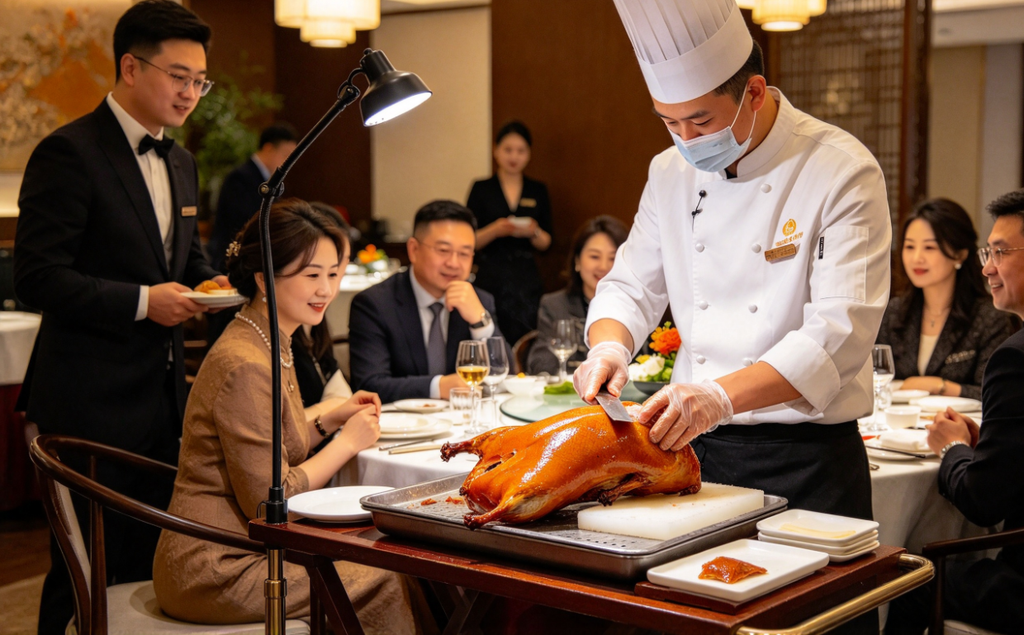
Peking duck is often presented as a shared meal rather than simply delivered as a plate of roasted meat.
In traditional restaurants, a skilled chef may carve the duck near the table. The slices are arranged for diners, who can appreciate the crisp skin and tender meat before assembling their own wraps.
This presentation demonstrates the importance of knife skills, consistency, and timing. Carving also separates the duck into different portions so that diners can enjoy the skin and meat in different ways.
The experience engages more than taste. Diners see the finished duck, hear the explanation of how to eat it, and participate in assembling each bite. For travelers unfamiliar with Chinese dining customs, this makes the meal memorable and relatively easy to share with companions.
4. A Flavor Combination That Balances Richness and Freshness
Peking duck is rich, but its traditional accompaniments help balance that richness.
The duck provides savory flavor and fat, while the sauce contributes sweetness and fermented soybean notes. Scallions add a sharp, fresh taste, and cucumber supplies a cool, crisp contrast.
The thin pancake brings the ingredients together without overwhelming the flavor of the duck itself.
Rather than relying on a single seasoning, the dish combines several elements that complement one another. Diners can adjust the proportions according to personal preference, using more vegetables for freshness or more sauce for a stronger, sweeter flavor.
How Is Traditional Peking Duck Prepared?
Authentic Peking duck requires considerably more preparation than simply placing a duck in an oven. The details vary between restaurants, but several stages are common to traditional approaches.
Step 1: Selecting and Preparing the Duck
The duck must have suitable characteristics for roasting, including an appropriate balance of skin, fat, and meat. After cleaning and preparation, the skin is treated to help it become crisp during cooking.
In some traditional methods, air is introduced between the skin and flesh. This creates separation that helps the exterior dry and roast more effectively.
The goal is not merely to brown the skin. The preparation must also support an even result across the duck.
Step 2: Applying a Glaze and Drying the Skin
A glaze containing maltose or another suitable sweetening ingredient may be applied to the exterior. This contributes to the glossy appearance and helps the skin develop its characteristic color during roasting.
The duck is then left to dry under controlled conditions. Drying is important because excessive surface moisture makes it more difficult to develop a crisp exterior.
Preparation time and methods depend on the kitchen’s equipment, recipe, and workflow. Traditional restaurant techniques can involve several hours of preparation before the duck enters the oven.
Step 3: Roasting With Controlled Heat
Two well-known traditional approaches are closed-oven roasting and hanging-oven roasting.
| Feature | Closed-oven method | Hanging-oven method |
|---|---|---|
| Cooking environment | Heat retained inside an enclosed oven | Duck suspended in an oven with an open fire |
| Traditional association | Bianyifang | Quanjude |
| Heat source and control | Radiant heat from heated oven surfaces | Heat from burning wood and the surrounding oven |
| Culinary focus | Controlled roasting in an enclosed environment | Roasting over a fire with close attention to color and skin |
These are broad distinctions, not guarantees of a particular flavor. The final result also depends on the duck, preparation, temperature control, roasting time, and the skill of the kitchen.
Modern restaurants may use different equipment or adapt traditional procedures. A restaurant’s quality should therefore be judged by the actual dish and cooking standards rather than by one technique alone.
Step 4: Carving and Serving
Once roasted, the duck is carved into slices suitable for serving. The skin and meat may be presented together or in separate portions, depending on the restaurant’s style.
The duck is then accompanied by pancakes, sauce, and vegetables. In some restaurants, the remaining meat and bones are used for additional dishes or soup, making the meal more varied and reducing waste.
This final stage matters because the texture of the skin changes as it cools. Serving and eating the duck promptly helps preserve the contrast between the crisp exterior and tender meat.
How Do You Eat Peking Duck?

First-time visitors do not need special expertise to enjoy Peking duck. The traditional approach is straightforward, and diners can adjust each wrap to their own taste.
Step 1: Start With the Skin
Some restaurants serve pieces of crisp skin separately, sometimes with a little sugar for dipping. This allows diners to appreciate the texture and roasted flavor before adding sauce or vegetables.
Not every restaurant follows exactly the same serving order, so follow the presentation offered by the chef.
Step 2: Add the Sauce to a Pancake
Place a thin pancake on your plate and spread a small amount of sweet bean sauce or the sauce provided by the restaurant.
Traditional Beijing preparations often use tianmianjiang, a sweet-savory fermented wheat and soybean paste. Some restaurants outside China use hoisin sauce instead. The two are related in culinary use but are not identical in flavor.
Start with a small amount of sauce, especially if you prefer the duck’s natural flavor to remain prominent.
Step 3: Add Duck and Vegetables
Place several slices of duck on the pancake, then add thin strips of scallion and cucumber.
The scallion contributes a sharp, aromatic flavor, while cucumber adds freshness and crunch. Together, they balance the richness of the roasted meat.
Step 4: Fold and Eat
Fold the sides of the pancake inward and roll it into a small wrap. Eat it while the duck is still warm.
There is no need to make the wrap perfectly neat. The aim is to combine the ingredients in a way that suits your taste.
A useful tip: Avoid adding too much sauce or filling the pancake with too much duck. A smaller wrap often makes it easier to appreciate the balance between skin, meat, sauce, and vegetables.
What Makes Peking Duck Different From Other Roast Duck Dishes?
Not every crispy roast duck dish is Peking duck. Other Chinese regions have their own duck preparations, with different seasonings, textures, and serving styles.
The distinction is especially important for travelers who have eaten Chinese roast duck in restaurants outside China.
| Feature | Peking duck | Other roast duck styles |
|---|---|---|
| Main characteristic | Crisp skin, tender meat, carefully prepared presentation | Varies by region and recipe |
| Common accompaniments | Thin pancakes, sweet bean sauce, scallions, cucumber | May include rice, noodles, other sauces, or different vegetables |
| Serving style | Often carved into slices and shared | May be chopped, sliced, or served as individual portions |
| Culinary identity | Closely associated with Beijing | Depends on regional tradition |
For example, Cantonese roast duck often has a different seasoning profile and is commonly served chopped, sometimes with rice or noodles. Crispy aromatic duck served in some Western restaurants also differs in its preparation and customary accompaniments.
The name on a menu does not always tell the whole story. If you want the traditional Beijing experience, look for a restaurant that specializes in Peking duck and explains how it prepares and serves the dish.
How to Choose a Good Peking Duck Restaurant in Beijing

A famous restaurant is not automatically the best choice for every traveler. The right restaurant depends on your budget, location, dining preferences, and interest in traditional techniques.
Look for Clear Preparation and Serving Information
A specialist restaurant should be able to explain its roasting style and the way the duck is served. Table-side carving can be part of the experience, although its absence does not necessarily mean the food is poor quality.
Look at recent reviews and photographs to understand portion sizes, presentation, and the overall dining environment.
Compare the Complete Meal Price
Before ordering, check whether the menu price refers to a whole duck, a half duck, or a specific portion.
Also consider whether pancakes, sauce, vegetables, side dishes, and soup are included or charged separately. Prices vary considerably by restaurant, location, and dining category, so avoid assuming that every famous establishment costs the same.
For couples or small groups, a whole duck may provide better value than ordering several separate portions, but the ideal choice depends on appetite and how many other dishes you plan to share.
Consider Traditional and Modern Styles
Bianyifang and Quanjude are useful reference points for travelers interested in the dish’s history and traditional roasting techniques. Other restaurants offer modern presentations, lighter interpretations, or a more contemporary dining environment.
There is no single restaurant style that suits everyone. Some visitors prioritize heritage, while others care more about flavor, service, location, or price.
Plan Around Your Sightseeing Schedule
Peking duck is often best enjoyed as a relaxed meal rather than something squeezed into a very short break.
If you are arranging a custom Beijing trip, consider where you will be sightseeing that day, how much time you want for dinner, and whether you need a reservation. This can help you choose a restaurant that fits naturally into your plans.
For additional ideas about Beijing’s dining traditions, explore this Peking duck guide, which can complement your research into the city’s wider food culture.
Is Peking Duck Worth Trying for First-Time Visitors?
For most visitors interested in Beijing’s culinary heritage, Peking duck is worth trying at least once. It combines a distinctive texture, a recognizable flavor profile, and a traditional way of serving food that makes the meal an experience in its own right.
However, it is not the only dish worth trying in Beijing. The city also has noodles, dumplings, traditional snacks, and other regional specialties. Travelers exploring what food is Beijing famous for can build a broader understanding of the city’s cuisine by trying different dishes rather than focusing on one famous meal.
Peking duck may be less suitable for diners who avoid meat, cannot eat duck, or need to avoid ingredients such as wheat or soy. The traditional pancakes generally contain wheat, and the sauce may contain soy or other ingredients. Ask the restaurant about preparation and cross-contact if you have an allergy or strict dietary requirement.
If you are traveling with a group, sharing a duck and ordering a few complementary dishes can make the meal more varied and help everyone find something they enjoy.
Frequently Asked Questions About Peking Duck
Is Peking duck the same as Beijing roast duck?
Yes. Peking duck and Beijing roast duck are commonly used English names for the same iconic Beijing dish. The Chinese name is 北京烤鸭 (Běijīng kǎoyā).
Why is Peking duck so expensive at some restaurants?
The price reflects several factors, including ingredient quality, preparation time, roasting equipment, carving skills, restaurant location, service, and reputation. Premium restaurants may also charge more for the dining environment and additional dishes. Comparing the complete meal is more useful than looking at the headline price alone.
What sauce is traditionally served with Peking duck?
A sweet-savory fermented bean paste, commonly known as tianmianjiang or sweet bean sauce, is traditional in Beijing-style serving. Some restaurants use hoisin sauce or offer alternatives. Ask the restaurant which sauce it serves if you want a more traditional flavor.
Do you eat Peking duck with your hands or chopsticks?
Both approaches are practical. Many diners use their hands to eat the pancake wraps, while chopsticks are useful for picking up individual slices and vegetables. Follow the restaurant’s serving style and use whichever method is comfortable.
Is the skin or the meat the best part?
That depends on personal preference. The skin is prized for its crisp texture and roasted flavor, while the meat offers a tender, savory taste. Trying the skin separately and then eating it with the meat is a good way to appreciate the contrast.
Can one Peking duck feed two people?
A whole duck can often be shared by two people, but the appropriate amount depends on the duck’s size, individual appetites, and the number of side dishes ordered. Ask the restaurant about portion sizes before ordering.
What is the difference between Peking duck and Cantonese roast duck?
Peking duck is particularly associated with crisp skin, thin pancakes, sweet bean sauce, scallions, and cucumber. Cantonese roast duck usually follows a different seasoning and preparation tradition and may be served chopped with rice, noodles, or other accompaniments.
Final Thoughts: More Than a Famous Beijing Dish
Peking duck is famous because it brings together culinary technique, distinctive texture, historical tradition, and a memorable shared dining experience. Its crisp skin and tender meat are important, but so are the roasting methods, carving skills, sauces, and accompaniments that make the dish recognizable.
For travelers, the best way to appreciate it is to understand how the ingredients work together, choose a restaurant that matches their preferences, and allow enough time to enjoy the meal.
Trying Peking duck will not tell you everything about Beijing cuisine, but it provides an excellent starting point for exploring the city’s food culture and its long-standing culinary traditions.