
How Much Does Peking Duck Cost in Beijing?
A whole Peking duck in Beijing typically costs around CNY 170–400 at mainstream restaurants, while premium dining rooms can charge CNY 400 or more. But the duck itself is only part of the bill. Pancakes, sauces, side dishes, drinks and possible service charges can make the final cost significantly higher. For two people, a realistic planning budget at a mainstream restaurant is often around CNY 400–900, depending on what you order.
An English-speaking Peking duck food tour can also be useful if you want help choosing a restaurant, understanding the menu and experiencing the dish beyond simply ordering a roast duck.
The important distinction is between the price of one duck and the cost of a complete meal. A restaurant advertising a duck for CNY 250 is not necessarily a CNY 250 dining experience for two. This guide explains what you are likely to pay, which restaurant styles suit different budgets, and how to avoid unnecessary expenses.
1. How Much Does a Whole Peking Duck Cost in Beijing?
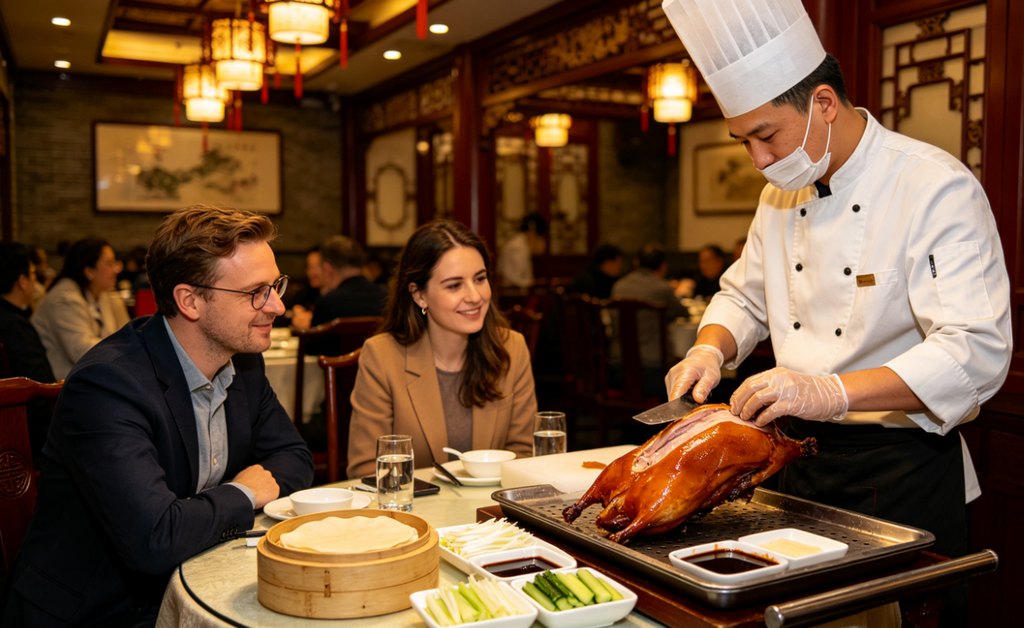
The price depends on the restaurant, its cooking style, location and dining experience. The following figures are useful for budgeting in 2026, but they are indicative ranges rather than guaranteed prices. Individual branches may have different menus, promotions and additional charges.
| Restaurant category | Indicative price for a whole duck | What to expect |
|---|---|---|
| Local and casual duck restaurants | CNY 170–250 | More straightforward dining and generally lower overall spending |
| Established traditional restaurants | CNY 250–350 | Recognized brands, traditional presentation and a more established dining experience |
| Modern premium restaurants | CNY 300–450+ | Refined presentation, premium positioning and usually higher spending on other dishes |
| Luxury hotel restaurants | CNY 400–700+ | Upscale surroundings, hotel-level service and a more expensive complete meal |
A half duck, where available, may cost around 50–60% of the whole-duck price. It can be a practical option for two people who want to try other Beijing dishes as well.
However, do not assume that every restaurant sells half a duck. Some branches offer only a whole duck or have specific set menus. Check the current menu before visiting.
What does one duck actually feed?
A whole duck is normally shared rather than ordered individually. As a rough planning guide:
- Two people: A whole duck can be generous, especially if you order several side dishes. A half duck may be enough for a lighter meal.
- Three people: One whole duck with one or two additional dishes is often a reasonable starting point.
- Four people: One whole duck can work as part of a larger meal, but you may want additional dishes depending on appetite.
- Five or more people: Consider whether one duck is enough for the group or whether ordering another duck or additional main dishes makes more sense.
These are serving suggestions, not fixed restaurant portions. The amount of edible meat, the number of pancakes and the size of the accompanying dishes vary.
2. What Is the Real Cost of Eating Peking Duck?

The most common budgeting mistake is comparing restaurants by the whole-duck price alone.
A complete meal may include the duck, pancakes, sauce, vegetables, additional dishes, tea and other drinks. Some restaurants include most accompaniments in the duck price, while others list certain items separately.
Here are practical planning examples:
| Dining situation | Suggested budget for two | Typical order |
|---|---|---|
| Simple duck meal | CNY 250–400 | Half duck or a lower-priced duck option, with limited extras |
| Mainstream restaurant meal | CNY 400–700 | One duck or a half duck with side dishes and drinks |
| More generous meal | CNY 700–900 | One whole duck, several dishes and drinks |
| Premium dining experience | CNY 900–1,500+ | Premium restaurant, additional dishes and a more elaborate meal |
These are estimated budgets, not published set-menu prices. The actual bill depends on the branch and the number of dishes ordered.
Five costs to check before ordering
1. Pancakes and condiments
Pancakes, sweet bean sauce, cucumber and scallions are essential parts of the meal, but not every restaurant handles them in the same way. They may be included, charged as a separate serving or offered in different quantities.
Do not assume that the duck price includes unlimited accompaniments.
2. Side dishes
The duck is usually the main event, but a complete meal often includes vegetables, cold dishes or another hot dish. Ordering several extras can quickly make the final bill higher than the price of the duck itself.
3. Tea and drinks
Ask whether tea is charged per person, per pot or by another arrangement. If you are not sure you want tea, ask about the price before agreeing to it.
4. Service charges
Some restaurants, particularly certain established or upscale venues, may add a service charge. This is not a universal Beijing restaurant fee. Check the menu or ask staff whether the displayed prices already include service and taxes.
5. Preparing the duck carcass
After the meat is carved, the remaining duck frame may be used for soup, fried duck bones or another preparation. Whether this is included, charged separately or available at all depends on the restaurant.
A useful question before ordering is:
Does the duck price include pancakes, sauce and vegetables? Are there any additional service or preparation charges?
That simple check is more reliable than assuming every restaurant follows the same pricing structure.
3. Where to Eat: Peking Duck Prices by Restaurant
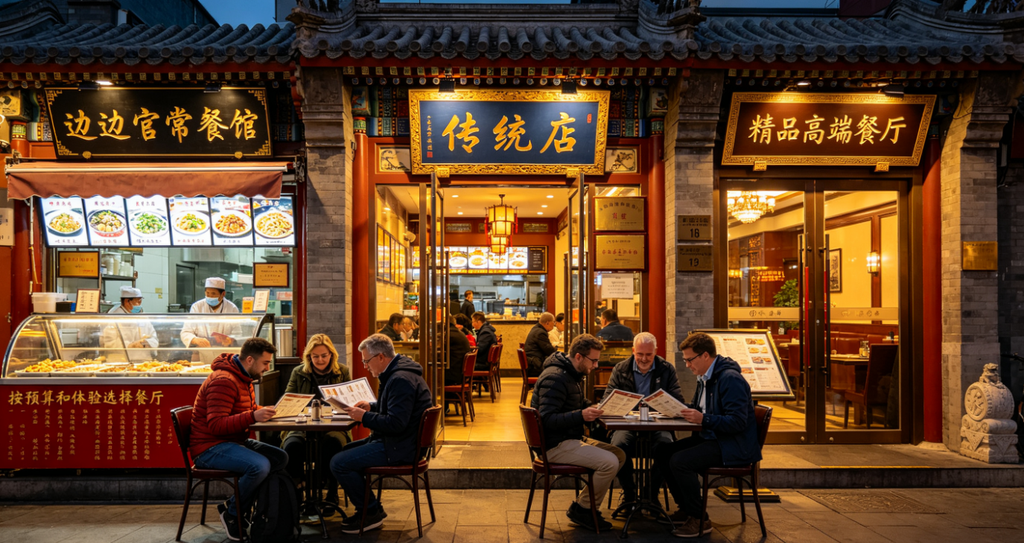
Different restaurants offer different experiences. Some are known for their history, some for value, and others for a more modern interpretation of the dish.
The following comparisons are intended to help you choose a dining style. The price ranges are indicative 2026 references, not confirmed live prices for every branch.
Siji Minfu: A Popular Balance of Price and Experience
Siji Minfu (四季民福) is a popular choice among visitors looking for a traditional-style roast duck meal without moving straight into luxury dining.
Recent third-party price references commonly place its whole duck around CNY 230–270, although the actual menu and the cost of accompaniments can vary by branch.
Its appeal is the balance of food, atmosphere and location. Some branches are particularly popular because of their proximity to major central Beijing attractions.
Best for: First-time visitors who want a recognizable Beijing duck experience at a mainstream restaurant price.
Consider before visiting: Popular branches can have substantial queues, particularly around dinner time. Check the specific branch’s queue or reservation arrangements rather than assuming you can walk straight in.
Quanjude: The Historic Restaurant Experience
Quanjude (全聚德) is one of Beijing’s best-known roast duck brands, with a history dating back to 1864.
For many visitors, the attraction is not simply the duck. It is the opportunity to experience a historic restaurant associated with Beijing’s roast-duck tradition, including the traditional carving presentation.
Recent guides place its whole-duck prices broadly around CNY 250–350, but branch pricing and service-charge arrangements should be checked before ordering.
Best for: Visitors who value the historical name and traditional dining presentation.
Consider before visiting: A famous brand does not guarantee that every branch offers the same experience. Choose the location and check the current menu instead of relying on the name alone.
Da Dong: A More Refined, Premium Experience
Da Dong (大董) is known for its modern interpretation of Peking duck, including a leaner style and more refined presentation.
Indicative 2026 references commonly place its duck around CNY 300–400 or more, depending on the branch and menu. The total meal can rise considerably once you add other dishes and drinks.
Best for: Travelers who want a more upscale meal, a modern presentation or a special-occasion restaurant.
Consider before visiting: You are paying for the overall dining experience as well as the duck. It is not necessarily the best option if your main goal is to try the dish at the lowest possible cost.
Bianyifang: A Different Roasting Tradition
Bianyifang (便宜坊) is associated with the closed-oven roasting method, which differs from the more familiar hung-oven style.
In broad terms, the difference is in how the duck is cooked and the texture of the finished dish. Hung-oven duck is commonly associated with crisp skin, while closed-oven duck offers a different balance of skin and meat texture.
Recent price references vary, with some placing its whole duck below the prices of the better-known premium options. Check the current branch menu rather than relying on a single quoted figure.
Best for: Travelers interested in comparing different Beijing roast-duck traditions.
Consider before visiting: Choose it for the cooking style and experience, not simply because its name or quoted price suggests it will always be the cheapest.
Li Qun: A More Intimate Hutong Setting
Li Qun (利群烤鸭) is known for its courtyard-style setting and more intimate atmosphere.
For some visitors, the appeal is the contrast with larger, more polished restaurants. It can feel like a different kind of Beijing dining experience.
Best for: Travelers who value atmosphere and want to combine a meal with a hutong visit.
Consider before visiting: The setting and location may be less straightforward for first-time visitors to navigate. Confirm the address, current operating arrangements and booking options before setting out.
For a more detailed comparison of restaurant locations, atmosphere and dining styles, read our guide to the best Peking duck restaurants in Beijing.
4. How to Choose the Right Restaurant for Your Budget
Instead of automatically choosing the most famous restaurant, start with the experience you want.
If your budget is limited
Look for a casual local restaurant or a more affordable established branch. Consider ordering a half duck if available, and limit the number of additional dishes.
A lower duck price does not automatically mean poor quality. It may simply reflect a more straightforward location, dining environment or menu.
If this is your first time eating Peking duck
A mainstream restaurant is often the most practical choice. You can experience the carving, pancakes and traditional accompaniments without paying for a luxury setting.
Prioritize a restaurant with a clear menu and a convenient location. That is usually more useful than choosing a famous name purely because it appears in every travel article.
If you want a special dining experience
A premium restaurant may be worth the extra cost if you care about presentation, service, atmosphere and a more refined interpretation of the dish.
However, decide whether those extras matter to you. If you mainly want to taste traditional roast duck, a mainstream restaurant may already meet your expectations.
If you are traveling with children or older family members
Convenience becomes part of the value calculation.
A restaurant close to your sightseeing route, with manageable waiting times and comfortable seating, may be a better choice than a famous branch that requires a long detour and an extended queue.
5. How to Order Peking Duck Without Overspending
You do not need to order every item on the menu to enjoy a proper roast-duck meal.
A few simple decisions can help you control the final bill.
Order the duck first. Some restaurants prepare the duck after you order, so ask how long it will take. You can then decide which additional dishes make sense.
Choose whole or half according to your group. Two people who want to try several Beijing dishes may prefer a half duck if the restaurant offers it. Three or four people may find a whole duck more practical.
Check the accompaniments. Confirm whether pancakes, sauce, cucumber and scallions are included. Avoid ordering duplicate portions without checking what is already provided.
Choose side dishes selectively. One vegetable dish and one additional local specialty may be enough for a small group. You do not need to order several expensive dishes just to make the meal feel complete.
Ask about the remaining duck frame. If you want soup or another preparation, confirm whether it is available and whether it costs extra.
Check the final bill. Before paying, review the itemized bill and ask about any charge you do not recognize.
For the traditional eating sequence, including how to combine the duck skin, meat, pancakes and condiments, see our practical guide to how to eat Peking duck.
6. Restaurant Dining vs. Packaged Peking Duck
Packaged roast duck sold in shops or online is not directly comparable with a freshly prepared restaurant meal.
A packaged product may be designed as a takeaway item or souvenir. It may be vacuum-sealed, chilled or prepared for reheating. A restaurant duck, by contrast, is served as part of a freshly prepared meal, often with carving and accompanying dishes.
The price difference reflects more than the duck itself:
- Restaurant location and rent
- Preparation and serving labor
- Dining space and service
- Fresh accompaniments
- Packaging and distribution costs for retail products
If your goal is to experience Peking duck for the first time, eating it freshly prepared in a restaurant is generally the more appropriate choice.
If you want to take something home, compare the packaging, storage instructions, production date and transport requirements. Do not assume that a cheaper packaged product offers the same experience as a restaurant meal.
7. When Is an English-Speaking Peking Duck Food Tour Worth It?
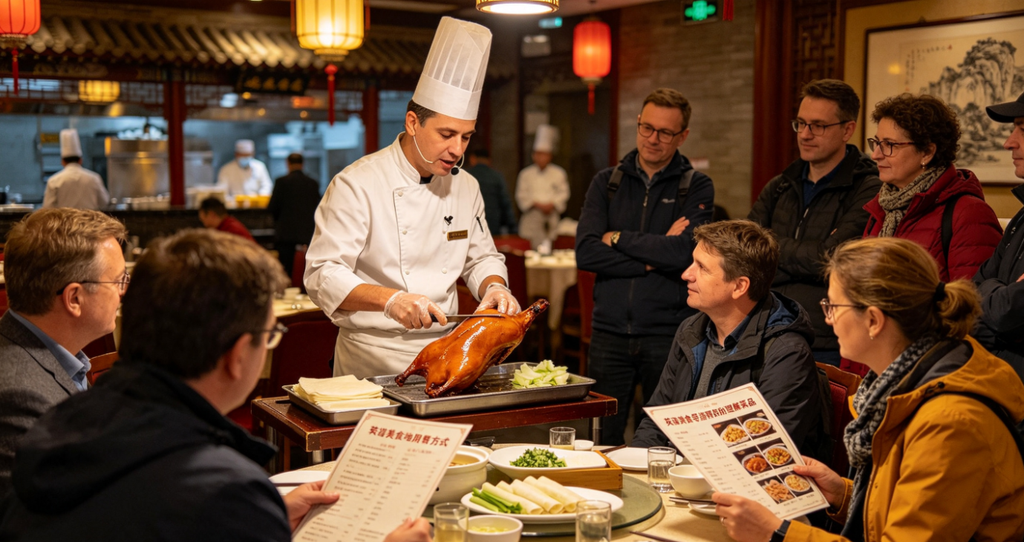
Eating Peking duck independently is entirely possible. Many restaurants are familiar with international visitors, and translation apps can help with basic menu questions.
A guided experience is more useful when you want help with decisions that go beyond ordering one dish.
Choosing a restaurant that matches your budget
A guide can help compare restaurant styles, locations and dining experiences. This is particularly useful when you have limited time and do not want to spend an evening traveling to a restaurant that does not match your expectations.
Understanding the menu and cooking methods
The difference between hung-oven and closed-oven duck, the role of the accompaniments and the traditional carving sequence are easier to understand when someone explains them during the meal.
Instead of simply eating what arrives at the table, you can learn why the dish is prepared and served in a particular way.
Handling local ordering and communication
Some restaurants have English menus, while others may rely more heavily on Chinese-language menus or digital ordering systems.
A guide can help communicate preferences, clarify portion sizes and check whether additional charges apply. This can be especially useful for visitors who are unfamiliar with local dining arrangements.
Making better use of limited sightseeing time
If you have only a few days in Beijing, restaurant selection is also a time-management decision.
A guide who understands the city can help choose a restaurant that fits naturally into your sightseeing route, rather than sending you across town solely for one meal.
Who probably does not need a guide?
If you already know which restaurant you want, can use translation apps comfortably and are happy to make your own arrangements, independent dining is a perfectly reasonable choice.
A guided meal is most valuable when you want local context, language support and a more organized experience—not simply because you are unable to order food yourself.
Before booking any guided experience, confirm what is included. Check whether the price covers the meal, restaurant reservation assistance, transport, guide service and any optional extras. Do not assume that a tour price automatically includes the duck or all dishes.
8. Practical Tips Before Visiting a Peking Duck Restaurant
A little preparation can make the experience easier and help prevent unexpected costs.
- Check the exact branch. Large restaurant brands may have different menus and pricing at different locations.
- Look at the current menu. Treat online price references as estimates, not guaranteed prices.
- Check waiting arrangements. Popular restaurants may use digital queue systems or branch-specific reservation procedures.
- Allow enough time. Do not schedule a roast-duck meal immediately before a timed attraction or a long-distance transfer.
- Mention dietary restrictions. Ask about ingredients and preparation if you have allergies or avoid particular foods.
- Bring a payment backup. Confirm accepted payment methods rather than assuming every branch accepts your preferred international card.
- Keep the group size in mind. A whole duck may be excessive for two people who also want to sample several other dishes.
FAQ: Peking Duck Prices in Beijing
How much does a whole Peking duck cost in Beijing?
A useful 2026 planning range is approximately CNY 170–400 at mainstream restaurants. Premium venues and luxury hotel restaurants may charge more. The actual price depends on the restaurant and branch.
How much should two people budget for Peking duck?
For two people, around CNY 400–900 is a reasonable planning range at many mainstream restaurants if you order a duck, additional dishes and drinks. A simpler meal may cost less, while premium dining can exceed this range.
Is a whole duck enough for two people?
Yes, but it may be generous if you also want to try several side dishes. If the restaurant offers half a duck, that can be a better option for two people with lighter appetites.
Which Beijing restaurant offers good value for Peking duck?
Siji Minfu is a popular mainstream choice for visitors seeking a balance of price, food and atmosphere. However, the best value depends on the branch, current menu and waiting time. A convenient restaurant with a shorter queue may be a better choice for your itinerary.
Is Quanjude more expensive than Siji Minfu?
Quanjude and Siji Minfu have different restaurant positioning and dining experiences. Their prices can overlap depending on the branch and menu. Compare the current whole-duck price, accompaniments and service charges rather than assuming one brand is always more expensive.
Why does Da Dong cost more?
Da Dong is positioned as a more refined dining experience and is known for its modern interpretation of roast duck. Its higher overall cost reflects the restaurant’s positioning, presentation and broader menu, not just the price of the duck.
Are pancakes and sauce included in the duck price?
It depends on the restaurant. Some include the main accompaniments, while others charge separately for certain items or portions. Ask what is included before ordering.
Is Peking duck cheaper at a local restaurant?
It can be. Casual neighborhood restaurants may offer lower prices than famous central branches or premium dining rooms. However, compare the complete meal and the restaurant’s location, not only the advertised duck price.
Is an English-speaking food tour worth it?
It can be worthwhile if you want help selecting a restaurant, understanding the cooking styles and communicating with staff. If you are comfortable choosing and ordering independently, you may not need a guide for this meal.
Final Verdict
Peking duck in Beijing does not have one fixed price. A whole duck at a mainstream restaurant is generally a CNY 170–400 planning expense, while a complete meal for two can cost around CNY 400–900 depending on the restaurant and what you order.
The smartest way to budget is to look beyond the duck price. Check whether pancakes and condiments are included, ask about service charges, choose side dishes carefully and compare the actual dining experience at each branch.
If you want to understand the food, avoid unnecessary guesswork and fit the meal smoothly into your Beijing visit, an English-speaking Peking duck food tour may be a worthwhile option. If you prefer to explore independently, choose a restaurant that matches your budget, check its current menu and enjoy one of Beijing’s most recognizable culinary traditions.