
What Should First-Time Visitors Know About Transportation in Beijing?
Beijing has an extensive subway network, airport buses, taxis, and ride-hailing services, but the fastest-looking option on a map is not always the fastest way to reach your destination. For first-time visitors, the best transportation choice depends on four practical factors: when you arrive, how much luggage you carry, how far your destination is from the station entrance, and whether your payment method is working.
The subway is usually the best option for predictable journeys between central districts during normal operating hours. However, a route that looks like a 20-minute subway ride can take considerably longer once you include station access, security screening, transfers, and walking to the actual attraction entrance.
Taxis and ride-hailing services are often better for late-night arrivals, heavy luggage, destinations far from subway stations, and journeys with several passengers. Airport buses can also be useful when subway services have stopped.
This guide explains how to make those decisions, prepare your payment methods, and switch transportation options when something goes wrong.
1. Choose Your Transportation Before You Choose Your Route
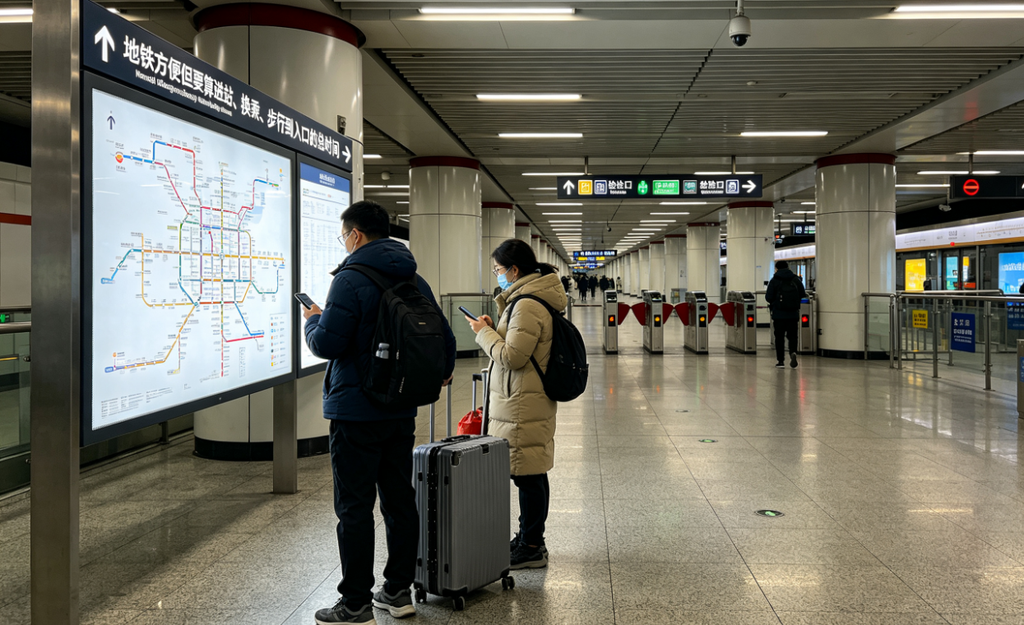
First-time visitors often make the mistake of selecting a subway route simply because a navigation app shows the shortest travel time. In Beijing, the total journey matters more than the train journey alone.
A more realistic door-to-door calculation is:
Total travel time = walking to the station + security screening + waiting + train journey + transfers + walking from the destination station.
For example, a route showing 20 minutes on the train might require another 10–15 minutes to reach the platform, additional time for security and waiting, and another 15 minutes to walk from the station to the attraction entrance.
That can turn a seemingly short journey into a trip lasting close to an hour.
When the subway is the better choice
Choose the subway when:
- Your hotel and destination are both reasonably close to stations.
- You have a small backpack or one manageable carry-on bag.
- The journey does not require several complicated transfers.
- You are traveling during daytime or normal subway operating hours.
- Road traffic is likely to be heavy.
- You have enough time to walk through large stations.
The subway is particularly useful for journeys between major central areas because road congestion can make driving times unpredictable.
When you should consider a taxi instead
A taxi or ride-hailing car may be a better choice when:
- Your destination is more than approximately 10–15 minutes on foot from the nearest convenient station.
- The route requires multiple transfers through large interchange stations.
- You have two or more large suitcases.
- You are traveling with young children or older family members.
- You arrive late at night and the subway connection is approaching its final departure.
- You have a fixed appointment or attraction entry time and cannot afford a long station walk.
- The final walk from the station is inconvenient, poorly suited to luggage, or difficult to navigate.
The 10–15-minute walking threshold is a practical planning guideline, not an official transport rule. A shorter walk may still be inconvenient if it involves stairs, crowded sidewalks, or heavy luggage.
A practical comparison
| Travel situation | Recommended option | Why |
|---|---|---|
| One traveler with a backpack, central hotel | Subway | Predictable and economical |
| Two adults with several suitcases | Taxi or ride-hailing | Avoids transfers and station walking |
| Late-night airport arrival | Airport bus or ride-hailing | Subway services may have ended |
| Central sightseeing during rush hour | Subway | Avoids road congestion |
| Attraction far from a subway entrance | Taxi or ride-hailing | Reduces the final walking distance |
| Several travelers sharing one car | Taxi or ride-hailing | Convenient door-to-door transport |
| Short journey between nearby neighborhoods | Walking or taxi | A subway journey may add unnecessary access time |
The important point is not to choose one transport method for your entire trip. A better approach is to choose the method that fits each journey.
For a broader explanation of route planning, see our guide to how to get around Beijing.
2. Beijing Subway: Convenient, but Allow Extra Time for Stations
The subway is one of the most useful transportation options for visitors, but its practical travel time is easy to underestimate.
Why subway journeys can take longer than expected
There are several reasons:
1. Large stations require substantial walking.
Major interchange stations can have long underground corridors. Changing lines may involve walking much farther than visitors expect, especially when following unfamiliar signs.
2. Security screening adds time.
Passengers and luggage must pass through station security checks. Queues can become longer during busy periods and holidays.
3. Rush-hour congestion affects movement.
Crowded platforms, station entrances, and transfer corridors can slow down your journey. Some stations may introduce passenger-flow controls when congestion becomes severe.
4. The station is not always close to the attraction entrance.
A navigation app may identify the nearest subway station, but the actual entrance to a park, museum, shopping area, or historic site may be considerably farther away.
For this reason, do not judge a route only by its displayed train time.
How much extra time should you allow?
Use the following as a practical starting point:
| Journey type | Additional planning allowance |
|---|---|
| Simple journey with no transfer | Allow 10–15 minutes beyond the displayed train time |
| One transfer at a large station | Allow approximately 15–25 extra minutes |
| Multiple transfers or unfamiliar stations | Allow at least 20–30 extra minutes |
| Busy holiday or peak-hour journey | Add more time based on current crowd conditions |
These are planning buffers, not guaranteed station processing times. Actual conditions vary by station, time, and passenger volume.
When should you abandon the subway plan?
Do not keep following a subway route just because you have already started it.
Consider switching to a taxi or ride-hailing service if:
- A transfer requires a long walk and you are already short of time.
- The station is unusually crowded or access is restricted.
- Your destination is still far from the station.
- You are carrying luggage that makes stairs and corridors difficult.
- The remaining subway journey would save little time compared with a direct car journey.
A useful rule is to compare the remaining door-to-door time, not the time already spent on the subway.
If you have an attraction reservation, a train departure, or a scheduled tour, leave a larger buffer than you would for an ordinary sightseeing trip.
Check the last train before you travel
Beijing subway lines do not all operate on identical schedules. First and last train times vary by line, direction, and station.
Check the official Beijing Subway information service before making a late-night journey.
Do not assume that the entire subway network operates until the same time.
3. Set Up Payment Before Arrival: Prepare a Primary and Backup Method

Payment is one of the most important parts of Beijing transportation for first-time visitors.
Beijing now supports several payment methods for overseas travelers, including contactless international bank cards on the subway. However, a payment method being officially supported does not guarantee that every individual card, phone, or bank transaction will work.
The safest strategy is to prepare more than one payment method before departure.
Payment method 1: International contactless bank card
Beijing Subway supports contactless payments through the five major card networks: China UnionPay, Mastercard, Visa, JCB, and American Express.
Visitors can use supported contactless cards to enter subway stations without downloading a transport app or purchasing a separate ticket.
Official information: Beijing Subway supports five major card networks.
Possible failure scenarios:
- Your physical card does not support contactless payments.
- Your bank has disabled overseas or contactless transactions.
- Your bank declines the transaction for security reasons.
- Your card has a spending limit or temporary authorization issue.
- Your phone wallet and physical card behave differently.
What to do if the gate rejects your card:
- Move away from the gate so you do not block other passengers.
- Check whether you are using a supported card network and a contactless-enabled card.
- Try the physical card if you first used a phone wallet, or the phone wallet if the physical card is not working.
- If the transaction is declined again, stop repeatedly tapping the same card.
- Use your prepared backup method or ask station staff for help buying a single-journey ticket.
Do not assume that repeatedly tapping a declined card will eventually make it work.
Also, do not switch rapidly between several bank cards at the same gate. Repeated attempts may create confusing pending transactions or additional security checks from your bank.
If one card fails, pause and identify the problem before choosing another payment method.
Payment method 2: Alipay with an international bank card
Alipay is useful for visitors because it can support payments through linked international bank cards and provide access to transport services.
Before leaving home:
- Download Alipay from your normal app store.
- Register your account using your own mobile number.
- Complete the required identity verification.
- Add an eligible international bank card.
- Follow the app’s instructions for any verification requirements.
- Test the account before relying on it for transportation.
What if you cannot receive the SMS verification code?
First, check whether your phone can receive international SMS messages. Confirm that roaming is enabled if required, that the number is entered correctly, and that your mobile operator is not blocking verification messages.
Then:
- Wait before requesting another code.
- Check whether the app offers another verification method.
- Avoid repeatedly requesting codes in a short period.
- If verification still fails, contact your mobile operator or use the app’s official support channel.
- Do not make Alipay your only transport payment method until you have successfully completed setup.
If your account is not ready, use a supported contactless bank card or buy a ticket at the station.
Payment method 3: BEIJING PASS
BEIJING PASS is a transport-oriented prepaid card designed to make payments easier for international visitors.
It can be useful if you prefer not to depend entirely on a smartphone or international bank card.
However, check the card’s purchase price, recharge rules, and refund conditions before buying it.
The official BEIJING PASS information states that the standard card costs CNY 20. The card fee is non-refundable, and the remaining balance cannot be refunded if the card is lost.
Official information: BEIJING PASS.
When is it useful?
- You expect to use public transportation frequently.
- You prefer a physical card rather than opening an app for every journey.
- You want a backup if your phone battery runs out.
- You are comfortable accepting the card’s purchase and balance-refund conditions.
Do not buy one simply because you assume it is the only way to use Beijing’s subway.
Payment method 4: Single-journey tickets
A single-journey ticket is a practical backup when your apps or bank cards are not working.
You can buy one at a station ticket machine or ask station staff for assistance.
Many ticket machines provide English-language instructions. If you cannot complete the purchase yourself, show the staff member the name of your destination station.
A single-journey ticket is particularly useful when:
- Your international card is declined.
- Your Alipay account is not verified.
- Your phone has no internet connection.
- Your smartphone battery is running low.
Keep some RMB cash available as a backup, but do not assume every ticket machine or service counter accepts every international payment method.
The payment backup hierarchy
| Problem | First response | Backup |
|---|---|---|
| Contactless card rejected | Check card support and contactless settings | Use another prepared payment method |
| Phone wallet rejected | Try the physical card once | Buy a single-journey ticket |
| Alipay SMS verification fails | Check roaming and verification options | Use contactless bank card |
| Alipay payment fails | Check the account and bank authorization | Use a ticket machine or staffed counter |
| Phone battery dies | Use physical bank card | Use BEIJING PASS or buy a ticket |
| No internet connection | Try offline contactless card payment | Use cash or a physical transport card |
The most important preparation rule is simple: never arrive in Beijing with only one untested way to pay for transportation.
For a more detailed explanation of international cards, mobile wallets, and transport payment setup, see how to pay for transportation in Beijing.
4. Airport Transfers: Decide Based on Your Actual Exit Time

Airport transportation requires more planning than an ordinary subway journey because flight arrival time and transport departure time are not the same thing.
Your actual departure from the airport may be delayed by:
- Immigration queues.
- Baggage collection.
- Customs procedures.
- Walking through a large terminal.
- Finding the correct transport level or ticket counter.
- Waiting for a taxi or ride-hailing pickup.
A flight landing at 22:30 does not mean you will be outside the terminal at 22:30.
For international arrivals, it is safer to calculate from your expected time of reaching the public arrivals area.
Capital Airport (PEK): Airport Express and late-night alternatives
The Capital Airport Express connects the airport with central Beijing.
It is useful for passengers whose hotels are close to the line or have convenient onward connections.
However, its operating hours matter.
The Terminal 3 Airport Express departure toward the city is listed with a final departure at approximately 22:52. The exact schedule should be checked for your travel date.
For example:
| Flight situation | Practical decision |
|---|---|
| Flight lands at 19:00 | Airport Express may be practical if immigration and baggage collection are completed in time |
| Flight lands at 21:30 | Do not assume you can catch the Airport Express; check the actual terminal departure time and your expected exit time |
| Flight lands at 22:30 | If you reach the public arrivals area around 23:15, the Terminal 3 Airport Express will already have finished operating |
| Flight lands after midnight | Plan for an airport bus or ride-hailing rather than relying on the Airport Express |
The key is to compare your expected terminal exit time with the last train departure, not your scheduled landing time.
Capital Airport night buses
Missing the Airport Express does not automatically mean you must take a taxi.
According to the official 2026 airport bus timetable updates:
- The Capital Airport–Beijing West Railway Station route operates 24 hours a day.
- The Beijing South Railway Station and Beijing Fengtai Railway Station routes have extended late-night services, with their last departures scheduled at 02:00.
- Routes and departure frequencies vary, so confirm the destination and current timetable before boarding.
Official timetable information: Beijing airport shuttle bus service updates.
A night bus may be a sensible choice if its final stop is close to your accommodation.
However, do not choose it just because it is cheaper. If you still need a long taxi journey after getting off, a direct ride-hailing trip may be more practical.
Daxing Airport (PKX): Night buses are an important alternative
Daxing Airport is farther from central Beijing than Capital Airport, so the choice of transport can make a substantial difference to your arrival experience.
The Daxing Airport Express is useful during operating hours, but visitors arriving late should also consider the airport bus network.
The official 2026 updates include:
- A Beijing Railway Station airport bus service operating 24 hours a day.
- A night route to Zhongguancun, with its last departure extended to 03:00 from April 7, 2026.
- Additional night services connecting the airport with other urban destinations.
Some night services run at intervals rather than as continuous departures. Others have fixed departure times.
Official information:
Airport arrival decision table
| Your actual exit time | Capital Airport | Daxing Airport |
|---|---|---|
| Before the evening transport cutoff | Check Airport Express and airport buses | Check Daxing Airport Express and airport buses |
| Around 22:00–23:00 | Compare the remaining Airport Express time with airport bus options | Airport Express may still be possible depending on the actual schedule |
| Around midnight | Consider 24-hour airport bus routes or ride-hailing | Consider the 24-hour Beijing Railway Station line, night routes, or ride-hailing |
| After 02:00 | Check the specific route’s current departure schedule; a direct car may be simpler | Check the 24-hour route and current night bus departures |
| Traveling with several large suitcases | Direct ride-hailing is often more convenient | Direct ride-hailing or a suitable airport bus route |
This table is a decision guide, not a guarantee that every route will have a bus immediately available.
A simple airport transfer calculation
Before flying, prepare three pieces of information:
- Your scheduled landing time.
- Your estimated time to reach the public arrivals area.
- Your hotel’s Chinese name and full address.
Then compare your estimated exit time with the latest departure of the transport route you intend to use.
For example:
- Scheduled landing: 22:30
- Estimated immigration and baggage time: 45 minutes
- Estimated public arrivals exit: 23:15
- Airport Express final departure: approximately 22:52 from Terminal 3
In this situation, the Airport Express is not a realistic option. You should instead compare the airport bus routes serving your destination with a direct ride-hailing journey.
If your flight is delayed, repeat the calculation. Do not keep following the original plan simply because you prepared it before departure.
When should you choose a taxi or ride-hailing service from the airport?
Choose a direct car when:
- You arrive after the relevant public transport services have finished.
- Your hotel is not near an airport bus stop.
- You have several large suitcases.
- You are traveling with children or older family members.
- You arrive exhausted and want to avoid additional transfers.
- Your hotel is outside the practical service area of the available airport buses.
Before leaving the terminal, check the official taxi queue or designated ride-hailing pickup area.
Do not accept unsolicited offers from drivers approaching you inside the terminal.
5. Taxis and Ride-Hailing: The Most Useful Backup for Difficult Journeys

Taxis and ride-hailing services are important because they solve problems that public transportation cannot always handle conveniently.
They are particularly useful for airport arrivals, journeys with luggage, and destinations located far from subway stations.
Taxi versus ride-hailing
| Feature | Official taxi | Ride-hailing |
|---|---|---|
| Booking | Official taxi queue or designated pickup point | Mobile app |
| Price | Meter-based for ordinary metered taxis | Displayed or calculated through the platform |
| Language | Communication may be difficult | App booking reduces verbal communication |
| Payment | Depends on the vehicle’s accepted methods | Depends on the platform and payment setup |
| Best use | Airport arrivals and immediate local journeys | Pre-planned pickups and destinations with precise addresses |
For international visitors, ride-hailing can be easier because the destination can be entered in the app rather than explained verbally.
However, the app must be working, your payment method must be accepted, and you must be able to identify the correct pickup point.
How to avoid pickup problems
Before confirming a ride:
- Check the pickup location shown in the app.
- Follow the airport’s official ride-hailing signs.
- Confirm the vehicle registration number.
- Check that the driver and vehicle details match the booking.
- Do not enter a car simply because someone says they are your driver.
Prepare your destination in Chinese
Do not rely entirely on the English name of your hotel.
Save these details before arrival:
- Hotel name in Chinese.
- Full Chinese address.
- Nearby landmark or intersection.
- Hotel telephone number.
A screenshot is useful if your phone loses internet access.
If you cannot communicate with a driver, show the Chinese address rather than trying to pronounce it.
6. Should First-Time Visitors Use Beijing Buses?
For most short-term international visitors, the answer is: you can skip ordinary city buses entirely without missing an essential part of your Beijing sightseeing experience.
This is not because Beijing buses are unreliable or unsuitable for local residents. They serve an important role in the city’s transport network.
The issue is that they can require more preparation from visitors who are unfamiliar with Chinese-language transport information.
Why ordinary buses are less convenient for first-time visitors
- Stop announcements and route information may be difficult to follow without Chinese-language support.
- Some journeys require scanning a QR code when boarding and getting off.
- Visitors may need to understand whether a route uses a flat fare or distance-based fare.
- Waiting times and traffic conditions can make arrival times less predictable.
- A missed stop can create additional navigation problems.
Beijing’s official transport guidance explains that some bus payment systems require passengers to scan when boarding and getting off. If you do not complete the required process, the fare calculation may not work as expected.
Official information: Transportation guidance for international travelers.
What if you must take a bus?
If you need to use a bus, prepare a backup plan rather than relying on spoken announcements.
Before boarding:
- Save the destination stop’s Chinese name.
- Save the Chinese name of the route’s final destination.
- Screenshot the route map and your boarding stop.
- Confirm how the route handles payment and whether you must scan when getting off.
- Keep the destination address available offline.
If you do not speak Chinese and your phone has no internet connection, show the saved Chinese destination and route information to station or transport staff where possible.
If you are unsure whether you have reached the correct stop, do not simply get off because other passengers are leaving.
For ordinary sightseeing, however, there is little reason to make bus travel your main transportation method. The subway and ride-hailing services are generally easier to manage.
7. Shared Bikes: Convenient for Some Travelers, but Not a Default Recommendation
Shared bicycles are common in Beijing and can be useful for short trips between nearby locations.
However, visitors who are unfamiliar with Chinese urban traffic should not assume that cycling is an easy or risk-free way to get around.
What makes cycling challenging?
Mixed traffic conditions
Although Beijing has designated non-motorized vehicle lanes in many areas, actual road conditions vary. Some sections may be obstructed, busy, or difficult to navigate.
Fast-moving electric bicycles
Electric bicycles are common in urban traffic. Their speed and movement patterns can surprise visitors who are accustomed to quieter cycling environments.
Complex intersections
Large roads, turning traffic, and busy junctions require careful attention. A visitor who is unfamiliar with local traffic patterns may find these situations stressful.
Winter conditions
Cold temperatures, wind, and occasional icy surfaces can make cycling uncomfortable or unsafe, particularly for travelers who are not used to riding in winter conditions.
Beijing’s non-motor-vehicle regulations require cyclists to follow traffic signals, avoid riding against traffic, and use designated non-motorized lanes where provided.
Official regulations: Beijing Regulations on the Administration of Non-Motor Vehicles.
When should you avoid shared bikes?
Avoid them if:
- You have little experience cycling in city traffic.
- You are carrying luggage.
- You are traveling with young children.
- You need to cross several large intersections.
- The weather is very cold, wet, or icy.
- You are unfamiliar with the local traffic environment.
For most first-time visitors, walking, the subway, and ride-hailing are easier options.
Shared bikes are best treated as an optional short-distance convenience, not an essential part of your Beijing transport plan.
8. Choose Transportation According to Your Actual Travel Situation
The best transport method changes depending on your arrival time, luggage, accommodation location, and daily schedule.
The following scenarios show how to apply these factors.
Scenario A: Solo traveler with one backpack, arriving around midday
Recommended approach: Subway first, taxi if the final walk is inconvenient.
If you are staying near Dongzhimen and arrive around midday with only one backpack, the subway may be a practical choice.
You can compare the Airport Express journey with a direct car journey, then continue by subway if your hotel is near a convenient station.
However, do not assume that the subway is automatically faster. Check the walking distance from your destination station to the hotel.
Scenario B: Family arriving at 22:00 with two large suitcases
Recommended approach: Check airport bus availability, then compare it with a direct ride-hailing journey.
For a family carrying two large suitcases, multiple subway transfers can become inconvenient.
If an airport bus serves a stop near your accommodation, it may be a reasonable option.
If not, a direct car is usually easier than transferring between trains with luggage.
The priority should be minimizing transfers and the amount of walking required after arrival.
Scenario C: Traveler staying outside the central subway network
Recommended approach: Compare the full journey, not just the subway fare.
A hotel located far from the nearest station may make a subway journey less practical.
You may spend a substantial amount of time walking or arranging a second vehicle after leaving the train.
In this situation, compare:
- Direct taxi or ride-hailing time.
- Subway time plus the final transfer.
- The cost of the additional journey from the station.
Sometimes the most economical subway route is not the most practical option.
Scenario D: Traveler with a fixed sightseeing reservation
Recommended approach: Use the most predictable door-to-door option.
If you have a timed museum entry, a scheduled tour, or a train departure, do not choose a complicated subway route simply because it looks cheaper.
A route with several transfers introduces more opportunities for delays.
Allow sufficient time for security checks, station walking, and road traffic.
Scenario E: Traveler arriving after midnight
Recommended approach: Check airport buses first, then use a direct car if the route is unsuitable.
At this time, the subway may no longer be available.
Check whether a 24-hour airport bus or an appropriate night route serves your destination.
If the bus requires a long onward journey, a direct ride-hailing trip may be the better option.
9. A Simple Decision Tree for Every Journey
Use this decision process before leaving your hotel or airport.
Step 1: Is the subway operating when you need it?
- No: Check airport buses, taxis, or ride-hailing.
- Yes: Continue to Step 2.
Step 2: Are you carrying heavy luggage or traveling with people who may struggle with long walks?
- Yes: Prefer a direct car unless the subway journey is exceptionally simple.
- No: Continue to Step 3.
Step 3: Is the destination reasonably close to a subway station?
- No: Consider a taxi or ride-hailing service.
- Yes: Continue to Step 4.
Step 4: Does the route require multiple transfers or a long walk through a large station?
- Yes: Compare the total journey time with a direct car.
- No: The subway is probably a practical option.
Step 5: Is the journey time-sensitive?
- Yes: Allow a larger buffer and choose the route with fewer uncertain steps.
- No: Use the most convenient option for your budget and preferences.
The priority order
When choosing transportation, use this order:
- Operating hours: Is the service available when you need it?
- Luggage and passenger needs: Can everyone manage the journey comfortably?
- Door-to-door distance: How far are the station and final destination from where you actually need to go?
- Transfer complexity: How many changes and long walks are required?
- Time pressure: Can you afford delays or a longer route?
- Cost: Once the practical options are identified, compare their prices.
This prevents the common mistake of choosing the cheapest or shortest-looking route before checking whether it is actually suitable.
10. Common Transportation Mistakes First-Time Visitors Should Avoid
Mistake 1: Trusting the subway travel time without adding station walking
A route displayed as a 20-minute journey may take much longer after station access, security, transfers, and the final walk.
Always calculate door-to-door time.
Mistake 2: Arriving with only one payment method
Your international card, mobile wallet, or app may not work as expected.
Prepare a physical backup and some RMB cash.
Mistake 3: Assuming the Airport Express runs after a late flight
A flight’s landing time is not the time you leave the terminal.
Calculate your expected immigration, baggage, and exit time before choosing the train.
Mistake 4: Assuming all airport bus routes operate 24 hours
Some routes are 24-hour services, while others have specific final departures.
Check the actual route and destination rather than relying on a general statement about airport buses.
Mistake 5: Choosing a bus without understanding its payment rules
Some bus systems require passengers to scan when boarding and getting off.
Confirm the process before using the route.
Mistake 6: Cycling without understanding local traffic
Shared bicycles can be useful, but they are not necessarily suitable for visitors who have never cycled in busy Chinese city traffic.
Mistake 7: Saving only the English hotel name
A Chinese address screenshot can be extremely useful when communicating with a driver or navigating without mobile data.
11. Transportation Preparation Checklist Before Flying to Beijing
A little preparation before departure can prevent many transport problems after arrival.
Apps and payment
- Install Alipay and complete the available account verification.
- Add an eligible international bank card if possible.
- Confirm that your physical bank card supports contactless payments.
- Check whether your bank allows overseas transactions.
- Prepare a second payment method.
- Carry a reasonable amount of RMB cash.
Airport planning
- Confirm whether your flight arrives at PEK or PKX.
- Save your terminal number.
- Estimate your actual public-arrivals exit time.
- Check the relevant Airport Express operating hours.
- Check whether an airport bus serves your hotel area.
- Save the official airport bus service hotline numbers.
Capital Airport Shuttle Bus: +86-10-64378900
Daxing Airport Shuttle Bus: +86-10-81698565
These numbers are published in Beijing’s official airport bus service updates. Telephone assistance may be in Chinese.
Hotel and navigation
- Save your hotel’s Chinese name.
- Save the complete Chinese address.
- Screenshot your hotel location and nearby subway stations.
- Save the nearest airport bus stop if relevant.
- Prepare offline route information.
- Check the walking distance from the nearest subway station to the hotel.
Personal travel needs
- Decide whether you will carry large suitcases on public transportation.
- Check the walking distance to major attractions.
- Allow additional time for large interchange stations.
- Avoid relying on a single payment app or a single transport option.
12. A Practical Transportation Strategy for Your First Three Days
You do not need to master every transport system immediately.
A simple approach is to start with the easiest journeys and become more familiar with the city gradually.
Day 1: Airport to hotel
Prioritize a straightforward transfer.
If you arrive during the day and your hotel is close to an airport rail connection, the Airport Express or Daxing Airport Express may be convenient.
If you arrive late, check the airport bus routes before choosing a direct car.
Avoid planning several sightseeing stops immediately after a long international flight.
Day 2: Use the subway for central sightseeing
For your first full day, choose attractions that can be reached through relatively simple subway journeys.
Check:
- The nearest station.
- The number of transfers.
- The station exit you need.
- The walking distance to the attraction entrance.
If the station is far from the attraction, consider using a taxi for the final section.
Day 3: Adjust based on your experience
By the third day, you should have a better understanding of:
- Which payment method works reliably for you.
- How comfortable you are navigating subway stations.
- How long station transfers actually take.
- Whether your hotel is well connected to public transportation.
You can then make more confident decisions about longer journeys and less familiar areas.
The goal is not to use the subway, buses, taxis, and bicycles equally. It is to choose the most practical method for each journey.
13. Frequently Asked Questions About Beijing Transportation
Is the subway the best transportation option for first-time visitors to Beijing?
The subway is usually the most practical option for journeys between central areas, particularly when traffic is heavy. However, it is not always the fastest door-to-door option. Large interchange stations, security checks, and long walks to attraction entrances can increase total travel time. Taxis and ride-hailing services may be better for late-night arrivals, heavy luggage, and destinations far from stations.
Can foreign tourists use international bank cards on the Beijing subway?
Yes. Beijing Subway supports contactless payments through China UnionPay, Mastercard, Visa, JCB, and American Express. However, individual cards and bank accounts may have different restrictions. Check your card’s contactless capability and overseas transaction settings before departure, and prepare another payment method.
What should I do if my international bank card is rejected at a subway gate?
Move away from the gate and check whether your card supports contactless payments and overseas transactions. If it fails again, do not keep tapping repeatedly. Try your prepared backup method or purchase a single-journey ticket at the station. Contact your bank if the transaction appears to have been declined for security reasons.
Is Alipay necessary for transportation in Beijing?
No. Alipay is useful, but it is not the only way to pay for the subway. Supported international contactless bank cards, BEIJING PASS, and single-journey tickets are alternatives. Having Alipay ready can make other payments easier, but visitors should not rely on it as their only payment method.
Can I take the subway from Capital Airport if my international flight lands at 10:30 p.m.?
Not necessarily. The Capital Airport Express from Terminal 3 has a listed final departure at approximately 22:52. If immigration and baggage collection mean you leave the terminal around 23:15, you will have missed that train. Check the airport bus services or arrange a taxi or ride-hailing pickup instead.
Does Daxing Airport have late-night buses to downtown Beijing?
Yes. Daxing Airport has several late-night airport bus services. The Beijing Railway Station route operates 24 hours a day according to the 2026 official timetable update. The night route to Zhongguancun has also been extended to a 03:00 final departure. Check the current route, destination, and departure time before relying on a specific service.
Do foreign tourists need to use Beijing’s public buses?
No. Most short-term visitors can complete their sightseeing without using ordinary city buses. The subway and ride-hailing services are often easier to navigate. Buses can still be useful when they provide a direct route, but visitors should understand the route and boarding and alighting payment requirements first.
Is it safe for foreign tourists to use shared bicycles in Beijing?
Shared bicycles are available, but they are not ideal for everyone. Busy traffic, electric bicycles, complicated intersections, and winter conditions can make cycling challenging for people unfamiliar with Chinese urban roads. Visitors without confident city-cycling experience should generally prefer walking, the subway, or ride-hailing.
Should I take a taxi or the subway when traveling with luggage?
For one small backpack or a manageable carry-on bag, the subway is often practical. For several large suitcases, multiple passengers, or a hotel far from the nearest station, a direct taxi or ride-hailing service is usually more convenient.
How can I avoid getting lost when taking a taxi in Beijing?
Save your hotel’s Chinese name and full Chinese address before leaving the airport. Show the driver the address in your phone rather than relying only on English pronunciation. For ride-hailing, confirm the pickup point and vehicle details before entering the car.
14. Official Resources for Planning Beijing Transportation
For the most accurate travel information, use official sources when checking transport schedules, payment methods, and service changes.
- Beijing Subway information — subway routes, service information, and operating notices.
- Beijing Subway international card payment guidance — contactless payment support for major international card networks.
- Airport shuttle bus timetable updates — updated airport bus routes and late-night services.
- Daxing Airport shuttle bus information — Daxing Airport’s city bus and night bus network.
- Transportation guidance for international travelers — information about buses, payment, and ride-hailing.
Final Advice: Plan Around the Journey You Actually Need to Make
Beijing transportation is manageable for first-time visitors, but a good trip depends on more than knowing which subway line to take.
Before choosing a route, check the operating hours, luggage requirements, number of transfers, and actual walking distance to your destination. Prepare at least two ways to pay, save your hotel’s Chinese address, and work out your airport transfer using your expected terminal exit time rather than your scheduled flight arrival.
The subway should be your starting option for many central journeys, not an automatic answer for every journey. When the station is far away, the route is complicated, or the timing is tight, a taxi or ride-hailing service may be the more sensible choice.
The best transportation plan for Beijing is a flexible one: use the subway when it saves time, use a car when it reduces unnecessary walking and transfers, and always have a backup when payment or late-night transport becomes a problem.