
How to Pay for Transportation in Beijing
Quick Answer
Foreign visitors have several ways to pay for transportation in Beijing, but the most convenient options depend on the type of transport you use.
For most travelers, mobile payment is the most useful solution, particularly for taxis, ride-hailing, and everyday purchases. Public transportation can also be accessed through transportation cards and supported mobile payment methods, while cash remains useful as a backup.
The important thing is to prepare your payment method before you arrive at a subway gate, bus stop, or taxi.
Beijing’s transportation system is extensive, but payment can feel unfamiliar to visitors because different transportation methods use different payment processes.
A practical approach is to prepare:
- a mobile payment option
- a backup bank card
- some Chinese yuan
- your hotel address in Chinese
- a working phone and internet connection
Understanding the payment system in advance makes using Beijing public transportation considerably less stressful.
1. Why Transportation Payment Can Be Confusing for First-Time Visitors
Beijing’s transportation network is relatively easy to understand once you know which payment method belongs to which service.
The confusion usually comes from the fact that there is no single payment method that works identically everywhere.
You may encounter:
- subway gates
- city buses
- airport transportation
- traditional taxis
- app-based ride-hailing
- private transfers
- intercity trains
Each can involve a slightly different process.
For example, entering a subway station is different from paying a taxi driver.
A bus may require a different method from a ride-hailing app.
This means that knowing the name of a payment app is not enough.
You need to understand when to use it and what happens at the point of payment.
2. The Main Payment Methods Tourists Should Know
For most visitors, the transportation payment system can be divided into five broad options:
| Payment Method | Best For | Convenience |
|---|---|---|
| Mobile payment | Everyday transport and taxis | High |
| Transportation card | Frequent public transport users | High |
| Bank card | Some supported services | Medium |
| Cash | Backup and certain payments | Medium |
| App-based payment | Ride-hailing | High |
The exact availability can vary by operator, service, station, and current payment policies.
Therefore, travelers should avoid relying on only one method.
A combination of mobile payment and a backup option is generally more practical for an international visitor.
3. Alipay: One of the Most Useful Options for Visitors
Alipay is particularly useful for travelers because it can serve as a bridge between international payment cards and China’s mobile-payment ecosystem.
Depending on the current service configuration, foreign visitors may be able to link an eligible international bank card to Alipay.
Once set up, Alipay can potentially be used for more than transportation.
That is important because you do not want to create a separate payment system for every part of your trip.
A single mobile wallet may also be useful for:
- restaurants
- convenience stores
- attractions
- shopping
- taxis
- ride-hailing
- other everyday purchases
Before relying on mobile payment, however, make sure your account is fully configured.
Do not wait until you are standing in front of a subway gate to discover that your card has not been successfully linked.
4. WeChat Pay as a Second Mobile Payment Option
WeChat Pay is another major payment system in China.
For travelers who already use WeChat for communication, adding payment functionality can be convenient.
The practical advantage of having both Alipay and WeChat Pay available is redundancy.
If one payment method encounters a verification problem, card issue, network problem, or account limitation, the other may provide an alternative.
This is particularly useful during a long trip.
Payment problems are rarely serious when you have a backup.
They become stressful when your phone contains your only payment method and that method suddenly stops working.
5. How Subway Payment Works
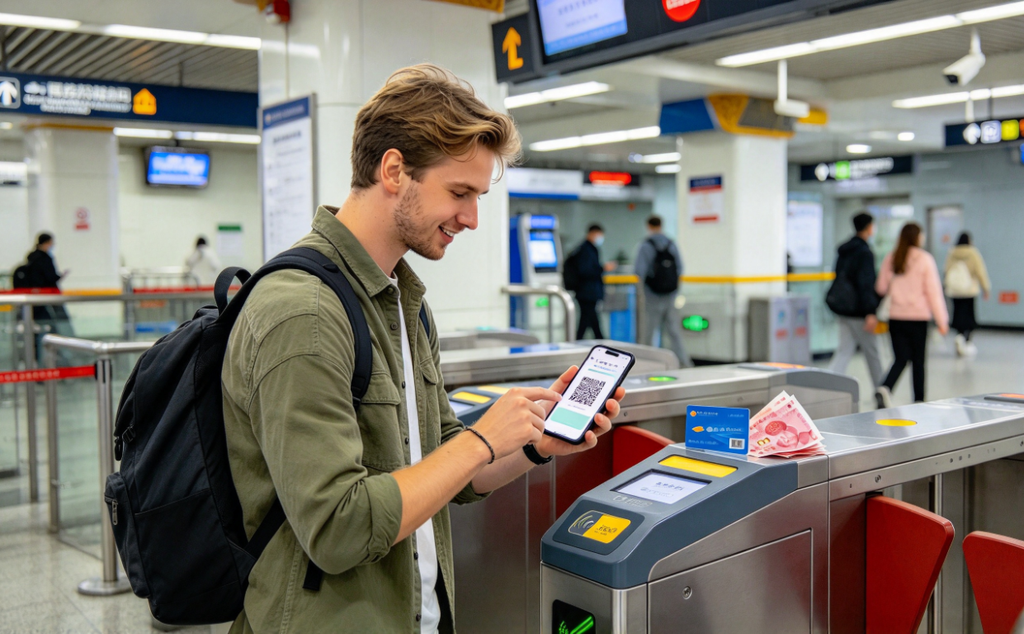
The Beijing subway generally uses a fare-based system rather than a single flat fare.
The amount you pay depends on the journey.
For visitors, there are several ways to access the system depending on the current station and payment options.
Possible methods can include:
- transportation cards
- mobile transportation QR codes
- supported ticketing/payment methods
- other station-supported payment options
If you use a mobile QR code, the process is different from simply showing a screenshot.
The system needs to recognize a valid, active code.
Therefore, make sure your phone is:
- charged
- connected appropriately
- unlocked when needed
- displaying the correct transportation code
Do not assume that a static screenshot of a payment QR code will work.
6. Using a Transportation Card
Beijing’s transportation card system has traditionally provided a convenient way to pay for public transport.
A transportation card can be useful if you plan to use buses and subways frequently and prefer not to depend on your phone.
Its biggest advantage is simplicity.
You tap or use the card according to the transportation system’s requirements instead of opening an app every time.
For longer stays, this can be attractive.
For short trips, however, the convenience of mobile payment may make obtaining a physical card unnecessary for some travelers.
Policies, purchase locations, refund procedures, and compatibility can change, so visitors should check the current arrangements when they arrive.
7. Can Foreign Bank Cards Be Used Directly?
This is one of the most important questions for international travelers.
The answer depends on the specific transportation service.
A foreign Visa or Mastercard should not automatically be assumed to work everywhere simply because Beijing is an international city.
Some services may support international cards directly or through specific payment systems.
Others may rely primarily on domestic payment infrastructure or mobile wallets.
Therefore, it is safer to think of an international bank card as a backup financial tool, rather than assuming it will function as your universal transportation ticket.
Before traveling, notify your bank if necessary and make sure your card can be used internationally.
8. Can You Still Pay With Cash?
Yes, cash remains useful as a backup.
Chinese yuan can be particularly valuable when:
- your phone battery is low
- mobile payment is temporarily unavailable
- a payment system rejects your card
- you have a technical problem
- you are using a service where cash is accepted
However, cash is not necessarily the most convenient way to handle every transportation transaction in modern Beijing.
The city’s payment environment is heavily digital.
That means cash should be viewed as a backup, not necessarily your primary strategy.
Carrying a modest amount can provide peace of mind without requiring you to conduct your entire trip with physical currency.
9. How to Pay for a Beijing Taxi
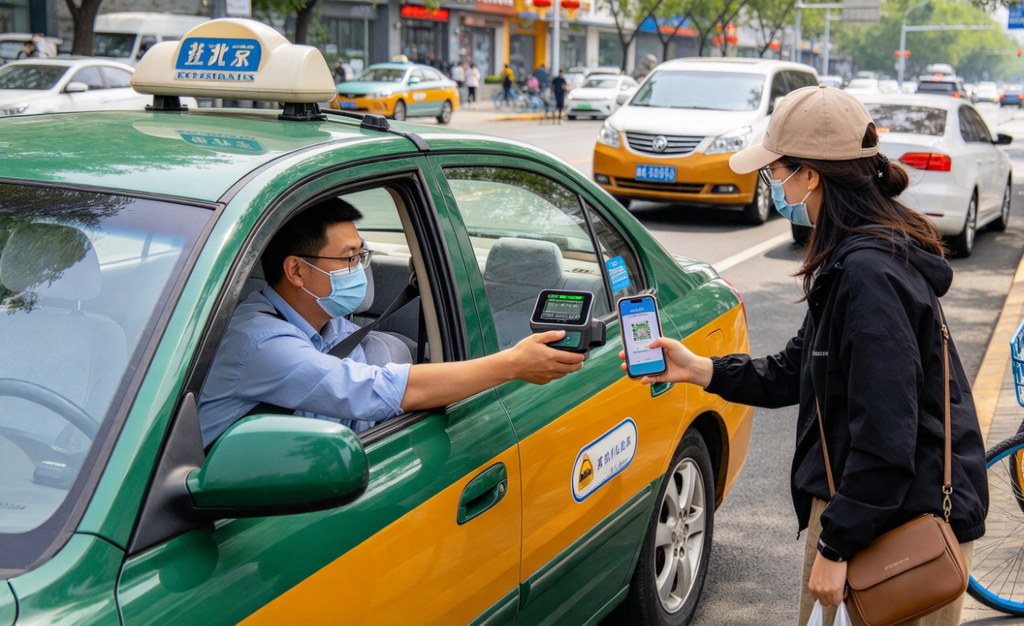
Traditional taxis generally calculate fares according to the meter.
At the end of the ride, the payment method can depend on the vehicle and current payment setup.
Depending on the taxi, you may encounter:
- mobile payment
- cash
- card or other supported payment methods
Before getting into a taxi, having your destination available in Chinese is often more important than worrying about the exact payment process.
A driver may not recognize the English spelling of your hotel or attraction.
A Chinese-language address displayed on your phone can eliminate unnecessary communication problems.
This is especially useful for hotels located inside residential compounds, hutongs, or large commercial areas.
10. How to Pay for Didi and Other Ride-Hailing Services
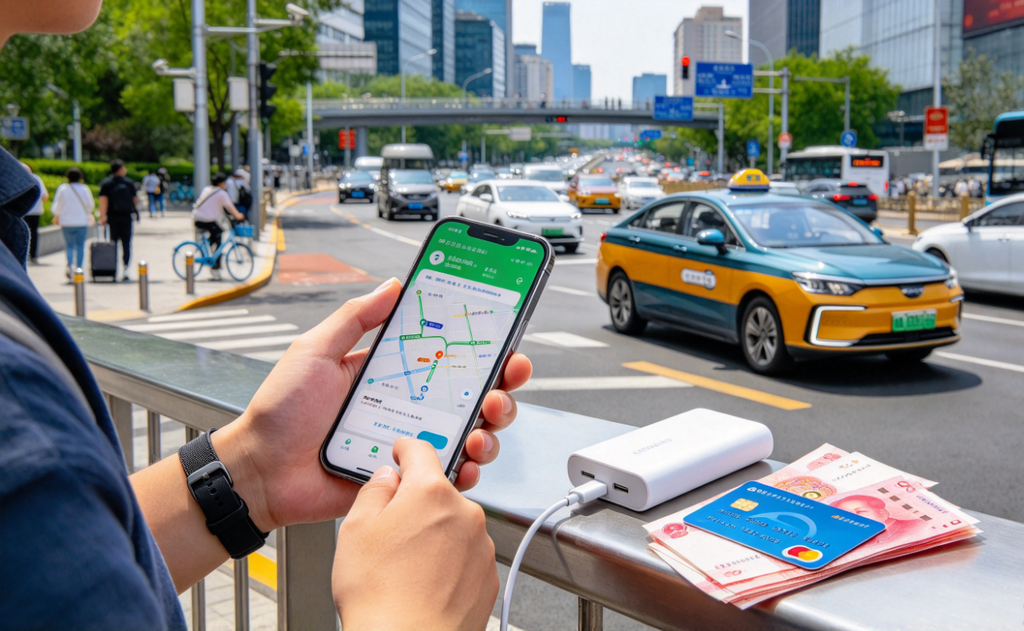
Ride-hailing is different from a traditional taxi because payment is usually integrated into the app or platform.
The general process is:
- Enter your destination.
- Confirm the pickup location.
- Select the appropriate vehicle/service.
- Complete the ride.
- Pay through the supported payment system.
For international visitors, the challenge is often not the ride itself.
It is setting up the account and payment method beforehand.
If you intend to use ride-hailing regularly, complete registration and payment setup before you actually need the service.
That way, you are not trying to solve account verification while standing outside an airport with luggage.
11. Airport Transportation Requires Extra Preparation
Airport transportation deserves special attention because it is often the first transportation payment tourists encounter.
Beijing has two major international airports:
- Beijing Capital International Airport
- Beijing Daxing International Airport
You may use:
- airport rail services
- subway connections
- taxis
- ride-hailing
- private transfers
The payment process differs between these options.
For example, a rail or subway journey uses a public transportation payment system, while a taxi involves payment after the journey.
A private transfer may have been prepaid before you arrive.
This is why airport transportation should be planned separately from your everyday city transportation.
12. Do You Need Cash at the Airport?
It is sensible to have a backup payment method when you land.
Your phone may not immediately have:
- a local SIM or data connection
- sufficient battery
- a configured mobile wallet
- successful card verification
Having some Chinese yuan gives you an additional layer of security.
You do not need to assume that your entire trip must be conducted in cash.
The practical strategy is:
mobile payment for convenience + bank card for backup + cash for emergencies.
This three-layer approach is particularly useful for first-time visitors.
13. What About Beijing Buses?
Buses can be inexpensive, but payment procedures may be less intuitive for foreign visitors than subway travel.
Depending on the bus and current system, passengers may use:
- transportation cards
- supported mobile payment methods
- other accepted fare-payment options
Some buses use distance-based fares, so the payment mechanism can differ from a simple fixed-price ticket.
For tourists, the bigger challenge is often not the fare.
It is identifying the correct route, stop, and direction.
If you are unfamiliar with Chinese, using a navigation app that clearly identifies bus routes can make the process much easier.
14. Mobile Payment Is More Than a Transportation Tool
One reason mobile payment is so valuable in Beijing is that transportation is only one part of the ecosystem.
Once configured correctly, the same payment setup can potentially be used throughout your trip.
For example:
Morning: subway
Lunch: restaurant
Afternoon: attraction ticket or convenience store
Evening: ride-hailing
This reduces the number of separate payment systems you need to understand.
It also makes budgeting easier because transactions are recorded digitally.
For travelers who plan Beijing trip itineraries around several neighborhoods and attractions, this flexibility can save time.
15. What Happens If Your Phone Dies?
This is one of the most overlooked transportation problems.
If your phone contains:
- your payment apps
- your navigation
- your hotel information
- your translation tools
- your transportation QR codes
then a dead battery can become a major inconvenience.
A portable power bank is therefore not simply an electronic accessory.
For a foreign visitor, it can function as part of the transportation system.
Keep your phone charged before long sightseeing days, especially when you expect to use public transportation several times.
For longer excursions, carry a power bank.
16. What If You Lose Internet Access?
Not every payment process requires the same type of connectivity.
Some mobile functions may continue to work under certain conditions, while others may require an active connection.
The safest approach is not to assume that your payment system will always work offline.
Prepare for situations such as:
- poor mobile signal
- temporary network problems
- roaming restrictions
- Wi-Fi interruptions
- app errors
Again, this is why carrying a backup card and some cash is sensible.
Travel planning is often less about eliminating every possible problem than about making sure one technical failure does not stop your entire day.
17. What If Your International Card Is Declined?
Do not assume that a declined transaction means your bank card is permanently unusable.
Possible causes can include:
- bank security controls
- international transaction restrictions
- verification problems
- merchant compatibility
- app configuration
- temporary network issues
If your card fails through a mobile wallet, try your backup payment method rather than repeatedly attempting the same transaction.
Before departure, it is also worth checking whether your bank has:
- international transactions enabled
- travel notifications enabled if required
- sufficient spending limits
- current contact information
These small preparations can prevent major inconvenience later.
18. Should You Carry a Physical Transportation Card?
For a short Beijing visit, not everyone needs one.
A physical transportation card can make sense if:
- you strongly prefer physical payment
- you will use public transportation frequently
- you do not want to rely on your phone
- you are staying for an extended period
It may be less necessary if you have already configured a reliable mobile transportation payment method.
The decision is therefore about convenience rather than necessity.
19. How Transportation Costs Affect Payment Choices
Knowing Beijing transportation costs is useful because payment convenience should be considered alongside spending patterns.
A traveler making two subway trips per day has different needs from someone taking several taxis.
If you mainly use the subway, a transportation card or mobile transit payment can be practical.
If you frequently use ride-hailing, your mobile wallet becomes much more important.
If you are traveling with several people, payment organization becomes another consideration.
One person may handle transportation payments for the group, while everyone else focuses on navigation and sightseeing.
Understanding cost and payment together allows you to choose the simplest system for your travel style.
20. Payment for Private Transfers
Private airport transfers and private sightseeing vehicles may work differently from public transportation.
Depending on the provider, payment can be:
- prepaid online
- paid through a booking platform
- settled through mobile payment
- paid in another agreed method
The advantage of arranging a private transfer in advance is that the payment process can be completed before the journey begins.
This can be particularly useful when arriving late at night, traveling with children, carrying large amounts of luggage, or arriving after a long international flight.
The important thing is to confirm the payment terms before the pickup date.
21. Payment Etiquette in Taxis and Public Transport
China generally does not have the same tipping culture associated with taxis in some Western countries.
The fare is normally the amount shown or calculated by the relevant transportation system.
You do not need to add a large tip simply because a driver helped with luggage or navigation.
If a driver provides exceptional assistance, travelers can decide individually whether to offer something extra, but it is not generally required as part of ordinary taxi payment.
For public transportation, payment is simply part of using the system.
There is no need for complicated etiquette.
22. What Should Foreign Visitors Set Up Before Arrival?
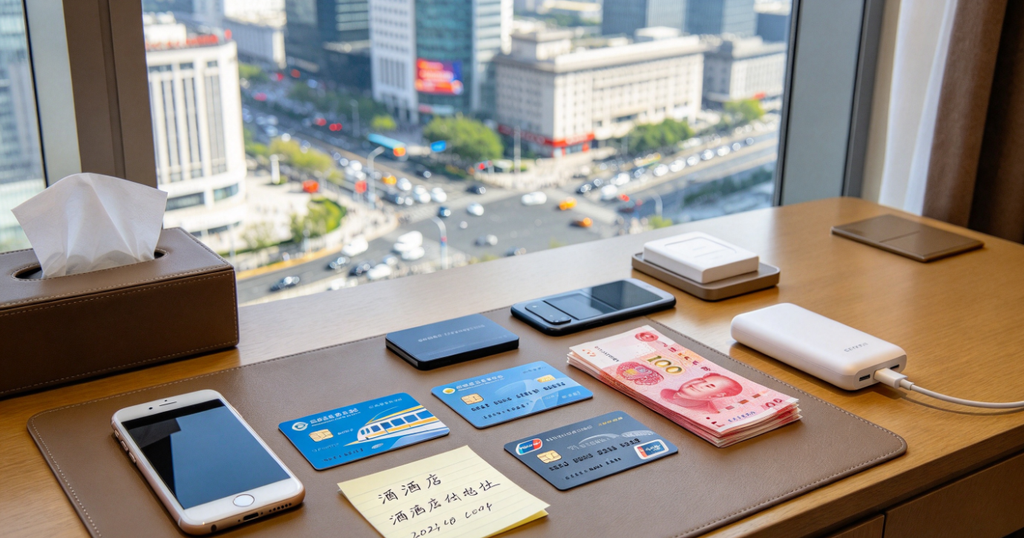
A few preparations can make transportation dramatically easier.
1. Set up a mobile payment method
Configure your preferred wallet before you need it.
2. Add an international card
Check that the card is accepted and successfully linked.
3. Install the relevant transportation or ride-hailing apps
Do not wait until arrival to discover that registration requires additional verification.
4. Save your hotel information
Keep the hotel name and address in Chinese.
5. Prepare a backup card
Carry a second payment card separately from your primary one.
6. Carry some yuan
Use it as an emergency backup rather than your main payment method.
7. Bring a power bank
Your phone is part of your travel infrastructure.
23. A Simple Payment Strategy for Different Travelers
Different travelers can use different systems.
Short first-time visit
Use mobile payment as your primary method and carry cash as a backup.
Budget traveler
Focus on subway and bus payment methods.
Family traveler
Use mobile payment for convenience and consider a physical backup method for situations where managing several passengers becomes complicated.
Frequent taxi user
Prioritize setting up ride-hailing and mobile payment before arrival.
Long-stay traveler
A transportation card may become more attractive if you use public transport repeatedly.
Traveler with limited phone access
Carry a physical transportation option and cash backup.
There is no need for every traveler to use exactly the same system.
24. Common Transportation Payment Mistakes
Mistake 1: Waiting until arrival to set everything up
This can create unnecessary stress at the airport.
Mistake 2: Relying on one bank card
Cards can be declined or temporarily blocked.
Mistake 3: Assuming every foreign card works directly
Payment acceptance varies by service.
Mistake 4: Letting the phone battery run low
A dead phone can affect payment, navigation, translation, and communication simultaneously.
Mistake 5: Carrying no cash at all
Digital payment is convenient, but a backup is still useful.
Mistake 6: Saving only the English address
A Chinese-language address can be much more useful when communicating with drivers.
Mistake 7: Treating public transportation and taxis as the same payment system
They operate differently and may require different preparation.
25. A Better Way to Think About Transportation Payment
The most useful mindset is not:
“Which payment method is the official one?”
Instead, think in layers.
Layer 1: Primary payment
Your main mobile payment or transportation method.
Layer 2: Secondary payment
A bank card that is separate from your primary method.
Layer 3: Emergency payment
A small amount of cash.
This structure protects you against most ordinary payment problems.
If your mobile wallet works, use it.
If it does not, use your card.
If your phone or card has a problem, use cash where accepted and resolve the technical issue later.
This is much more practical than trying to find one perfect payment solution.
26. How Payment Fits Into a Larger Beijing Transportation Strategy
Transportation payment should not be planned separately from your itinerary.
Suppose your day includes:
Hotel → Forbidden City → hutongs → restaurant → evening attraction
Public transportation may make sense for some sections.
A taxi may save time for another.
If you understand how each payment system works, you can switch between transportation modes without hesitation.
This is particularly important because the cheapest transportation method is not always the most efficient one.
A subway journey may save money but require additional walking and transfers.
A taxi may cost more but save time when traveling with luggage or a group.
The goal is to choose transportation based on the entire day’s schedule.
27. How Much Cash Should You Carry?
There is no universal amount because spending patterns differ.
Instead of carrying a large amount of cash, keep enough for basic emergencies.
Your cash backup might cover:
- a simple meal
- short-distance transportation
- a small purchase
- an unexpected payment problem
The rest of your spending can be handled through your preferred digital payment system.
This reduces the risk associated with carrying large amounts of physical currency while still giving you a safety net.
28. What If You Do Not Speak Chinese?
Payment itself is often easier than communication.
The bigger challenge can be explaining:
- where you are going
- which entrance you need
- where you want to be dropped off
- which hotel you are staying at
For this reason, save important destinations in Chinese.
For example, keep:
Hotel name + Chinese address + phone number
in your phone.
You can show the information directly to a driver when necessary.
This simple habit can be more useful than memorizing transportation vocabulary.
29. Is Beijing Transportation Expensive to Use?
Compared with many major international capitals, everyday public transportation in Beijing is generally relatively affordable.
But the amount you actually spend depends on your transportation style.
A traveler using the subway extensively may spend very little.
A traveler using taxis and ride-hailing throughout the day can spend considerably more.
This is why payment planning and transportation budgeting should be considered together.
The question is not simply how much a subway ticket costs.
It is how your transportation choices fit your entire itinerary.
Final Takeaway
Learning how to pay for transportation in Beijing is less complicated once you separate the city into different transportation systems.
For most international visitors, the practical approach is:
mobile payment for convenience + a backup bank card + some Chinese yuan.
Use public transportation payment methods for the subway and buses, prepare your ride-hailing account before you need it, and do not assume that every foreign bank card will work directly on every transportation service.
Most importantly, prepare before your first journey.
Set up your payment app, verify your card, keep your phone charged, save important addresses in Chinese, and carry a backup payment method.
Once these basics are in place, transportation becomes much less of a logistical problem and more of a simple part of exploring the city.
When you plan Beijing trip around neighborhoods and attractions rather than treating every journey separately, you can combine subway, buses, taxis, and ride-hailing according to time, convenience, and budget.
The goal is not to use one transportation method everywhere.
It is to make sure you can pay confidently, switch between transportation options easily, and keep moving when one payment method does not work.