
Can You Travel Beijing Independently as a Foreigner?
Quick Answer
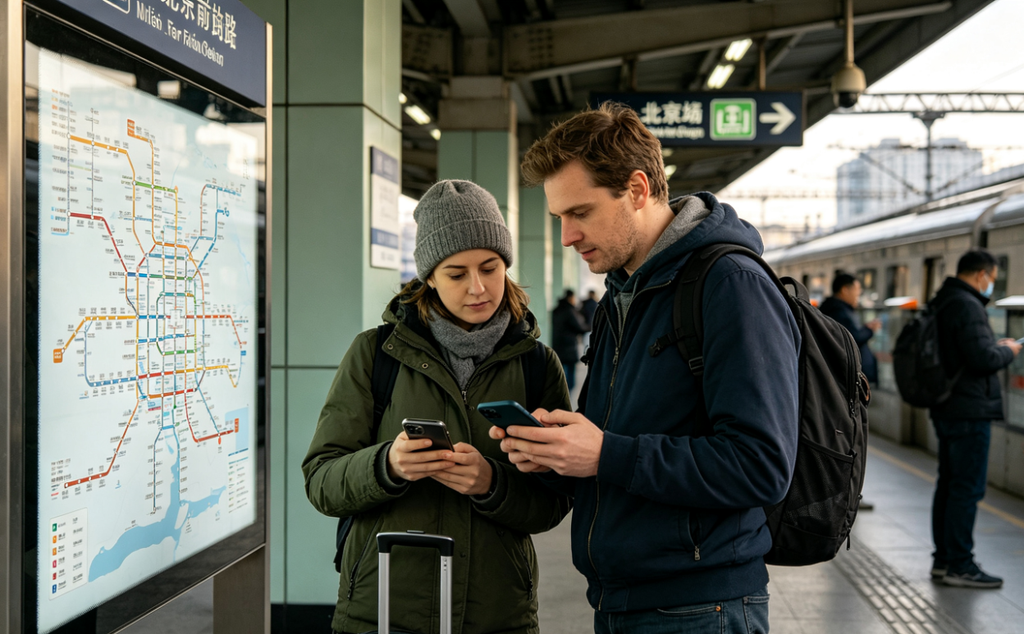
Yes. You can travel Beijing independently as a foreigner, and many international visitors can explore the city without hiring a guide for every day of their trip.
The key question is not whether you speak Chinese or have extensive travel experience. It is whether you can manage several practical systems independently:
- Getting from one place to another
- Handling payments
- Navigating unfamiliar areas
- Managing attraction reservations
- Understanding transportation information
- Keeping important addresses and booking details
- Dealing with unexpected changes
- Adjusting your schedule when something takes longer than expected
Beijing is a large and highly structured city, so independent travel is very different from simply arriving and improvising everything.
The most successful independent travelers usually prepare the important logistical decisions in advance, while leaving enough flexibility to explore the city spontaneously.
What Does “Independent Travel” Actually Mean?
Independent travel does not necessarily mean doing everything alone.
It means that you control the main decisions of the trip.
You choose:
- Where to stay
- Which attractions to visit
- How to move between them
- Where to eat
- How much time to spend in each place
- Whether to change the schedule
- Whether to use public transportation, taxis, private transfers, or guides
You can still use professional services when they solve a specific problem.
For example, booking a private driver for a Great Wall excursion does not make the rest of your Beijing trip a guided tour.
This distinction is useful because independent travel exists on a spectrum.
Fully Independent
You organize accommodation, transportation, attractions, food, and daily activities yourself.
Partially Supported
You organize most of the trip but use a guide, driver, or tour for one complicated component.
Fully Guided
A professional organization manages most of the itinerary and logistics.
The right model depends on your travel style rather than nationality alone.
Is Beijing Suitable for Independent Foreign Travelers?
Beijing has several characteristics that make independent exploration practical.
The city has a large urban transportation network, numerous major attractions, extensive accommodation options, and a well-developed tourism infrastructure.
At the same time, it has characteristics that make preparation important.
Beijing is geographically enormous.
A journey that looks simple on a map can involve:
walking → station access → transportation → transfer → exit navigation → another walk
Major attractions can also be much larger than their names suggest.
A place listed as a single attraction may involve several hours of walking, multiple entrances, security procedures, and long distances between different points of interest.
Therefore, Beijing is not necessarily difficult because it is inaccessible.
It is challenging because scale magnifies small planning mistakes.
The Biggest Question Is Not “Can I Do It?”
A better question is:
Which parts of my trip can I comfortably manage myself?
You might be perfectly comfortable exploring central Beijing independently but prefer assistance for a remote Great Wall section.
You might enjoy taking the subway but dislike coordinating airport transfers with luggage.
You might be happy choosing restaurants independently but prefer a guide for understanding historical sites.
This is why independent travel should be designed according to specific travel tasks, not treated as an all-or-nothing decision.
What Can Most Travelers Handle Independently?
For many visitors, several parts of a Beijing trip are relatively straightforward once properly prepared.
Hotels
Booking accommodation independently is common.
The more important decision is choosing a location that fits your sightseeing priorities and transportation needs.
Subway Travel
Once you understand the basic network, many urban journeys can be handled independently.
Restaurants
Visitors can explore a wide range of restaurants without joining a food tour.
Major Attractions
Many famous attractions can be visited independently if reservations and entry requirements are handled correctly.
Shopping
Commercial districts and shopping centers can generally be explored without a guide.
Neighborhood Exploration
Walking through suitable historic or commercial neighborhoods can be one of the easiest ways to experience Beijing independently.
The difficulty increases when several of these tasks have to be coordinated simultaneously.
Where Independent Travel Becomes More Complicated
The challenges usually appear at the boundaries between systems.
For example:
Airport → hotel
may require transportation, luggage management, payment, and communication.
Or:
Hotel → Great Wall → remote entrance → return to Beijing
may involve multiple transportation decisions and a long travel day.
Or:
Attraction → timed reservation → restaurant → evening activity
may become difficult if the first activity takes longer than expected.
Independent travel therefore becomes less about individual tasks and more about coordination.
Language Is a Factor, But Not the Whole Problem
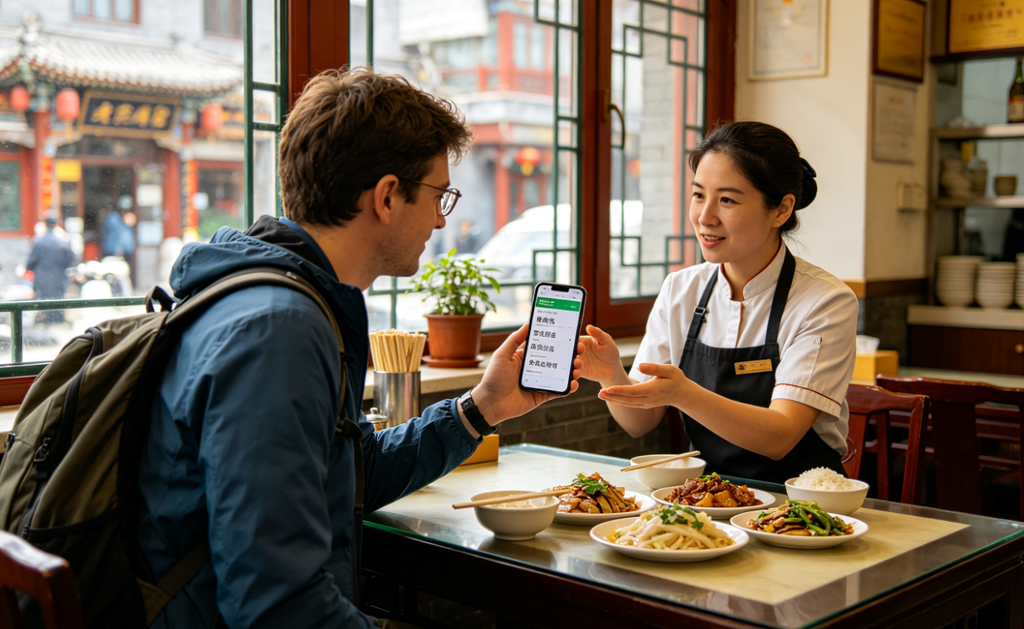
Not speaking Chinese does not automatically prevent independent travel.
As discussed in a dedicated guide on how to travel around Beijing without speaking Chinese, travelers can use Chinese destination names, digital maps, translation tools, screenshots, and written addresses to reduce the need for verbal communication.
The more important issue is whether you have a backup when communication fails.
For example, if a driver cannot understand your pronunciation, can you show the Chinese address?
If you cannot understand a sign, can you translate it?
If your internet connection fails, do you have the hotel address saved?
Independent travel becomes much easier when the answer to these questions is yes.
The Chinese Address Is One of Your Most Useful Tools
Foreign visitors often underestimate the value of having destination information in Chinese.
Save both versions:
English name: Your hotel
Chinese name: 中文名称
Chinese address: 中文地址
Do the same for:
- Restaurants
- Railway stations
- Attraction entrances
- Tour meeting points
- Great Wall sections
- Airports
- Important transportation hubs
A Chinese address can often communicate more effectively than a long verbal explanation.
This is particularly useful when using taxis or ride-hailing services.
Payments Should Be Prepared Before You Need Them
Payment is another area where independent travelers should prepare in advance.
Do not wait until you are standing at a restaurant or transportation counter to discover that your preferred payment method is inconvenient.
Before your trip, understand:
- Which payment methods you can use
- How your cards work abroad
- Whether you have set up the relevant mobile payment options
- How you will pay for transportation
- What backup payment method you have
The principle is simple:
Create your payment system before your first busy travel day.
This is one of the differences between being technically capable of traveling independently and being comfortably prepared to do so.
Attraction Reservations Matter More Than Most First-Time Visitors Expect
Independent travel gives you freedom, but freedom does not mean every attraction can be visited spontaneously.
Some major attractions may have reservation or ticketing procedures that need to be understood before arrival.
This means independent travelers should distinguish between:
Places that can be explored flexibly
and
Places that require advance planning.
If a major attraction is central to your trip, check its current reservation requirements before building your day around it.
This is particularly important during:
- Public holidays
- Peak travel periods
- Weekends
- Popular seasonal periods
A missed reservation can affect an entire day’s schedule.
Independent Travel Requires More Responsibility for Timing
When traveling with a tour group, someone else usually monitors the schedule.
When traveling independently, you do.
You need to know:
- When you need to leave
- When reservations begin
- How long transportation takes
- How much time you need at each attraction
- When restaurants become busy
- When you need to return to your hotel
- How much buffer you need before trains or flights
This does not mean watching the clock constantly.
It means understanding which parts of the day are time-sensitive.
Geography Is Probably More Important Than Language
A first-time visitor may worry about not speaking Chinese.
But for many travelers, the larger practical challenge is Beijing’s geographic scale.
Imagine a traveler staying in one part of the city and choosing attractions based entirely on online popularity.
The resulting schedule might look like:
Morning — central Beijing
Afternoon — far north
Late afternoon — western Beijing
Evening — back across the city
Every attraction may be individually reasonable.
The overall day is not.
This is why plan Beijing trip decisions should begin with geography rather than simply creating a list of famous places.
Your Hotel Location Affects Independent Travel
A hotel is not just a place to sleep.
It becomes your daily starting point and recovery point.
When choosing accommodation, consider:
- Subway access
- Distance from your main sightseeing areas
- Ease of airport or railway connections
- Evening transportation
- Availability of restaurants nearby
- Whether returning to the hotel is convenient after a long day
A slightly more convenient location can reduce repeated transportation and make independent travel less tiring.
This is particularly valuable for first-time visitors.
Use a “Geographic Cluster” Approach
Instead of planning:
“I want to visit these ten attractions.”
Start with:
“Which attractions make sense together?”
This creates geographic clusters.
A cluster might combine:
- A major historical attraction
- A nearby neighborhood
- A restaurant
- A park
- A museum
The purpose is not to see everything in one day.
It is to reduce unnecessary movement.
This approach also makes independent travel more forgiving.
If you spend an extra hour at the first attraction, you can often adjust the nearby activities without rebuilding the entire day.
Independent Travel Does Not Mean Maximum Density
Some travelers assume that if they are organizing the trip themselves, they should maximize the number of attractions.
That often produces the opposite result.
A self-planned trip should leave room for:
- Longer visits
- Unexpected discoveries
- Meals
- Rest
- Navigation problems
- Weather changes
- Delays
A schedule with fewer commitments can actually provide more meaningful sightseeing time.
The objective is not:
“How many places can I check off?”
It is:
“How much control do I have over my day?”
Build Your Days With Different Levels of Commitment
A useful independent-travel strategy is to classify activities.
Fixed
These cannot easily move.
Examples:
- Train
- Flight
- Timed reservation
- Private guide
- Pre-booked experience
Important
You strongly want to do them, but they can move.
Examples:
- Museum
- Historic district
- Shopping
- Restaurant
Optional
You will do them if time and energy permit.
Examples:
- Extra café
- Additional viewpoint
- Small shop
- Longer walk
This gives you a decision-making system when plans change.
The “One Difficult Thing Per Day” Rule
For first-time independent travelers, it can be useful to limit the number of highly complicated activities on the same day.
A difficult activity might involve:
- Long-distance transportation
- Extensive walking
- Multiple transfers
- Strict reservation timing
- Complex navigation
- Remote locations
A Great Wall excursion might already represent a high-complexity day.
Adding another distant attraction afterward may not add much value.
This is especially relevant for travelers who are comfortable sightseeing independently but have limited experience navigating Beijing.
When the Great Wall Changes the Equation
The Great Wall is different from most Beijing attractions.
You are not simply traveling to a point inside the city.
Different sections are located outside the central urban area, and the transportation arrangements can vary significantly.
Independent visitors therefore need to decide:
- Which section to visit
- How to reach it
- Which entrance to use
- How long the journey takes
- How much walking is involved
- How to return
For confident travelers, this can be handled independently.
For travelers who prioritize convenience or have limited time, a private transfer or guide may reduce logistical complexity.
The decision should depend on how much planning you want to manage yourself.
Who Is a Good Candidate for Independent Travel?
Independent Beijing travel may suit you if you:
- Enjoy planning your own trips
- Are comfortable using maps
- Can handle digital tools
- Are willing to research attraction requirements
- Can adapt when plans change
- Do not mind occasional uncertainty
- Prefer choosing your own restaurants and activities
- Want flexibility rather than a fixed schedule
You do not need to be an experienced world traveler.
You need to be comfortable solving small logistical problems.
Who May Prefer More Support?
Additional support may be useful if you:
- Have very limited travel experience
- Are traveling with young children
- Are traveling with elderly family members
- Have mobility limitations
- Have a very short Beijing stay
- Need extensive historical interpretation
- Want to visit remote Great Wall sections
- Have complicated transportation requirements
- Prefer someone else to coordinate reservations and transfers
This does not mean independent travel is impossible.
It means that professional assistance may remove tasks you do not particularly enjoy.
A Hybrid Trip Can Be More Practical Than Either Extreme
Many travelers assume they must choose between:
100% independent
or
100% guided.
There is a third option.
Hybrid Travel
You independently manage:
- Hotel
- Restaurants
- Subway travel
- Central attractions
- Neighborhood exploration
- Free time
Then use professional assistance for:
- Great Wall transportation
- Historical guided visits
- Airport transfers
- A complicated day trip
- Specialized food or cultural experiences
This model can preserve independence while reducing the most complicated logistical tasks.
It is particularly useful for first-time visitors who want both flexibility and reassurance.
How Much Planning Do You Actually Need?
Independent travel does not require planning every detail months in advance.
A better approach is to divide decisions into three categories.
Must Decide Before Arrival
- Accommodation
- Major transportation
- Important reservations
- Great Wall section
- Essential payment arrangements
Should Decide Before Each Day
- Main destination
- Transportation route
- Important booking times
- General meal area
- Return plan
Can Decide During the Day
- Café
- Small shops
- Additional neighborhood walking
- Optional attractions
- Exact dinner choice
This prevents overplanning while protecting the important parts of the trip.
A Simple Independent Travel System
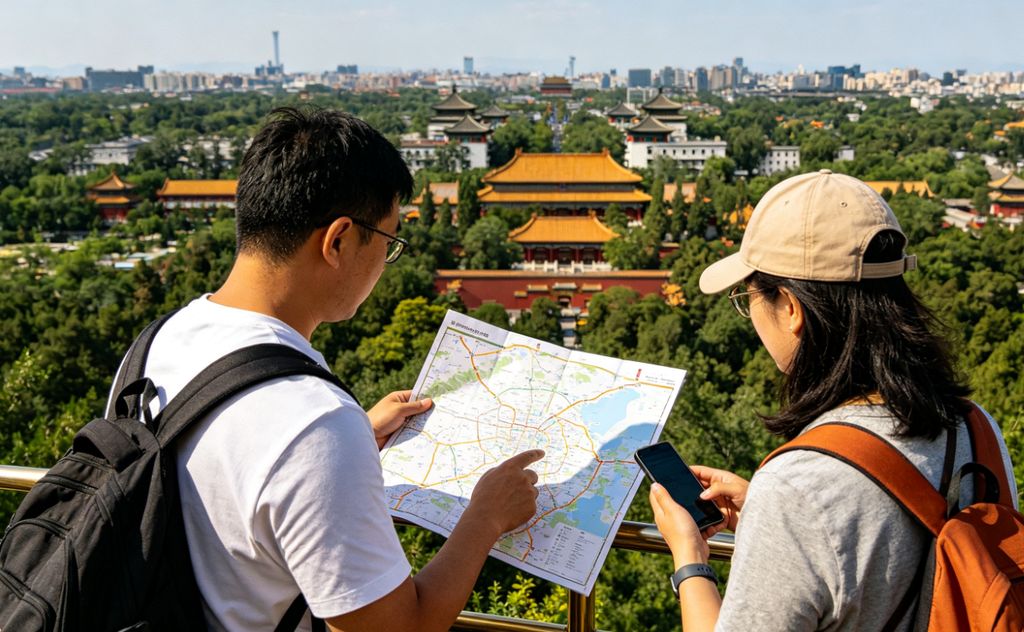
You can organize the trip around five questions.
1. Where am I staying?
Know your hotel’s location and nearest transportation.
2. What is today’s main goal?
Choose one primary experience.
3. How will I get there?
Know the route before leaving.
4. What happens if the plan changes?
Have one flexible alternative.
5. How will I get back?
Know the general return route before the evening.
If you can answer these five questions each morning, you can manage a surprisingly large amount of Beijing independently.
What If Something Goes Wrong?
This is where independent travelers differ most from guided travelers.
If your train is delayed, you need to find another option.
If a restaurant is closed, you need another meal.
If a subway route changes, you need another route.
If the weather ruins an outdoor activity, you need a replacement.
The solution is not to eliminate uncertainty.
It is to build decision buffers.
For important activities, identify:
Plan A
Your preferred option.
Plan B
A realistic alternative nearby.
Plan C
A low-effort option if you are tired or delayed.
This system gives you control without requiring a rigid schedule.
Use Your Phone as a Travel Command Center
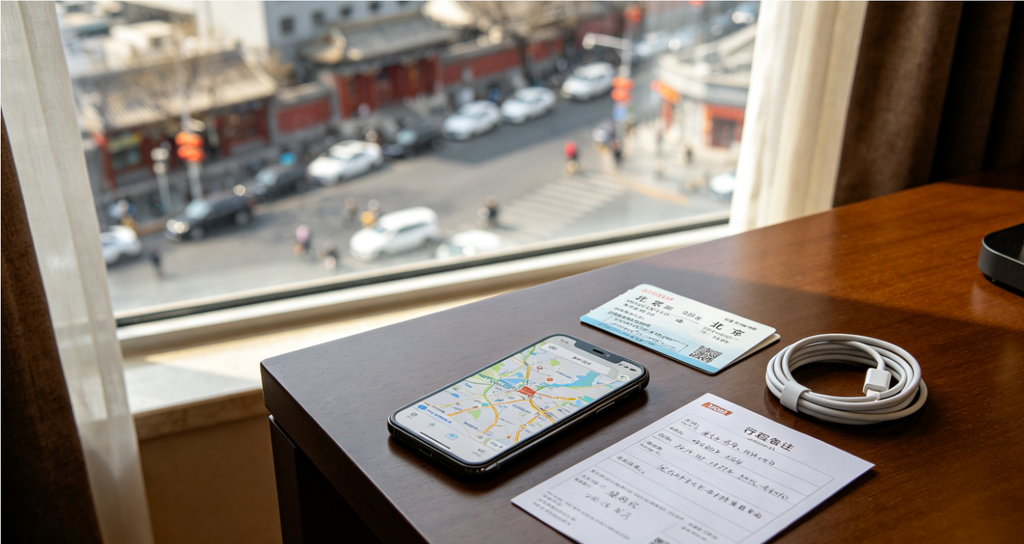
An independent traveler should be able to access the following quickly:
- Hotel information
- Chinese addresses
- Maps
- Transportation information
- Attraction reservations
- Payment tools
- Translation tools
- Important phone numbers
- Booking confirmations
- Backup screenshots
Do not scatter these across dozens of unrelated applications.
Create one easily accessible travel folder.
The easier information is to find, the less stressful unexpected situations become.
Your First Day Should Be Easier Than Your Second
A useful strategy for first-time visitors is to avoid making arrival day your most complicated day.
After a long international flight, you may be dealing with:
- Jet lag
- Luggage
- Airport procedures
- Currency/payment setup
- Internet connectivity
- Hotel check-in
- Navigation
There is little value in immediately testing yourself with the most complicated possible itinerary.
Use the first day to understand your neighborhood and transportation environment.
Once you know how the city feels, more complicated independent travel becomes easier.
How to Know Whether You Are Overplanning
Ask yourself:
Could I still enjoy this day if one activity took 45 minutes longer than expected?
If the answer is no, the schedule is probably too tight.
Another useful question:
If my afternoon attraction became unavailable, would I know what to do instead?
If the answer is no, the day may be too dependent on a single plan.
A resilient itinerary is more valuable than a perfectly optimized one.
How Independent Travelers Can Experience More Local Life
One advantage of independent travel is flexibility.
You do not need to move from one major attraction to another all day.
You can stop when something catches your attention.
You can:
- Explore a hutong
- Sit in a local park
- Try a neighborhood restaurant
- Browse a market
- Visit a small shop
- Spend longer in a museum
- Return to an area you enjoyed
These moments can be difficult to fit into a rigid group itinerary.
Independent travel therefore has a cultural advantage: you can respond to the city rather than simply follow a schedule.
What Independent Travel Cannot Solve by Itself
Independence does not automatically provide historical context.
You can stand inside a major imperial complex and understand where you are without understanding why the space was designed that way.
You can walk through a hutong without knowing how the neighborhood developed.
You can visit the Great Wall without understanding the military system surrounding it.
This is where a guide can add value even for otherwise independent travelers.
A guide does not need to manage your entire trip.
Sometimes their most valuable role is simply helping you understand a particular place.
Independent Travel vs. Guided Travel
The choice becomes clearer when you compare the responsibilities.
| Independent Travel | Guided Travel |
|---|---|
| More control over schedule | More structured schedule |
| More freedom to change plans | More logistical support |
| More responsibility for reservations | Less personal coordination |
| More freedom with restaurants | More organized experiences |
| More navigation responsibility | Guide handles many transitions |
| Potentially more spontaneous | Usually more predictable |
| Requires more preparation | Requires less independent planning |
Neither model is universally appropriate.
The important question is which responsibilities you want to handle yourself.
A Practical Self-Assessment
Before deciding how independently to travel, rate your comfort with these tasks:
Navigation
Can you comfortably use digital maps?
Transportation
Can you handle transfers and route changes?
Communication
Can you solve simple problems without relying on spoken English?
Digital Tools
Can you manage bookings, payment, maps, and translation?
Flexibility
Can you change plans when something goes wrong?
Research
Are you willing to check current attraction requirements?
Physical Stamina
Can you handle substantial walking when necessary?
If most answers are yes, independent travel is likely a realistic option.
If only some are yes, a hybrid trip may reduce the areas that create unnecessary stress.
A Better Way to Think About Independence
Independent travel is not about proving that you can do everything yourself.
It is about deciding which responsibilities are worth taking on.
You may choose to navigate the subway yourself because you enjoy it.
You may choose a private transfer to the Great Wall because you would rather spend that time sightseeing.
You may explore restaurants independently but hire a guide for a historical district.
These choices do not make the trip less independent.
They make the trip more deliberately designed around your priorities.
Final Checklist for First-Time Independent Visitors
Before traveling to Beijing independently, make sure you have:
- A hotel in a practical location
- Chinese hotel information
- A reliable navigation method
- A payment plan and backup
- Important attraction reservations
- Transportation information
- A list of key Chinese addresses
- Screenshots of essential bookings
- A plan for the Great Wall
- Translation tools
- Flexible daily schedules
- Backup activities
- Enough phone battery
- A way to contact your accommodation
- A realistic understanding of how much walking you can handle
You do not need to prepare every possible scenario.
You need to prepare the scenarios most likely to affect your trip.
Final Takeaway
So, can you travel Beijing independently as a foreigner?
Yes.
But successful independent travel is not simply a matter of confidence. It depends on preparation, digital access, geographic awareness, time management, and the ability to adapt when reality differs from the original plan.
The strongest independent approach is often neither completely improvised nor completely scheduled.
It is structured independence:
- Prepare the important logistics.
- Understand the geography.
- Reserve what needs to be reserved.
- Keep transportation options flexible.
- Protect time for unexpected delays.
- Use professional help when a particular task is genuinely complicated.
- Leave enough freedom to experience Beijing at your own pace.
If you already know how to plan your days in Beijing efficiently, understand how to navigate the city without relying entirely on Chinese, and are comfortable solving small logistical problems, you can manage a large part of a Beijing trip yourself.
The goal is not to prove that you need no assistance.
The goal is to have enough control to decide when you want independence and when outside support genuinely adds value.